Homeostasis Hero Teacher Guide Regents Living Environment
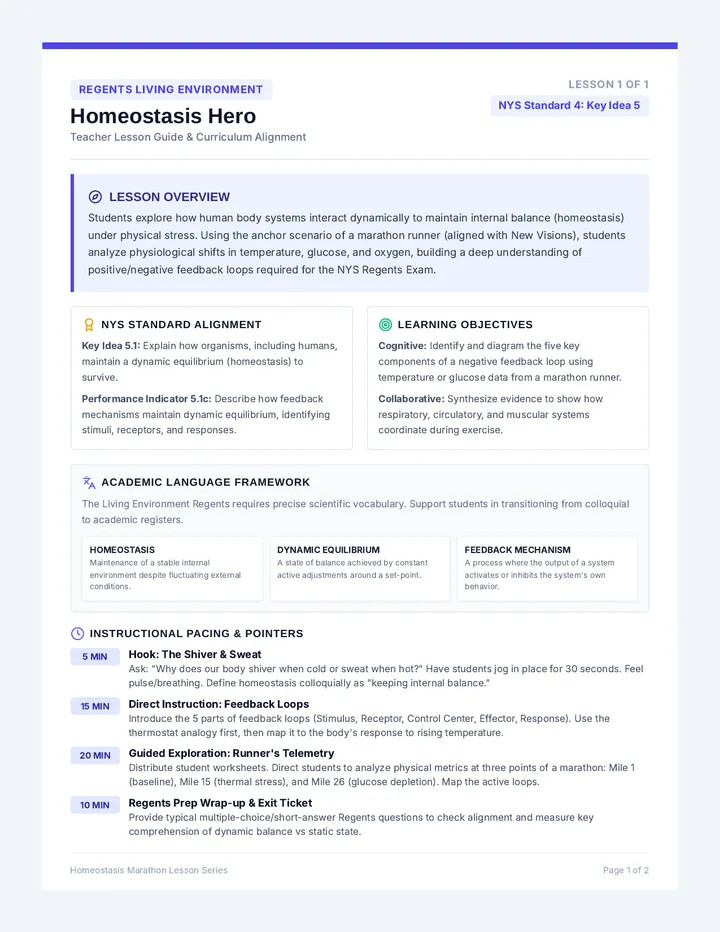
Homeostasis Hero
Teacher Lesson Guide & Curriculum Alignment
Lesson 1 of 1 NYS Standard 4: Key Idea 5
LESSON OVERVIEW
Students explore how human body systems interact dynamically to maintain internal balance (homeostasis) under physical stress. Using the anchor scenario of a marathon runner (aligned with New Visions), students analyze physiological shifts in temperature, glucose, and oxygen, building a deep understanding of positive/negative feedback loops required for the NYS Regents Exam.
NYS Standard Alignment
Key Idea 5.1: Explain how organisms, including humans, maintain a dynamic equilibrium (homeostasis) to survive.Performance Indicator 5.1c: Describe how feedback mechanisms maintain dynamic equilibrium, identifying stimuli, receptors, and responses.
Learning Objectives
Cognitive: Identify and diagram the five key components of a negative feedback loop using temperature or glucose data from a marathon runner.Collaborative: Synthesize evidence to show how respiratory, circulatory, and muscular systems coordinate during exercise.
Academic Language Framework
The Living Environment Regents requires precise scientific vocabulary. Support students in transitioning from colloquial to academic registers.
Homeostasis
Maintenance of a stable internal environment despite fluctuating external conditions.
Dynamic Equilibrium
A state of balance achieved by constant active adjustments around a set-point.
Feedback Mechanism
A process where the output of a system activates or inhibits the system's own behavior.
Instructional Pacing & Pointers
5 MIN
Hook: The Shiver & Sweat
Ask: "Why does our body shiver when cold or sweat when hot?" Have students jog in place for 30 seconds. Feel pulse/breathing. Define homeostasis colloquially as "keeping internal balance."
15 MIN
Direct Instruction: Feedback Loops
Introduce the 5 parts of feedback loops (Stimulus, Receptor, Control Center, Effector, Response). Use the thermostat analogy first, then map it to the body's response to rising temperature.
20 MIN
Guided Exploration: Runner's Telemetry
Distribute student worksheets. Direct students to analyze physical metrics at three points of a marathon: Mile 1 (baseline), Mile 15 (thermal stress), and Mile 26 (glucose depletion). Map the active loops.
10 MIN
Regents Prep Wrap-up & Exit Ticket
Provide typical multiple-choice/short-answer Regents questions to check alignment and measure key comprehension of dynamic balance vs static state.
Homeostasis Marathon Lesson Series Page 1 of 2
Regents Living Environment
Teacher Guide
Answer Keys, Misconceptions, & Prompts
Lesson 1 of 1 Answer Keys & Pedagogy
COMMON STUDENT MISCONCEPTIONS
Misconception 1: "Homeostasis means everything is kept perfectly flat/fixed."Misconception 2: "Body systems operate independently of each other."
Socratic Facilitation Prompts
For Oxygen/CO2 Balance:
"If muscle cells produce a large amount of CO2 as toxic waste during cellular respiration, what will happen to blood acidity if the respiratory system does not accelerate ventilation?"
For Glucose Regulation:
"Why does insulin decrease after mile 10 even though the runner needs energy? What hormone takes its place to release stored glycogen?"
Student Worksheet Answer Key
Part 2: Dual Feedback Loop Key
Loop A: Thermoregulation 2. Receptor: Skin thermoreceptors5. Response: Evaporation cools skin (returning to normal)
Loop B: Blood Glucose 3. Active Hormone: Glucagon (from pancreas)5. Response: Glucose level rises (providing muscle fuel)
Part 3: Multiple-Choice Regents Diagnostics
Q1: Feedback loops work to...
Q2: Insulin release acts to...
Part 3: Short Answer Regents Rubric Guide
Full Credit (2 pts): Student explicitly connects the respiratory and circulatory systems. Example: "The muscles require more oxygen, so the respiratory system increases the rate of breathing to bring in oxygen, while the circulatory system pumps blood faster to transport oxygen to the muscle tissues."
Homeostasis Marathon Lesson Series Page 2 of 2
Body in Motion Worksheet Regents Living Environment — 5E Explore Phase
Body in Motion Lab
Explore: How does physical stress affect your homeostatic balance?
Student Handout 5E Inquiry
Name: ___________________________
Date: ________________________
Period: _____________________
Part 1: Mini-Inquiry — My Own Telemetry Lab
Instructions: Measure your resting heart rate (pulse) and breathing rate (breaths per minute) for 30 seconds (multiply by 2). Then, safely perform jumping jacks or jog in place for 1 full minute. Immediately measure your active rates!
My Health Metric Resting (Baseline) Active (Post-Exercise) Heart Rate (Pulse BPM) ____________ bpm ____________ bpm Breathing Rate (Breaths/min) ____________ breaths/min ____________ breaths/min
Part 2: Mapping Organs Involved in Homeostasis
On the human body map, identify and write down which systems or organs work together to maintain internal balance when exercising.
Brain (Hypothalamus) Role: Command Center
Lungs (Respiratory) Role: Gas Exchange
Heart (Circulatory) Role: Transports O2/CO2
Head
Chest Abdomen
Body Map
Pancreas / Liver Role: Glucose Balance
Skin Glands Role: Sweat / Heat release
Skeletal Muscles Role: Generates Heat
Observation Check: Explain how your muscles and your lungs worked together during your 1-minute exercise:
Homeostasis Marathon — 5E Explore Lab Page 1 of 2
Regents Living Environment — Explain & Elaborate
Telemetry & Feedback
Explain: Applying homeostasis concepts to extreme performance models
Student Handout Marathon Model
Marathon Telemetry Data
Runner Métrica Resting Baseline Mile 15 (Mid-Race) Mile 26 (Finish Line) Heart Rate (BPM) 70 bpm 155 bpm 175 bpm Breathing Rate
Marathon Runner Slides NYS Regents Biology
Homeostasis
Marathon
How human body systems coordinate to survive extreme performance.
Unit 1: Living Systems Start Presentation →
The Marathon Challenge
MILE 20 TELEMETRY
Core Body Temp
38.9°C
Normal is 37°C. Rising dangerously due to muscle work!
Heart Rate
165 BPM
Pumping blood to deliver oxygen & clear carbon dioxide.
Blood Sugar
75 mg/dL
Dropping fast as muscle cells burn glucose for ATP energy.
The Big Question: How does the body keep running without failing?
Core Concept
REGENTS KEY TERM
Homeostasis
Internal Stability
The ability of an organism to keep its internal environment stable even when outer conditions change completely.
Dynamic Equilibrium
Constant Adjustments
A state of balance where conditions vary around a healthy average set-point rather than staying flat-line static.
💡 Analogy Check: It's like riding a bicycle—you constantly wobble slightly to remain upright!
Feedback Mechanisms
HOW IT WORKS
1. STIMULUS
A change occurs (e.g., body temp heats up).
2. RECEPTOR
Sensors detect the change (e.g., skin nerves).
3. CONTROL
Brain processes & sends signals (e.g., Hypothalamus).
4. EFFECTOR
Target responds to command (e.g., sweat glands).
5. RESPONSE
Original stimulus is negated, restoring balance.
Negative Feedback: The response opposes/stops the original change to bring you back to normal.
The Glucose Loop
ENDOCRINE REGULATION
Your cells burn sugar (glucose) to make ATP energy. When blood sugar wanders from its set-point, the **Pancreas** steps in with two hormones:
High Blood Sugar After Eating
Pancreas releases Insulin . Insulin signals body cells and the liver to take up glucose from blood and store it as glycogen. Blood sugar goes **DOWN**.
Low Blood Sugar During Exercise
Pancreas releases Glucagon . Glucagon signals the liver to break down glycogen and release active glucose back into blood. Blood sugar goes **UP**.
📌 Regents Reminder: The pancreas serves as both the sensor and control center in this feedback loop.
Runner Lexicon Handout Regents Living Environment
Runner Lexicon
Homeostasis & Systems Vocabulary Reference Sheet
Reference Guide Core Terminology
How to use this guide: Keep this vocabulary helper handy during your readings, class activities, and when analyzing scientific data. These terms are frequently tested on the NYS Living Environment Regents Exam .
Homeostasis
The active process of keeping a stable internal environment despite fluctuating external conditions.
Context: Body temp stays at ~37°C in winter.
Dynamic Equilibrium
A state of balance where conditions fluctuate slightly around a stable average/set-point.
Context: Heart rate going up & down as you jog.
Physiological Shift
A physical, measurable change in body functions (like heart rate or sweating) in response to stress/exercise.
Context: Sweat rate jumping from 50 to 1200 mL/hr.
Negative Feedback Loop
A process where the body's response opposes (stops/reverses) the original change to bring you back to balance.
Context: Shivering when cold to warm back up.
Stimulus
A change in the internal or external environment that triggers a sensory response.
Context: Core body temperature rising.
Effector
An organ, gland, or muscle that takes physical action to restore balance based on commands from the control center.
Context: Sweat glands releasing sweat.
Glucagon
A hormone released by the pancreas that signals the liver to release stored glucose, raising blood sugar levels.
Context: Released when exercising on an empty stomach.
Insulin
A hormone released by the pancreas that signals cells and the liver to take in glucose, lowering blood sugar levels.
Context: Released after digesting a large meal.
Mini Quick Check
Match the definition concept in your head. Write a brief sentence explaining why insulin and glucagon work in opposition to manage dynamic balance.
Homeostasis Marathon — Runner Lexicon Vocabulary Page 1 of 1
El Cuerpo en Movimiento Ficha Regents de Biología del Estado de NY
El Cuerpo en Movimiento
Homeostasis y el desafío del corredor de maratón
Actividad del Estudiante Equilibrio Dinámico
Nombre: ___________________________
Fecha: ________________________
Período: ____________________
El Escenario: 42 Kilómetros de Supervivencia
Imagina correr un maratón. Durante horas de ejercicio intenso, tus músculos generan un calor inmenso, producen dióxido de carbono y consumen glucosa rápidamente. Sin embargo, tu temperatura corporal se mantiene cerca de los 37°C, tu química sanguínea permanece estable y tu cerebro sigue funcionando. ¿Cómo? Tus sistemas corporales trabajan en conjunto constantemente, iniciando mecanismos de retroalimentación precisos para mantener la homeostasis (equilibrio dinámico).
Telemetría Fisiológica en Tiempo Real
Métrica Fisiológica Línea de Base (Reposo) Milla 15 (Mitad del camino) Milla 26 (Meta) Frecuencia Cardíaca (BPM) 70 bpm 155 bpm 175 bpm Frecuencia Respiratoria 14 resp/min 38 resp/min 42 resp/min Temp. Corporal (°C) 37.0°C 38.9°C 38.1°C Tasa de Sudoración (mL/h) 50 mL/h 1,200 mL/h 800 mL/h Glucosa en Sangre (mg/dL) 90 mg/dL 110 mg/dL 75 mg/dL
Parte 1: Análisis de Telemetría
1. Identifica las tendencias en la frecuencia cardíaca y respiratoria del corredor desde el reposo hasta la milla 26. ¿Por qué ocurren estos cambios?
2. Explica cómo los datos de la tasa de sudoración en la milla 15 demuestran una respuesta homeostática al aumento de la temperatura corporal. Nombra el sistema corporal principal que lo coordina.
El Maratón de la Homeostasis — Ficha del Estudiante Página 1 de 2
Regents de Biología del Estado de NY
Circuitos de Retroalimentación
Modelado de Mecanismos y Práctica del Examen de Regents
Actividad del Estudiante Modelado
Parte 2: Diagramar los Mecanismos Activos
Bucle A: Termorregulación
1. Estímulo: Cuerpo se sobrecalienta (>37°C)
Body in Motion Simplified Worksheet Regents Biology — Supported Edition
Body in Motion (Simplified)
Homeostasis & The Marathon Runner Challenge
Scaffolded Handout Equilibrium
Name: ___________________________
Date: ________________________
Period: _____________________
The Scenario: 26.2 Miles of Survival
Running a marathon is hard work. As you run, your muscles get hot and burn sugar for energy. However, your body temperature must stay near 98.6°F to survive. Your body systems work together to keep you safe. This balance is called homeostasis (internal balance). Your body constantly adjusts to keep this balance.
Runner's Health Data Table (Telemetry)
Health Metric Resting (Normal) Mile 15 (Mid-Race) Mile 26 (Finish) Heart Rate (Pulse) 70 bpm (slow) 155 bpm (fast) 175 bpm (very fast) Breathing Rate 14 breaths/min 38 breaths/min 42 breaths/min Body Temperature 37.0°C (normal) 38.9°C (hot) 38.1°C (cooling down) Sweat (Water release) 50 mL (low) 1,200 mL (high) 800 mL (medium) Blood Sugar (Energy) 90 mg/dL 110 mg/dL 75 mg/dL (low sugar)
Part 1: Health Data Analysis
1. Look at the Heart Rate. What happens to the runner's heart rate as they run? Complete the sentence starter below:
Sentence Starter:
"The runner's heart rate goes _____________________ because the muscle cells need more _____________________."
2. Why does the runner sweat so much at Mile 15? Complete the sentence starter below:
Sentence Starter:
"The runner sweats so much because their body temperature is _____________________ and sweat helps to _____________________."
Homeostasis Marathon — Simplified Student Edition Page 1 of 2
Regents Biology — Supported Edition
Feedback Loops
How Body Systems Control Health Levels
Scaffolded Handout Loop Modeling
Part 2: Fill-in the Body Controls Loops
Use the Word Bank at the bottom to complete the two control systems loops.
Loop A: Temperature Control
El Cuerpo en Movimiento Ficha Simplificada Regents de Biología — Edición con Apoyo
El Cuerpo en Movimiento (Simplificado)
Homeostasis y el desafío del corredor de maratón
Ficha Simplificada Homeostasis
Nombre: ___________________________
Fecha: ________________________
Período: ____________________
El Escenario: Correr 42 Kilómetros
Correr un maratón es un trabajo difícil. Al correr, tus músculos se calientan y queman azúcar para obtener energía. Sin embargo, la temperatura de tu cuerpo debe mantenerse cerca de los 37°C para sobrevivir. Tus sistemas corporales trabajan juntos para mantenerte a salvo. Este equilibrio interno se llama homeostasis (equilibrio interno).
Tabla de Datos de Salud del Corredor
Métrica de Salud Reposo (Normal) Milla 15 (Mitad) Milla 26 (Meta) Pulso (Frec. Cardíaca) 70 bpm (lento) 155 bpm (rápido) 175 bpm (muy rápido) Frecuencia Respiratoria 14 resp/min 38 resp/min 42 resp/min Temp. Corporal 37.0°C (normal) 38.9°C (caliente) 38.1°C (enfriándose) Sudor (Liberar agua) 50 mL (bajo) 1,200 mL (alto) 800 mL (medio) Azúcar en Sangre (Energía) 90 mg/dL 110 mg/dL 75 mg/dL (bajo azúcar)
Parte 1: Análisis de Datos de Salud
1. Observa el Pulso (Frecuencia Cardíaca). ¿Qué le ocurre al pulso del corredor mientras corre? Completa:
Inicio de oración:
"El pulso del corredor se vuelve _____________________ porque las células musculares necesitan más _____________________."
2. ¿Por qué el corredor suda tanto en la milla 15? Completa la frase:
Inicio de oración:
"El corredor suda tanto porque su temperatura corporal está _____________________ y el sudor ayuda a _____________________."
El Maratón de la Homeostasis — Edición Simplificada Página 1 de 2
Regents de Biología — Edición con Apoyo
Circuitos de Control
Cómo los Sistemas del Cuerpo Controlan la Salud
Ficha Simplificada Circuitos
Parte 2: Completar los Circuitos de Control del Cuerpo
Usa el Banco de Palabras al final para completar los dos circuitos de control.