Regents Biology Rescue Blueprint
NYS Living Environment Regents
BIOLOGY RESCUE
10-Week Intensive Remedial Blueprint
Teacher Guide
Program Target
High-Risk Students
Pacing Strategy
8 Wks Core + 2 Wks Prep
NYS Alignment
HS-LS Core Standards
NYS Living Environment Exam Structure
Part A
30 Qs • Multiple Choice
30 Points
Part B-1
13 Qs • Applied MC
13 Points
Part B-2
12 Qs • MC/Graph/SA
12 Points
Part C
10 Qs • Short Answer
20 Points
Part D
10 Qs • State Labs
10 Points
Critical Remedial Strategies
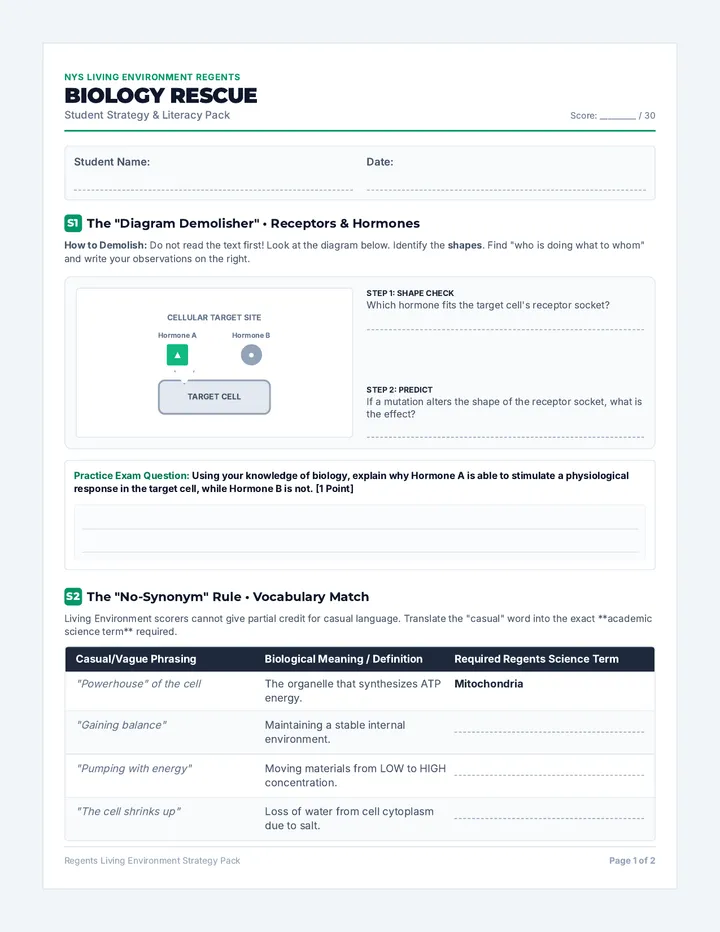
1 Diagram Demolisher
Analyze diagrams first! Find the "who is doing what to whom" relationship before reading the technical passage.
2 Exact Terminology
Remedial rubrics offer no mercy. Students must write "active transport" or "receptors," not vague phrases.
3 ACE Short Answers
Answer directly, Cite the diagram/text, and Explain biological cause. Avoid extra text to prevent loss of credit.
Schedule: Weeks 1 to 3 (Foundations & Cells)
Week / Focus
Daily Topics & Core Content
NYS Standards
Literacy & Exam Strategy
WEEK 1 Inquiry
D1: Exam Design & Structure Intro
D2: IV vs. DV & Hypotheses
D3: Controls vs. Experimental Groups
D4: Valid Designs (Trials/Sample Size)
D5: Graphing & Data Tables Practice
• HS-LS1-3 (Feedback)
• Appendix A Lab Skills
Extracting variables from science paragraphs; reading graph axes and scaling correctly.
WEEK 2 Cells
D1: Cell Theory & Core Organelles
D2: Diffusion, Osmosis & Active Transport
D3: State Lab: Diffusion (Part 1)
D4: State Lab: Diffusion - Plasmolysis (Part 2)
D5: Receptor Proteins & Communication
• HS-LS1-1 (Structure)
• HS-LS1-2 (Interactions)
• State Lab: Diffusion
State Lab essentials: starch/glucose indicators, salt effect on cell size (plasmolysis).
WEEK 3 Cell Energy
D1: Photosynthesis (Inputs/Outputs)
D2: Cellular Respiration (Aerobic vs. Anaerobic)
D3: ATP & Energy Work inside Cells
D4: Enzymes: Lock-and-Key Catalysts
D5: Enzyme Factors (pH, Temp, Denaturing)
• HS-LS1-5 (Photosynthesis)
• HS-LS1-6 & HS-LS1-7 (Energy)
Interpreting energy input/output cycle diagrams; identifying enzyme optimum peaks.
Regents Living Environment Remedial Syllabus Page 1 of 3
NYS Living Environment Regents
BIOLOGY RESCUE
10-Week Intensive Remedial Blueprint
Teacher Guide
Pacing Alert: Weeks 4 to 7 comprise over 50% of the exam's overall points. Monitor individual student progress closely during these weeks with specific emphasis on genetics and ecological web construction.
Schedule: Weeks 4 to 7 (Genetics, Evolution & Ecology)
Week / Focus
Daily Topics & Core Content
NYS Standards
Literacy & Exam Strategy
WEEK 4 Genetics
D1: DNA Structure & Replication
D2: Protein Synthesis (Transcription/Translation)
D3: Mutations & Gene Regulation
D4: Biotechnology (Cloning, Gene Splicing)
D5: State Lab: Relationships & Biodiversity (Pt 1)
• HS-LS1-1 (Genetics)
• HS-LS3-1, HS-LS3-2
• State Lab: Relationships
Using DNA codon translation wheels; analyzing gel electrophoresis bands for relatedness.
WEEK 5 Reproduction
D1: Mitosis (Asexual) vs. Meiosis (Sexual)
D2: Fertilization & Recombination (Diversity)
D3: Male & Female Human Reproduction Systems
D4: Fetal Development & the Placenta
D5: Environmental Toxicity & Development
• HS-LS1-4 (Reproduction)
• HS-LS3-2 (Variation)
Understanding placental diffusion: transfer of oxygen, nutrients, and waste without blood mixing.
WEEK 6 Evolution
D1: Variation, Overproduction, Selection Pressures
D2: Sources of Variation & Adaptations
D3: Natural Selection in Action (Resistance)
D4: Evolutionary Trees & Fossil Records
D5: State Lab: Beaks of Finches
• HS-LS4-1, HS-LS4-2
• HS-LS4-3 & HS-LS4-4
• State Lab: Finches
Finch wheel navigation; deciphering ancestor nodes vs. modern descendants on cladograms.
WEEK 7 Ecology
D1: Biotic vs. Abiotic & Carrying Capacity
D2: Food Webs & Energy Pyramids (10% Rule)
D3: Niche Competition & Symbiosis
D4: Ecological Succession (Pioneer to Climax)
D5: Biodiversity & Ecosystem Resilience
• HS-LS2-1, HS-LS2-2
• HS-LS2-4 (Energy Pyramids)
• HS-LS2-6 (Stability)
Drawing food web arrows correctly (pointing to consumer); energy reduction analysis.
Regents Living Environment Remedial Syllabus Page 2 of 3
NYS Living Environment Regents
BIOLOGY RESCUE
10-Week Intensive Remedial Blueprint
Teacher Guide
Schedule: Weeks 8 to 10 (Revision & Exams)
Week / Focus
Daily Topics & Core Content
NYS Standards
Literacy & Exam Strategy
WEEK 8 Impact & Lab
D1: Global Warming, Fossil Fuels, Carbon Cycle
D2: Deforestation & Loss of Biodiversity
D3: Environmental Trade-offs & Decisions
D4: State Lab: Making Connections (Pt 1)
D5: Lab 4 Data Analysis & Experimental Design
• HS-LS2-7 (Ecosystem)
• HS-LS4-6 (Human Impact)
• State Lab: Connections
Mastering the "Trade-off" prompt (balancing economic benefit with ecological preservation).
WEEK 9 Diagnostics
D1: Complete Mock Regents (Parts A & B-1)
D2: Complete Mock Regents (Parts B-2, C & D)
D3: Personalized Error Analysis & Target Review
D4: Part B-2 Graphing Mastery & Labeling Drills
D5: Part C Short Answer Criteria & Grading Rules
• Exam Diagnostics
• Appendix A Graphing
Point-recovery training for partial credit; identifying key action verbs in scoring keys.
WEEK 10 Blitz
D1: Lab Review: Diffusion & Biodiversity
D2: Lab Review: Finches & Connections
D3: Diagram Flashcard Drills: High-Frequency Items
D4: Short-Answer Clean-up (Removing Synonyms)
D5: Final Test-Day Strategy & Logistical Setup
• Comprehensive Synthesis
• State Lab Mega Review
Calming anxiety with structural cues; final review of packing lists and basic math keys.
Must-Teach High-Frequency "Hot Spots"
Genetics & Cellular Energy
- Ribosome Function: Where proteins are made from mRNA instructions. Mutation changes protein shapes.
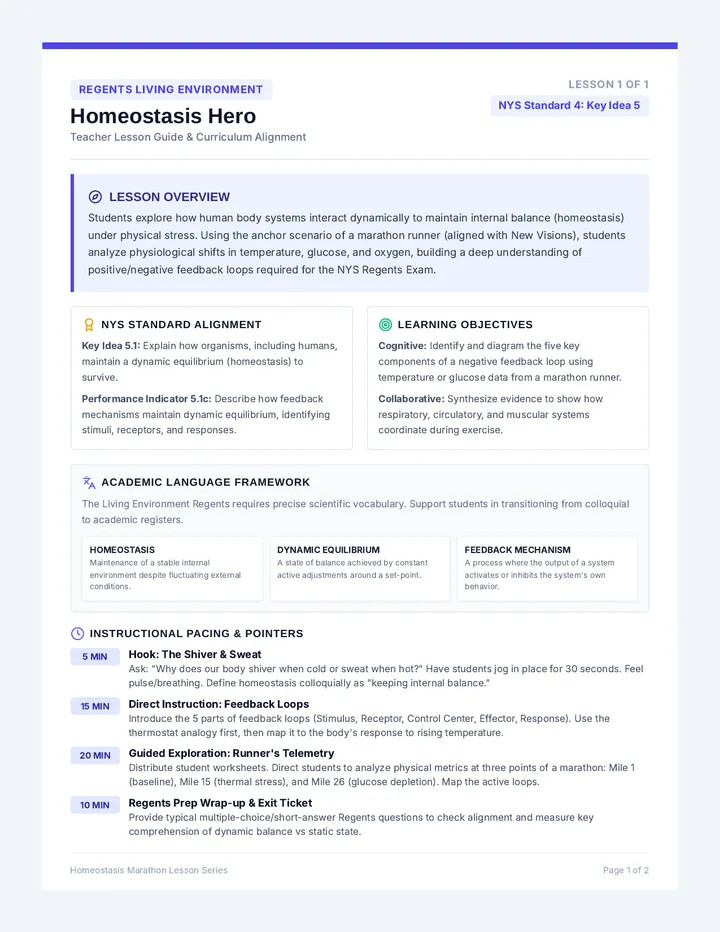
- Receptors & Hormones: Shape specific! A hormone only works on target cells with matching shapes.
- Photosynthesis Inputs: \(CO_2\), \(H_2O\), Light. Outputs: Glucose and Oxygen (\(O_2\)).
NYS State Lab Quick-Keys
- Diffusion Lab: Starch is too BIG to leave; glucose is SMALL and diffuses. Salt shrinks cytoplasm, cell wall stays.
- Beaks of Finches: Proves competition for food. Overlapping niches drive natural selection.
- Making Connections: Cellular work causes higher pulse rate to distribute \(O_2\) & clear metabolic wastes.
Teacher Instructional Best Practices
Utilize daily 3-question warm-ups sourced from real unedited past examinations. Do not adapt the text—students must master decoding complex phrasing in context. Ensure lab portfolios are organized: students require 1,200 lab minutes with completed, signed lab reports to sit for the exam.
Regents Living Environment Remedial Syllabus Page 3 of 3
Regents Biology Rescue Practice Pack
NYS Living Environment Regents
BIOLOGY RESCUE
Student Strategy & Literacy Pack
Score: _________ / 30
Student Name:
Date:
S1
The "Diagram Demolisher" • Receptors & Hormones
How to Demolish: Do not read the text first! Look at the diagram below. Identify the shapes. Find "who is doing what to whom" and write your observations on the right.
Cellular Target Site
Hormone A
▲
Hormone B
●
Target Cell
Step 1: Shape Check
Which hormone fits the target cell's receptor socket?
Step 2: Predict
If a mutation alters the shape of the receptor socket, what is the effect?
Practice Exam Question: Using your knowledge of biology, explain why Hormone A is able to stimulate a physiological response in the target cell, while Hormone B is not. [1 Point]
S2
The "No-Synonym" Rule • Vocabulary Match
Living Environment scorers cannot give partial credit for casual language. Translate the "casual" word into the exact **academic science term** required.
Casual/Vague Phrasing
Biological Meaning / Definition
Required Regents Science Term
"Powerhouse" of the cell
The organelle that synthesizes ATP energy.
Mitochondria
"Gaining balance"
Maintaining a stable internal environment.
"Pumping with energy"
Moving materials from LOW to HIGH concentration.
"The cell shrinks up"
Loss of water from cell cytoplasm due to salt.
Regents Living Environment Strategy Pack Page 1 of 2
NYS Living Environment Regents
BIOLOGY RESCUE
Student Strategy & Literacy Pack
Score: _________ / 30
S3
Decoding Ecosystem Energy (The Arrow Rule)
The Arrow Rule: Food web arrows represent the **flow of energy**. The arrow always points **from the organism being eaten to the organism eating it** (into the stomach of the consumer!).
☀️ Sun
Ultimate Source
Grass
Producer
Rabbit
Primary Herbivore
Hawk
Apex Carnivore
Check: In the chain above, which direction does energy flow? Grass → Rabbit → Hawk (Points to Consumer)
Practice Exam Question: State the physiological pathway that transfers solar energy from the Sun directly into the organic bonds of the grass. [1 Point]