Built to Survive Slides Survival Secrets Unit
Lesson 1: Adaptations
Built to Survive
How amazing body parts help animals live, find food, and stay safe in their homes.
🐻 Polar Bear • 🐫 Camel • 🦈 Shark
Let's Explore! →
Vocabulary Focus Definition
What is it?
An Adaptation is:
A body part or behavior that helps a living thing survive in its home.
Examples
🦅
Sharp Beaks
To catch food
🌵
Thick Prickles
To save water
Think: What is a body part that helps you survive? Slide 2 of 6
Habitat 1: The Polar Ice
Very Cold & Snowy
🐻❄️
The Polar Bear
Perfectly designed for freezing weather
Adaptation 1
Thick White Fur
Keeps them super warm and hides them in the snow.
Adaptation 2
Huge Paws
Act like snowshoes so they don't sink in deep snow.
Cause & Effect
The Environment (Cause)
Freezing cold ice and white snow
⬇️
The Helpful Trait (Effect)
Thick white fur protects from cold & camouflage
Imagine if a polar bear had dark brown fur. What would happen? Slide 3 of 6
Habitat 2: The Hot Desert
Very Hot & Dry
🌵
The Saguaro Cactus
Built to store every drop of water
Adaptation 1
Spongy Stem
Expands to hold gallons of water when it finally rains.
Adaptation 2
Sharp Spines
Protect the plant's stored water from thirsty desert animals.
Cause & Effect
The Environment (Cause)
Almost no rain, blazing hot sun
⬇️
The Helpful Trait (Effect)
Spines keep water safe & spongy skin stores it
What would happen to a leafy forest plant in the desert? Slide 4 of 6
Habitat 3: The Wide Ocean
Wet, Deep & Cold
🦈
The Great White Shark
The ultimate underwater hunter
Adaptation 1
Super Gills
Allow them to breathe oxygen straight from the water.
Adaptation 2
Streamlined Fins
Perfect shape to slice through the water at high speeds.
Cause & Effect
The Environment (Cause)
Surrounded by water, fast swimming prey
⬇️
The Helpful Trait (Effect)
Gills provide oxygen & tail fin drives speed
Could a human survive underwater without special gear? Why not? Slide 5 of 6
Quick Quiz Time!
Show What You Know
Match the adaptation to its super power!
1️⃣ 🐻❄️ White Fur
Where does this animal live?
Polar Ice ❄️
2️⃣ 🌵 Sharp Spines
Where does this plant live?
Hot Desert ☀️
3️⃣ 🦈 Sharp Gills
Where does this animal live?
Deep Ocean 🌊
Great job! Let's work on our guides now! Slide 6 of 6
Built to Survive Handout SURVIVAL FIELD GUIDE
Lesson 1: Adapted Reading
Name:
Date:
What are Adaptations?
Every living creature has a special home called a Habitat . A habitat has everything an animal needs to live, like food, water, and shelter. But some habitats can be very tough! They might be freezing cold like the polar ice, or extremely dry and hot like a desert.
To survive in these tough homes, plants and animals have Adaptations . An adaptation is a special body part or behavior that helps them live. Without these adaptations, animals would not be able to find food or stay safe!
🐻❄️
Cold Adaptations
Polar Bears have thick white fur. The fur keeps them incredibly warm. The white color helps them hide in the cold white snow so they can hunt.
🌵
Dry Adaptations
Cactus Plants have sharp spines. These spines prevent thirsty desert animals from chewing the cactus and taking its precious stored water.
Key Rule: If an animal fits its habitat, it survives! If its habitat changes and it doesn't have the right traits, it will have a hard time living there.
Unit: Survival Secrets Page 1 of 2
SURVIVAL FIELD GUIDE
Lesson 1: Guided Practice
Name:
Date:
Fill-In-The-Blanks
Use the word bank to complete each sentence about survival secrets.
📦 Word Bank
Adaptation Habitat White Fur Spines Survive
1
A is a special home where a plant or animal lives.
2
An is a body part or behavior that helps a living thing.
3
Adaptations make it easier for plants and animals to in their environments.
4
To stay warm in the snow, a polar bear has thick .
5
To stop thirsty animals from eating it, a cactus has sharp .
Unit: Survival Secrets Page 2 of 2
Trait Matching Worksheet SURVIVAL FIELD GUIDE
Lesson 1: Practice
Name:
Date:
Adaptation Matching
Draw a line from the physical adaptation to its correct habitat!
Physical Traits
🐻❄️
Thick White Fur
Stay warm & hide
🌵
Spongy Stems
Store rain water
🦈
Super Gills
Breathe underwater
❓
❓
❓
Habitats
🌊
Deep Ocean
Wet salt water
❄️
Polar Ice
Freezing cold & snow
☀️
Hot Desert
Dry and sandy dunes
Design Your Own Adaptation!
Think of an animal. Draw its special adaptation (like sharp claws, huge ears, or wings) in the box.
My animal's adaptation is helpful because: ____________________________________________________
Unit: Survival Secrets Page 1 of 1
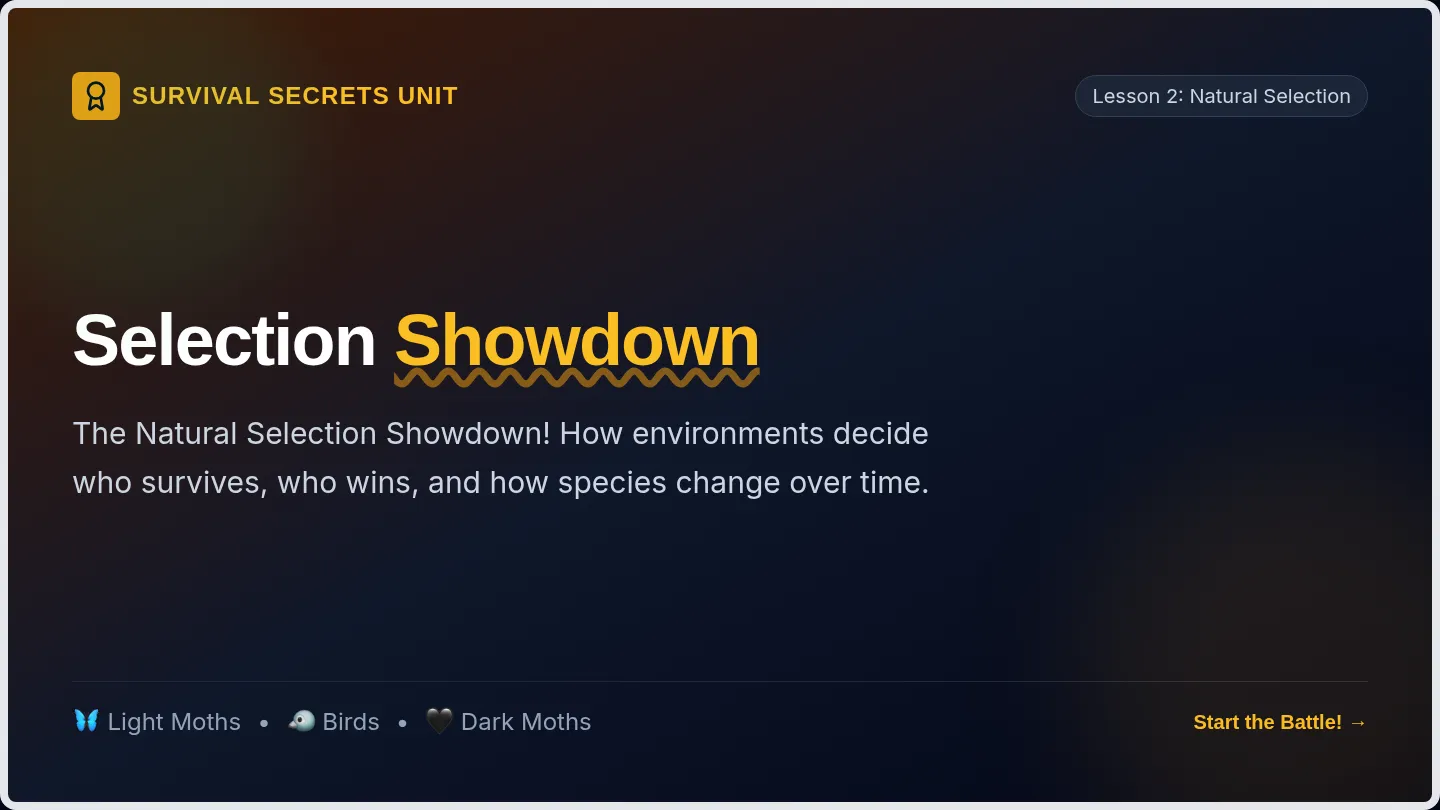
Selection Showdown Slides Survival Secrets Unit
Lesson 2: Natural Selection
Selection Showdown
The Natural Selection Showdown! How environments decide who survives, who wins, and how species change over time.
🦋 Light Moths • 🐦 Birds • 🖤 Dark Moths
Start the Battle! →
Core Concept How Nature Works
What is
Natural Selection?
1️⃣
Animals in a family have slightly different traits (some are lighter, some are darker).
2️⃣
The environment decides which trait is the most helpful to survive.
Survival Rule
"Best traits live.
Winners have more babies! 🐣
Think: What makes an animal "win" in its home? Slide 2 of 6
Case Study: 150 Years Ago
The Clean Forest
The Tree Bark is Light Gray
Moths resting on light trees have different colors:
⚪
Light Gray Moths
Perfect camouflage! Birds can't see them. They live.
⚫
Dark Black Moths
Stick out like a sore thumb! Birds eat them quickly.
Who Survives?
Light Moths ⚪ SURVIVE ✅
Dark Moths ⚫ EATEN 🐦
Most moths in this forest are light gray!
Think: Why were there so few black moths back then? Slide 3 of 6
The Change: Factories & Smoke
The Industrial Revolution
The Tree Bark Turns
Dark Black
Coal factories covered the tree trunks in dark black soot. The clean, light habitat changed forever!
The New Reality
Moths that were good at hiding before are suddenly in deep trouble!
New Problem
Light Moths Glow!
⚪ ➡️ 🎯 ➡️ 🐦
Light moths are now super easy for birds to spot on the dark tree trunks!
Imagine if the trees stayed clean. Would this have happened? Slide 4 of 6
The Present: Who Wins Now?
Natural Selection Complete
Dark Moths Survive & Multiply
🛡️
New Camouflage
Dark moths blend in with dark trees. Birds can't see them!
🥚
More Babies
Since dark moths survive, they live long enough to lay eggs and have dark moth babies.
Before vs After
150 Years Ago
Moth Mystery Worksheet MOTH MYSTERY CASES
Lesson 2: Adapted Reading
Name:
Date:
The Story of the Peppered Moth
A long time ago, forests in England were clean. The tree bark was a light gray color. Resting on these trees were two kinds of peppered moths: light gray moths and dark black moths.
Because the trees were light, the light gray moths were camouflaged (hidden). Birds flying around looking for food could easily see the dark black moths, but they couldn't see the light ones. Birds ate the dark moths. Because light moths survived, they had many light gray babies!
But then, humans built giant coal factories ! The smoke from the factories turned the tree trunks dark black with soot. The trees were no longer light gray!
Suddenly, the light gray moths stood out against the black bark. Birds could see them and eat them! But now, the dark black moths were hidden on the dark bark. They survived and had dark babies. Over time, the light gray moths disappeared, and almost all the moths in the forest became dark black!
Review Question:
Why did the moths change from light gray to dark black? (Circle one):A) They painted themselves • B) The dark ones survived better on dirty trees
Unit: Survival Secrets Page 1 of 2
MOTH MYSTERY CASES
Lesson 2: Practice
Name:
Date:
Moth Flowchart Challenge
Number the steps from 1 to 4 to show how natural selection happened.
Environment Change
Coal factories burn fuel and turn the white birch tree bark black.
Different Colors (Variation)
Moths in the forest have different colors (some light gray, some dark black).
Reproduction & Growth
Dark black moths survive, live long, and have many black moth babies.
Survival Selection
Birds eat the light gray moths because they stand out. The dark moths hide safely.
Unit: Survival Secrets Page 2 of 2
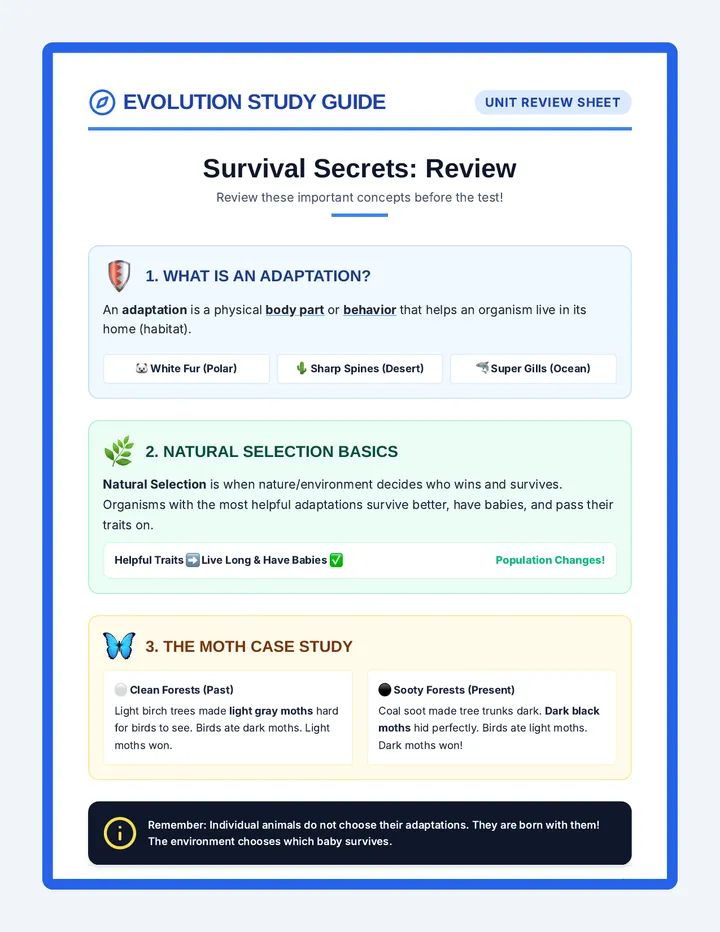
Survival Secrets Study Guide EVOLUTION STUDY GUIDE
Unit Review Sheet
Survival Secrets: Review
Review these important concepts before the test!
🛡️
1. What is an Adaptation?
An adaptation is a physical body part or behavior that helps an organism live in its home (habitat).
🐻❄️ White Fur (Polar)
🌵 Sharp Spines (Desert)
🦈 Super Gills (Ocean)
🌿
2. Natural Selection Basics
Natural Selection is when nature/environment decides who wins and survives. Organisms with the most helpful adaptations survive better, have babies, and pass their traits on.
Helpful Traits ➡️ Live Long & Have Babies ✅ Population Changes!
🦋
3. The Moth Case Study
⚪ Clean Forests (Past)
Light birch trees made light gray moths hard for birds to see. Birds ate dark moths. Light moths won.
⚫ Sooty Forests (Present)
Coal soot made tree trunks dark. Dark black moths hid perfectly. Birds ate light moths. Dark moths won!
Remember: Individual animals do not choose their adaptations. They are born with them! The environment chooses which baby survives.
Unit: Survival Secrets Page 1 of 1
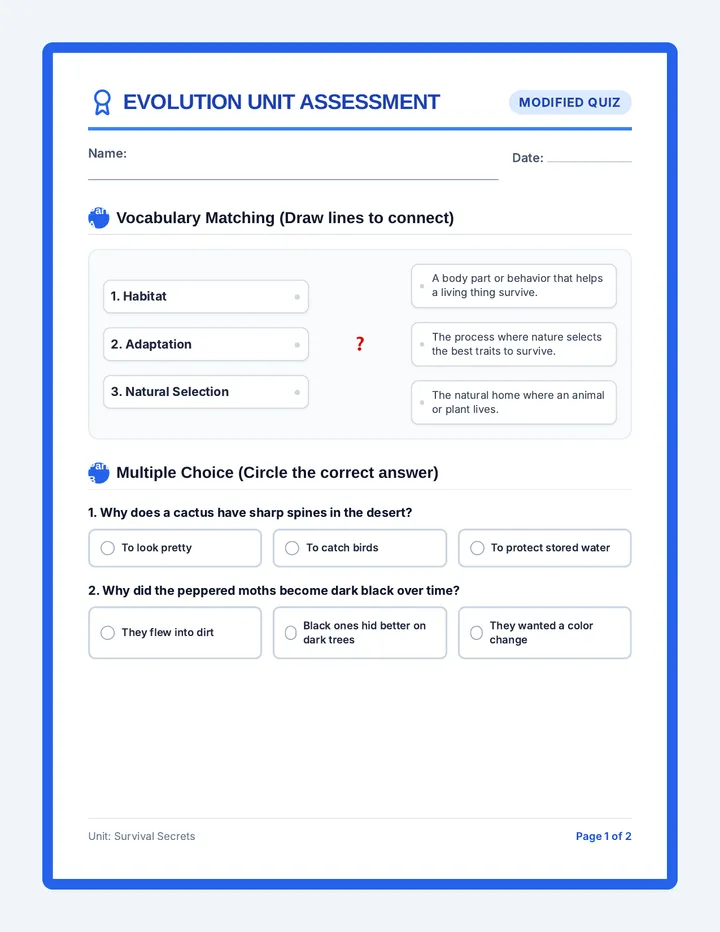
Survival Secrets Assessment EVOLUTION UNIT ASSESSMENT
Modified Quiz
Name:
Date:
Part A Vocabulary Matching (Draw lines to connect)
1. Habitat ●
2. Adaptation ●
3. Natural Selection ●
❓
● A body part or behavior that helps a living thing survive.
● The process where nature selects the best traits to survive.
● The natural home where an animal or plant lives.
Part B Multiple Choice (Circle the correct answer)
1. Why does a cactus have sharp spines in the desert?
To look pretty
To catch birds
To protect stored water
2. Why did the peppered moths become dark black over time?
They flew into dirt
Black ones hid better on dark trees
They wanted a color change
Unit: Survival Secrets Page 1 of 2
EVOLUTION UNIT ASSESSMENT
Modified Quiz
Name:
Date:
Part C True or False (Circle TRUE or FALSE)
1. Individual animals can choose to change their traits instantly.
True False
2. Thick white fur helps a polar bear survive in the cold polar ice.
True False
3. Animals with helpful adaptations are more likely to have babies.
True False
Part D Short Answer Writing
Choose ONE adaptation from your study guide (thick white fur, sharp spines, or super gills). How does that adaptation help that animal/plant survive?
💡 Need help starting? Try writing this:
"The ________ has the adaptation of ________. This adaptation is helpful because ________."
Unit: Survival Secrets Page 2 of 2
Survival Secrets Teacher Key TEACHER KEY & FACILITATION GUIDE
Teacher Resource
Unit: Survival Secrets (Evolution)
Grade: High School SDC (Adapted)
Duration: 3-Day Mini-Unit
SDC Accommodation Checklist
Visual Support
Use high-contrast slides, real photos of polar bears, desert cacti, and moths. Pair words with emojis/gestures.
Chuncked Reading
Have students read pages chorally or echo-read. Stop after each paragraph to ask: "Where does it live?" "What helps it?"
Worksheet Answer Keys
🔑 Lesson 1: Built to Survive Handout (Page 2)
Question 1: Habitat
Question 2: Adaptation
Question 3: Survive
Question 4: White Fur
Question 5: Spines
🔑 Lesson 1: Trait Matching
Thick White Fur ➡️ Polar Ice ❄️
Spongy Stems ➡️ Hot Desert ☀️
Super Gills ➡️ Deep Ocean 🌊
🔑 Lesson 2: Moth Flowchart
Order of boxes from top to bottom on the sheet:
Box A: 2 Box B: 1 Box C: 4 Box D: 3
Unit: Survival Secrets Page 1 of 2
TEACHER KEY & FACILITATION GUIDE
Teacher Resource
🔑 Unit Assessment Keys & Rubrics
Part A: Matching
1. Habitat connects to: "The natural home where an animal or plant lives."2. Adaptation connects to: "A body part or behavior..."3. Natural Selection connects to: "The process where nature selects..."
Part B: Multiple Choice
Question 1: Correct choice is "To protect stored water" (Option 3).Question 2: Correct choice is "Black ones hid better on dark trees" (Option 2).
Part C: True or False
1. False
2. True
3. True
Part D: Short Answer Grading (4 Points)
Grade the short answer generously based on conceptual effort. Use the following rubric:
● 4 Points: Correctly names adaptation, links it to its environment, and correctly explains the benefit using simple cause/effect logic.