Water Motion Slides Hydro Flow • Day 1
Active Science
Water in Motion
Let's explore the Hydrosphere and discover how water travels in an endless, exciting loop!
Today's goal: Name the 4 steps of the water cycle!
What is the Hydrosphere?
Definition
All the Water on Earth!
The Hydrosphere is the total amount of water on our planet.
Hydro = Water
Liquid Water
Oceans, rivers, lakes, and puddles!
Gas Water
Invisible water vapor in the warm air!
Solid Water
Glaciers, ice caps, and falling snow!
Water is always changing shape and moving around the globe.
1
Stage 1 of the Cycle
Evaporation
Going Up!
The sun heats up water on the ground and turns it into invisible gas called water vapor .
How does it feel?
Think of a wet towel drying in the warm sun. The water doesn't disappear—it turns to gas and rises!
Sun Heat
Gas (Vapor)
Rising
Gas (Vapor)
Liquid Water (Lake / Ocean)
Formula: Liquid Water + Heat energy = Gas Vapor!
2
Stage 2 of the Cycle
Condensation
Cool Air
Gas cools down to make clouds!
Gas turns back into liquid droplets.
Cooling Down!
High in the sky, the air is cold. The warm gas cools down and turns back into tiny drops of liquid water to form clouds .
Real-Life Clue:
The cold glass of water on a hot summer day. Water drops form on the outside. That is condensation!
Formula: Cold Air + Water Vapor = Clouds (Liquid)!
3
Stage 3 of the Cycle
Precipitation
Falling Down!
The cloud gets so heavy that it cannot hold any more water. Water falls back down to Earth!
🌧️
Rain Warm air (Liquid)
❄️
Snow Freezing air (Solid)
Heavy Clouds
Ground and Plants Catch It!
Gravity pulls the water droplets back down to Earth.
4
Stage 4 of the Cycle
Collection
Ground Catch
Water pools together!
Collected water goes back to lakes and oceans.
Gathering Together!
Water pools in oceans, lakes, and rivers, or sinks deep into the soil as groundwater .
Where does it go?
Plants drink it, animals drink it, and the sun prepares to heat it up all over again!
Collection prepares the water for step 1 (Evaporation) again!
The Ultimate Loop
Recap
1. Evaporate
Water turns to invisible gas and rises.
2. Condense
Gas cools down to make clouds.
3. Precipitate
Heavy drops fall down to the ground.
4. Collect
Water gathers in pools and lakes.
The water cycle NEVER stops! We are drinking the same water the dinosaurs drank! 🦖
Water Motion Notes Science • Lesson 1 Notes
Water in Motion
HYDRO FLOW
Name:
Date:
Part 1: Key Vocabulary Tracing
Trace the words that describe where all Earth's water lives:
1. Water Planet (noun) HYDROSPHERE
All water on Earth 💧 🌎
2. Invisible Water Gas (noun) WATER VAPOR
Water in the air 💨 ☁️
Part 2: The Great Heat Up & Cool Down
Word Bank
SUN CLOUDS GAS COOLS
1 Stage 1: Evaporation (Liquid to Gas)
The warm heats up the lake water. The water rises up into the sky and turns into an invisible .
2 Stage 2: Condensation (Gas to Liquid)
High in the cold sky, the water gas down. These tiny water drops cluster together to make white, fluffy .
Day 1 • Turn page for Precipitation & Collection
Water Cycle Notes (Continued) Page 2 of 2
Part 3: The Downpour & Gathering
Word Bank
RAIN HEAVY OCEANS COLLECTS
3 Stage 3: Precipitation (Water Falls)
The clouds get too with water. The water falls back down to Earth as liquid or cold snow.
4 Stage 4: Collection (Water Gathers)
Water pools and in rivers, lakes, and deep so the sun can heat it up again.
Part 4: Draw a Line to Match
Match each stage with its correct drawing and description:
☀️ EVAPORATION
☁️ CONDENSATION
🌧️ PRECIPITATION
Gas cools and forms clouds
Water drops or snow fall down
Sun heats water to rise as gas
Part 5: Express Yourself
Which stage of the water cycle is most interesting to you? Circle ONE:
☀️ Evaporation
☁️ Condensation
🌧️ Precipitation
🌊 Collection
Unit: Hydro Flow Great job completing your notes! ⭐
Water Motion Guide Day 1 • Teacher Resource
Water in Motion Guide
TEACH
Lesson Goal
Students will identify the hydrosphere and explain the sequence of the 4 water cycle stages using multi-sensory and scaffolded worksheet prompts.
Target Audience
9th-10th Grade SPED (IEP accommodations for visual matching, tracing, word-banks)
Pacing & Session Breakdown
10 MINS Hook & Vocabulary Define Hydrosphere. Trace terms.
15 MINS Direct Instruction Use Slides 1-6. Interactive movements.
15 MINS Guided Practice Fill in notes together. Support IEPs.
10 MINS Check & Close Recap Slide 7. Peer-share matching.
Multi-Sensory Accommodation Strategies
🙌 Total Physical Response (TPR)
Assign physical movements to each cycle stage:Evaporation: Reach hands up, wiggle fingers like warm rising gas.Condensation: Clasp hands tight like a cold, compact cloud.Precipitation: Rain fingers down toward the ground.
✏️ Visual & Tracing Supports
For students struggling with fine motor skills or spelling:
Slide Presentation Guide
Slides 2 & 3 Script (Hydrosphere & Evaporation)
"Students, look at Slide 2. 'Hydro' means water! Let's touch our water bottles. Where else do we see water? (Oceans, air, ice). Now Slide 3: Evaporation. Heat from the sun is the engine. Let's do our rising gas movement!"
Slides 4 & 5 Script (Condensation & Precipitation)
"Look at Slide 4. High in the air, the gas gets cold and packs close together like a warm hug. It forms clouds. On Slide 5, the cloud becomes heavy. Let's make rain finger motions! Rain is liquid, snow is solid."
Unit: Hydro Flow • Day 1 Teacher Guide Turn Page for Answer Keys
Answer Keys & Assessment Support Page 2 of 2
KEY
Water Motion Notes • Page 1 Keys
Part 1: Key Vocabulary Tracing
Ensure students trace the dotted lines for: HYDROSPHERE and WATER VAPOR .
Part 2: The Great Heat Up & Cool Down Sentences
Stage 1 Sentence: "The warm SUN heats up the lake water. The water rises up into the sky and turns into an invisible GAS ."
Stage 2 Sentence: "High in the cold sky, the water gas
Water Life Slides Hydro Flow • Day 2
Active Science
Water and Life
How does the Water Cycle keep plants growing, animals drinking, and ecosystems thriving?
Today's goal: Discover how plants release water vapor!
How Plants Drink
Absorption
Drinking From the Soil
Plants cannot hold cups! Instead, they use underground roots to pull collected water out of the soil.
The roots act like tiny straw networks sucking water up into the stems and leaves!
Soil Water
Roots Pulling Up
Wet Soil & Earth
Without collection in the soil, plants would dry up!
Plant Breathing
Transpiration
Leaf Exhale
Water leaves the plant!
Invisible vapor floats into the air.
The "Sweat" of Plants!
Transpiration is when plants release extra water from their leaves back into the air.
Cycle Connection:
This is plant-powered evaporation ! It helps build big rain clouds in the sky.
One giant tree can sweat out thousands of gallons of water vapor each year!
How Plants Grow
Photosynthesis
Water is Power!
Plants use water , sunlight, and air to make their own sugary food.
Simple Equation:
Water 💧 + Sun ☀️ = Plant Energy ⚡
The Kitchen of the Leaf Making sugar and releasing oxygen for us to breathe!
💧 H₂O
☀️ Light
=
🍎 Growth
No Water = No Plant Food!
Photosynthesis is how plants feed themselves and help us breathe clean air.
Our Local Ecosystem
Watershed
Local Habitat
🦌 🌲 Forest Life
Watershed Connection
An area of land where all water drains to one lake or river!
Watering the Neighborhood
A Watershed keeps local rivers full so deer, birds, and fish have a safe, wet home to live and drink.
Our Local Watershed:
Feeds local trees, fills neighborhood reservoirs, and cleans water naturally in swamps.
Everything in nature is connected by the watershed!
Why Water Matters
Recap
1. Roots Pull
Water Life Activity Science • Lesson 2 Activity
Water and Life
HYDRO FLOW
Name:
Date:
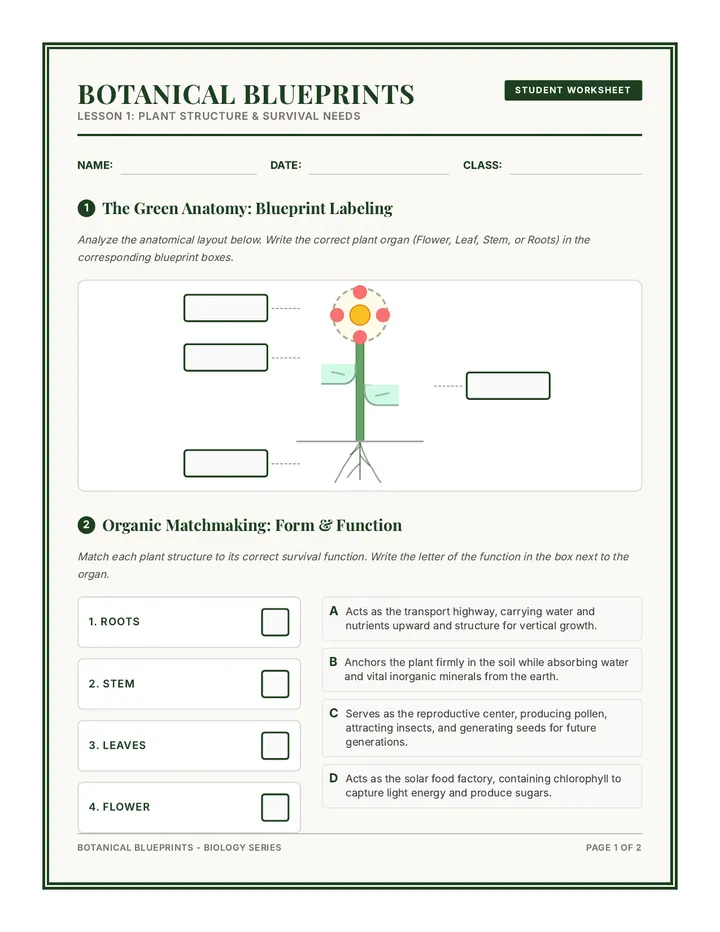
Part 1: Diagram of a Plant Drinking
Use the words in the word bank to label how water moves through a plant:
Word Bank
ROOTS (Suck water) LEAVES (Sweat gas) STEM (Travel up) SOIL (Holds water)
☁️ 🌧️ 🌧️
☀️
🌿 Leaf Sweat (Gas)
🪱 🌱 Roots Drinking Water
1. What releases the water vapor into the air?
2. What pipe does the water travel up?
3. What straw network drinks soil water?
4. What muddy layer stores the water pools?
Day 2 • Turn page for Watershed Case Study
Ecosystem Case Study & Questions Page 2 of 2
Part 2: Case Study • The Redwood Stream
Read the short story below:
Deep in the Redwood Forest, rain falls onto the giant trees. The redwood leaves act like giant hands catching the water. The water drops slip down to the muddy forest watershed . This collected water flows into a crystal-clear stream. A local family of black deer visits this stream every single afternoon to drink cool water. Without the rain collection, the trees would go hungry and the deer would have no fresh water.
Part 3: Show What You Know
Answer the following questions based on the Redwood story:
1. Who drinks from the forest stream afternoon reservoir?
🦊 Wild Foxes
🦌 Black Deer
🐻 Brown Bears
2. Where do the plant roots get their drink of water from?
☁️ Inside clouds
💨 Inside warm air
🤎 Muddy soil
3. True or False: Do plants release water vapor into the air to help build clouds?
👍 TRUE (Yes)
👎 FALSE (No)
Part 4: Clean Water Connection
Why is it important to keep our local watershed and streams clean? Write ONE word:
Unit: Hydro Flow Eco-Star Award! 🦌🏆
Water Life Guide Day 2 • Teacher Resource
Water and Life Guide
TEACH
Lesson Goal
Students will explain the biology of plant water absorption (roots) and leaf water release (transpiration), and identify how watersheds sustain animal habitats.
Focus
Biological Connections (Transpiration, Photosynthesis, Watersheds)
Day 2 Pacing Breakdown
10 MINS Review & Setup Recap 4 stages. Connect to plants.
15 MINS Slide Facilitation Slides 1-6. Introduce Transpiration.
15 MINS Diagram Lab Complete Plant Diagram together.
10 MINS Case Study Check Read Redwood Stream aloud. Score.
Multi-Sensory Concrete Analogies
🍹 The Straw Analogy (Roots & Stem)
Bring a drinking straw to class.roots pulling collected soil water up to the leaves .
💦 The Sweat Analogy (Transpiration)
Explain that plants sweat just like us!
Slide Cues & Questions
Slide 3 & 4 (Transpiration & Photosynthesis) Script
"Students, look at Slide 3. Plants release invisible vapor into the air. What do we call that? Transpiration! Let's whisper it: tran-spi-ra-tion. Slide 4: Plants cook sugar using water and light. If they have no water, can they make food? (No!)."
Slide 5 (Watershed & Ecosystem) Script
"Look at Slide 5. A watershed acts like a giant natural bowl gathering all the mountain rainwater. Why do the animals like the deer care if the watershed is clean? (So they have safe, tasty drinking water!)."
Unit: Hydro Flow • Day 2 Teacher Guide Turn Page for Answer Keys
Answer Keys & Scoring Guidelines Page 2 of 2
KEY
Water Life Activity • Page 1 Keys
Part 1: Diagram Label Answers
Label 1 (Releases water vapor): LEAVES
Label 2 (Water travels up pipe): STEM
Label 3 (Sucks soil water network): ROOTS
Label 4 (Muddy layer storage): SOIL
Scaffolded Grading Tips:
Accept phonetic spelling (e.g. "soyl" for soil, "steme" for stem, "leevs" for leaves). The primary focus is correct vocabulary conceptual placement, not mechanical orthography.
KEY
Water Life Activity • Page 2 Keys