An introductory lesson exploring plant and animal cells, their differences, and the roles of key organelles (nucleus, cell membrane, cell wall, cytoplasm, mitochondria, chloroplast, ribosomes, ER, Golgi body, and vacuoles) through visual slides, structured guided notes, a creative cell-coloring activity, and a quick exit ticket assessment.
Completed guided notes can be used to study for exams! Page 2 of 2
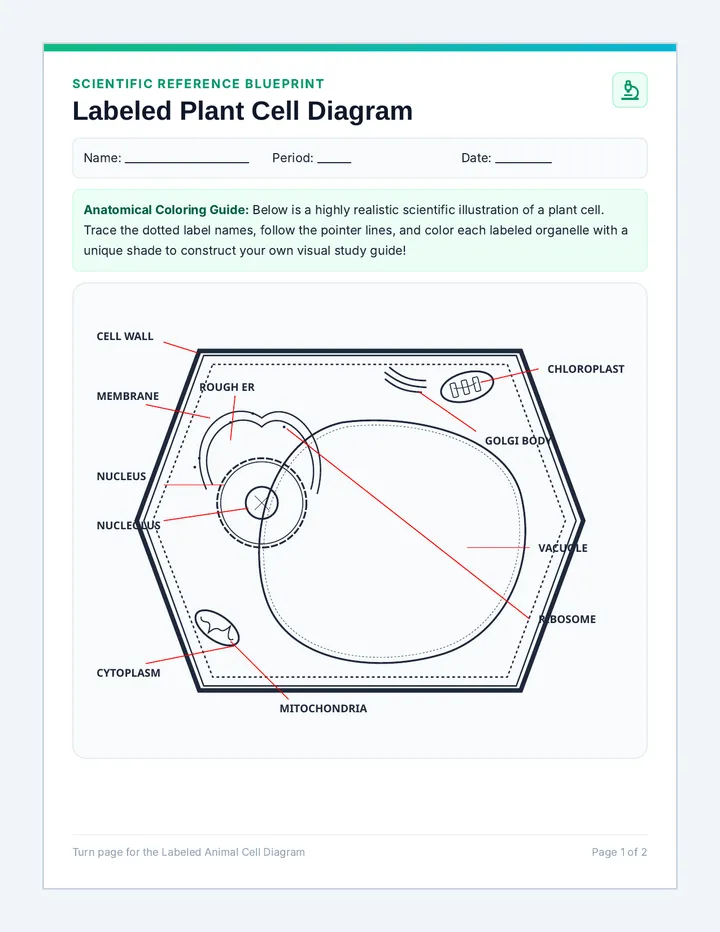
7. Chloroplast (Analogy: Solar Roof Herb Greenhouse)
Green chloroplasts perform photosynthesis, harvesting solar energy inside chlorophyll pigments to synthesize chemical sugars. They function like a solar roof greenhouse, growing fresh ingredients.
Turn page for Page 3: Consolidated Questions Sheet Page 2 of 3
Workbook Answer Sheet
Cellular Blueprints: Evidence Questions
Name: ______________________
Period: ______
Date: __________
Part I: Universal Cell Parts
UNDERLINE GRAY & COLOR GEL GRAY
Q1: What job does the cytoplasm perform?
UNDERLINE PURPLE & COLOR NUCLEUS PURPLE
Q2: What metabolic jobs does the nucleus do?
UNDERLINE RED & DRAW RED CHROMATIN
Q3: What code is held inside the nucleus?
UNDERLINE BLUE & TRACE MEMBRANE BLUE
Q4: Why is the membrane "semi-permeable"?
UNDERLINE CYAN & SHADE LIPIDS CYAN
Q5: Why is it necessary to have a membrane?
UNDERLINE ORANGE & COLOR MITOCHONDRIA ORANGE
Q6: What energy molecule is generated?
Part II: Universal Continues & Plant Only
UNDERLINE PINK & COLOR COOKS PINK
Q7: What items do ribosomes assemble?
UNDERLINE INDIGO & COLOR ER CANALS INDIGO
Q8: What is the folded ER highway called?
UNDERLINE YELLOW & COLOR GOLGI YELLOW
Q9: What is the packing task of the Golgi?
UNDERLINE BLUE & COLOR FREEZER LIGHT BLUE
Q10: What primary items do vacuoles hold?
UNDERLINE GREEN & COLOR WALL DARK GREEN
Q11: What compound makes up the cell wall?
UNDERLINE LIME & COLOR GREENHOUSE BRIGHT GREEN
Q12: What process occurs inside chloroplasts?
Synthesize Your Evidence
Why must the Golgi body receive cargo from the Endoplasmic Reticulum and ribosomes before shipping?
Submit all 3 pages together to receive full active-reading science lab credit. Page 3 of 3
UNDERLINE THE ANSWER USING A DARK BLUE COLORED PENCIL.
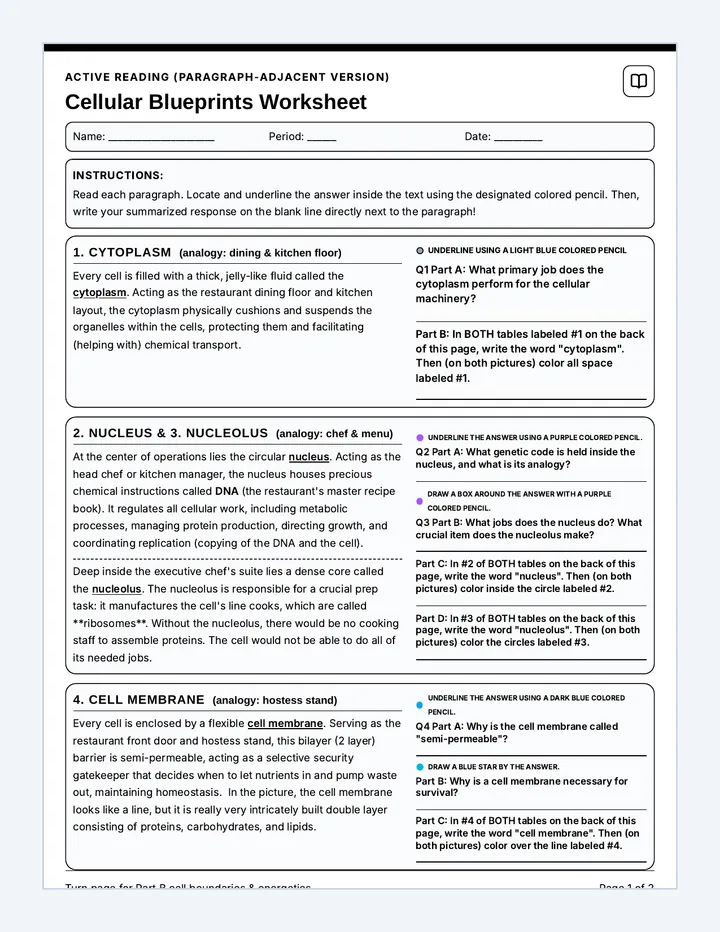
Q4 Part A: Why is the cell membrane called "semi-permeable"?
DRAW A BLUE STAR BY THE ANSWER.
Part B: Why is a cell membrane necessary for survival?
Part C: In #4 of BOTH tables on the back of this page, write the word "cell membrane". Then (on both pictures) color over the line labeled #4.
Turn page for Part B cell boundaries & energetics Page 1 of 2
Active Reading (Paragraph-Adjacent Version) Section 2: Energetics, Assembly & Packaging
5. Mitochondria (ovens) and 6. Chloroplast (greenhouse) During cellular respiration, bean-shaped mitochondria break down glucose sugars with oxygen to generate ATP energy for the body to use, acting like kitchen gas ovens. (Water and Carbon Dioxide also result from this process).
Photosynthesis is the opposite process. Plant cells also contain green chloroplasts, which harvest solar (the sun's) energy like a solar roof greenhouse growing fresh ingredients, and along with carbon dioxide, produces glucose sugar and oxygen.
UNDERLINE THE ANSWER IN ORANGE
Q5 Part A: What energy molecule is generated by mitochondria? Part B: In #5 of BOTH tables on the back of this page, write the word "mitochondria". Then (on both pictures) color all mitochondria labeled #5.
UNDERLINE THE ANSWER IN GREEN.
Q6 Part A: What process occurs in chloroplasts?
Part B: In #6 of ONLY the plant cell table on the back of this page, write the word "chloroplast". Then color all chloroplasts labeled #6.
7. ribosomes (COOKS) & 8. endOPlasmic reticulum( PREP COUNTERS) To construct proteins, the nucleolus creates and then releases tiny dots called ribosomes that act as line cooks. They are attached to the folded membrane Endoplasmic Reticulum (ER) prep counters, which process and transport manufactured cargo. One easy way to tell the difference between the ER and the Golgi body is that the ER next to the nucleus usually has ribosomes attached.
UNDERLINE THE ANSWER FOR QUESTIONS 7 AND 8 IN BLACK COLORED PENCIL
Q7 Part A: What do ribosomes assemble?
Part B: In #7 of BOTH tables on the back of this page, write the word "ribosomes". Then color all ribosomes labeled #7.
Q8 Part A: What is the folded ER highway called? Part B: In #8 of BOTH tables on the back of this page, write the word "endoplasmic reticulum". Then color all ER labeled #8.
9. GOLGI APPARATUS (GOLGI BODY) & 10.VACUOLES(plating food & storage) Materials made in the cell are dispatched (sent) to the stacked Golgi body, serving as the plating and takeout packaging station. Some finished materials and a lot of components like nutrients are held in vacuoles, serving as the Cold Storage walk-in or dry pantry. While plants and animals can have vacuoles for storage, plant cell vacuoles are quite large and are part of creating turgor pressure for plants.
UNDERLINE YOUR ANSWER USING A YELLOW COLORED PENCIL.
Q9: What is the main packing task of Golgi?
Part B: In #9 of BOTH tables on the back of this page, write the word "Golgi". Then color the Golgi bodies labeled #9.
UNDERLINE YOUR ANSWER WITH A BLUE COLORED PENCIL.
Q10: What primary items do vacuoles hold?
Part B: In #10 of BOTH tables on the back of this page, write the word "vacuole". Then color the vacuoles labeled #10.
11. Cell Wall (Plant Only - Analogy: building walls) ONLY plant cells feature a tough outer cell wall constructed from cellulose. Animal cells have no need for a cell wall! Acting as the restaurant building's exterior stone walls, it provides shape and physical support.
UNDERLINE YOUR ANSWER WITH A GREEN COLORED PENCIL.
Q11: What compound makes up the cell wall, and why is it needed?
Part B: In #11 of ONLY the plant table on the back of this page, write the word "cell wall". Then color the cell labeled #11.
Completed activities count as formal biology lab participation. Page 2 of 2