Speedway Sweat Packet SPEEDWAY SWEAT
Homeostasis & Body Systems • Page 1
NAME:
DAE:
THE HOT SEAT!
An Indy 500 race car is very fast. It is also extremely hot! The air inside the car can reach 130 degrees . The driver wears a heavy suit. The driver gets very, very hot. How does the body survive this heat?
1 The Brain and Skin Team
Your body has different parts called systems . These systems work together like a race pit crew. When the driver gets hot, the brain (Nervous System) gets a message. The brain tells the skin (Integumentary System) to start making sweat .
1. Cockpit Heat 130°F air
2. Brain Sense Nervous System
3. Skin Sweats Integumentary
Pit Stop Check-In
1. Which organ senses that the driver is too hot and sends a message?
The Heart
The Brain
2. Why does the driver sweat inside the hot car?
To keep warm
To cool down
Speedway Sweat • Homeostasis Packet Page 1
SPEEDWAY SWEAT
Homeostasis & Body Systems • Page 2
NAME:
HEART, BLOOD, AND WATER
Sweat is made of water from inside the body. When sweat dries on the skin, it carries heat away. But where does the heat come from? The heart (Circulatory System) pumps blood very fast. It pushes hot blood away from the core, straight to the skin . This lets the heat escape.
2 Refueling the Body
Sweating acts as the body's cooling system, but it uses up water fast. A driver can lose 5 to 10 pounds of water during a race! If they run out of water, their body will overheat and stop working. To stay safe, drivers drink water through a long tube inside their helmet during the race.
1. Pumping Heat Away
The heart beats fast to push hot blood out to the skin.
2. Driver Re-hydration
Drinking water replaces sweat so the body can keep cooling down.
Word Race Challenge
Word Bank: SWEAT • HEART • WATER
SWEAT HEART WATER
The driver gets hot and makes to cool off.
To stay hydrated, the driver must drink .
The beats very fast to move hot blood.
Speedway Sweat • Homeostasis Packet Page 2
SPEEDWAY SWEAT
Homeostasis & Body Systems • Page 3
NAME:
THE BIG WORD: HOMEOSTASIS
Homeostasis (ho-me-o-STAY-sis) is body balance. It means keeping everything inside your body steady and safe, even when the outside world changes. Your body wants to stay at 98.6 degrees . Sweat helps you stay balanced!
3 Match the Team Members!
Draw a line from the body part on the left to its job on the right.
1. BRAIN
2. SKIN
3. HEART
Pumps blood fast to carry heat out.
Senses the hot heat and sends messages.
Makes sweat to cool the body down.
4 Your Turn
How does your body feel when you run fast or get too hot? Give one way your body cools down.
Speedway Sweat • Homeostasis Packet Page 3
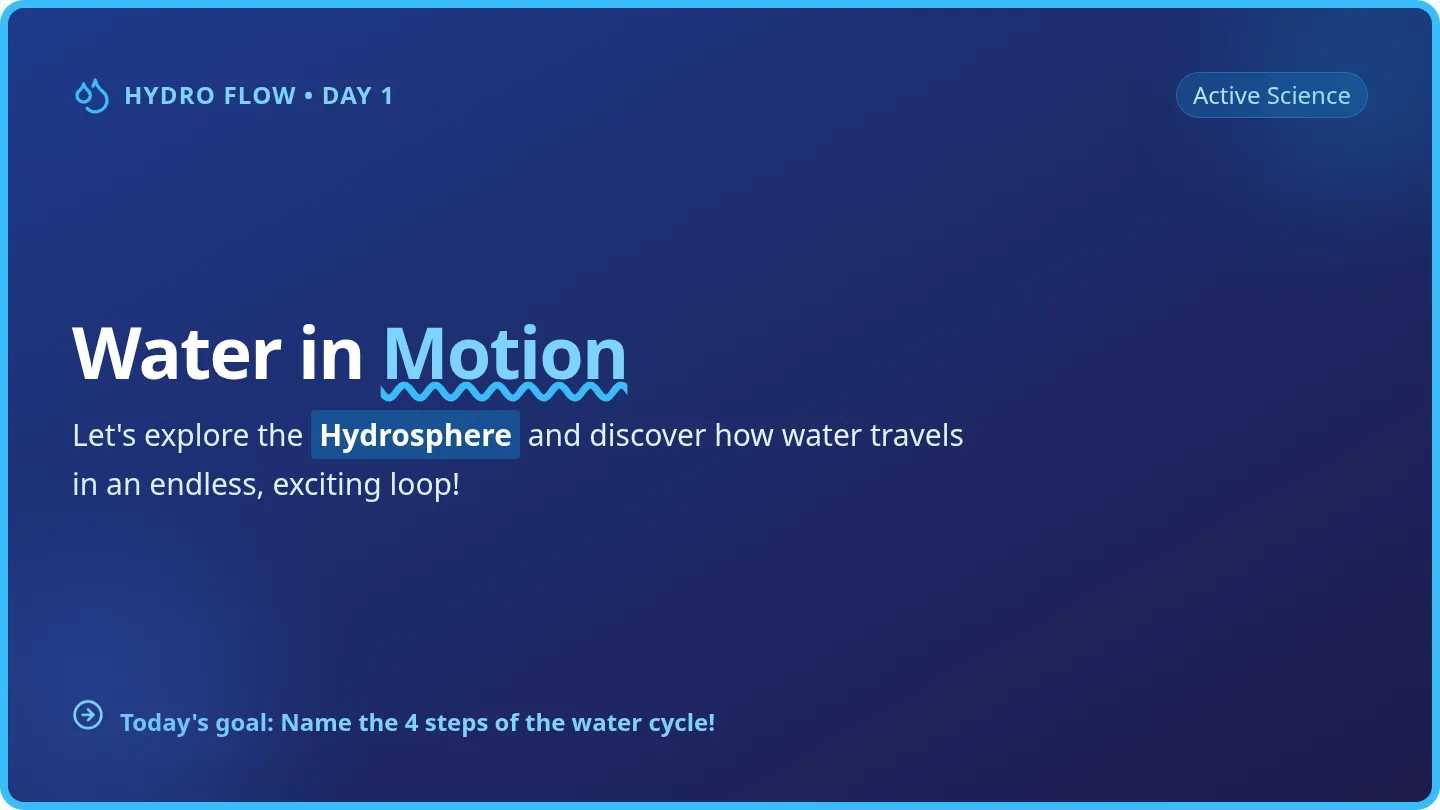
Speedway Sweat Slides INDY 500 BIOLOGY SLIDE 1 OF 6
Homeostasis in Action
SPEEDWAY SWEAT
How Indy 500 drivers survive extreme heat inside their race cars.
Ready to Race? Let's go!
Speedway Sweat Lesson
THE COCKPIT SLIDE 2 OF 6
130°F Inside the Car!
• Indy 500 race cars go extremely fast.
• The big engine makes the car super hot .
• The driver gets very hot inside their suit.
130°F
Hotter than a hot desert!
Key Question: How do drivers survive? Speedway Sweat Lesson
TEAMWORK 1 SLIDE 3 OF 6
The Brain & Skin
• Your body systems work like a race team .
• The Brain senses the hot heat.
• The brain tells the Skin : Make sweat!
Brain Nervous
Skin Integumentary
Sweating cools down the hot driver!
Teamwork: Nervous System + Integumentary System Speedway Sweat Lesson
TEAMWORK 2 SLIDE 4 OF 6
Heart & Water Pumping
• The Heart beats very fast to push hot blood out.
• This moves the heat from inside to the skin.
• The driver must drink water to replace sweat!
Fast Heart Pumps heat out fast
Water Tube Driver drinks inside helmet
Teamwork: Circulatory System + Hydration Speedway Sweat Lesson
THE BIG CONCEPT SLIDE 5 OF 6
HOMEOSTASIS
pronounced: ho-me-o-STAY-sis
Homeostasis is BALANCE.
It is keeping the inside of your body steady and safe, even when the outside environment gets super hot.
Goal: Keep the body at a steady 98.6°F Speedway Sweat Lesson
PIT STOP SLIDE 6 OF 6
Pit Stop Review!
1
Why do Indy 500 drivers sweat so much during the race?
2
What is the big biology word that means "body balance"?
3
What happens if a driver does not drink water during a hot race?
Discuss these out loud together! Speedway Sweat Lesson
Speedway Sweat Teacher Guide Teacher Resource
SPEEDWAY SWEAT
Instructional Pacing & Answer Key
Unit: Human Body Systems Target Audience: High School (Level: 2nd Grade Reading)
Estimated Time 45 Minutes
Primary Focus Homeostasis
Key Systems Nervous, Skin, Heart
ESSENTIAL SCAFFOLDING STRATEGIES
Choral & Echo Reading: Read the short text segments aloud, prompting students to echo the vocabulary (e.g., Homeostasis ).Multi-Sensory Modeling: Have students rub their hands together rapidly to generate friction heat, making the temperature scale physical.Age-Respectful Tone: Emphasize that Indy 500 driving is an intense physical sport. Maintain high expectations for biological concepts while providing simplified reading structures.
Slide Facilitation & Lesson Flow
Slides 1-2
The Hook: Introduce cockpit heat. Ask students: "Have you ever sat inside a hot parked car? Imagine driving at 200 mph in that heat!" Read aloud the bullet points clearly. Highlight 130 degrees .
Slide 3
Brain & Skin: Explain that the Brain is like the race car's dashboard sensor. Introduce the Nervous System as a communications wire and the Skin (Integumentary) as the cooling radiator.
Slide 4
Heart & Water: Introduce the Circulatory System . Explain that heart rate increases during heat to carry core heat to the surface of the body where it can escape. Emphasize why drinking water is a safety rule.
Slides 5-6
The Balance Concept: Have the class repeat "ho-me-o-STAY-sis" three times in a rhythmic chant. Relate it back to a balance scale. Lead the class oral check questions before directing them to individual packet work.
Teacher Answer Key
Packet Page 1: Check-In
Q1: The BrainQ2: To cool down
Packet Page 2: Word Race
...makes SWEAT
...must drink WATER
The HEART beats fast...
Packet Page 3: Match Team
Brain → Senses hot heatSkin → Makes sweatHeart → Pumps blood fast
Speedway Sweat Quiz SPEEDWAY QUIZ
Homeostasis & Body Systems Assessment
NAME:
DATE:
Read This First:
An Indy 500 driver gets very hot in the race car. The driver's body must work together as a team to stay alive. The brain (nervous system) senses heat. The heart (circulatory system) pumps blood fast. The skin (integumentary system) makes sweat. This keeps the body balanced and safe. This balance is called homeostasis .
1 What is homeostasis?
Keeping the inside of the body balanced and safe
Driving a race car fast around the track
2 The driver's heart is a body part made of tissues working together. What level of organization is the heart?
An Organ (like a heart or brain)
A Single Cell (the smallest part)
3 A driver must drink water during the race. Living things need materials and water to live. Which characteristic of life is this?
Living things use energy and materials
Living things do not change over time
4 When the cockpit gets hot, the skin makes sweat to cool down. What does this show about living things?
Living things respond to changes in their environment
Living things do not need any organs to live
Bonus Check
Write the word HOMEOSTASIS below to show you know the big word for body balance!
Speedway Sweat • Assessment Quiz Page 1
Speedway Sweat Grade Level Packet SPEEDWAY TELEMETRY
Homeostasis & Thermoregulation • Page 1
STUDENT NAME:
DATE:
The Physics & Physiology of Indy 500 Cockpits
Inside an Indy 500 race car, conditions are extreme. Surrounded by a 700-horsepower engine, cockpit temperatures regularly exceed 130°F (54.4°C) . As a driver maneuvers around the track at speeds averaging 220 mph, their skeletal muscles generate immense metabolic heat. To prevent life-threatening heat stroke, the human body initiates thermoregulation —a specific division of homeostasis that active, living organisms use to maintain a stable internal temperature of approximately 98.6°F (37°C) .
Telemetry Log: 2.5-Hour Driver Study
Race Time (Min) Cockpit Temp (°F) Core Temp (°F) Sweat Rate (Liters/Hour) Heart Rate (BPM) 0 (Baseline) 75°F 98.6°F 0.1 L/hr 70 BPM 30 112°F 99.5°F 1.2 L/hr 145 BPM 60 125°F 100.4°F 1.8 L/hr 162 BPM 120 (Max) 131°F 101.1°F 2.3 L/hr 175 BPM
Technical Analysis
1. Analyze the relationship between Cockpit Temperature, Sweat Rate, and Heart Rate. Describe the correlation you observe as the race progresses.
2. If an average driver loses 2.3 liters of sweat per hour at peak heat, calculate the total liters of water lost during a 2-hour racing stint. Why must this fluid be replaced?
Speedway Biology Unit • Grade-Level Homeostasis Page 1
FEEDBACK CONTROL
Homeostasis & Thermoregulation • Page 2
STUDENT NAME:
Cellular Feedback Loops & Vasodilation
To maintain internal balance, the body utilizes negative feedback loops . A negative feedback loop counteracts changes in a variable to bring the body back to its ideal set point. When internal temperature rises, specialized thermoreceptors (sensors) send nerve impulses to the hypothalamus (the control center in the brain). The hypothalamus triggers effectors: sweat glands (integumentary system) and blood vessels (circulatory system). Blood vessels near the skin undergo vasodilation , widening to increase blood flow to the body surface, allowing radiant heat loss.
Speedway Sweat Grade Level Slides TELEMETRY STUDY 01 GRADE LEVEL • SLIDE 1
Thermoregulation & Homeostasis
DRIVE TO SURVIVE
A physiological analysis of thermal regulation and negative feedback systems in Indy 500 athletes.
Active Telemetry Active • Core temp: 98.6°F
Speedway Biology Unit
THE COCKPIT ENVIRONMENT SLIDE 2 OF 6
The Thermal Crucible
• External temperatures inside the carbon fiber cockpit exceed 130°F (54°C) .
• Muscular exertion at 220 mph produces high rates of metabolic heat .
• The driver must active-cool or risk rapid hyperthermia (heat stroke).
Cockpit Sensor ALERT
131°F
Cockpit Ambient Temp
Core Physiological Challenge: Keep inner core at 98.6°F Speedway Biology Unit
NEGATIVE FEEDBACK LOOPS SLIDE 3 OF 6
Negative Feedback Loop
• A negative feedback loop counteracts change to restore balance.
• Sensors (thermoreceptors) detect heat deviations.
• The Hypothalamus (control center) directs effectors.
Loop Mechanics
STIMULUS Heat Rises
SENSOR Receptors
CONTROL Hypothalamus
Effectors Activated Sweat Production & Vasodilation initiated.
The loop works to return internal temperature to 98.6°F Speedway Biology Unit
COOLING PATHWAYS SLIDE 4 OF 6
Vasodilation & Evaporation
• Vasodilation: Skin blood vessels widen to push hot blood to the surface.
• This facilitates high rates of heat transfer to the cooler outside air.
• Evaporation: Sweat glands release fluid. Water evaporation absorbs body heat.
VASODILATION Widens vessels to shed heat.
EVAPORATION Requires massive hydration replenishment.
If fluid is not replaced, sweating halts, causing thermal shock. Speedway Biology Unit
SYSTEMS HIERARCHY SLIDE 5 OF 6
Levels of Biological Organization
1. CELL Cardiac Muscle
2. TISSUE Cardiac Tissue
3. ORGAN The Heart
4. SYSTEM Circulatory
5. ORGANISM The Driver
Cells form tissues, tissues form organs, organs integrate into organ systems, and systems coordinate to support the living organism.
Speedway Sweat Grade Level Teacher Guide Standard Lesson Guide
SPEEDWAY SWEAT
Grade-Level Lesson Plan & Key • HS-LS1-3
Unit: Homeostasis & Systems Grade Level: 9th Grade Standard Biology
NGSS Focus HS-LS1-3 (Feedback)
Core Mechanics Negative Feedback
Inquiry Type Telemetry Data Lab
Instructional Flow (50 Minutes)
1. Anchor Phenomenon (10m): Use Slides 1-2 to introduce driver conditions. Emphasize that cockpit heat (130°F) is a powerful external stressor. Discuss the definition of metabolic heat generation in high-exertion environments.
2. Lab Telemetry & Feedback Analysis (20m): Distribute Packet Page 1 . Instruct students to graph or interpret telemetry table trends. Project Slides 3-4 to model the negative feedback pathways (Vasodilation & Transpiration) that coordinate to reduce core heat.
3. Hierarchical Mapping & Wrap-Up (20m): Project Slide 5 . Have students trace the cardiovascular system from cardiac muscle cells to the whole driver. Connect with Slide 6 for a critical thinking discussion on dehydration-induced positive feedback loops.
Grade-Level Packet Answer Key
Page 1: Telemetry Data
Question 1: Positive correlation. As cockpit temp increases, the driver's sweat rate and heart rate increase to shed heat and sustain core cooling.Question 2: 4.6 Liters total (2.3 L × 2 hr). Water must be replaced to maintain blood volume and sustain active sweating.
Page 2: Feedback Loop Labels
Sensor: Thermoreceptors in skin/coreControl Center: Hypothalamus (Brain)Effectors (Skin): Sweat glands release sweatEffectors (Vessels): Vasodilation (widening)
Page 2: Feedback Loop Contrast
Negative feedback minimizes the change to restore baseline. Positive feedback amplifies the change. Thermoregulation must be negative because the goal is returning the body to a safe baseline, not making it hotter.
Page 3: Mapping & Critical Thinking
Hierarchy: Cardiac Muscle Cell → Cardiac Tissue → Heart → Circulatory System → Human Driver.Systems Failure: Dehydration causes sweating to stop. Evaporative cooling ceases, resulting in rapid spikes in core temp (hyperthermia), cardiac strain, and central nervous system failure.
Speedway Sweat Grade Level Quiz SYSTEMS EVALUATION
Homeostasis, Loops & Organization Quiz
STUDENT NAME:
DATE:
Phenomenon Overview: During the Indy 500, drivers operate in cockpit temperatures of 130°F. Core thermoreceptors detect temperature increases and signal the brain, which initiates a negative feedback loop to activate sweat glands and expand blood vessels (vasodilation) to protect body systems.
1 Which of the following outlines the correct sequence of events inside a driver's negative feedback loop?
Stimulus (heat) → Receptors (thermoreceptors) → Control Center (hypothalamus) → Effectors (sweat glands)
Stimulus (sweating) → Control Center (hypothalamus) → Receptors (heart) → Effector (temperature baseline)
2 How does the driver's heart demonstrate the hierarchical integration of biological levels of organization?
Cardiac muscle cells organize into specialized tissues, which form the heart organ, a component of the circulatory system.
The entire muscular organism directly generates individual cells to assist cardiac structures without any tissue intermediates.
3 As drivers race, they consume fluid and lose up to 10 pounds of body mass through sweating. This demonstrates:
Living organisms require inputs of materials and energy, interact with environment, and maintain homeostasis.
Living organisms require a static, completely non-changing internal environment that never exchanges matter.
4 If severe dehydration prevents sweat production, core body temperatures skyrocket, leading to system failure. This shows:
Multicellular organism survival depends on the continuous integration and coordination of multiple, distinct organ systems.
Each organ system functions completely independently of others and cannot be affected by structural failure of another.
Critical Synthesis (2 Points)
Contrast how positive and negative feedback loops differ. Why is negative feedback essential for a driver’s cockpit survival?
Speedway Biology Unit • Standard Systems Assessment Page 1