MODULE 01.3: TRANSLATION KEYS SLIDE 4/6
MISSION TEST TELEMETRY CHECKPOINT
Which of the descriptions below corresponds to each physical behavior?
A
Position vs. Time
Constant velocity backward toward the landing beacon.
B
Position vs. Time
The rover is stationary far away from the origin.
C
Velocity vs. Time
The rover is completely still (Velocity = 0).
MODULE 01.4: TELEMETRY DRILL SLIDE 5/6
MISSION COMPLETION NEXT PROTOCOLS
ACTIVE DIRECTIVE
Open your Cruise Control Worksheet. Complete the slope calculations for Ares-V and plot the corresponding Velocity-Time curve.
STATUS: MISSION CONTROL DISPATCHED
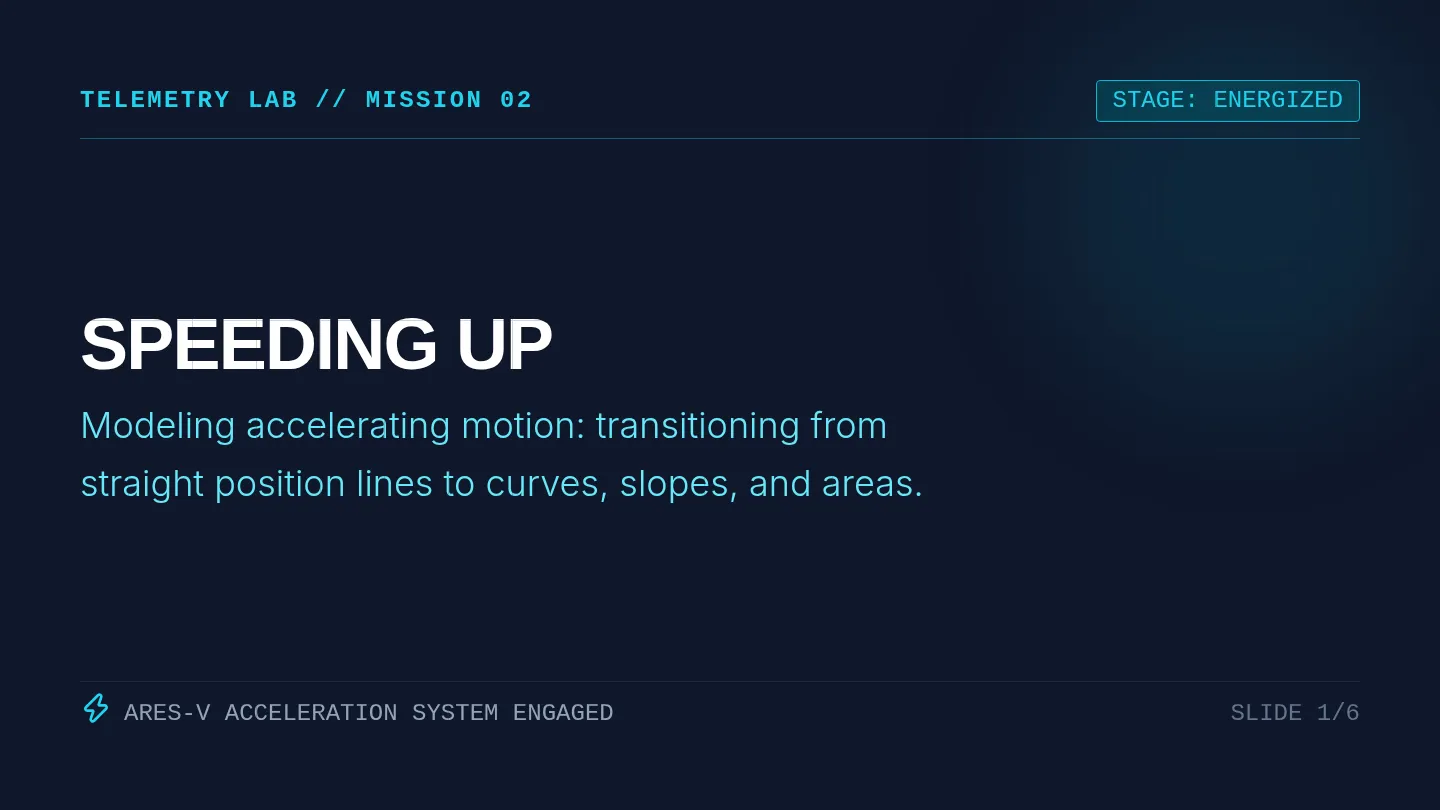
MODULE 01.5: EXECUTION SLIDE 6/6
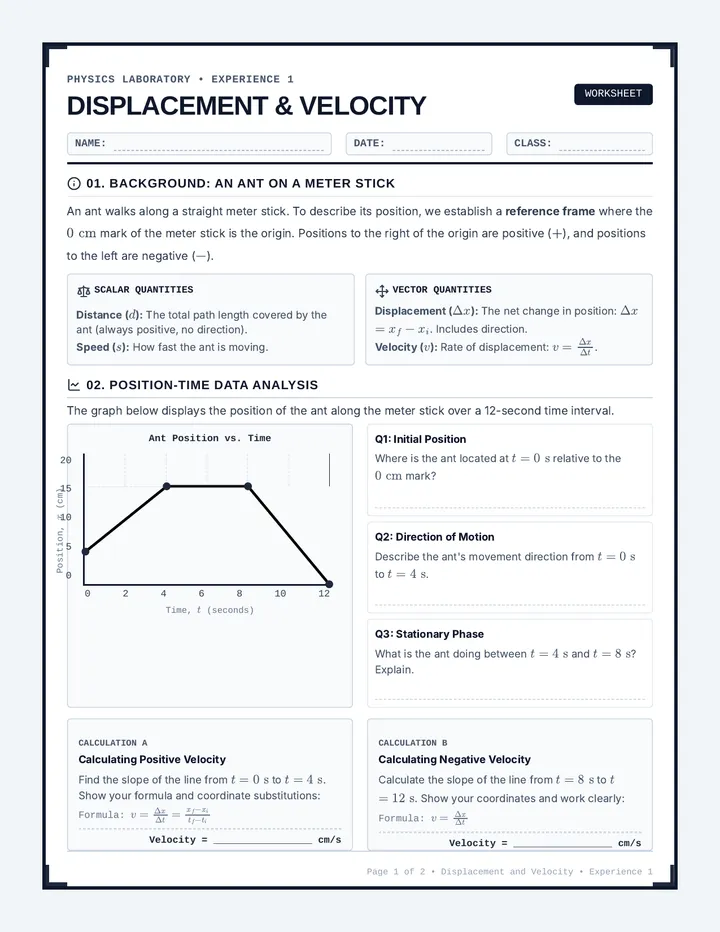
Page 1: Ant on a Meter Stick
Page 2: Graph Translation
Page 1 Answers
Page 2 Answers
Page 2 of 2 • Teacher Facilitation Guide • Physics 1D Motion
Every kinematic equation maps directly to the geometry of the Velocity graph.
Equation 1: Final Velocity Slope Theorem
\[v_f = v_i + a t\]
Derived directly from the definition of slope: acceleration (\(a\)) is the rate at which velocity increases from its initial speed (\(v_i\)).
Equation 2: Displacement Composite Area
\[\Delta x = v_i t + \frac{1}{2} a t^2\]
The sum of the rectangular baseline area (\(v_i \cdot t\)) and the triangular acceleration wedge area (\(\frac{1}{2} \cdot t \cdot at\)).
MODULE 02.4: MATHEMATICAL DERIVATION SLIDE 5/6
MISSION DIRECTIVE PHASE 2 DEPLOYMENT
TELEMETRY CHALLENGE
If a rover accelerates at \(+2\text{ m/s}^2\) starting from rest, what is its position and speed after exactly \(4.0\) seconds? Use the geometric formulas!
STATUS: EQUATIONS DEPLOYED
MODULE 02.5: TRANSITION SLIDE 6/6
1. POSITION
Curve from \(0\text{ to }4\text{ s}\) (Speeding up), straight flat slope from \(4\text{ to }8\text{ s}\) (Constant speed).
40 20 0
0s 2s 4s 6s 8s
2. VELOCITY
Calculate speeds at \(t=0\), \(t=4\), and \(t=8\text{ s}\), then sketch the velocity profile.
10 5 0
0s 2s 4s 6s 8s
3. ACCELERATION
Map the slope of your velocity lines to plot the acceleration profile.
3 1.5 0
0s 2s 4s 6s 8s
Translation Reasoning: \(0\text{ to }4\text{ s}\)
Why is the acceleration graph a flat horizontal line above zero during the first interval? Connect slope properties to physical speed.
Translation Reasoning: \(4\text{ to }8\text{ s}\)
Explain the change in acceleration at \(t = 4.0\text{ s}\). What is the value of acceleration, and how did your velocity slope tell you this?
Page 2 of 2 • Mission: Speeding Up • Telemetry Lab
Area Theorem Displacement
A velocity-time graph of a speed run shows Ares-V moving at a constant speed of \(v = 4.0\text{ m/s}\) for \(10.0\text{ seconds}\).
Questions to Solve:
Area:___________ m
Displacement:___________ m
CARD 07: KINEMATICS
Rover Booster Math
Ares-V accelerates from rest (\(v_i = 0\)) at a rate of \(a = 3.0\text{ m/s}^2\) for a duration of \(t = 4.0\text{ s}\).
Questions to Solve:
Final Speed \(v_f\):_________ m/s
Distance \(\Delta x\):___________ m
CARD 08: SYNTHESIS
Translation Challenge
The rover's position graph shows a flat horizontal line at \(x = 5\text{ m}\) for \(3\text{ seconds}\).
Questions to Solve:
Velocity \(v\):_________ m/s
Acceleration \(a\):_______ m/s²
Cards 5-8 • Mission: Speeding Up • Telemetry Lab
Physics Unit 01 Exam • Part A Continued
QUESTIONS 07 - 12
Q7. Speed-Time Graph Scenario Matching (TEKS 5.A) 1 PT
A bicyclist starts riding down a hill, gaining speed constantly, and then glides on flat ground at a constant speed. Which speed vs. time description matches this physical scenario?
A) A line sloping down to the axis, then horizontal.
B) A diagonal line rising upward, then horizontal.
C) A horizontal line high, then sloping down.
D) A curved line sloping down, then vertical to zero.
Q8. Calculate Velocity from Acceleration-Time Graph (TEKS 5.A) 1 PT
An acceleration-time (\(a\)-\(t\)) graph shows a constant horizontal line at \(a = 3.0\text{ m/s}^2\) for \(5.0\text{ s}\). If the object's initial velocity is \(0\text{ m/s}\), what is its final velocity at \(t = 5.0\text{ s}\)?
A) \(0.6\text{ m/s}\)
B) \(1.5\text{ m/s}\)
C) \(15.0\text{ m/s}\)
D) \(8.0\text{ m/s}\)
Q9. Free Fall Graph Characteristics (TEKS 5.A) 1 PT
For an object dropped from rest in free fall (ignoring air resistance), how do its position-time (\(y\)-\(t\)) and velocity-time (\(v\)-\(t\)) graphs appear?
A) \(y\)-\(t\) is linear; \(v\)-\(t\) is curved.
B) \(y\)-\(t\) is horizontal; \(v\)-\(t\) is horizontal.
C) \(y\)-\(t\) is curved downward; \(v\)-\(t\) is diagonal.
D) \(y\)-\(t\) is diagonal; \(v\)-\(t\) is diagonal.
Q10. Projectile Motion Peak Velocity (TEKS 5.D) 1 PT
A projectile is launched upward at an angle. At the absolute peak of its parabolic trajectory, what is its vertical velocity component (\(v_y\))?
A) Zero (0 m/s)
B) Max speed
C) Same as horiz.
D) \(-9.8\text{ m/s}\)
Q11. Reading Distance-Time Graph: At Rest (TEKS 5.A) 1 PT
On a distance-time graph, which curve feature shows that the object is completely stationary?
A) A slanted line dropping towards the horizontal axis.
B) A straight diagonal line rising at constant angle.
C) A horizontal straight line above the time axis.
D) An upward curved exponential line.
Q12. Distance-Time Graph Greatest Speed (TEKS 5.A) 1 PT
When analyzing a distance-time graph, how can you identify the time interval during which the object has its greatest speed?
A) Look for the flat, horizontal segment of the curve.
B) Look for the steepest (most vertical) segment.
C) Find the segment with the lowest positive value.
D) Identify where the line curves back to touch zero.
Page 2 of 4 • Physics Unit 01 Exam
Physics Unit 01 Exam • Part B
POINTS: 4
SCR 1: Geometric Displacement (TEKS 5.A, 5.C) 2 POINTS
Explain how to find the displacement of an object geometrically from its Velocity-Time (\(v\)-\(t\)) graph when it undergoes constant acceleration. In your explanation, identify the specific geometric shape formed and write down the corresponding mathematical formula used to compute this area.
SCR 2: Scalar vs. Vector Walk (TEKS 5.B, 5.C) 2 POINTS
An ant crawls along a meter stick starting at the \(10\text{ cm}\) mark, travels to the \(40\text{ cm}\) mark, and then turns around and walks backward to the \(25\text{ cm}\) mark. Identify both the total distance and the net displacement of the ant. Show your calculations and explain why one quantity is a scalar while the other is a vector.
Page 3 of 4 • Physics Unit 01 Exam
Physics Unit 01 Exam • Teacher Answer Key
TEACHER KEY
Part A: Multiple Choice Answer Rationales
Q1 Correct: C — \(\Delta x = x_f - x_i = (+12\text{ cm}) + (-8\text{ cm}) = \mathbf{+4\text{ cm}}\) (East).
Rationales: A is total distance (20cm). B has reversed direction. D combines distance with wrong direction.
Q2 Correct: B — A horizontal flat line on \(x\)-\(t\) means position is constant over time, so velocity is zero.
Rationales: A & D denote constant non-zero speed. C represents constant acceleration.
Q3 Correct: C — Acceleration is a continuously changing speed, which forms a curved parabola on an \(x\)-\(t\) graph.
Rationales: A shows constant velocity. B & D represent stationary systems.
Q4 Correct: A — Position is measured in meters (\(\text{m}\)), velocity in \(\text{m/s}\), and acceleration in \(\text{m/s}^2\).
Rationales: B, C, & D all misalign dimensions with their metric equivalents.
Q5 Correct: B — \(a = \frac{v_f - v_i}{\Delta t} = \frac{15 - 3}{4} = \mathbf{3.0\text{ m/s}^2}\).
Rationales: A is inverted. C & D miscalculate numerator values.
Q6 Correct: B — \(\text{Slope} = \frac{9.0 - 0.0}{3.0 - 0.0} = \mathbf{3.0\text{ m/s}^2}\).
Rationales: A, C, & D represent mathematical computation errors of rise over run.
Q7 Correct: B — Constantly gaining speed is a rising diagonal line; gliding at constant speed is flat.
Rationales: A represents deceleration. C is constant speed first. D has non-uniform curves.
Q8 Correct: C — Area under \(a\)-\(t\) is \(\Delta v = a \cdot t = 3.0\text{ m/s}^2 \times 5.0\text{ s} = \mathbf{15.0\text{ m/s}}\).
Rationales: A is ratio. B is area divided by time. D is sum of quantities.
Q9 Correct: C — Free fall has a constant downward acceleration (\(-g\)), making \(y\) quadratic (curved) and \(v\) linear.
Rationales: A, B & D violate acceleration laws.
Q10 Correct: A — At peak trajectory height, the vertical motion momentarily stops, so \(v_y = \mathbf{0\text{ m/s}}\).
Rationales: B represents peak speed (launch/land). C is only true horizontal. D is acceleration.
Q11 Correct: C — Distance cannot decrease. Zero speed means distance stays constant over time (horizontal line).
Rationales: A is physically impossible. B is constant motion. D is acceleration.
Q12 Correct: B — Speed is the magnitude of the slope of the distance-time graph. Steeper slope = faster speed.
Rationales: A denotes rest. C is lowest speed. D indicates touching zero (unmoving).
Part B: Short Constructed Response Keys
SCR 1 Exemplar & Grading Guide (2 Points)
Exemplar Response: "To find the displacement geometrically, you calculate the area enclosed under the line on a Velocity-Time graph. For constant acceleration, the graph forms a trapezoid (or a rectangle under a triangle). The formula for the composite area is \(\Delta x = v_i t + \frac{1}{2} a t^2\), where \(v_i t\) is the rectangular base and \(\frac{1}{2} at^2\) is the triangular wedge."
Rubric:
• 1 Point: Clearly identifies the geometric shape as a trapezoid OR a composite rectangle + triangle.
• 1 Point: Correctly states the formula (\(\Delta x = v_i t + \frac{1}{2} a t^2\) or \(\text{Area} = \frac{1}{2}(b_1+b_2)h\) or equivalents).
SCR 2 Exemplar & Grading Guide (2 Points)
Exemplar Response: "First leg: ant walks \(+30\text{ cm}\) (from 10 to 40). Second leg: walks \(-15\text{ cm}\) (from 40 to 25).
• \(\text{Total Distance} = 30\text{ cm} + 15\text{ cm} = \mathbf{45\text{ cm}}\). Distance is scalar because it represents the total ground covered without direction.
• \(\text{Displacement} = x_f - x_i = 25\text{ cm} - 10\text{ cm} = \mathbf{+15\text{ cm}}\) (or 15 cm East). Displacement is a vector because it is a direct straight-line measurement from start to end, which includes direction."
Rubric:
• 1 Point: Calculates BOTH correct values (Distance = \(45\text{ cm}\); Displacement = \(+15\text{ cm}\)).
• 1 Point: Correctly explains scalar (magnitude only) vs vector (magnitude and direction).
Page 4 of 4 • Teacher Key & Option Rationales • Physics Unit 01