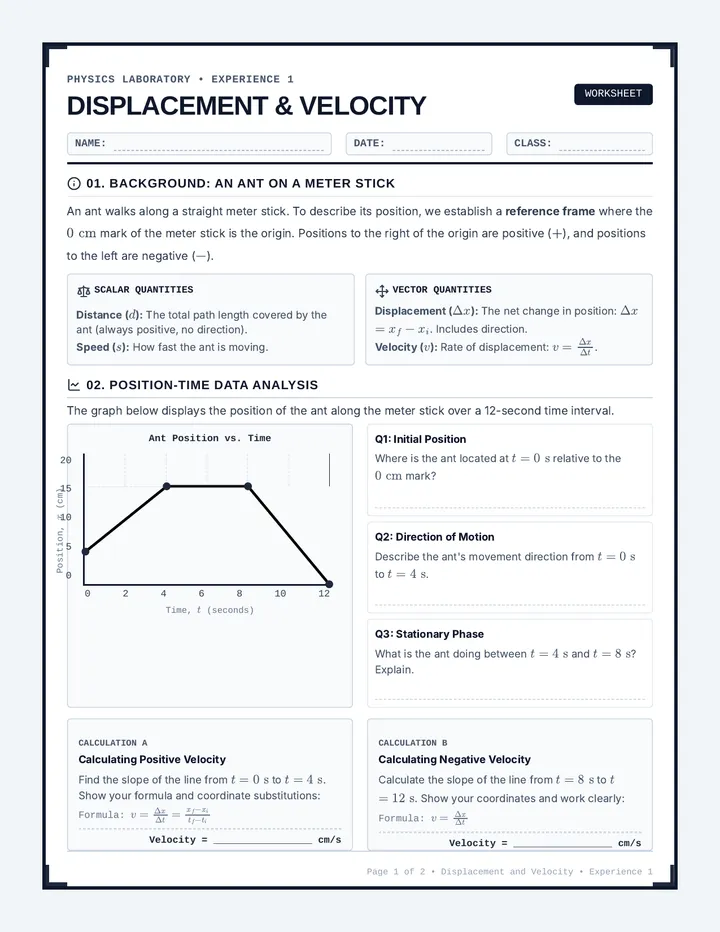
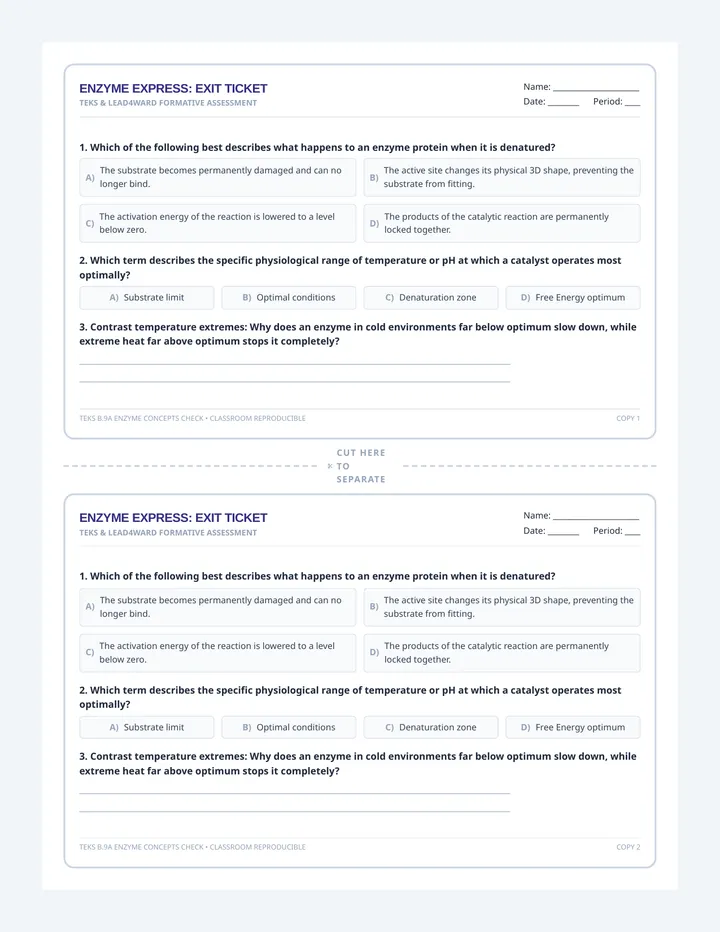
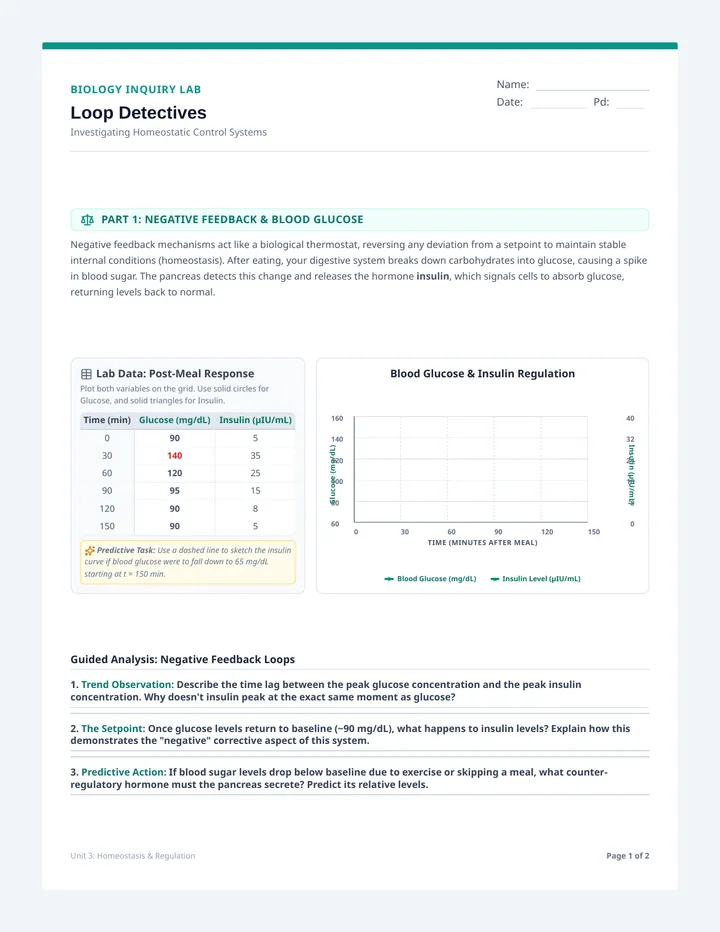
An active, hands-on station lab where high school biology students analyze, sketch, and interpret 10 different enzyme reaction rate graphs to master factors affecting enzymatic activity including pH, temperature, concentration, and inhibition.
STATION 6: VENT BACTERIA (EXTREME HEAT) Temperature Graph 1
Sketch Graph & Label Peak Temperature (°C) Reaction Rate
1. At what temperature does this vent enzyme operate most optimally?
Explain why enzymes are classified as proteins. How does denaturation affect the overall three-dimensional shape of an enzyme's active site, and why does this halt activity?
Compare physical conditions: What is the biological difference between an enzyme in an environment far below its optimal temperature versus far above its optimal temperature?
Explain how enzymes contribute to a cell maintaining homeostasis. Use your answers from the pH and temperature stations to explain how an organism's survival depends on physiological stability.
Station 3 (Salivary Amylase pH): 1) Salivary amylase operates most optimally at neutral pH of 7.0. 2) Amylase denatures below pH 4.0 and above pH 10.0.
Station 4 (Alkaline Catalase pH): 1) This basic bacterial enzyme operates most optimally at a strongly basic pH of 10.0. 2) Catalase becomes denatured below pH 7.0 on the acidic/neutral side.
Station 5 (Activation Energy): 1) Protein catalysts stabilize transition states, lowering the threshold energy barrier (Ea) needed for the reaction. 2) No, reactant and product net energy remains unchanged.
Stations 6 - 10 Keys (Temperature)
Station 6 (Thermophile Temp): 1) This vent bacterial enzyme operates most optimally at 75°C. 2) It denatures at extreme heat above 90°C.
Station 7 (Human Amylase Temp): 1) Human amylase functions most optimally at mammalian body core temperature of 37°C. 2) Severe heat above 42°C breaks sensitive hydrogen bonds, altering structural shape of active sites.
Station 8 (Arctic Fish Temp): 1) Arctic fish enzyme functions most optimally at freezing cold 5°C. 2) This highly specialized, flexible enzyme denatures at mild heat above 15°C.
Station 9 (Plant Peroxidase Temp): 1) Peroxidase operates most optimally at 40°C. 2) It denatures sharply above 45°C. The "thermal melt" refers to the sudden breaking of protein secondary/tertiary folding.
Station 10 (Lizard Catalyst Temp): 1) Lizard metabolic catalyst operates most optimally at basking temperature of 28°C. 2) It denatures above 38°C. Metabolic enzymes are needed for cell survival, so denaturation stops essential cellular pathways.
Synthesis Solutions Guidance
Synthesis A (Proteins & Active Sites): Enzymes are coded by genes to link amino acids into 3D folded proteins. Denaturation alters active site geometry so it cannot hold substrate reactants.
Synthesis B (Below vs. Above Optimum): Temperatures below optimal only slow down kinetic energy and molecular collision rates (reversible). Temperatures above optimal physically shatter bonds and unfold active sites, denaturing proteins (irreversible).
Synthesis C (Homeostasis): Homeostasis is maintaining physiological balance. Because enzymes have highly specific optimal temperature and pH zones, any failure in stability can cause wide-scale denaturation and death.