Spark of Curiosity Slides OHIO SCIENCE STANDARDS : GRADE 4 INQUIRY
DAY 1 / 5
The Spark of Curiosity
Making systematic observations & designing testable questions. Connected directly to Grade 4 Earth, Life, & Physical Sciences.
UNIT: METHOD INVESTIGATIONS [PRESS NEXT TO PROCEED]
STATE CRITERIA DAY 1 / 5
Ohio Inquiry Standard
In 4th grade, Ohio scientists must plan & conduct simple investigations , use instruments to gather data, and explain how the natural world works.
Active Topics This Week: Weathering rocks, electrical conductors, heating matter, and fossil evidence.
1
Observe & Question (Today!)
2
Fair Tests & Variables (Day 2)
3
Step-by-Step Recipes (Day 3)
4 & 5
Math, Graphs & C.E.R. Evidence
OHIO ESS/PS/LS LINKED READY FOR HOOK_ACTIVATE
HOOK : PROTOCOL UNVEILED DAY 1 / 5
Embedded media
Active Note-Taking
As you watch, complete your Day 1 Note Sheet ! Pay close attention to:
What is the first step?
How do we ask a scientific question?
What makes a guess "scientific"?
MEDIA: SCIENTIFIC METHOD VIDEO WATCH & LOG IN JOURNAL
STEP 1 : COLLECTING CLUES DAY 1 / 5
Observation
Information gathered directly through your 5 senses . It is a verifiable fact.
Ohio ESS Example: "The sandstone rock has smooth, rounded edges and is crumbling."
Inference
An explanation or assumption based on observations and your past knowledge.
Ohio ESS Example: "The sandstone was weathered and worn down by moving river water."
RULE: SEPARATE OBSERVATION FROM INTERPRETATION STATUS: ENGAGED
STEP 2 : THE CRUCIBLE DAY 1 / 5
The Testable Question
We cannot test opinions, emotions, or broad queries. In 4th grade, a scientific question must be testable through hands-on experiments.
❌ Untestable (Too Broad/Opinion)
"Which copper coin looks the coolest?"
Opinions can't be objectively measured in a circuit.
✅ Testable (Specific & Measurable)
"Does replacing a copper wire with a plastic strip light the lightbulb?"
Ohio PS Link: Directly tests conductors vs. insulators.
CRITERIA: MEASURABLE, SPECIFIC, FEASIBLE MISSION ASSIGNED
DISPATCH : MISSION READY DAY 1 / 5
Verify Your Clearance
Classroom instruction for Day 1 is complete. Prepare your Ohio Grade 4 science journal to complete your daily Exit Ticket and prove your expertise.
// READY FOR DAY 2: THE GREAT GUESS
SESSION LOGGED OUT SYSTEM STABLE
Spark of Curiosity Notes Organizer OHIO SCIENCE : INQUIRY PROTOCOL
1.1 Spark of Curiosity Notes
Grade 4 Ohio Standards Alignment — Observations & Questions
LEVEL-01_SEC-01
INVESTIGATOR NAME
DATE RECORDED
SCIENCE PERIOD
Part A: Scientific Method Basics (Video Notes)
As we watch the hook video, use what you learn to fill in these blanks:
1. The Scientific Method is a step-by-step process used by scientists to investigate , solve problems, and test ideas.
2. It always begins when we make an using our senses. This triggers a scientific .
3. We cannot test personal opinions. A scientific question must be , meaning we can answer it by gathering real-world evidence.
Part B: Observation vs. Inference
Write O for Observation (senses) or I for Inference (guess/logic) next to each statement:
1. The sandstone block has deep cracks and is breaking into smaller grains of sand. (ESS)
2. Water froze inside the rock cracks and weathered the sandstone over time. (ESS)
3. The simple circuit's lightbulb lights up when a copper coin is added. (PS)
4. Copper is a conductor that allows electrical energy to flow and light the bulb. (PS)
Part C: Creating Testable Questions
Opinion-based questions cannot be scientifically tested. Convert this opinion circuit question into a concrete, testable research question.
❌ UNTESTABLE OPINION QUESTION
"Which electrical circuit wire looks the prettiest?"
✅ REWRITE AS A TESTABLE RESEARCH QUESTION (TIP: Use "conductors" or "lightbulbs")
UNIT: INQUIRY PROTOCOL (DAY 1) FORM-IP-01_NOTES
Spark of Curiosity Exit Ticket INQUIRY PROTOCOL : EXIT GATEWAY
1.1 Spark of Curiosity Exit Ticket
Grade 4 Ohio Standards — Science Method Foundations
GATE-01
INVESTIGATOR NAME
DATE RECORDED
Directions: Complete the 3 questions below independently. Use terms from Day 1 instruction (senses, observations, inferences, and testable parameters).
QUESTION 1: IDENTIFICATION
Which of the following is a physical observation of weathering, rather than an inference?
A
The sandstone block is breaking because water froze inside its deep cracks.
B
There are small, red sandstone grains piled on the table beneath the rock.
C
The river weathered the rock millions of years ago when the climate was tropical.
D
The limestone rock is softer than sandstone and will erode much faster next year.
QUESTION 2: THE SCIENTIFIC GAP
In your own words, explain the difference between making an observation and writing an inference about weathered rocks.
QUESTION 3: APPLICATIONS (CIRCUITS)
Why is the question "Is electricity awesome?" untestable ? How can you rewrite it to be testable?
UNIT: INQUIRY PROTOCOL (DAY 1) FORM-IP-01_TICKET
Spark of Curiosity Teacher Guide INQUIRY PROTOCOL : TEACHER RESOURCE
1.1 Spark of Curiosity Teacher Guide
Ohio Grade 4 Standards — Pacing, Misconceptions, & Answer Keys
KEYS-01
Instructional Pacing & Tips (60 Mins)
Hook Video (10m): Play the Scratch Garden video. Have students listen for active words.Direct Instruction (20m): Present slides 4 & 5. Use the tactile sandstone weathering example.Guided Notes (15m): Work through Part B & C collectively. Reinforce the "opinion vs. metric" rule.Exit Ticket (15m): Administer individually. Check for confusion on observations vs. inferences.
Common Grade 4 Misconception: Students often mistake logical inferences as physical observations (e.g., seeing a cracked rock and saying "I observe water froze inside it" instead of "I observe a crack"). Emphasize that observations are strictly what we see, hear, or measure physically.
Notes Organizer Answer Key
Part A: Video Reflection Blanks 1. ...investigate questions / phenomena, solve problems, and test ideas.
Part B: Observation vs. Inference 1. O (Observation) — physical color description.
Part C: Question Transformation
Accept any answer that makes the prettiest wire question testable. Good example:
"Does replacing a copper wire with aluminum, steel, or plastic in a circuit change if the lightbulb turns on?"
Exit Ticket Answer Key
Q1: Identification: Correct Option is B. (Option B represents a physical, color-based observation of sandstone grains. All other options are inferences explaining why or when.)
Q2: Observations vs Inferences:
"An observation is a fact we gather directly using our 5 senses (like seeing rock cracks). An inference is an explanation or smart guess about what caused that observation (like guessing water froze inside to crack it)."
Q3: Testability:
"It's untestable because 'awesome' is an opinion, which cannot be measured. A testable rewrite is: 'Does adding a second battery to a circuit increase the brightness of the lightbulb?'"
The Great Guess Slides OHIO SCIENCE : FAIR TESTS
DAY 2 / 5
The Great Guess
Designing fair tests! Constructing hypotheses and identifying variables using Grade 4 Heat & Thermal Energy concepts.
OHIO PS LINK: HEAT TRANSFER & MATTER [PRESS NEXT TO PROCEED]
THE BLUEPRINT DAY 2 / 5
The Hypothesis Formula
A hypothesis is not just "any" random guess. It is a formal statement of cause and effect , structured using a strict triple-part protocol:
IF... [What you change]
The action you actively make inside the experiment.
"If we wrap a cup in foam..."
THEN... [The response]
The measurable change you expect to record.
"...then the water temperature will stay high..."
BECAUSE... [Science logic]
The 4th-grade science reason behind the change.
"...because foam acts as an insulator."
FORMULA: IF + THEN + BECAUSE READY FOR THE VARIABLES
COGNITIVE TOOLS : THE VARIABLES DAY 2 / 5
Independent Variable (IV)
The factor that is intentionally altered by the experimenter. It is the Cause .
"What I change." (e.g., cup material: foam vs. metal)
Dependent Variable (DV)
The factor that is measured or observed. It changes in response to the IV. It is the Effect .
"What I measure." (e.g., water temperature in °C)
EQUATION: CAUSE (IV) ➡️ EFFECT (DV) STATUS: SYNCHRONIZED
FAIR TESTING PROTOCOL DAY 2 / 5
Controlled Variables (Constants)
To ensure a fair test , we must keep all other variables exactly the same. That way, we know the cup material is the ONLY thing affecting the water temperature!
Ohio Standard Warning: If we change more than one variable at a time, we cannot draw a logical conclusion!
Thermal Cup Constants
Same volume of water (200 mL)
Same initial water temp (60°C)
Same size and shape cup
Same room temperature
PROTOCOL: BIAS ELIMINATION & FAIR TESTS SYSTEM LOCKED
DISPATCH : MISSION READY DAY 2 / 5
Verify Your Clearance
Classroom instruction for Day 2 is complete. Open your investigator notebooks to Page 2. Prove you can construct hypotheses and isolate thermal variables on your daily Exit Ticket .
// READY FOR DAY 3: TRIAL AND ERROR
The Great Guess Notes Organizer OHIO SCIENCE : INQUIRY PROTOCOL
1.2 The Great Guess Notes
Grade 4 Ohio Standards Alignment — Fair Tests & Variables
LEVEL-01_SEC-02
INVESTIGATOR NAME
DATE RECORDED
SCIENCE PERIOD
Part A: The Standard Hypothesis Formula
Fill in the missing rules of our standard cause-and-effect prediction syntax:
1. IF... [What we change]
This is the variable. State the material or condition you alter.
2. THEN... [What we measure]
This is the variable. Predict the change in temperature or light.
3. BECAUSE... [The Logic]
Provide the scientific rationale, such as whether it's an or conductor.
Part B: Isolating Variables for Fair Tests
Read the investigations and identify their core parameters:
Scenario 1: Thermal Insulation (PS)
Wrap three cups with different wraps (foil, bubble wrap, paper) to see which wrap keeps 200 mL of boiling water hot for the longest time.
WHAT WE CHANGE (IV):
WHAT WE MEASURE (DV):
KEEP THE SAME (CONST):
Scenario 2: Simple Conductors (PS)
Insert items made of copper, steel, wood, and plastic into a simple battery circuit to observe if they allow electric current to light a bulb.
WHAT WE CHANGE (IV):
WHAT WE MEASURE (DV):
KEEP THE SAME (CONST):
Part C: Creating Hypotheses
Convert the given research question into a comprehensive If-Then-Because hypothesis:
RESEARCH QUESTION (THERMAL)
"Does a metal spoon transfer heat out of a bowl of soup faster than a plastic spoon?"
YOUR HYPOTHESIS STATEMENT (IF... THEN... BECAUSE...)
IF
THEN
BECAUSE
UNIT: INQUIRY PROTOCOL (DAY 2) FORM-IP-02_NOTES
The Great Guess Exit Ticket INQUIRY PROTOCOL : EXIT GATEWAY
1.2 The Great Guess Exit Ticket
Grade 4 Ohio Standards — Fair Tests & Heat Variables
GATE-02
INVESTIGATOR NAME
DATE RECORDED
Directions: Complete the 3 questions below independently. Pay careful attention to how we keep tests fair in Grade 4 physical science labs.
QUESTION 1: ISOLATING PARAMETERS
A student measures hot water temperature inside cups made of plastic, metal, and foam. What is the independent variable (the thing we change)?
A
The temperature of the water measured in degrees Celsius.
B
The different cup materials (plastic, metal, and foam).
C
The total amount of water poured into each cup (200 mL).
D
The thermometer used to measure the temperature.
QUESTION 2: THE "FAIR TEST" RULE
Why is it critical to use the exact same volume of water in each cup when testing thermal insulation? Explain using the term fair test .
QUESTION 3: FORMULATING PREDICTIONS
Write a complete If-Then-Because hypothesis to test if metal conduct electricity better than wood in a simple circuit.
UNIT: INQUIRY PROTOCOL (DAY 3 READY) FORM-IP-02_TICKET
The Great Guess Teacher Guide INQUIRY PROTOCOL : TEACHER RESOURCE
1.2 The Great Guess Teacher Guide
Ohio Grade 4 Standards — Fair Testing & Variable Answer Keys
KEYS-02
Instructional Pacing & Tips (60 Mins)
Review (5m): Quick recap of observations vs. inferences.Direct Instruction (25m): Present slides 2-4. Explain independent vs. dependent variables as "Cause" and "Effect."Guided Notes (15m): Dissect Scenario 1 & 2 variables together. Explain "fair tests" clearly.Exit Ticket (15m): Administer individually. Check for understanding of Constants.
Common Grade 4 Misconception: Students often assume that the "Control Variable" is something that changes, or confuse Independent (Cause) with Dependent (Effect). Remind them: "I change the independent, I measure the dependent, and I keep the constants completely the same."
Notes Organizer Answer Key
Part A: The Standard Hypothesis Formula 1. ...state the independent variable...
Scenario 1: Thermal Insulation • Change: Cup/wrap material
Scenario 2: Simple Conductors • Change: Test item material
Part C: Creating Hypotheses
IF we use a metal spoon in the soup,THEN the soup temperature will drop faster than with a plastic spoon,BECAUSE metal is a thermal conductor that transfers heat away quickly, whereas plastic is an insulator.
Exit Ticket Answer Key
Q1: Isolating Parameters: Correct Option is B. (The cup materials are what the investigator is actively changing.)
Q2: The "Fair Test" Rule:
"If you use different amounts of water, you won't know if the cup material or the water volume kept it warm. Holding everything constant ensures a fair test."
Q3: Formulating Predictions:
"IF we add metal vs wood to a circuit, THEN only the metal will light the bulb, BECAUSE metal is an electric conductor whereas wood is an insulator."
UNIT: INQUIRY PROTOCOL (OHIO GRADE 4) GUIDE-IP-02
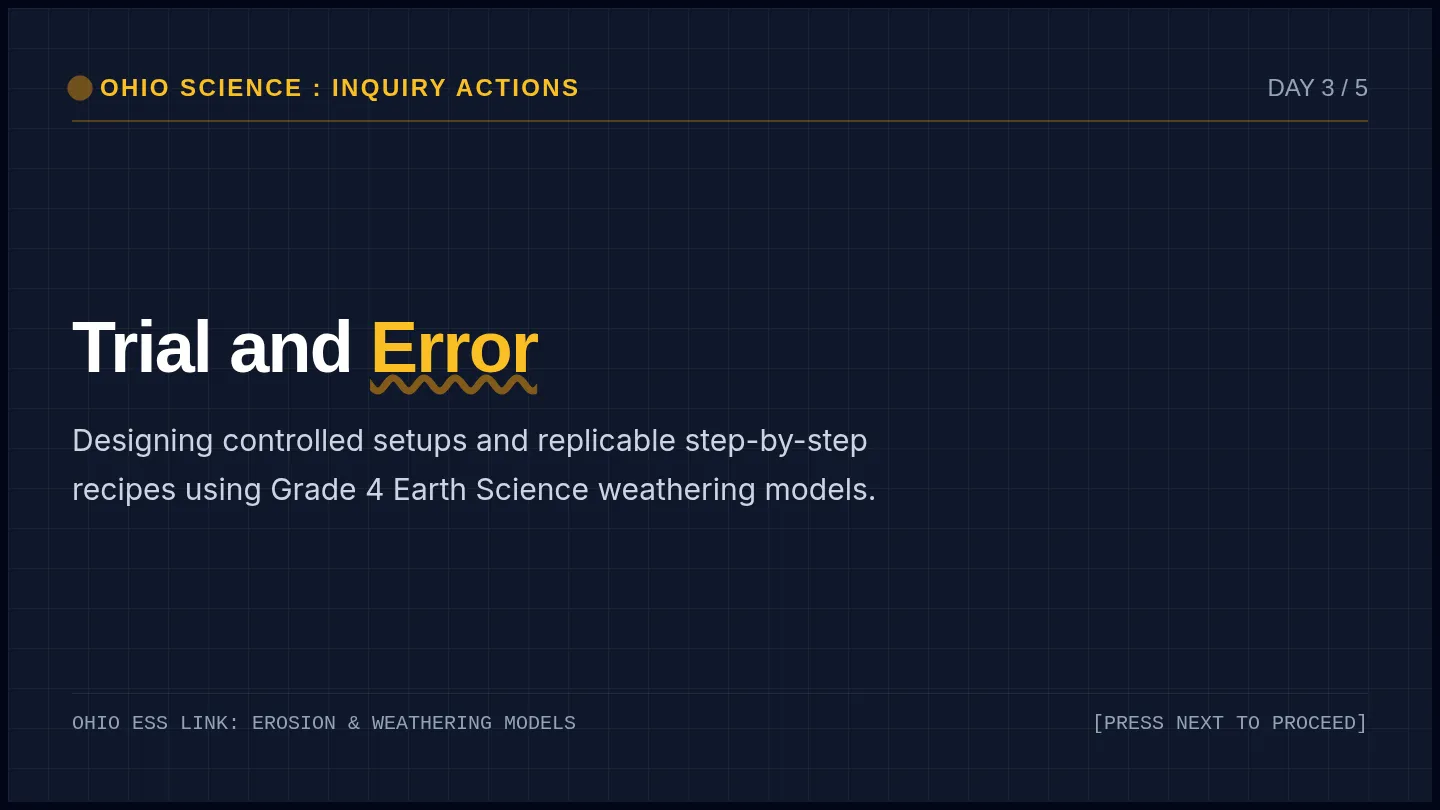
Trial and Error Slides OHIO SCIENCE : INQUIRY ACTIONS
DAY 3 / 5
Trial and Error
Designing controlled setups and replicable step-by-step recipes using Grade 4 Earth Science weathering models.
OHIO ESS LINK: EROSION & WEATHERING MODELS [PRESS NEXT TO PROCEED]
WEATHERING MODEL GROUPS DAY 3 / 5
Experimental Group
The setup that receives the treatment or change (what we are actively testing).
Ohio ESS Example: Sandstone rocks shaken inside a plastic jar with water.
Control Group
The baseline setup left in its natural, unaltered state. Purely used for comparison.
Ohio ESS Example: Sandstone rocks left completely dry in an open tray.
RULE: CONTROL SETUP = SCIENTIFIC BASELINE STATUS: READY
REPLICABLE INSTRUCTIONS DAY 3 / 5
What is Replicability?
In science, a result is meaningless unless another student in Ohio can perform your exact experiment and get the exact same result.
The Recipe Rule: Write your procedure as if you are giving a recipe to a classmate. If you leave out details, the experiment fails!
Must-Include Details
Mass in grams (e.g., of rock)
Time spent shaking (seconds)
Clear ordered steps
Number of shake trials
TEST: WILL ANOTHER CLASSROOM SUCCEED? SYSTEM VERIFIED
DISPATCH : MISSION READY DAY 3 / 5
Verify Your Clearance
Classroom instruction for Day 3 is complete. Access page 3 of your log files. Show you can design precise weathering models on your daily Exit Ticket .
// READY FOR DAY 4: DATA DETECTIVES
SESSION LOGGED OUT SYSTEM STABLE
Trial and Error Notes Organizer OHIO SCIENCE : INQUIRY PROTOCOL
1.3 Trial and Error Notes
Grade 4 Ohio Standards Alignment — Comparative Groups & Procedures
LEVEL-01_SEC-03
INVESTIGATOR NAME
DATE RECORDED
SCIENCE PERIOD
Part A: Setting up Comparative Groups
Fill in the definitions we use to compare setups in a weathering model:
1. EXPERIMENTAL SETUP:
The group where we actively change a factor to test our prediction. (e.g., shaking sandstone in water to model ).
2. CONTROL BASELINE SETUP:
The group left under completely conditions. No weathering forces are applied. We use this group purely for .
Part B: Critique of an Ambiguous Weathering Procedure
Read this poorly designed weathering procedure. Why does it fail the peer replicability test?
❌ VAGUE PROCEDURE LAB MANUAL
"Put some soft sandstone blocks in a container. Put some water in with them. Shake the container around for a while. Take the rocks out and see how much smaller they are."
CRITICAL METRIC GAPS WE MUST CORRECT
Amount of water (mL):
Rock weight (g):
Shaking duration (min):
Number of trials:
Part C: The Precise Recipe (Metric Redraft)
Rewrite the first two steps of the rock-shaking experiment below. Be highly specific by adding actual numbers, metric volumes (mL), and weights (grams).
STEP 01
STEP 02
UNIT: INQUIRY PROTOCOL (DAY 3) FORM-IP-03_NOTES
Trial and Error Exit Ticket INQUIRY PROTOCOL : EXIT GATEWAY
1.3 Trial and Error Exit Ticket
Grade 4 Ohio Standards — Control baselines & Weathering Recipes
GATE-03
INVESTIGATOR NAME
DATE RECORDED
Directions: Complete the 3 questions below independently. Ensure your procedural feedback is precise, citing concrete parameters like volume, time, or starting mass.
QUESTION 1: CONTROL BASELINES
To test if freezing water can weather soft shale blocks, a student puts ten identical shale blocks in a freezer with water, and leaves ten identical shale blocks dry on a science table. What is the role of the ten dry shale blocks?
A
They represent the Experimental Group, which receives the weathering change.
B
They represent the Control Group, providing a baseline comparison.
C
They serve as the independent variable being changed.
D
They represent the water molecules weathering the shale.
QUESTION 2: THE "WHY"
Why must we test and shake multiple sandstone blocks in our erosion lab rather than concluding after testing a single block?
QUESTION 3: PROCEDURAL PRECISION
Explain why this step is not replicable and write a correction: "Shake the sandstone blocks in the jar for a little while until they look eroded."
UNIT: INQUIRY PROTOCOL (DAY 4 READY) FORM-IP-03_TICKET
Trial and Error Teacher Guide INQUIRY PROTOCOL : TEACHER RESOURCE
1.3 Trial and Error Teacher Guide
Ohio Grade 4 Standards — Experimental Group & Recipe Design Answer Keys
KEYS-03
Instructional Pacing & Tips (60 Mins)
Review (5m): Revisit variables and hypotheis drafting.Direct Instruction (25m): Present slides 2 & 3. Use the weathering model to define Experimental vs. Control setups.Guided Notes (15m): Complete Parts A & B collectively. Critique the vague recipe.Exit Ticket (15m): Administer individually. Assess understanding of controls & replicability.
Common Grade 4 Misconception: Students often write "See what happens" or "Observe the rock" as a step in their procedures. Remind them: procedures are active commands (actions we perform) with clear numbers and tools, not descriptions of what they expect to see.
Notes Organizer Answer Key
Part A: The Comparative Groups 1. ...actively alters the independent variable...
Part B: Critique of a Vague Procedure
Students should identify the following missing details:
• Amount of juice: e.g., 50 mL
• Type/Amount of dirt: e.g., 200 g potting soil
• Duration: e.g., 14 days total
• Repeat trials: e.g., 3 identical containers
Part C: The Precise Recipe (Metric Redraft)
Accept any answer that incorporates numbers, metric units (mL/g), and clear steps. Good example:
Step 1: Label two plastic containers as 'Water' and 'Juice'. Fill each container with exactly 200 grams of soil.Step 2: Place 3 identical bean plants of 5 cm height into each container. Pour 50 mL of juice into the 'Juice' container, and 50 mL of water into the 'Water' container.
Exit Ticket Answer Key
Q1: Experimental Controls: Correct Option is B. (Leaving the blocks dry on the table is the control setup, which acts as the comparison baseline.)
Q2: Multiple Trials:
"Testing multiple times ensures that our results are not a random fluke or mistake. It makes our rock weathering data trustworthy and reliable."
Q3: Replicability Critique:
"The step lacks numbers and measurements. A correct step is: 'Using a Bunsen burner, heat 100 mL of water in a beaker for exactly 120 seconds until it reaches 80 degrees Celsius.'"
Data Detectives Slides OHIO SCIENCE : DATA AND METRICS
DAY 4 / 5
Data Detectives
Cracking the code of raw numbers, identifying patterns, and selecting the perfect graph using Grade 4 weathering and circuit logs.
SYSTEM: DATA RECOGNITION & VISUALIZATION [PRESS NEXT TO PROCEED]
THE TWO CLUE TYPES DAY 4 / 5
Quantitative
Numerical values tracked using instruments (rulers, scales, thermometers). It answers "How much?" and includes metric units.
Ohio ESS Example: "The sandstone lost 12.4 grams of mass after shaking."
Qualitative
Descriptive observations using our five senses . Strictly categorical, no math.
Ohio PS Example: "The copper circuit wire looked shiny and smelled like metallic copper."
LOGIC: USE BOTH TO GET THE COMPLETE STORY STATUS: DETECTING
GRAPH SELECTION RULES DAY 4 / 5
Bar Graph
Best for comparing distinct groups or categories .
Ohio ESS Example: Weathering mass loss of Sandstone vs. Limestone vs. Slate.
Line Graph
Best for tracking continuous changes over time .
Ohio PS Example: Temperature of water in an insulated cup measured every 5 minutes.
PROTOCOL: CATEGORIES ➡️ BAR | TIME ➡️ LINE READY
GRAPH QA CHECKLIST DAY 4 / 5
The T.A.L.K.S. Check
Before finalizing any graph in your Grade 4 science log, ensure it passes the T.A.L.K.S. Checklist :
T Title
Tells exactly what the graph is measuring.
A Axes
Independent on X, Dependent on Y.
L Labels
Add names and precise metric units (g, s, °C).
K Key
Add legends if plotting multiple sets of data.
S Scale
Even, consistent increments on intervals (e.g., 0, 5, 10, 15).
CHECKLIST: T.A.L.K.S. MANDATORY SYSTEM VERIFIED
DISPATCH : MISSION READY DAY 4 / 5
Verify Your Clearance
Classroom instruction for Day 4 is complete. Access page 4 of your log files. Demonstrate your data visualization mastery on your daily Exit Ticket .
// READY FOR DAY 5: THE FINAL VERDICT
SESSION LOGGED OUT SYSTEM STABLE
Data Detectives Notes Organizer OHIO SCIENCE : INQUIRY PROTOCOL
1.4 Data Detectives Notes
Grade 4 Ohio Standards Alignment — Data Types & Graph Construction
LEVEL-01_SEC-04
INVESTIGATOR NAME
DATE RECORDED
SCIENCE PERIOD
Part A: Categorizing Evidence
Write N for Quantitative (numerical metrics) or L for Qualitative (senses) next to each standard-aligned statement:
1. The weathered sandstone feels gritty. (ESS)
2. The water temperature is 18.2 °C. (PS)
3. The circuit wire is copper and shiny. (PS)
4. The shale block lost 8.3 grams. (ESS)
Part B: Graph Selection Algorithm
Determine whether a Bar Graph or a Line Graph is appropriate for these Grade 4 Ohio investigations:
1. Thermal Energy Loss (PS)
Measuring water temperature inside an insulated paper cup every 2 minutes for 10 minutes to track continuous heat transfer.
SELECT TYPE:
2. Rock Weathering Rates (ESS)
Measuring the total mass in grams lost by three distinct types of rocks (Sandstone, Limestone, Slate) after being shaken inside containers.
SELECT TYPE:
Part C: Graph Drafting Practice
Review the thermal cup insulation table and construct a Line Graph. Label both axes (with metric units!) and mark an even scale.
INSULATION_DATA
Time (min) Temp (°C) 0 min 50 °C 2 min 45 °C 4 min 40 °C 6 min 35 °C
Y-Axis
X-Axis
X-Axis Label: _________________ Y-Axis Label: _________________
UNIT: INQUIRY PROTOCOL (DAY 4) FORM-IP-04_NOTES
Data Detectives Exit Ticket INQUIRY PROTOCOL : EXIT GATEWAY
1.4 Data Detectives Exit Ticket
Grade 4 Ohio Standards — Data Classification & Visual Metrics
GATE-04
INVESTIGATOR NAME
DATE RECORDED
Directions: Complete the 3 questions below independently. Ensure your justifications for graph types reference continuous vs. categorical data explicitly.
QUESTION 1: CLASSIFICATION
An investigator records that "the warm water in the metal cup took 25.4 seconds to drop in temperature, and small air bubbles formed on the side." How do we classify this data?
A
It is strictly Quantitative, as it records a physical observation.
B
It is strictly Qualitative, as there are no units recorded.
C
It contains both Quantitative (time in seconds) and Qualitative (bubbles observed) data.
D
It is neither, as heat transfer is a chemical change rather than a physical parameter.
QUESTION 2: THE GRAPH RULE
Why is a Line Graph required to show water temperature in an insulated cup over 10 minutes, rather than a bar graph?
QUESTION 3: T.A.L.K.S. COMPLIANCE
A student graphs their data but counts their Y-axis grid blocks like this: 0, 5, 10, 20, 25, 40 . What part of the T.A.L.K.S. protocol was violated?
UNIT: INQUIRY PROTOCOL (DAY 5 READY) FORM-IP-04_TICKET
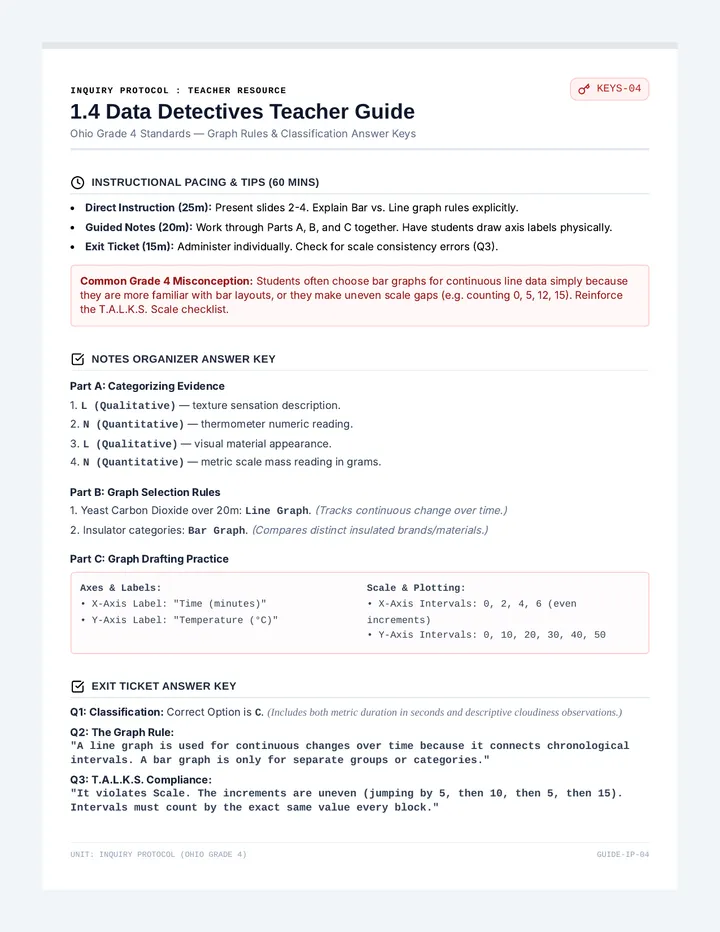
Data Detectives Teacher Guide INQUIRY PROTOCOL : TEACHER RESOURCE
1.4 Data Detectives Teacher Guide
Ohio Grade 4 Standards — Graph Rules & Classification Answer Keys
KEYS-04
Instructional Pacing & Tips (60 Mins)
Direct Instruction (25m): Present slides 2-4. Explain Bar vs. Line graph rules explicitly.Guided Notes (20m): Work through Parts A, B, and C together. Have students draw axis labels physically.Exit Ticket (15m): Administer individually. Check for scale consistency errors (Q3).
Common Grade 4 Misconception: Students often choose bar graphs for continuous line data simply because they are more familiar with bar layouts, or they make uneven scale gaps (e.g. counting 0, 5, 12, 15). Reinforce the T.A.L.K.S. Scale checklist.
Notes Organizer Answer Key
Part A: Categorizing Evidence 1. L (Qualitative) — texture sensation description.
Part B: Graph Selection Rules 1. Yeast Carbon Dioxide over 20m: Line Graph. (Tracks continuous change over time.) (Compares distinct insulated brands/materials.)
Part C: Graph Drafting Practice
Axes & Labels:
Scale & Plotting:
Exit Ticket Answer Key
Q1: Classification: Correct Option is C. (Includes both metric duration in seconds and descriptive cloudiness observations.)
Q2: The Graph Rule:
"A line graph is used for continuous changes over time because it connects chronological intervals. A bar graph is only for separate groups or categories."
Q3: T.A.L.K.S. Compliance:
"It violates Scale. The increments are uneven (jumping by 5, then 10, then 5, then 15). Intervals must count by the exact same value every block."
UNIT: INQUIRY PROTOCOL (OHIO GRADE 4) GUIDE-IP-04
The Final Verdict Slides OHIO SCIENCE : SCIENTIFIC PERSUASION
DAY 5 / 5
The Final Verdict
Writing evidence-based scientific conclusions using Claim, Evidence, & Reasoning (C.E.R.) grounded in Grade 4 rock weathering trials.
SYSTEM: CONCLUSION & SYNTHESIS [PRESS NEXT TO PROCEED]
THE CONCLUSION ENGINE DAY 5 / 5
What is C.E.R.?
Ohio scientists do not simply state "my guess was right!" They must construct a structured C.E.R. argument to defend their final verdict:
CLAIM [C]
A direct, one-sentence answer that states if the hypothesis was supported.
"Our weathering hypothesis is supported..."
EVIDENCE [E]
The specific, quantitative metric data points collected during trials.
"...sandstone lost 12 grams while granite lost 1 gram..."
REASONING [R]
The underlying scientific concept that explains why this occurs.
"...because sandstone is softer than igneous granite."
FORMULA: CLAIM + EVIDENCE + REASONING READY FOR THE COMPLETE RECAP
INQUIRY PROTOCOL : COMPLETE RECAP DAY 5 / 5
The Complete Inquiry Cycle
Let's review the final assembly of the protocol we have built together this week. Each gear connects to the next:
01 Observation & Question
02 Fair Tests & Variables
03 Controlled Recipes
04 Data & Graphing
05 Conclusions & C.E.R.
LOOP COMPLETE: SCIENTIFIC MASTERY UNLOCKED SYSTEM READY FOR DISPATCH
DISPATCH : PROTOCOL GRADUATION DAY 5 / 5
Mastery Verified
You have successfully completed the Inquiry Protocol training sequence. Access page 5 of your log files to write your final conclusion. Prove your expertise on today's Final Exit Ticket .
// PROTOCOL TERMINATED: GRADS CONFIRMED
UNIT COMPLETED SYSTEM POWER DOWN
The Final Verdict Notes Organizer OHIO SCIENCE : INQUIRY PROTOCOL
1.5 The Final Verdict Notes
Grade 4 Ohio Standards Alignment — Claim, Evidence, & Reasoning (C.E.R.)
LEVEL-01_SEC-05
INVESTIGATOR NAME
DATE RECORDED
SCIENCE PERIOD
Part A: The C.E.R. Defense Framework
Define each component of a solid scientific defense statement in 4th grade:
CLAIM [C]
A single-sentence direct answer to your question. It states whether your hypothesis was .
EVIDENCE [E]
Scientific and measurements from your data log. Must cite actual units!
REASONING [R]
The science or concept that explains why your data supports your claim.
Part B: Case File — Rock Weathering Rates (ESS)
Analyze the rock-shaking weathering logs to construct your C.E.R. argument:
CASE_LOG_DATA
Rock Type Start Mass End Mass Sandstone 50 g 38 g Granite 50 g 49 g
Ohio ESS Concept: Sandstone is a soft sedimentary rock held together by loose mineral cements, making it weather quickly under friction. Granite is a dense igneous rock with interlocked quartz crystals that resist weathering.
Part C: Conclusion Drafting (Question: "Which rock weathered faster?")
Synthesize a comprehensive conclusion using the Case File logs above:
CLAIM
EVIDENCE
REASON
UNIT: INQUIRY PROTOCOL (DAY 5) FORM-IP-05_NOTES
The Final Verdict Exit Ticket INQUIRY PROTOCOL : EXIT GATEWAY
1.5 The Final Verdict Exit Ticket
Grade 4 Ohio Standards — C.E.R. Argumentation & Sequence Review
GATE-05
INVESTIGATOR NAME
DATE RECORDED
Directions: Complete the 3 questions below independently. Synthesize your final evaluations using precise scientific arguments.
QUESTION 1: C.E.R. MECHANICS
Which of the following best describes the role of Reasoning in a scientific weathering conclusion?
A
It states that Sandstone weathered much faster than igneous Granite.
B
It cites that the sandstone block lost exactly 12 grams of mass.
C
It explains that sandstone is a soft sedimentary rock held together by loose cementation, which is easily crumbled by water friction.
D
It lists the variables kept constant, like container water volume.
QUESTION 2: DEFECT DETECTION (WEATHERING)
A student writes: "My hypothesis is supported because the shaken shale weathered extremely quickly. The dry control shale stayed completely normal." what core C.E.R. element is missing ?
QUESTION 3: CHRONOLOGY
Match the five daily milestones of the Inquiry Protocol in their proper chronological order (write numbers 1 to 5):
Controlled testing
Observation & Qs
C.E.R. Conclusion
Hypothesis Syntax
T.A.L.K.S. Graphs
UNIT: INQUIRY PROTOCOL (CONGRATULATIONS!) FORM-IP-05_TICKET
Inquiry Protocol Anchor Chart The Inquiry Protocol
STANDARD OPERATING GUIDE : THE SCIENTIFIC METHOD
01
Observe & Question
Scan your surroundings with your five senses. Notice anomalous details, state physical facts, and craft a testable, measurable scientific question .
02
Hypothesize & Map Variables
Construct an If-Then-Because prediction. Explicitly isolate the cause (Independent Variable ), effect (Dependent Variable ), and keep other metrics constant.
03
Controlled Testing
Execute step-by-step, replicable metric instructions. Compare an unaltered Control Group baseline against the treated Experimental Group . Run multiple trials!
04
Analyze & Graph (T.A.L.K.S.)
Record raw numerical data. Map discrete groups on a Bar Graph or continuous rates of change on a Line Graph . Verify the graph passes Title, Axes, Labels, Key, and Scale (T.A.L.K.S.) .
05
The C.E.R. Verdict
Deliver your scientific defense: make a clear, supported or refuted Claim [C] , cite exact quantitative Evidence [E] from logs, and defend with conceptual Reasoning [R] .
"Nullius in verba" — Take nobody's word for it; trust the evidence!
INQUIRY PROTOCOL ANCHOR CHART FORM-IP-ANCHOR_V1
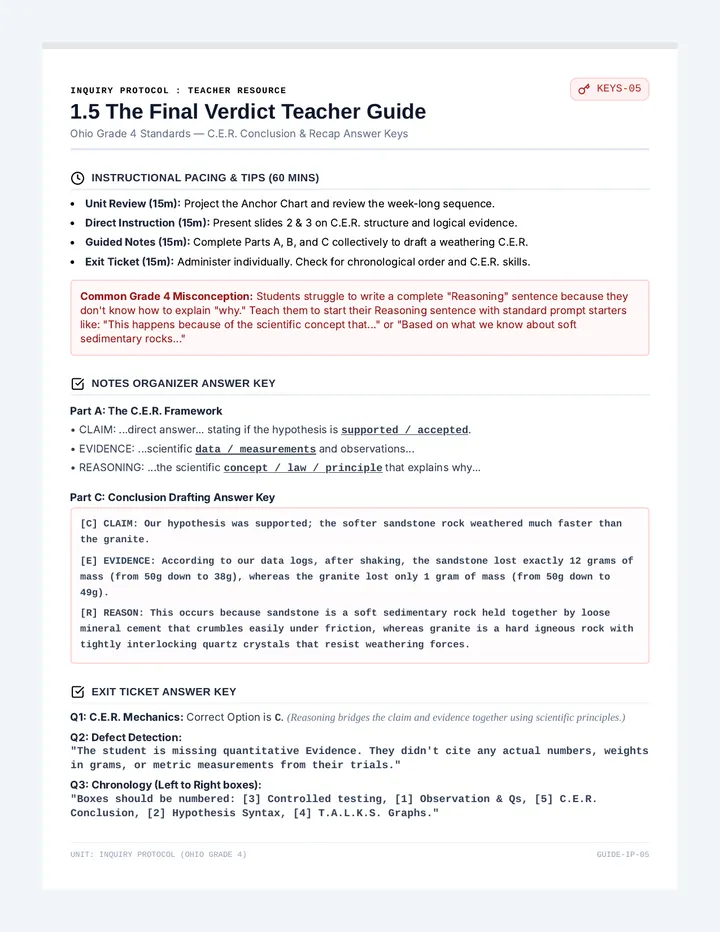
The Final Verdict Teacher Guide INQUIRY PROTOCOL : TEACHER RESOURCE
1.5 The Final Verdict Teacher Guide
Ohio Grade 4 Standards — C.E.R. Conclusion & Recap Answer Keys
KEYS-05
Instructional Pacing & Tips (60 Mins)
Unit Review (15m): Project the Anchor Chart and review the week-long sequence.Direct Instruction (15m): Present slides 2 & 3 on C.E.R. structure and logical evidence.Guided Notes (15m): Complete Parts A, B, and C collectively to draft a weathering C.E.R.Exit Ticket (15m): Administer individually. Check for chronological order and C.E.R. skills.
Common Grade 4 Misconception: Students struggle to write a complete "Reasoning" sentence because they don't know how to explain "why." Teach them to start their Reasoning sentence with standard prompt starters like: "This happens because of the scientific concept that..." or "Based on what we know about soft sedimentary rocks..."
Notes Organizer Answer Key
Part A: The C.E.R. Framework • CLAIM: ...direct answer... stating if the hypothesis is supported / accepted.
Part C: Conclusion Drafting Answer Key
[C] CLAIM: Our hypothesis was supported; the softer sandstone rock weathered much faster than the granite.
[E] EVIDENCE: According to our data logs, after shaking, the sandstone lost exactly 12 grams of mass (from 50g down to 38g), whereas the granite lost only 1 gram of mass (from 50g down to 49g).
[R] REASON: This occurs because sandstone is a soft sedimentary rock held together by loose mineral cement that crumbles easily under friction, whereas granite is a hard igneous rock with tightly interlocking quartz crystals that resist weathering forces.
Exit Ticket Answer Key
Q1: C.E.R. Mechanics: Correct Option is C. (Reasoning bridges the claim and evidence together using scientific principles.)
Q2: Defect Detection:
"The student is missing quantitative Evidence. They didn't cite any actual numbers, weights in grams, or metric measurements from their trials."
Q3: Chronology (Left to Right boxes):
"Boxes should be numbered: [3] Controlled testing, [1] Observation & Qs, [5] C.E.R. Conclusion, [2] Hypothesis Syntax, [4] T.A.L.K.S. Graphs."
UNIT: INQUIRY PROTOCOL (OHIO GRADE 4) GUIDE-IP-05