Tier 3 Intervention Gaps Guide
TIER 3
MTSS Leadership & Coaching Protocol Quick Reference One-Pager
Common Tier 3 Intervention Teacher Gaps
Diagnostic Walkthrough Reference: Observable Gaps, Concrete Examples & Observer Look-Fors
Common Teacher Gap
Coaching Look-For
Observer: __________________
Interventionist: _____________
Date/Time: ________________
Target Deficit: ___________
1 Planning & Intervention Design
Targeting & Fidelity
• Gap: Not Targeted to Specific Skill Deficit
Delivering generic reading/math help instead of the prerequisite foundational gap diagnosed by assessment.
Example: Phoneme segmentation deficit treated with reading comprehension tasks.
Look for: Clearly isolated deficit, measurable objective, and activities aligned 1:1.
• Gap: Intervention Mirrors Tier 1 Instruction
Extra time on grade-level assignments rather than explicit, systematic prerequisite instruction.
Example: Non-decoding CVC student given extra grade-level independent reading time.
Look for: Explicit modeling, scaffolded practice, feedback, cumulative review at student level.
• Gap: Inconsistent Session Implementation
Sessions shortened, canceled, interrupted, or repurposed for homework or classroom reteaching.
Look for: Protected scheduling, documented frequency/duration, faithful intervention delivery.
2 Instructional Delivery & Practice
Active Engagement
• Gap: Too Much Teacher Talk; Insufficient Student Practice
Teacher lectures and over-explains; students have limited opportunities to respond, practice, or retrieve.
Look for: High student response rates (OTRs), frequent checks for understanding, brisk pacing.
• Gap: Errors Are Not Corrected Explicitly
Incorrect responses persist, teacher gives answers away too quickly, or leaves misconceptions unaddressed.
Look for: Immediate corrective feedback (Model-Lead-Test), explicit reteach, and independent retry.
• Gap: Instruction Not Individualized Within Group
All students do identical work at uniform speed despite differing error profiles and learning rates.
Look for: Flexible grouping, tailored prompts, differentiated scaffolding based on student performance.
3 Progress Monitoring & Data Use
Measurement & Aimlines
• Gap: Progress Monitoring Missing or Inconsistent
Relying on subjective impressions or completed worksheets rather than standardized, consistent data probes.
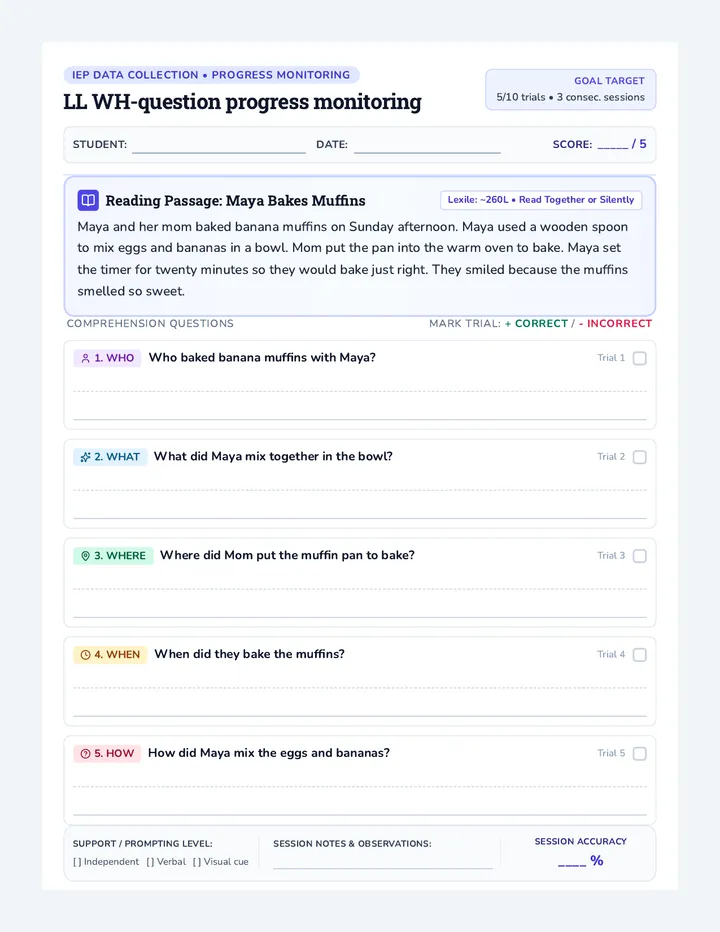
Look for: Baseline, measurable goal, standardized probe method, dated points, performance log.
• Gap: Data Is Collected but Not Analyzed
Scores logged without analyzing trends, diagnosing error patterns, or assessing goal trajectory.
Look for: Rate of improvement (ROI) vs. aimline review, interpretation of instructional impact.
• Gap: Instruction Does Not Change on Stalled Growth
Continuing the same lesson sequence despite repeated evidence of flat or non-responsive student growth.
Look for: Documented instructional adjustments (dosage, group size, scaffold) and follow-up data.
4 MTSS Decisions & Collaboration
System Integrity
• Gap: Inadequate Intervention Documentation
Records fail to capture intervention curriculum, dosage, frequency, student response, or fidelity.
Look for: Detailed logs enabling MTSS team/colleagues to understand exact content, dosage & responses.
• Gap: Decisions Based on Outcome Alone (No Fidelity Check)
Student labeled "non-responsive" without verifying whether intervention was delivered with intended fidelity.
Look for: Joint evaluation of student outcome data AND implementation fidelity before altering plans.
• Gap: Limited Collaboration with MTSS Team
Interventionists operate in silos; failure to connect intervention findings to Tier 1 classroom practice.
Look for: Regular data reviews, actionable classroom recommendations, clear follow-up roles.
5 Student Engagement & Responsiveness Gaps
Independence & Transfer
Passive / Low OTR
Time lost to waiting, slow transitions, or passive listening.
Prompt Dependent
Answers correctly with teacher cues but lacks independent mastery.
No Generalization
Demonstrates skill at table but cannot apply in class or novel tasks.
Insufficient Review
Previously taught skills not revisited; results in weak retention.
Mismatched Level
Work consistently too difficult or too easy to trigger growth.
Coaching Look-Fors: Active participation • Gradual release of support • Cumulative practice • Independent mastery checks • Evidence of transfer
Fidelity Standard
Core Tier 3 Principle Target root deficit • Explicit systematic delivery • High student response frequency • Pivot when flat
Observer Check: [ ] Commended [ ] Coaching Action Plan MTSS Fidelity Protocol