Story Elements Teacher Guide
Story Elements 4-Day Plan
Text: Maria Goes to School (Reading A-Z Level A) • Target: Comprehension Discrimination
Teacher & Intervention Guide
Early Literacy / AAC / SPED
Instructional Scope & Sequence Overview
| Day | Skill & Target | Teacher Moves & Scripted Prompts | Student Response | Scaffolds & Support |
|---|
| Day 1 | Discriminate 2 Characters (Who) | Read story. “This story has two characters: Maria and Carlos.” Ask: “Who went to the bus?” “Who is in our story?” | Points, touches, reaches, or uses AAC to pick specific character. | Field of 2 (Maria vs. Carlos). Model pointing. Visual card frame. |
| Day 2 | Identify Setting (Where) | Reread text. Review “who”. “The characters are at school. Setting means where.” Prompt: “Show me where Maria is.” | Selects correct setting picture (School/Classroom vs. Farm). | High-contrast distractors (ocean, bedroom). Block extra clutter. |
| Day 3 | Identify Major Event (What Happened) | Pause after major action: “Maria paints a picture. Look.” Present cards: “Point to what happened.” | Selects illustration showing the action (Painting vs. Cooking). | Reread event sentence right before prompt. Start with 2 choices. |
| Day 4 | Synthesize: Who + Where + What | Cycle through: “Point to who.” → “Show me where.” → “Show me what happened.” Present full scenes: “Point to the picture that shows our story.” | Selects composite picture containing all 3 core story elements. | Start with stark distractor; fade to subtle distractor. Run 5 scored trials. |
During the Read-Aloud: Rapid Point & Show Routine
Replace open-ended questions with rapid, active discrimination trials every 1–2 pages. Embed these exact 10 point-and-show prompts during shared reading:
-
“Point to Maria.”
-
“Show me Carlos.”
-
“Point to the school bus.”
-
“Where is Maria? Point.”
-
“Show me the classroom.”
-
“Point to who is painting.”
-
“Show me the blocks.”
-
“Where are they playing? Point.”
-
“Point to Maria now.”
-
“Show me Carlos at school.”
Accommodations, Scaffolding & Response Rules
Response Modality
- • Accept nonverbal responses: point, touch, eye-gaze, AAC, or card hand-over.
- • Maintain exact verbs: stick to “Point to” or “Show me”.
- • Provide 5–10 seconds wait time before repeating prompt.
Visual Presentation
- • Field size: start with field of 2; progress to 3 when >80% accuracy.
- • High-contrast distractors: target vs. stark contrast (School vs. Ocean).
- • Cover adjacent pictures/text if visual overload occurs.
Error Correction
- • Errorless transfer: if hesitant, immediately model/gesture, then re-present.
- • First/Then contingency: “First point to Maria, then we turn page.”
- • Specific praise: “Yes! You showed me Maria. Maria is the character!”
Story Elements Intervention Protocol • Designed for Early Childhood & Low-Incidence / AAC Settings Page 1 of 3
Daily Lesson Execution Scripts
Scripted teacher models, guided discrimination, and independent trial procedures
Days 1 – 4 Protocol
DAY 1
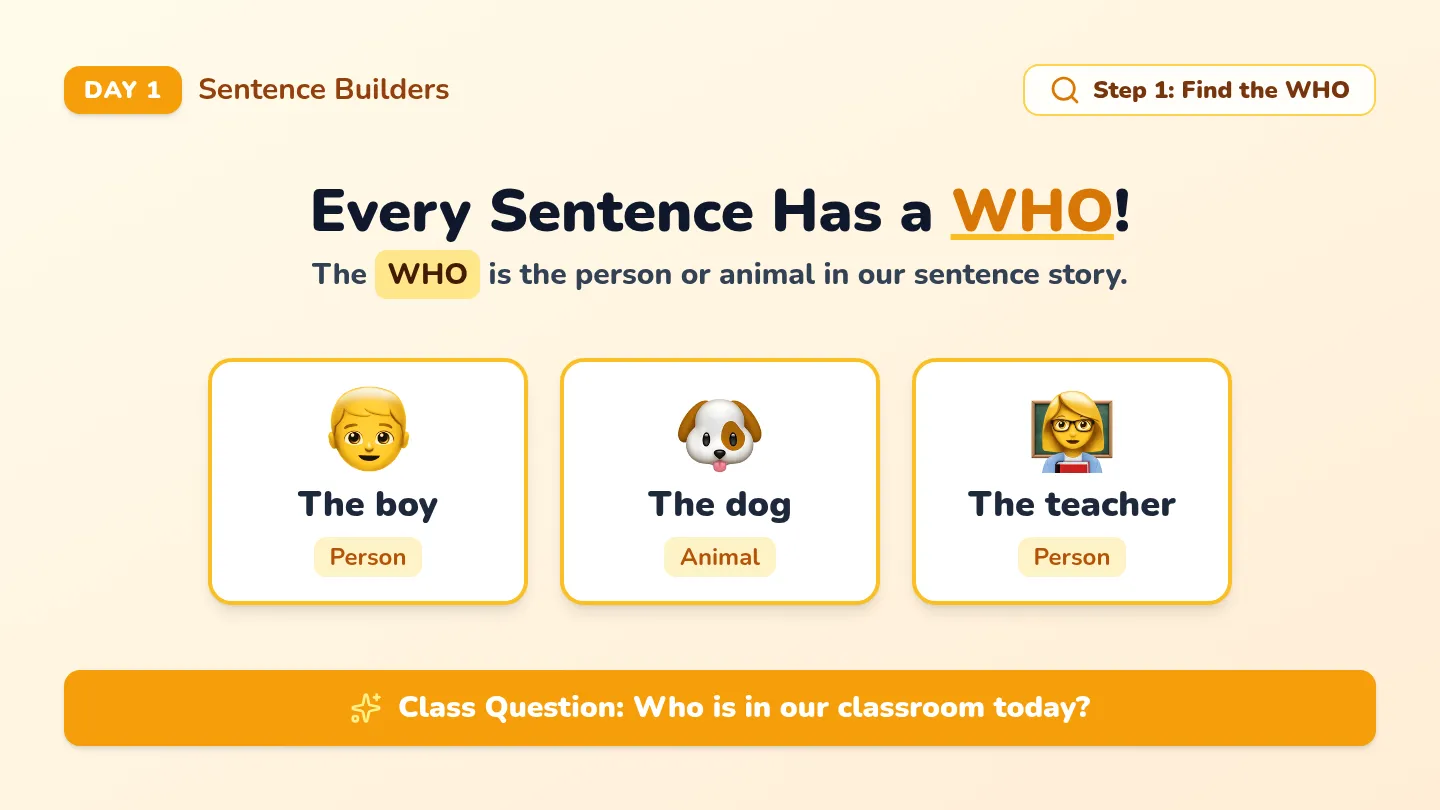
WHO? Discriminate Characters (Maria vs. Carlos)
Goal: 4/5 correct trials
1. Anchor & Introduce
Show book cover & WHO cue card. “We are reading Maria Goes to School. Character means who. This story has two characters: Maria and Carlos.” Present cards: “Point to Maria.” “Point to Carlos.”
2. Model & Guided Read
Model: “Who went to the classroom? I remember Maria walked in. I point to Maria.” Present field of 2: “Who went on the bus? Show me.” Guide to Maria. Present distractor (bear): “Who is in our story?”
3. 5-Trial Assessment
T1: “Who went to the bus?” (Maria)
T2: “Who played with blocks?” (Carlos)
T3: “Who is in our story?” (Maria/Carlos)
T4: “Who painted a picture?” (Maria)
T5: “Who went to playground?” (Carlos)
DAY 2
WHERE? Identify Setting (School / Classroom)
Goal: 4/5 correct trials
1. Review & Introduce
Review: “Point to Maria. Character means who.” Introduce: “Today we look for WHERE. Setting means where. Maria is at school. Show me the school.”
2. Contrast & Reread
Present School vs. stark distractor (Ocean/Bedroom): “Show me where the story happens.” Reread story pausing: “Point to Maria. Where is she? Point to classroom.”
3. 5-Trial Assessment
Present 2–3 setting choices for each:
T1: School vs. Ocean (“Where is Maria?”)
T2: Classroom vs. Farm (“Setting?”)
T3: Bus vs. Forest (“Where did she ride?”)
T4: Playground vs. Bedroom
T5: School vs. Beach
DAY 3
WHAT HAPPENED? Identify Major Event / Detail
Goal: 4/5 correct trials
1. Preview & Event Cue
Review Who and Where. “Now we look for WHAT HAPPENED. Maria painted a bright picture. Painting is what happened. Show me painting.”
2. Restate & Discriminate
Reread event page. Immediately restate: “Maria paints a picture.” Present Painting vs. Cooking food card: “Point to what happened in our story.” Guide to correct event.
3. 5-Trial Assessment
T1: Painting vs. Firefighting (“What happened?”)
T2: Building blocks vs. Cooking
T3: Riding bus vs. Sleeping
T4: Painting vs. Eating pizza
T5: Playing with blocks vs. Swimming
DAY 4
SYNTHESIS: Who + Where + What Happened
Goal: 4/5 composite trials
1. Visual Triad Review
Line up cue icons: WHO (Maria), WHERE (School), WHAT (Painting). “Point to who. Show me where. Show me what happened.”
2. Think-Aloud Modeling
Show target scene vs. distractor scene. Think aloud: “Do I see who? Maria. Where? School. What? Painting. This picture tells our whole story! I point here.”
3. 5-Trial Synthesis Probe
T1: Maria painting at school vs. Bear at ocean
T2: Carlos building at school vs. Chef cooking
T3: Maria on bus vs. Dog on farm
T4: Maria in class vs. Firefighter scene
T5: Full story scene vs. Bedroom scene
Data Rule: Score [+] only if response initiated within 10s without teacher prompting. Score [P] if gestural or model prompt required.
Mastery: 80% (4/5 trials across 2 days)
Story Elements Intervention Protocol • Daily Lesson Scripts & Fidelity Guides Page 2 of 3
Daily Trial Data Log & IEP Progress Tracker
Document 5 discrete trials per instructional session • Maria Goes to School
Form: SE-4D
Student Name
Observer / Instructor
Primary Response Mode
Point / Touch / AAC
Session Dates
DAY 1: Character (WHO) Score: ___ / 5
| Tr. | Prompt & Target | Score | Notes |
|---|
| 1 | “Who went to the bus?” (Maria) | [ + / P / - ] | ______ |
| 2 | “Who played with blocks?” (Carlos) | [ + / P / - ] | ______ |
| 3 | “Who is in our story?” (Maria/Carlos) | [ + / P / - ] | ______ |
| 4 | “Who painted a picture?” (Maria) | [ + / P / - ] | ______ |
| 5 | “Who went to playground?” (Carlos) | [ + / P / - ] | ______ |
DAY 2: Setting (WHERE) Score: ___ / 5
| Tr. | Prompt & Target | Score | Notes |
|---|
| 1 | “Where is Maria?” (School) | [ + / P / - ] | ______ |
| 2 | “Point to classroom” (Classroom) | [ + / P / - ] | ______ |
| 3 | “Where did she ride?” (Bus) | [ + / P / - ] | ______ |
| 4 | “Where is Carlos playing?” (Playground) | [ + / P / - ] | ______ |
| 5 | “Show setting of story” (School) | [ + / P / - ] | ______ |
DAY 3: Event (WHAT HAPPENED) Score: ___ / 5
| Tr. | Prompt & Target | Score | Notes |
|---|
| 1 | “Point to what happened” (Painting) | [ + / P / - ] | ______ |
| 2 | “What did Carlos do?” (Blocks) | [ + / P / - ] | ______ |
| 3 | “How did they get there?” (Rode Bus) | [ + / P / - ] | ______ |
| 4 | “Show Maria's action” (Painting) | [ + / P / - ] | ______ |
| 5 | “Point to event in story” (Playing) | [ + / P / - ] | ______ |
DAY 4: Synthesis (WHO + WHERE + WHAT) Score: ___ / 5
| Tr. | Prompt & Target | Score | Notes |
|---|
| 1 | “Picture from our story” (Maria Paint) | [ + / P / - ] | ______ |
| 2 | “Show story picture” (Carlos Blocks) | [ + / P / - ] | ______ |
| 3 | “Who + Where + What” (Maria on Bus) | [ + / P / - ] | ______ |
| 4 | “Point to whole story” (Classroom) | [ + / P / - ] | ______ |
| 5 | “Show picture of story” (Playground) | [ + / P / - ] | ______ |
Scoring Key
- [+] Independent: Points/selects correctly within 10s with no teacher cue.
- [P] Prompted: Requires gestural, visual frame, or model prompt to select.
- [-] Incorrect: Selects distractor, no response after 10s, or physical guide.
Intervention Fidelity Check
- ☐ Reread text before trials to ensure familiarity.
- ☐ Maintained consistent prompts (“Point to” / “Show me”).
- ☐ Delivered 5–10 second wait time prior to prompt repeat.
- ☐ Paired specific verbal feedback with target vocabulary.
Story Elements Intervention Protocol • Trial Data Log & Fidelity Sheet Page 3 of 3
Story Elements Choice Cards
Story Elements Picture Cards • Set 1: WHO
Day 1 & Cumulative Discrimination • Cut along dashed borders • Ready for laminate / AAC / pocket charts
Cut & Show Cards
Anchor Cue PROMPT
Character
WHO?
A person or animal in our story
Anchor Cue PROMPT
Setting
WHERE?
The place where the story happens
Anchor Cue PROMPT
Event / Action
WHAT?
What someone does in the story
WHO Choice
👧
Maria
Girl in story
WHO Choice
👦
Carlos
Boy in story
WHO Choice
🐻
Bear
Animal
WHO Choice
🐶
Dog
Pet
WHO Choice
👩🏫
Teacher
Adult at school
WHO Choice
🐱
Cat
Pet
Cut along dotted lines • Field of 2 or 3 choices • Pair with verbal prompt: “Point to who” / “Show me [name]” Page 1 of 4 • WHO & Prompts
Story Elements Picture Cards • Set 2: WHERE
Day 2 Setting Identification • Targets (School, Classroom, Bus, Playground) + High-Contrast Distractors
Setting Field
WHERE Setting
🏫
School
School building
WHERE Setting
🖍️
Classroom
Inside school
WHERE Setting
🚌
School Bus
Yellow bus
WHERE Setting
🛝
Playground
Outside school
WHERE Setting
🚜
Farm
Barn & fields
WHERE Setting
🏖️
Ocean Beach
Water & sand
WHERE Setting
🛏️
Bedroom
Home bed
WHERE Setting
🌲
Forest
Trees & woods
WHERE Setting
🍳
Kitchen
Stove & cooking
Cut along dotted lines • Pair with verbal prompt: “Show me where” / “Point to the setting” Page 2 of 4 • WHERE (Settings)