Orthographic Dyslexia Caregiver Guide
Family & Caregiver Guide
Understanding Orthographic Dyslexia
Reading & Learning Support
Plain-Language Reference
The "Mental Word Camera" Analogy
Fluent reading relies on an internal photo album: after seeing a word several times, your brain takes an instant snapshot of the letter pattern and files it away. This skill is called orthographic processing.
With an orthographic processing deficit, the brain's camera shutter is slow to store the picture. Even when a child can sound out every letter accurately, they have to re-solve the same word again and again as if seeing it for the first time.
Everyday Signs You May Notice
- • Slow, choppy reading: Sounds out common words like said, was, or they repeatedly.
- • Phonetic spelling: Writes skool for school or wuz for was (hears sounds, misses visual patterns).
- • Homophone mix-ups: Confuses there/their, meat/meet, or see/sea.
- • Reading fatigue: Re-decoding drains stamina quickly.
Crucial Facts for Families
- • Not a vision issue: Eye exams show normal 20/20 vision. The difficulty is in how the brain files printed word forms.
- • High intellect: Children often show strong verbal reasoning, rich vocabularies, and creative problem-solving.
- • Not effort-related: Re-sounding every word requires 5 to 10 times more cognitive energy than automatic recognition.
Practical Ways to Support Reading at Home
1
Use "Heart Word" Techniques
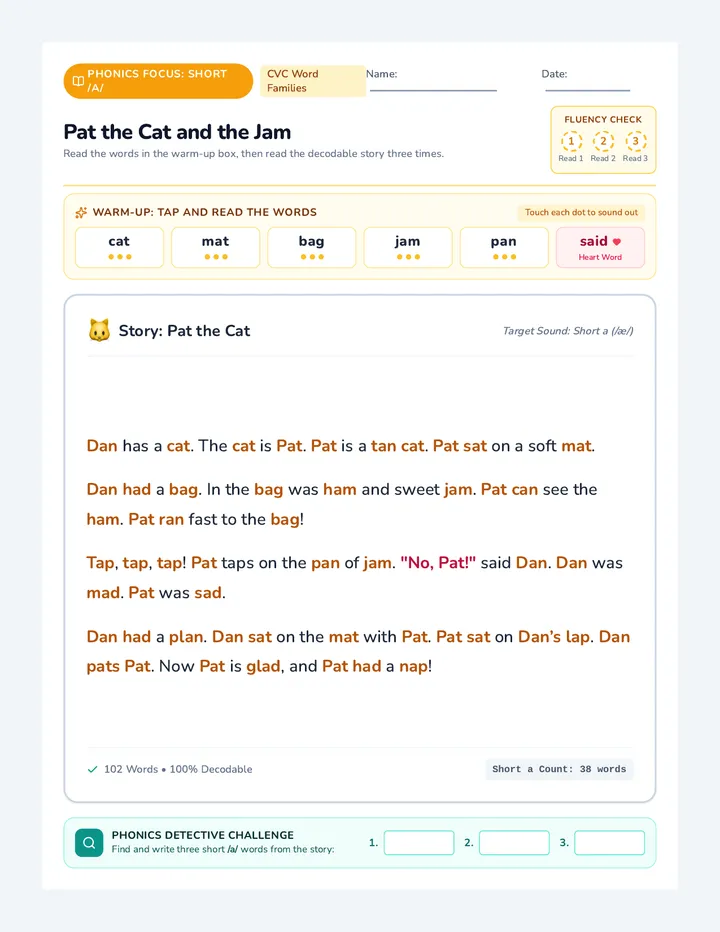
Rather than memorizing words by rote flashcards, map regular sounds first, and put a heart over irregular letters (e.g., in said, the "ai" says /e/).
2
Anchor Visual Clues
Connect letter shapes to meaning. Turn double "o"s in look into eyes or draw ocean waves beneath sea to distinguish it visually from see.
3
Embrace "Ear Reading"
Audiobooks protect love for stories and grow sophisticated background knowledge while taking decoding pressure off during leisure reading.
4
Short, High-Success Pacing
Keep print reading sessions to 10-15 minutes. Celebrate accurate mapping and effort rather than comparing reading speed to classmates.
Key Takeaway for Families
With explicit multisensory mapping and supportive accommodations, children successfully build visual word memory and lifelong reading confidence.
Page 1 of 2
School Team Reference
Orthographic Deficit: MTSS & IEP Planning
Educational Framework
Double-Deficit Model Context
Subtype Distinction: Phonological vs. Orthographic Processing
| Dimension |
Phonological Core Deficit |
Orthographic Processing Deficit |
| Core Bottleneck |
Sound segmentation, blending, and phonemic awareness. |
Forming & retrieving mental graphemic representations (MGRs). |
| Pseudoword Decoding |
Significantly impaired (e.g., struggles with slarp). |
Preserved or functional; sounds out nonsense words reliably. |
| Sight Word Efficiency |
Secondary delay resulting from phonological weakness. |
Marked primary impairment on timed and irregular word reading. |
| Spelling Error Profile |
Phonetically inaccurate (e.g., omits sounds: stmp for stamp). |
Phonetically accurate but orthographically wrong (e.g., thot / thought). |
Diagnostic Battery Indicators
- CTOPP-2: Discrepancy between depressed Rapid Naming (RAN) and intact Phonological Awareness.
- TOWRE-2: Substantial split where Sight Word Efficiency (SWE) is markedly lower than Phonemic Decoding (PDE).
- WIAT-4 / WJ-IV: Low scores on Orthographic Fluency, timed lexical retrieval, and irregular spelling subtests.
Classroom Presentation & Impact
- Fluency plateau: Rate stalls despite high phonological accuracy due to constant re-decoding.
- Cognitive fatigue: Lexical decoding load erodes stamina for comprehension on longer grade-level passages.
- Writing output inhibition: Hesitation over orthographic spelling slows written generation and idea flow.
Targeted Structured Literacy Interventions
Orthographic Mapping
Phoneme-grapheme mapping routines (Elkonin sound-boxes with colored letter tiles & heart-word marking).
Morphemic Analysis
Explicit study of roots, prefixes, and suffixes to transition processing from single letters to larger visual chunks.
Immediate Feedback
Paired repeated reading of controlled decodable text with immediate correction to reinforce exact visual word forms.
Recommended IEP / Section 504 Accommodations
1.5x–2.0x Extended Time: Offsets slower lexical retrieval on reading and writing assessments.
Text-to-Speech (TTS): Protects stamina for content comprehension in social studies and science.
Spelling Waiver on Content: Assess conceptual mastery independently of orthographic accuracy.
Assistive Word Banks: Provide phonetic spell-checkers and illustrated vocab banks to reduce drafting friction.
Unified Messaging: Align home and school teams with consistent shared terminology (e.g., "Mental Word Camera" and "Heart Words") to reinforce student confidence.
Page 2 of 2