Support Strategies Slides
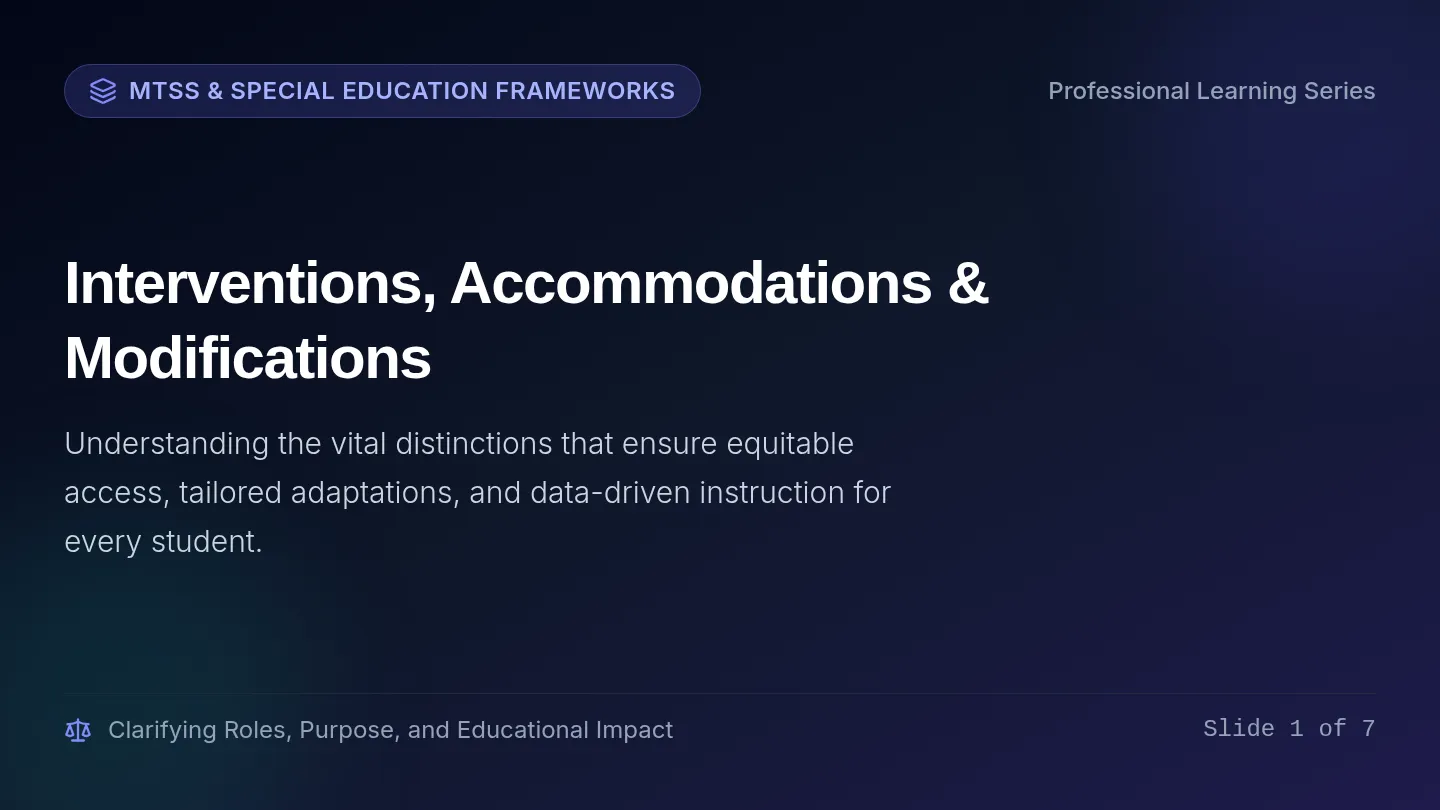
MTSS & Special Education Frameworks
Professional Learning Series
Interventions, Accommodations & Modifications
Understanding the vital distinctions that ensure equitable access, tailored adaptations, and data-driven instruction for every student.
Clarifying Roles, Purpose, and Educational Impact
Slide 1 of 7
The Guiding Question
Slide 2 of 7
Essential Distinction
How are accommodations and modifications different than instructional interventions?
Skill-Focused
Instructional interventions focus on a specific skill rather than a disability.
The Iris Center, 2018
Data-Driven
Planned instruction driven from the data taken (progress monitoring).
Morin, n.d.
Accessible to All
An IEP or 504 is not required for instructional interventions.
Morin, n.d.
Interventions directly teach new skills; accommodations and modifications adapt conditions or standards.
Morin (n.d.) • Iris Center (2018)
Definition & Three Pillars
Slide 3 of 7
What are accommodations?
Changes to how the learning content is presented, how students demonstrate their knowledge, and changes to the learning environment based on the students’ needs, without lowering academic expectations.
Presentation
Audiobooks, digital screen readers, large print, visual organizers.
Demonstrating Knowledge
Oral responses, speech-to-text, typed work, calculation aids.
Environment
Preferential seating, reduced distractions, lighting adjustments.
Accommodations ensure equal access without compromising rigor or learning outcomes.
The IRIS Center (2018)
Categories of Support
Types of Accommodations
Slide 4 of 7
There are four types of accommodations:
Presentation
How content is received
Changes how instructional information and directions are accessed.
Examples: Audiobooks, text-to-speech, visual cues, large print.
Setting
Where learning happens
Changes the physical location or sensory features of the space.
Examples: Preferential seating, quiet testing space, low distractions.
Response
How knowledge is shown
Changes how students complete tasks and demonstrate learning.
Examples: Speech-to-text, oral answers, typing, graphic organizers.
Timing and Scheduling
When & pacing
Changes time limits, break frequencies, or scheduling intervals.
Examples: Extended time, frequent sensory pauses, multi-day testing.
All 4 types preserve grade-level learning goals while providing customized access pathways.
Section 504 & MTSS Guidelines
Comparative Analysis
Accommodations vs. Modifications
Slide 5 of 7
Accommodations
- Does not change what the student is learning
- Makes the learning content more accessible for students
- Changes how the students learn or present their knowledge
Focus: Access & Delivery
Both
- Specific to the students’ needs
- Promotes equity for all students
Rooted in Individualization
Modifications
- Changes what the students are learning
- Changes expectations for learning
Focus: Altered Standards
Accommodations adapt the path; modifications adapt the destination. Equitable Student Support
Comprehensive Matrix
Comparing the Three Support Pillars
Slide 6 of 7
Access
Accommodations
- Changes how students learn or demonstrate mastery
- Academic expectations remain unchanged
- Documented in 504 plans, IEPs, or general plans
Adapt
Modifications
- Changes what students are expected to learn
- Curriculum standards are lowered or altered
- Legally required through formal IEP process
Teach
Interventions
- Target specific skill deficits directly
- Progress monitoring data drives instruction
- No IEP or 504 required to implement
Accommodations provide access • Modifications alter targets • Interventions teach skills MTSS Core Principles
Practical Takeaway
Decision Guide for Educators
Slide 7 of 7
Scenario 1
Lacks a Key Skill
A student struggles with decoding multi-syllabic words or regrouping in subtraction.
Provide Intervention
Scenario 2
Needs Access Support
A student understands concepts but needs speech-to-text, audiobooks, or extended time.
Provide Accommodation
Scenario 3
Adjusted Expectations
An IEP indicates that standard grade-level learning targets must be modified to functional goals.
Apply Modification
Accommodations promote access; interventions systematically close skill gaps.
Morin (n.d.) • Iris Center (2018)
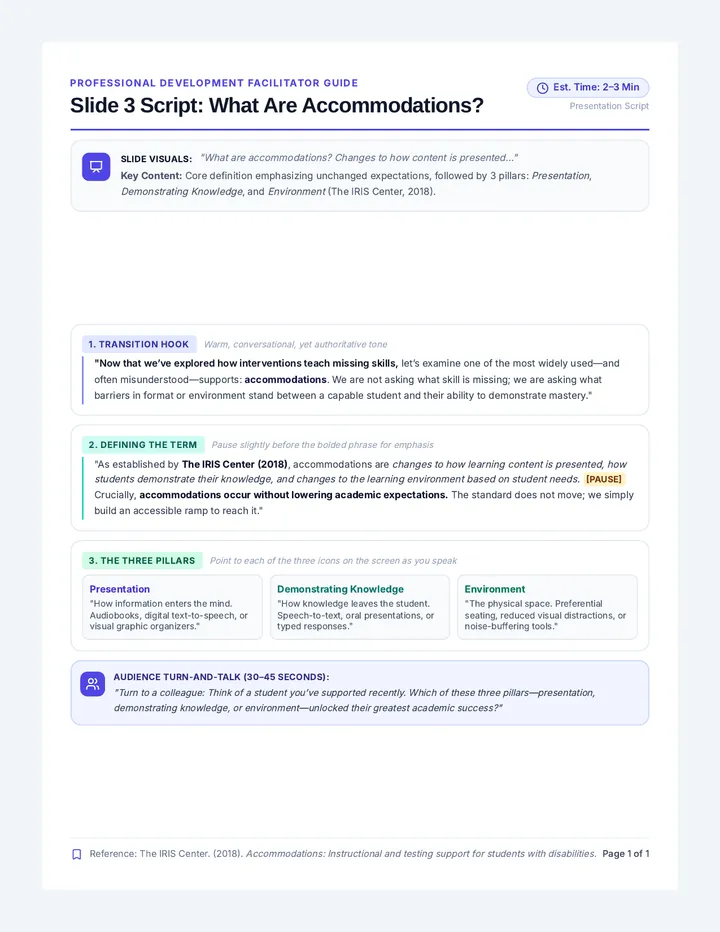
Accommodations Presenter Script Guide
Professional Development Facilitator Guide
Slide 3 Script: What Are Accommodations?
Est. Time: 2–3 Min Presentation Script
Slide Visuals: "What are accommodations? Changes to how content is presented..."
Key Content: Core definition emphasizing unchanged expectations, followed by 3 pillars: Presentation, Demonstrating Knowledge, and Environment (The IRIS Center, 2018).
1. Transition Hook Warm, conversational, yet authoritative tone
"Now that we’ve explored how interventions teach missing skills, let’s examine one of the most widely used—and often misunderstood—supports: accommodations. We are not asking what skill is missing; we are asking what barriers in format or environment stand between a capable student and their ability to demonstrate mastery."
2. Defining the Term Pause slightly before the bolded phrase for emphasis
"As established by The IRIS Center (2018), accommodations are changes to how learning content is presented, how students demonstrate their knowledge, and changes to the learning environment based on student needs. [PAUSE] Crucially, accommodations occur without lowering academic expectations. The standard does not move; we simply build an accessible ramp to reach it."
3. The Three Pillars Point to each of the three icons on the screen as you speak
Presentation
"How information enters the mind. Audiobooks, digital text-to-speech, or visual graphic organizers."
Demonstrating Knowledge
"How knowledge leaves the student. Speech-to-text, oral presentations, or typed responses."
Environment
"The physical space. Preferential seating, reduced visual distractions, or noise-buffering tools."
Audience Turn-and-Talk (30–45 Seconds):
"Turn to a colleague: Think of a student you’ve supported recently. Which of these three pillars—presentation, demonstrating knowledge, or environment—unlocked their greatest academic success?"
Reference: The IRIS Center. (2018). Accommodations: Instructional and testing support for students with disabilities.
Page 1 of 1