Nine Week Data Sheet IEP Oral Retell Data Sheet
9-Week Progress Monitoring • Page 1 of 2
Student: ________________________
Case Mgr: ______________________
Start Date: _____________________
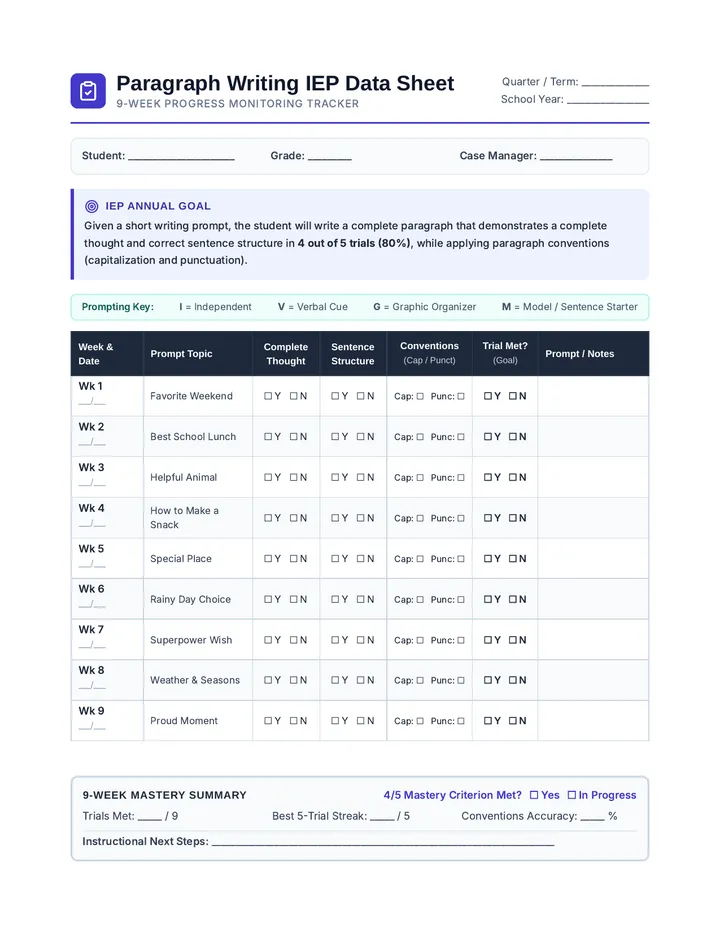
Target IEP Goal
Given a short reading passage, the student will orally retell the main idea and two supporting details in 4 out of 5 trials (80% accuracy).
Trial Scoring (3/3 = Pass) Check each component retold accurately: MI (Main Idea), D1 (Detail 1), D2 (Detail 2).
Prompt Level Codes I = Independent • V = Verbal Cue • G = Visual/Graphic • M = Model
Week / Tier
Trial 1
Trial 2
Trial 3
Trial 4
Trial 5
Pass /5
Prompt & Notes
Week 1
Tier 1
Date: _____
|
☐ MI
☐ D1
☐ D2
P: ___
|
☐ MI
☐ D1
☐ D2
P: ___
|
☐ MI
☐ D1
☐ D2
P: ___
|
☐ MI
☐ D1
☐ D2
P: ___
|
☐ MI
☐ D1
☐ D2
P: ___
|
___ / 5
☐ 4/5 Met
| |
|
Week 2
Tier 1
Date: _____
|
☐ MI
☐ D1
☐ D2
P: ___
|
☐ MI
☐ D1
☐ D2
P: ___
|
☐ MI
☐ D1
☐ D2
P: ___
|
☐ MI
☐ D1
☐ D2
P: ___
|
☐ MI
☐ D1
☐ D2
P: ___
|
___ / 5
☐ 4/5 Met
| |
|
Week 3
Tier 1
Date: _____
|
☐ MI
☐ D1
☐ D2
P: ___
|
☐ MI
☐ D1
☐ D2
P: ___
|
☐ MI
☐ D1
☐ D2
P: ___
|
☐ MI
☐ D1
☐ D2
P: ___
|
☐ MI
☐ D1
☐ D2
P: ___
|
___ / 5
☐ 4/5 Met
| |
|
Week 4
Tier 2
Date: _____
|
☐ MI
☐ D1
☐ D2
P: ___
|
☐ MI
☐ D1
☐ D2
P: ___
|
☐ MI
☐ D1
☐ D2
P: ___
|
☐ MI
☐ D1
☐ D2
P: ___
|
☐ MI
☐ D1
☐ D2
P: ___
|
___ / 5
☐ 4/5 Met
| |
|
Week 5
Tier 2
Date: _____
|
☐ MI
☐ D1
☐ D2
P: ___
|
☐ MI
☐ D1
☐ D2
P: ___
|
☐ MI
☐ D1
☐ D2
P: ___
|
☐ MI
☐ D1
☐ D2
P: ___
|
☐ MI
☐ D1
☐ D2
P: ___
|
___ / 5
☐ 4/5 Met
| |
IEP Oral Retell Data Sheet (Continued)
Weeks 6–9 & Progress Summary • Page 2 of 2
Student: ________________________
Week / Tier
Trial 1
Trial 2
Trial 3
Trial 4
Trial 5
Pass /5
Prompt & Notes
Week 6
Tier 2
Date: _____
|
☐ MI
☐ D1
☐ D2
P: ___
|
☐ MI
☐ D1
☐ D2
P: ___
|
☐ MI
☐ D1
☐ D2
P: ___
|
☐ MI
☐ D1
☐ D2
P: ___
|
☐ MI
☐ D1
☐ D2
P: ___
|
___ / 5
☐ 4/5 Met
| |
|
Week 7
Tier 3
Date: _____
|
☐ MI
☐ D1
☐ D2
P: ___
|
☐ MI
☐ D1
☐ D2
P: ___
|
☐ MI
☐ D1
☐ D2
P: ___
|
☐ MI
☐ D1
☐ D2
P: ___
|
☐ MI
☐ D1
☐ D2
P: ___
|
___ / 5
☐ 4/5 Met
| |
|
Week 8
Tier 3
Date: _____
|
☐ MI
☐ D1
☐ D2
P: ___
|
☐ MI
☐ D1
☐ D2
P: ___
|
☐ MI
☐ D1
☐ D2
P: ___
|
☐ MI
☐ D1
☐ D2
P: ___
|
☐ MI
☐ D1
☐ D2
P: ___
|
___ / 5
☐ 4/5 Met
| |
|
Week 9
Tier 3
Date: _____
|
☐ MI
☐ D1
☐ D2
P: ___
|
☐ MI
☐ D1
☐ D2
P: ___
|
☐ MI
☐ D1
☐ D2
P: ___
|
☐ MI
☐ D1
☐ D2
P: ___
|
☐ MI
☐ D1
☐ D2
P: ___
|
___ / 5
☐ 4/5 Met
| |
9-Week Mastery Tracker (Shade boxes for successful 3/3 trials)
Goal Line = 4/5 Trials (80%)
9-Week Quarter Summary & Instructional Notes Goal Status: ☐ Met (4/5+) ☐ Progressing ☐ Needs Support
Retell Support Mat My Oral Retell Map
Use this mat to organize your thoughts before or during your retell
Name: _______________________
Date: _______________________
1. MAIN IDEA (The Big Picture)
What is it mostly about?
Say: "The passage is mostly about..." or "The big idea is..."
Proved By
Proved By
2. SUPPORTING DETAIL 1
Say: "One important detail is..."
3. SUPPORTING DETAIL 2
Say: "Another detail from the text is..."
Student Self-Check Before You Finish
☐ I told the big idea in my own words.
☐ I shared 2 real details from the passage.
☐ My details match the main idea.
Retell Cue Cards & Visual Supports
Cut along dashed lines for desk strips, or keep whole as a student reference sheet
Main Idea Finder
The main idea is the big umbrella that covers the whole passage—not just one small fact.
Ask Yourself:
• Who or what is this mostly about?
• What is the most important point?
• Look at the title & first sentence!
Cue Level: Visual / Verbal Prompt Support
Detail Detective
Supporting details are the facts, examples, or reasons that prove the main idea is true.
Ask Yourself:
• What facts did I read that prove it?
• Can I name two different examples?
• Did I stick to what the text said?
Cue Level: Visual / Verbal Prompt Support
Oral Retell Sentence Starters
To state the Main Idea:
"This passage is mostly about..."
"The author wants us to know that..."
To give Supporting Details:
"First, the text explains that..."
"Also, I learned that..."
Keep on desk during independent retell
3-Finger Retell Check
Hold up one finger as you say each part out loud:
1. Thumb Main Idea (The Big Picture)
2. Index Detail 1 (First Fact)
3. Middle Detail 2 (Second Fact)
Goal: All 3 fingers up!
Fading Supports Over 9 Weeks
Weeks 1–3: Allow full use of the Retell Map and Sentence Starters (record Prompt Code G ). Weeks 4–6: Transition to the 3-Finger Retell Check only. Weeks 7–9: Fade visual supports to assess independent oral retell (Prompt Code I ) toward IEP mastery.
Weekly Retell Passages WEEK 1
Weekly Retell Passages
Tier 1: Foundational
Name: ___________________ Date: _________
Passage 1A
Busy Honeybees
66 words • Explicit Main Idea
Honeybees are very helpful insects. They fly from flower to flower to drink sweet nectar. As they land on each bloom, yellow pollen sticks to their fuzzy legs. When the bees visit new flowers, they drop off the pollen. This helps plants grow fruits and seeds. Back at the hive, honeybees turn the nectar into sweet honey that people and animals enjoy.
Oral Prompt: Tell me the main idea and two supporting details. MI ☐ D1 ☐ D2 ☐ P: ___
Passage 1B
The School Garden
68 words • Explicit Main Idea
Students at Oak Elementary work together to care for their school garden. Every Tuesday, classes take turns pulling weeds from the dirt. Other students carry watering cans to keep the soil damp. Soon, bright red tomatoes and crunchy carrots begin to grow. At harvest time, the students wash the fresh vegetables and share them in the school cafeteria for everyone to taste.
Oral Prompt: Tell me the main idea and two supporting details. MI ☐ D1 ☐ D2 ☐ P: ___
Tier 1 Focus: Explicit main idea in the first sentence • Concrete everyday details
WEEK 2
Weekly Retell Passages
Tier 1: Foundational
Name: ___________________ Date: _________
Passage 2A
Staying Safe in the Sun
69 words • Explicit Main Idea
It is important to protect your skin and eyes when you play outside on sunny days. Putting on sunscreen before you go out helps stop painful sunburns. Wearing a wide-brimmed hat keeps bright sunlight off your face and neck. Sunglasses also shield your eyes from strong light. Drinking plenty of cold water keeps your body cool while you have fun outdoors.
Oral Prompt: Tell me the main idea and two supporting details. MI ☐ D1 ☐ D2 ☐ P: ___
Passage 2B
The Public Library
71 words • Explicit Main Idea
A public library is a great place for people of all ages to learn and explore. With a free library card, visitors can borrow picture books, chapter books, and magazines to read at home. Libraries also have quiet tables where students can finish their homework. Many libraries even host fun story times and craft clubs on weekends. Everyone is welcome inside!
Oral Prompt: Tell me the main idea and two supporting details. MI ☐ D1 ☐ D2 ☐ P: ___
Tier 1 Focus: Explicit main idea in the first sentence • Concrete everyday details
WEEK 3
Weekly Retell Passages
Tier 1: Foundational
Name: ___________________ Date: _________
Passage 3A
How Frogs Grow
73 words • Sequential Details
A frog goes through big changes as it grows from an egg into an adult. First, a mother frog lays tiny, jelly-like eggs in a calm pond. Soon, a little tadpole hatches from each egg. Tadpoles have long tails and breathe underwater like fish. Next, the tadpole grows back legs and then front legs. Finally, its tail disappears, and the grown frog hops onto land.
Oral Prompt: Tell me the main idea and two supporting details. MI ☐ D1 ☐ D2 ☐ P: ___
Passage 3B
Caring for a Puppy
74 words • Explicit Main Idea
Bringing home a new puppy is exciting, and it takes daily care to keep a puppy healthy. Puppies need fresh water in their bowl and healthy puppy food every day. Because puppies have lots of energy, they also need daily walks and playtime in a safe yard. Taking your puppy to the vet for checkups and shots helps prevent sickness. Love and patience help a puppy feel right at home.
Oral Prompt: Tell me the main idea and two supporting details. MI ☐ D1 ☐ D2 ☐ P: ___
Tier 1 Focus: Explicit main idea in the first sentence • Concrete everyday details
WEEK 4
Weekly Retell Passages
Tier 2: Developing
Name: ___________________ Date: _________
Passage 4A
Sea Turtles at Night
90 words • Mid-Passage Main Idea
When the sun goes down on warm beaches, baby sea turtles crack out of their leathery eggshells beneath the sand. They must dig their way to the surface and reach the ocean quickly. Unfortunately, bright porch lights and streetlamps near the beach can confuse the tiny turtles. Instead of crawling toward the moonlight reflecting on the water, they sometimes head toward the road. Many beach towns now turn off outdoor lights during hatching season so baby sea turtles can safely find their way home to the sea.
Oral Prompt: Tell me the main idea and two supporting details. MI ☐ D1 ☐ D2 ☐ P: ___
Passage 4B
Why Bridges Have Arches
92 words • Cause & Effect
If you look closely at old stone bridges, you will often see curved shapes called arches underneath. Engineers have used arches for thousands of years because they make bridges remarkably strong. A flat beam can bend or snap when heavy trucks drive over it. An arch, however, spreads the weight outward and downward into the sturdy stone walls on both sides of the river. Because the force is shared across the whole curve, arch bridges can hold enormous loads and last for centuries.
Oral Prompt: Tell me the main idea and two supporting details. MI ☐ D1 ☐ D2 ☐ P: ___
Tier 2 Focus: Compound sentences • Main idea may appear mid-passage or at the end
WEEK 5
Weekly Retell Passages
Tier 2: Developing
Name: ___________________ Date: _________
Passage 5A
The Magic of Compost
95 words • Process & Purpose
Every day, kitchens throw away banana peels, apple cores, and coffee grounds. Instead of sending those scraps to the landfill, many families toss them into a compost bin. Inside the bin, tiny bacteria and hungry earthworms break down the food scraps along with dry leaves and grass clippings. Over a few months, the messy pile transforms into dark, crumbly soil that smells like a forest floor. Gardeners spread this rich compost around their plants to help them grow healthier without chemical fertilizers.
Oral Prompt: Tell me the main idea and two supporting details. MI ☐ D1 ☐ D2 ☐ P: ___
Passage 5B
Teamwork in a Coral Reef
96 words • Main Idea at End
Deep under warm ocean waves, tiny clownfish dart in and out of stinging sea anemones. Most fish stay far away from the anemone's venomous tentacles, but clownfish have a special coating of mucus that protects them. In return for a safe hiding spot, clownfish chase away hungry predators that try to nibble on the anemone. They also fan fresh water over the anemone and leave behind scraps of food. In the coral reef, even very different creatures can become helpful partners.
Oral Prompt: Tell me the main idea and two supporting details. MI ☐ D1 ☐ D2 ☐ P: ___
Tier 2 Focus: Compound sentences • Main idea may appear mid-passage or at the end
WEEK 6
Weekly Retell Passages
Tier 2: Developing
Name: ___________________ Date: _________
Passage 6A
How Popcorn Pops
98 words • Scientific Explanation
Have you ever wondered why popcorn kernels burst into fluffy white snacks? Unlike regular sweet corn, popcorn kernels have a very hard outer shell and a tiny drop of water trapped inside a starchy center. When you heat the kernels in a pot, that hidden water turns into steam. Because the hard shell traps the steam, pressure builds up higher and higher inside. Finally, the shell bursts open with a loud pop, and the soft starch puffs up into the crunchy treat we eat at the movies.
Oral Prompt: Tell me the main idea and two supporting details. MI ☐ D1 ☐ D2 ☐ P: ___
Passage 6B
The Great Monarch Journey
100 words • Implied Main Idea
Every autumn, millions of orange-and-black monarch butterflies leave Canada and the northern United States. Even though they weigh less than a paperclip, these butterflies fly up to three thousand miles south to escape the freezing winter. Along the way, they stop at wildflowers to sip nectar for energy and rest together in tall trees at night. By November, the monarchs reach the warm mountain forests of central Mexico, where they cluster on fir branches until spring arrives and guides their return.
Oral Prompt: Tell me the main idea and two supporting details. MI ☐ D1 ☐ D2 ☐ P: ___
Tier 2 Focus: Compound sentences • Main idea may appear mid-passage or at the end
WEEK 7
Weekly Retell Passages
Tier 3: Stretch
Name: ___________________ Date: _________
Passage 7A
Living Lights in the Deep
118 words • Synthesized Main Idea
Sunlight cannot reach the deepest parts of the ocean, leaving the water pitch black. Yet many creatures down there create their own light through a chemical reaction called bioluminescence. The anglerfish dangles a glowing lure in front of its mouth to attract curious prey in the darkness. Meanwhile, certain deep-sea squid release clouds of glowing ink to startle predators and escape. Other animals, such as lanternfish, flash patterns along their sides to signal mates or blend in with faint light from above. Without electricity or batteries, deep-sea animals use living light to survive in a dark world.
Oral Prompt: Tell me the main idea and two supporting details. MI ☐ D1 ☐ D2 ☐ P: ___
Passage 7B
A Code You Can Touch
120 words • Historical Nonfiction
In the early 1800s, a young French boy named Louis Braille lost his eyesight after an accident in his father's workshop. At that time, books for blind readers used giant raised letters that were slow and clumsy to read by touch. Determined to read faster, Louis learned about a military code of raised dots used by soldiers to read messages in the dark. By age fifteen, he invented a simpler system using grids of six raised dots to stand for letters, numbers, and musical notes. Today, Braille's tactile alphabet still opens the world of books to millions of blind readers.
Oral Prompt: Tell me the main idea and two supporting details. MI ☐ D1 ☐ D2 ☐ P: ___
Tier 3 Focus: Academic vocabulary • Synthesized or inferential main idea
WEEK 8
Weekly Retell Passages
Tier 3: Stretch
Name: ___________________ Date: _________
Passage 8A
Robotic Explorers on Mars
123 words • Space Science
Sending astronauts to Mars is difficult because the journey takes months and the red planet has freezing temperatures and thin air. Instead of risking human lives first, space agencies send wheeled robots called rovers to explore. Rovers like Perseverance carry high-definition cameras, weather sensors, and robotic drills across dusty craters. They collect rock samples and test the soil for signs of ancient water or microscopic life. Because radio signals take several minutes to travel between Earth and Mars, engineers program the rovers to avoid steep cliffs and sharp boulders on their own.
Oral Prompt: Tell me the main idea and two supporting details. MI ☐ D1 ☐ D2 ☐ P: ___
Passage 8B
Farming Inside Skyscrapers
124 words • Modern Innovation
Crowded cities rarely have enough open land for traditional farms, so some communities are growing food straight up instead of out. Inside vertical farms, trays of lettuce, herbs, and strawberries are stacked in tall towers under glowing LED lights. Instead of soil, plant roots misted with nutrient-rich water absorb exactly what they need. Because the indoor climate is controlled year-round, crops grow even during snowy winters and use far less water than outdoor fields. Best of all, fresh produce can be harvested and delivered to neighborhood grocery stores within hours.
Oral Prompt: Tell me the main idea and two supporting details. MI ☐ D1 ☐ D2 ☐ P: ___
Tier 3 Focus: Academic vocabulary • Synthesized or inferential main idea
WEEK 9
Weekly Retell Passages
Tier 3: Stretch
Name: ___________________ Date: _________
Passage 9A
Why Autumn Leaves Change Color
126 words • Earth Science
During spring and summer, tree leaves act like tiny food factories, using sunlight and a green chemical called chlorophyll to make sugar. Chlorophyll is so strong that it hides all the other colors inside the leaf. As autumn arrives, days grow shorter and cooler, signaling trees to prepare for winter rest. The trees stop making food, and the bright green chlorophyll slowly fades away. Once the green disappears, hidden yellow and orange pigments finally shine through. Cooler nights can also trap extra sugar in some leaves, creating brilliant reds and purples before the leaves drift to the ground.
Oral Prompt: Tell me the main idea and two supporting details. MI ☐ D1 ☐ D2 ☐ P: ___
Passage 9B
The Secret Thread of Silk
128 words • History & Science
For thousands of years, weavers in ancient China kept a valuable secret: how to make shimmering silk cloth. Unlike cotton from plants or wool from sheep, silk comes from tiny caterpillars called silkworms. After feasting on mulberry leaves, each silkworm spins a protective cocoon made from a single, ultra-thin thread that can stretch over half a mile long. Workers gently soak the cocoons in warm water to loosen the threads and spin them together into smooth, strong yarn. Because silk was so rare and prized, traders carried it across deserts and mountains along the famous Silk Road.
Oral Prompt: Tell me the main idea and two supporting details. MI ☐ D1 ☐ D2 ☐ P: ___
Tier 3 Focus: Academic vocabulary • Synthesized or inferential main idea
Scoring Guide and Key Scoring Guide & Administration Protocol
Teacher Reference • Page 1 of 4
1. Standard Administration Steps (5-Trial Weekly Probe)
Step 1: Read
Student reads passage aloud or silently (per IEP accommodations).
Step 2: Prompt
Say: "Tell me the main idea and two supporting details."
Step 3: Observe
Wait 5 seconds before offering any cue. Note prompt level if needed.
Step 4: Score
Check MI, D1, and D2 on Data Sheet. 3/3 = 1 Passing Trial.
Step 5: Track
Complete 5 trials per week; shade the 9-Week Mastery Graph.
2. Trial Scoring Rubric (3 Points = Passing Trial)
Component
1 Point (Credit Earned)
0 Points (No Credit)
Main Idea (MI)
Accurately states the overarching big idea of the passage in own words or key text phrasing.
Names only a single detail, gives an off-topic statement, or omits the central point.
Supporting Detail 1 (D1)
States one accurate fact, example, or step from the text that directly supports the main idea.
Fact is inaccurate, invented from outside knowledge, or unrelated to the main idea.
Supporting Detail 2 (D2)
States a second, distinct accurate fact or example from the text (not a repeat of Detail 1).
Repeats Detail 1 in different words, gives an inaccurate fact, or omits second detail.
3. Prompting Hierarchy & Data Codes
I — Independent (Goal Target)
Student retells main idea and two details after the standard prompt with no extra cues or graphic mat.
V — Verbal Cue
Teacher gives a non-specific verbal nudge (e.g., "Can you tell me one more detail?" or "What was it mostly about?" ).
G — Visual / Graphic Support
Student uses the My Oral Retell Map , sentence starter strips, or 3-Finger Retell card to organize response.
M — Model / Direct Teach
Teacher models the main idea or locates a detail in the text with the student before student repeats.
4. Mastery Criteria & Mixed-Difficulty Pacing
Weekly Mastery: Student scores 3/3 (MI + D1 + D2) on at least 4 out of 5 trials (80%) at the Independent (I) level.5-Trial Structure: Use Passages A & B for initial instruction and progress checks, plus 3 additional trials using alternate passages or re-reads across the week.Mixed-Difficulty Progression: Weeks 1–3 build confidence with Tier 1 explicit main ideas; Weeks 4–6 introduce Tier 2 mid-passage/end main ideas; Weeks 7–9 assess generalization on Tier 3 synthesized texts.
Answer Key: Weeks 1–3 (Tier 1 Foundational)
Accept accurate student paraphrases that capture these core ideas • Page 2 of 4
Passage 1A: Busy Honeybees
Main Idea: Honeybees are helpful insects that help plants grow and make honey.
Acceptable Details (any 2): (1) They drink sweet nectar from flowers. (2) Pollen sticks to their legs and drops onto new flowers to help plants grow fruits/seeds. (3) They turn nectar into honey at the hive.
Passage 1B: The School Garden
Main Idea: Students at Oak Elementary work together to take care of their school garden.
Acceptable Details (any 2): (1) Classes pull weeds every Tuesday. (2) Students water the soil with watering cans. (3) They grow tomatoes and carrots. (4) They wash and share the vegetables in the cafeteria.
Passage 2A: Staying Safe in the Sun
Main Idea: It is important to protect your body when playing outside in the sun.
Acceptable Details (any 2): (1) Put on sunscreen to stop sunburns. (2) Wear a wide-brimmed hat to shade your face/neck. (3) Wear sunglasses to shield your eyes. (4) Drink cold water to stay cool.
Passage 2B: The Public Library
Main Idea: A public library is a great place for everyone to learn and explore.
Acceptable Details (any 2): (1) Visitors can borrow books and magazines for free with a library card. (2) There are quiet tables for doing homework. (3) Libraries host story times and craft clubs on weekends.
Passage 3A: How Frogs Grow
Main Idea: A frog goes through big changes as it grows from an egg to an adult.
Acceptable Details (any 2): (1) A mother frog lays tiny eggs in a pond. (2) Tadpoles hatch with tails and breathe underwater. (3) Tadpoles grow back legs and front legs. (4) The tail disappears and the frog hops onto land.
Passage 3B: Caring for a Puppy
Main Idea: Keeping a new puppy healthy requires daily care.
Acceptable Details (any 2): (1) Puppies need fresh water and healthy food every day. (2) They need daily walks and playtime. (3) They need vet checkups and shots to prevent sickness. (4) They need love and patience.
Answer Key: Weeks 4–6 (Tier 2 Developing)
Accept accurate student paraphrases that capture these core ideas • Page 3 of 4
Passage 4A: Sea Turtles at Night
Main Idea: Bright beach lights confuse baby sea turtles, so towns turn off lights to help them reach the ocean.
Acceptable Details (any 2): (1) Baby turtles hatch at night and must dig to the surface. (2) Porch lights/streetlamps pull them toward roads instead of moonlight on the water. (3) Beach towns turn off outdoor lights during hatching season.
Passage 4B: Why Bridges Have Arches
Main Idea: Arches make bridges very strong by spreading heavy weight across the curve.
Acceptable Details (any 2): (1) Flat beams can bend or snap under heavy trucks. (2) An arch pushes weight outward and downward into stone walls on both sides. (3) Arch bridges can hold huge loads and last for centuries.
Passage 5A: The Magic of Compost
Main Idea: Composting turns kitchen food scraps and yard waste into rich soil for gardens.
Acceptable Details (any 2): (1) Families put banana peels, apple cores, and leaves into a bin instead of the landfill. (2) Bacteria and earthworms break down the scraps. (3) It becomes dark, crumbly soil that helps plants grow without chemicals.
Passage 5B: Teamwork in a Coral Reef
Main Idea: Clownfish and sea anemones are ocean partners that help each other survive.
Acceptable Details (any 2): (1) Clownfish have special mucus that protects them from stinging tentacles, giving them a safe home. (2) Clownfish chase away predators that eat the anemone. (3) Clownfish fan fresh water and leave food scraps for the anemone.
Passage 6A: How Popcorn Pops
Main Idea: Popcorn pops because trapped water inside a hard kernel turns to steam and bursts the shell.
Acceptable Details (any 2): (1) Popcorn kernels have a hard outer shell and a drop of water inside starch. (2) Heating turns the water into steam, building pressure. (3) The shell bursts open and the starch puffs into a crunchy snack.
Passage 6B: The Great Monarch Journey
Main Idea: Monarch butterflies make a long migration south every autumn to escape the cold winter.
Acceptable Details (any 2): (1) They fly up to 3,000 miles from Canada/northern US. (2) They stop at wildflowers for nectar and rest in tall trees. (3) They spend winter clustered on fir trees in central Mexico until spring.
Answer Key: Weeks 7–9 (Tier 3 Stretch)
Accept accurate student paraphrases that capture these core ideas • Page 4 of 4
Passage 7A: Living Lights in the Deep
Main Idea: Deep-sea animals make their own light (bioluminescence) to survive in the pitch-black ocean.
Acceptable Details (any 2): (1) Anglerfish use a glowing lure to attract prey. (2) Deep-sea squid release glowing ink to startle predators. (3) Lanternfish flash patterns to signal mates or blend in.
Passage 7B: A Code You Can Touch
Main Idea: Louis Braille invented a raised-dot alphabet so blind people could read faster and more easily.
Acceptable Details (any 2): (1) Early books used giant raised letters that were slow to read. (2) Louis adapted a military dot code at age 15. (3) His six-dot grid stands for letters, numbers, and music, and is still used today.
Passage 8A: Robotic Explorers on Mars
Main Idea: Space agencies send robotic rovers to explore Mars safely instead of sending humans first.
Acceptable Details (any 2): (1) Mars is dangerous for humans due to freezing temperatures, thin air, and a long trip. (2) Rovers carry cameras, sensors, and drills to test rocks for ancient water or life. (3) Rovers are programmed to avoid cliffs and boulders on their own.
Passage 8B: Farming Inside Skyscrapers
Main Idea: Vertical indoor farms allow cities to grow fresh food year-round using less space and water.
Acceptable Details (any 2): (1) Plants are stacked in tall towers under LED lights. (2) Roots are misted with nutrient water instead of planted in soil. (3) Climate control lets crops grow in winter and reach nearby stores in hours.
Passage 9A: Why Autumn Leaves Change Color
Main Idea: Leaves change color in autumn because green chlorophyll fades away, revealing hidden colors.
Acceptable Details (any 2): (1) In spring/summer, green chlorophyll makes food and hides other colors. (2) Shorter, cooler days signal trees to stop making food. (3) When green fades, yellow/orange show through, and trapped sugar makes reds/purples.
Passage 9B: The Secret Thread of Silk
Main Idea: Ancient China discovered how to make valuable silk cloth from silkworm cocoons.
Acceptable Details (any 2): (1) Silkworms eat mulberry leaves and spin cocoons from a single long thread. (2) Workers soak cocoons in warm water and spin the threads into yarn. (3) Silk was so prized that traders carried it along the Silk Road.