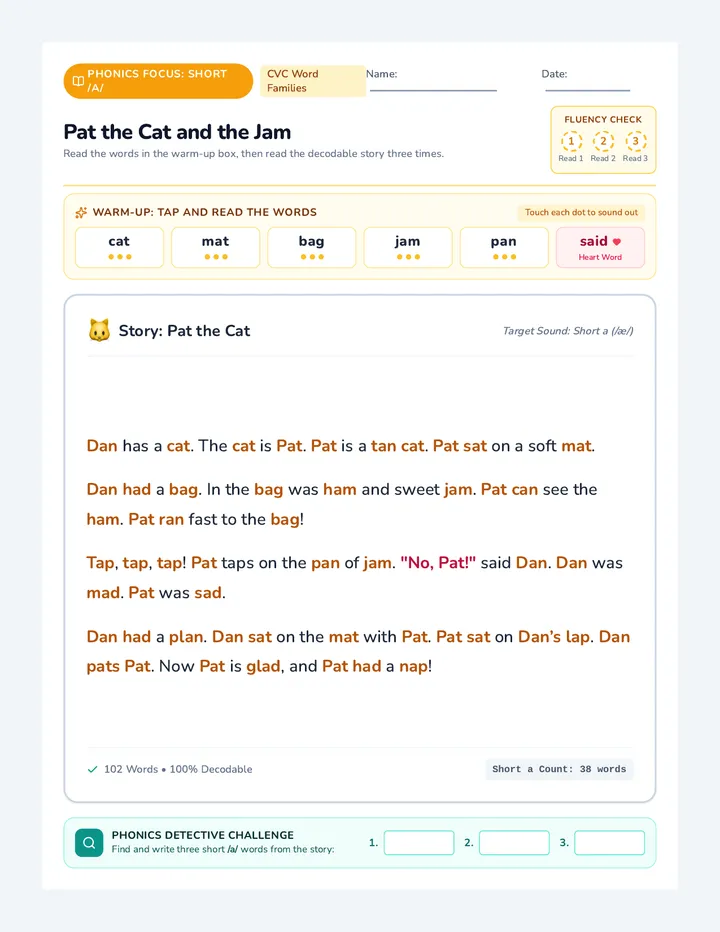
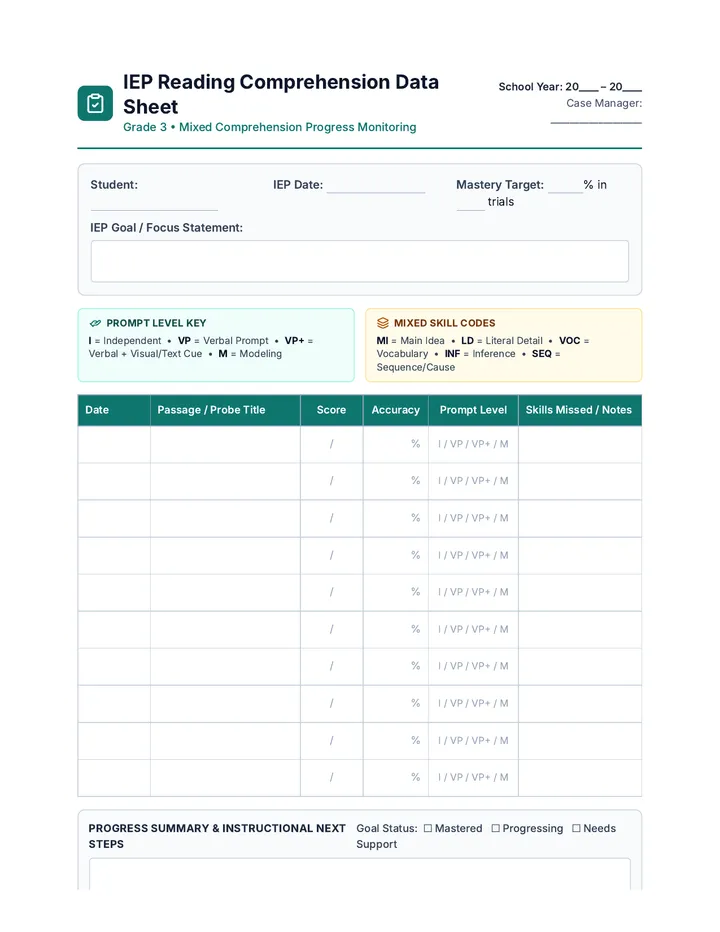
Goal 1 Inference Worksheet Goal 1 • 4th Grade • Inference
Progress Check: Reading Between the Lines
Target: 75% Accuracy (3 out of 4 correct)
Teacher Score
____ / 4 (____%)
Name: ____________________________________
Date: _________________
Directions: Read the story carefully on your own. Use clues from the story and what you already know to answer the inference questions on the next page.
The Muddy Pawprints
Leo stepped onto the back porch, holding a fresh plate of peanut butter cookies for his little sister, Maya. He set the plate down on the wicker table for just a moment to untie his muddy soccer cleats. When he looked up, the screen door was swinging gently back and forth, and the porch was quiet.
"Maya?" Leo called out, glancing toward the kitchen. Only the low hum of the refrigerator answered him. He turned back to the wicker table and froze. The plate was now sitting on the floor, completely empty except for a few crumbs.
Leo knelt down to inspect the wooden boards. Leading away from the plate were four small, brown smudges shaped like teardrops, heading straight toward the bushes at the edge of the yard. Near the bottom step, he spotted a single tuft of golden fur caught on a splinter.
From behind the hydrangea bush came a low, contented crunching sound, followed by the soft thump-thump-thump of something hitting the fence. Leo sighed, picked up the empty plate, and walked back inside to grab a mop—and another batch of cookies.
Goal 1 Questions: Making Inferences
4th Grade • 4 Questions
1. Why did Leo set the plate of cookies down on the wicker table?
A. He wanted to cool the cookies off in the fresh air.
B. He needed both hands free to untie his dirty shoes.
C. He saw his sister Maya coming out of the kitchen.
D. He was tired of carrying the heavy plate inside.
2. Who most likely ate the peanut butter cookies?
A. Leo's little sister, Maya
B. A squirrel from the trees
C. A golden-colored dog
D. A neighbor walking past the yard
3. What was making the "soft thump-thump-thump" sound behind the bush?
A. A happy tail wagging against the fence
B. Maya bouncing a soccer ball in the yard
C. The screen door blowing in the wind
D. Leo tapping his cleats on the porch
4. Why did Leo go inside to grab a mop at the end of the story? Explain using clues from the text.
Goal 2 Comprehension Worksheet Goal 2 • 5th Grade • Comprehension
Progress Check: Reading Comprehension
Target: 80% Accuracy (4 out of 5 correct)
Teacher Score
____ / 5 (____%)
Name: ____________________________________
Date: _________________
Directions: Read the passage independently. Then answer all five comprehension questions on the next page.
The Secret Language of Whales
Deep beneath the ocean waves, sunlight fades into a dark blue world where eyes are not very useful. To survive, humpback whales rely on sound. Because sound travels nearly four times faster in water than in air, a whale's voice can carry across miles of open ocean.
Male humpback whales are famous for singing long, complex songs that can last up to thirty minutes. Scientists who study marine acoustics have discovered that these songs are not random noises. Instead, each song is made of repeating patterns called phrases and themes, much like verses in a human song.
Even more surprising, whales living in the same ocean region tend to sing the exact same song during a breeding season. Over the months, small changes appear in the melody—a high whistle might be added, or a deep groan might be shortened. Gradually, every whale in the group learns the new version, as if a hit song is spreading across the sea.
Researchers are still working to understand the exact purpose of whale songs. Many believe the music helps males attract mates or mark their territory. Whatever the reason, these underwater concerts remind us that the ocean is far from silent.
Goal 2 Questions: Comprehension Check
5th Grade • 5 Questions
1. Why do humpback whales rely on sound more than sight deep in the ocean?
A. Whales are born without eyes.
B. Sunlight fades underwater, and sound travels very fast in water.
C. Ocean water blocks all sounds from traveling far.
D. Whales only swim at night when it is dark.
2. How are humpback whale songs similar to human songs?
A. They are both written down using musical notes.
B. They are both sung only by females.
C. They are made of repeating patterns like phrases and themes.
D. They both last exactly thirty minutes long.
3. What happens to a whale group's song over the course of a breeding season?
A. Small changes appear, and every whale learns the new version.
B. Every whale invents its own completely different song.
C. The whales stop singing until the next year.
D. The song stays exactly the same without any changes.
4. Based on the passage, what does the phrase "marine acoustics" most likely mean?
A. The study of ocean plants and coral reefs
B. The study of sound in the ocean
C. The study of how whales swim
D. The study of deep-sea sunlight
5. According to the text, what are two possible reasons male humpback whales sing?
Goal 3 Literal Worksheet Goal 3 • Literal Comprehension • Level K
Progress Check: Game Day
Teacher Score
____ / 4 (____%)
Name: ____________________________________
Date: _________________
Directions: Read the paragraph carefully. Then answer the four questions below using facts from the text.
Game Day at the Gym
Max gets off the bus with his red gym bag. He puts on his black cap and meets his pal, Ben. Today is a big game! Max and Ben run fast in the gym. Max makes a good shot, and his team gets ten. They win the big game! After the game, Max and Ben sit down to eat a snack.
1. What color is Max's gym bag?
A. red
B. blue
C. black
2. Who does Max meet before the game?
A. Sam
B. Ben
C. Tim
3. Where do Max and Ben run fast?
A. on the bus
B. in the park
C. in the gym
4. What do Max and Ben do after the game?
Goal 4 Conclusions Worksheet Goal 4 • 4th Grade • Inferences & Conclusions
Progress Check: Drawing Conclusions
Target: 80% Accuracy (4 out of 5 correct)
Teacher Score
____ / 5 (____%)
Name: ____________________________________
Date: _________________
Directions: Read the passage carefully. Combine what the text says directly with implied clues to draw conclusions and answer the questions on the next page.
The Midnight Greenhouse
Every morning at six o'clock, Mr. Alvarez unlocked the glass doors of his neighborhood greenhouse. Even in the middle of January, when frost painted the sidewalks white, the air inside smelled like damp soil and blooming jasmine.
One Tuesday, Clara arrived early to help water the ferns. She noticed Mr. Alvarez sitting on an overturned bucket, rubbing his hands together. A thick wool scarf was wrapped around his neck, and his breath puffed out in tiny white clouds. Beside the back wall, the old copper heater stood silent, its pilot light dark.
"We have to move fast, Clara," Mr. Alvarez said, standing up and reaching for a stack of heavy burlap blankets. "If the temperature drops any lower, the orchid buds won't survive until noon."
For the next hour, Clara and Mr. Alvarez draped blankets over the delicate orchid tables and carried the smaller potted plants into the back office, where a small space heater hummed warmly. By the time the sun climbed over the roof, Clara's cheeks were pink, and every fragile plant was tucked safely away.
Goal 4 Questions: Inferences & Conclusions
4th Grade • 5 Questions
1. What season is it during this story?
A. Spring
B. Summer
C. Autumn
D. Winter
2. What can you conclude happened in the greenhouse before Clara arrived?
A. Mr. Alvarez forgot to lock the glass doors overnight.
B. The main copper heater stopped working.
C. All of the orchid buds had already bloomed.
D. Someone broke a window in the back office.
3. Why did Mr. Alvarez and Clara cover the orchid tables with burlap blankets?
A. To keep the bright morning sun off the leaves
B. To hide the flowers from neighborhood customers
C. To trap warmth and protect the plants from freezing
D. To keep dust off the tables while sweeping
4. Based on the passage, what can you infer about orchids?
A. They grow best in freezing temperatures.
B. They are sensitive to cold and need warmth to survive.
C. They do not need any water during January.
D. They are stronger than ferns and jasmine.
5. How do you know the back office was warmer than the main greenhouse? Use two details from the text.
Goal 5 Comprehension Worksheet Goal 5 • 5th/6th Grade • Literal & Inferential
Progress Check: Space Exploration
Target: 80% Accuracy (4 out of 5 correct)
Teacher Score
____ / 5 (____%)
Name: ____________________________________
Date: _________________
Directions: Read the informational passage carefully. Answer the literal and inferential comprehension questions on the next page.
Sailing on Sunlight
Traditional rockets require enormous tanks of heavy chemical fuel to push a spacecraft through space. Once that fuel burns up, the spacecraft can no longer accelerate. To solve this problem, aerospace engineers developed a clever alternative inspired by ocean ships: solar sails.
A solar sail is a giant, ultra-thin sheet of reflective material—often thinner than a human hair—stretched across lightweight carbon-fiber booms. Instead of catching wind, the sail catches photons, which are tiny packets of energy that stream constantly from the Sun. Although a single photon has no mass, billions of photons bouncing off a mirror-like sail create a gentle, continuous push.
At first, that push is barely noticeable, roughly equal to the weight of a paperclip resting on your hand. However, because there is no air resistance in the vacuum of space, the spacecraft never slows down. Day after day, the steady pressure of sunlight builds up, eventually accelerating the craft to tens of thousands of miles per hour without burning a single drop of fuel.
In 2010, Japan's IKAROS spacecraft became the first to successfully demonstrate solar-sail propulsion on a voyage past Venus. Since then, engineers have tested even larger sails, hoping they might one day carry small probes to distant asteroids and beyond.
Goal 5 Questions: Literal & Inferential
5th/6th Grade • 5 Questions
1. (Literal) What does a solar sail catch in order to move a spacecraft?
A. Ocean winds from Earth's atmosphere
B. Photons streaming from the Sun
C. Liquid chemical fuel stored in tanks
D. Carbon-fiber booms floating in space
2. (Literal) Which spacecraft first proved that solar-sail propulsion works on a voyage past Venus?
A. Apollo 11
B. Voyager
C. IKAROS
D. Sputnik
3. (Inferential) Why must a solar sail be made of "mirror-like" reflective material instead of dark cloth?
A. So astronauts can see their reflection from Earth
B. So photons bounce off the surface to create a push
C. Because dark cloth is too heavy to fold into a rocket
D. Because dark materials melt immediately near Venus
4. (Inferential) Why would a solar sail NOT work well to lift a rocket off Earth's launchpad?
A. Sunlight cannot reach Earth's surface.
B. The initial push is too weak to overcome Earth's gravity and air resistance.
C. Photons only exist beyond the planet Venus.
D. Carbon-fiber booms cannot support any weight on Earth.
5. (Inferential) Explain why a tiny push equal to a paperclip can eventually make a spacecraft travel tens of thousands of miles per hour.
Goal 6 Main Idea Worksheet Goal 6 • Instructional Level • Main Idea & Details
Progress Check: Main Idea & Details
Target: Identify the main idea and at least 2 supporting details
Teacher Score
____ / 3 (____%)
Name: ____________________________________
Date: _________________
How Honeybees Talk by Dancing
Honeybees do not use words to share news, yet they are expert communicators. When a worker bee discovers a field full of sweet nectar, she flies straight back to the hive to tell the other bees exactly where to find the food.
To share directions, the bee performs a special figure-eight movement called the "waggle dance." The angle of her dance shows the other bees which direction to fly compared to the sun. Even more amazing, the length of time she waggles tells them how far away the flowers are. By watching her dance closely, dozens of bees can fly directly to the same flower patch without ever having seen it before.
1. Main Idea (What is the whole passage mostly about?)
2. Supporting Detail #1 (A key fact from the text that supports the main idea)
3. Supporting Detail #2 (Another key fact from the text that supports the main idea)
Goal 7 Comprehension Worksheet Goal 7 • 4th Grade • Comprehension
Progress Check: Reading Comprehension
Target: 85% Accuracy (6 out of 7 correct)
Teacher Score
____ / 7 (____%)
Name: ____________________________________
Date: _________________
Directions: Read the passage carefully. Then answer all seven comprehension questions on the next page.
The Floating Gardens of Xochimilco
Hundreds of years ago, the Aztec people built their capital city on an island in the middle of a shallow lake in Mexico. Because there was very little dry land for farming, they needed a smart way to grow enough food for thousands of citizens. Their solution was to build chinampas , often called "floating gardens."
Even though they looked like they were floating, chinampas did not actually drift around. Workers wove giant rectangular mats out of reeds and anchored them to the muddy lake bottom with wooden stakes. Next, they piled layers of rich lake mud and decaying plants onto the mats to create fertile soil.
To keep the soil from washing away, farmers planted willow trees along the edges of each garden. The willow roots grew deep into the lakebed, locking the island firmly in place. Because the gardens were surrounded by water, the crops never dried out, and farmers could harvest corn, squash, beans, and bright marigolds up to seven times a year!
Today, visitors can still glide past the remaining chinampas in colorful wooden boats in Xochimilco, just south of Mexico City, admiring one of the most creative farming inventions in history.
Goal 7 Questions: Comprehension Check
4th Grade • 7 Questions
1. Why did the Aztec people need to invent chinampas?
A. There was little dry land for farming.
B. They wanted to race colorful boats.
C. Willow trees could not grow on land.
D. The lake had no fish left to catch.
2. What were the giant rectangular mats made from?
A. Flat stones
B. Woven reeds
C. Dry cornstalks
D. Willow bark
3. Why is the nickname "floating gardens" a little misleading?
A. The gardens did not actually drift; they were anchored to the lakebed.
B. Only flowers were grown on the mats, not vegetables.
C. The gardens were built high up in the mountains.
4. How did willow trees help the chinampas?
A. Their leaves provided shade for tourists in wooden boats.
B. Their deep roots locked the soil and islands firmly in place.
C. Their branches were used to build Aztec houses.
5. How many times a year could Aztec farmers harvest crops from a chinampa?
A. Once a year
B. Twice a year
C. Up to four times a year
D. Up to seven times a year
6. Which of these was NOT listed as a crop grown on chinampas?
A. Corn
B. Wheat
C. Squash
D. Marigolds
7. Why did crops on chinampas never dry out?
Goal 8 Evidence Worksheet Goal 8 • 5th/6th Grade • Comprehension & Text Evidence
Progress Check: Citing Text Evidence
Target: 80% Accuracy (4 out of 5 correct with evidence)
Teacher Score
____ / 5 (____%)
Name: ____________________________________
Date: _________________
Directions: Read the informational passage. On the next page, answer each question and support your answer with specific evidence from the text.
The Mystery of the Monarch Migration
Every autumn, millions of monarch butterflies embark on one of nature's most astonishing journeys. Weighing less than a paperclip, these fragile insects travel up to 3,000 miles from Canada and the northern United States to a small patch of mountain forest in central Mexico.
What makes this migration truly puzzling is that the butterflies making the trip south have never been to Mexico before. In fact, they are three or four generations removed from the ancestors that flew north in the spring. Somehow, without maps or parents to guide them, they find the exact same oyamel fir trees year after year.
Scientists have discovered that monarchs use a built-in "sun compass" to stay on track. Special sensors in their antennae measure the position of the sun in the sky, while an internal clock in their brains adjusts for the time of day. On cloudy days, when the sun is hidden, monarchs appear to rely on a magnetic sense—similar to a bird's—to keep heading southwest.
Unfortunately, monarch populations have declined in recent decades due to habitat loss and fewer milkweed plants, which are the only food monarch caterpillars can eat. Conservationists now encourage families to plant native milkweed to help keep this remarkable migration alive.
Goal 8 Questions: Answer & Support with Evidence
5th/6th Grade • 5 Questions
1. Why is the monarchs' autumn trip to Mexico considered puzzling by scientists? Cite evidence from the text.
2. How do monarchs navigate on sunny days? Include two specific body parts mentioned in the passage.
3. What backup system do monarchs use when clouds block the sun? Quote or paraphrase the text.
4. Why are milkweed plants essential to the survival of monarch butterflies? Support your answer with text evidence.
5. Based on the passage, what is one way people can help protect the monarch migration?
Goal 9 Main Idea Worksheet Goal 9 • 3rd/4th Grade • Main Idea
Progress Check: 5 Main Idea Trials
Target: Identify the main idea in 4 out of 5 trials (80%)
Teacher Score
____ / 5 Trials
Name: ____________________________________
Date: _________________
Directions: Read each short paragraph carefully. Choose the sentence that best states the main idea of that paragraph.
Trial 1
Sea otters spend most of their lives in cold ocean water, so they need a way to stay warm. Unlike whales and seals, otters do not have a thick layer of fat. Instead, they have the thickest fur of any animal on Earth—up to one million hairs per square inch! This dense coat traps tiny air bubbles next to their skin, keeping icy water out.
What is the main idea of Trial 1?
A. Whales and seals have thick layers of fat.
B. Sea otters stay warm in cold water thanks to their super-thick fur.
C. Sea otters spend most of their time sleeping on rocks.
Trial 2
Before refrigerators were invented, keeping food fresh was a big challenge. People in warm areas salted meat or dried fruit in the sun so it would not spoil. In colder places, workers cut giant blocks of ice from frozen lakes in winter and stored them under sawdust in icehouses to use all summer long.
What is the main idea of Trial 2?
A. Long ago, people used creative methods to keep food from spoiling.
B. Sawdust was the most useful material in winter.
C. Dried fruit tastes better than fresh fruit.
Goal 9: Main Idea Trials (Continued)
3rd/4th Grade • Trials 3–5
Trial 3
Every morning, the school's Green Team empties the blue recycling bins from each classroom. They sort out plastic bottles, aluminum cans, and clean paper, then weigh everything on a scale. Last month alone, the students kept over two hundred pounds of trash out of the local landfill.
What is the main idea of Trial 3?
A. Blue recycling bins are heavier than trash cans.
B. The school's Green Team works hard to recycle and reduce waste.
C. Students should only use aluminum cans at lunch.
Trial 4
A cactus is built to survive in the dry desert. Its thick, waxy skin locks moisture inside so the sun cannot dry it out. Instead of wide leaves, a cactus grows sharp spines that shade the stem and protect its stored water from thirsty desert animals.
What is the main idea of Trial 4?
A. A cactus has special features that help it save water in the desert.
B. Desert animals are always looking for shade.
C. Cactus spines are sharper than rose thorns.
Trial 5
Learning to ride a bicycle takes patience and practice. At first, it is normal to wobble or lose your balance when you push off the curb. With a helmet on and someone steady beside you, each short ride builds confidence until pedaling feels effortless.
What is the main idea of Trial 5?
A. Helmets come in many different colors.
B. Nobody should ever ride near a curb.
C. Riding a bike gets easier with patience and practice.
Goal 10 Literal Worksheet Goal 10 • 3rd/4th Grade • Literal (5 Ws & H)
Progress Check: Who, What, When, Where, How
Target: 80% Accuracy (4 out of 5 correct)
Teacher Score
____ / 5 (____%)
Name: ____________________________________
Date: _________________
Directions: Read the story carefully. Then answer the five literal questions (Who, What, When, Where, and How) on the next page using facts stated directly in the story.
Saturday at the Community Garden
Last Saturday morning at eight o'clock, Elena and her grandfather walked two blocks to the Maple Street Community Garden. Elena carried a small canvas bag filled with bright orange carrot seeds and a pair of green gardening gloves.
When they arrived, several neighbors were already pulling weeds near the wooden tool shed. Elena's grandfather showed her how to prepare their raised garden bed. First, they loosened the dark soil with a hand rake. Next, Elena poked shallow rows into the dirt with her finger, dropped in the tiny seeds, and gently patted the soil back over them.
Before heading home for lunch, Elena filled a blue watering can from the rain barrel and sprinkled water evenly across the bed. She couldn't wait to come back in a few weeks to see the first green sprouts!
Goal 10 Questions: Literal Comprehension
3rd/4th Grade • 5 Questions
WHO 1. Who walked together to the community garden?
WHAT 2. What two items did Elena carry inside her small canvas bag?
WHEN 3. When did Elena and her grandfather go to the garden?
WHERE 4. Where was the community garden located?
HOW 5. How did Elena and her grandfather plant the carrot seeds?
Goal 11 Comprehension Worksheet Goal 11 • 1st Grade • Comprehension
Reading Check: Mia's Lost Mittens
Teacher Score
____ / 4 (____%)
Name: __________________________________
Date: ______________
Mia's Lost Mittens
It was cold outside, and Mia wanted to play in the snow.
She looked on her bed, but her warm pink mittens were not there.
Mia looked under the brown chair and inside her red coat pocket.
At last, she saw her puppy sitting on the pink mittens by the door!
Mia laughed, put on her mittens, and ran out to build a snowman.
1. Why did Mia need her mittens?
She wanted to play in the snow.
She was going to sleep.
She wanted to wash her hands.
2. Where did Mia find her pink mittens?
On her bed
Under her puppy by the door
Inside her coat pocket
3. How did Mia feel when she saw her puppy on the mittens?
Mad
Sad
Happy
4. What did Mia do after she put on her mittens?
Goal 12 Open Ended Worksheet Goal 12 • 5th Grade • Open-Ended Response
Progress Check: Open-Ended Questions
Target: 75% Accuracy (3 out of 4 correct)
Teacher Score
____ / 4 (____%)
Name: ____________________________________
Date: _________________
Directions: Read the passage carefully. Answer each open-ended question on the next page in complete sentences.
The Bridge Made of Grass
High in the Andes Mountains of Peru, a deep canyon cuts through the rocky landscape above the Apurimac River. Hundreds of years ago, the Inca Empire needed a way to cross this steep gorge so messengers and traders could travel between mountain villages. Instead of building with stone or wood, Inca engineers wove a suspension bridge entirely out of wild mountain grass.
The bridge, known as Q'eswachaka , stretches more than one hundred feet across the canyon. Because dried grass eventually wears down in the wind and rain, the bridge cannot last forever. For over five centuries, nearby communities have gathered every June for a three-day festival to rebuild it together.
First, families harvest tough ichu grass and twist it into thin cords. Then, teams braid those cords into thick cables as wide as a person's arm. Finally, skilled weavers tie the new grass cables across the canyon and carefully cut away the old bridge. Within three days, a brand-new bridge swings safely above the river—a living tradition passed down from ancestors to their grandchildren.
Goal 12 Questions: Open-Ended Responses
5th Grade • 4 Questions
1. Why did the Inca Empire originally need to build the Q'eswachaka bridge?
2. Why do the nearby communities rebuild the bridge every single June?
3. Describe the main steps the villagers follow to turn wild grass into a strong bridge.
4. What do you think the author means by calling the bridge a "living tradition"?
Goal 13 Inference Worksheet Goal 13 • 5th Grade • Inference & Evidence
Progress Check: Inference & Text Evidence
Target: Answer inference questions and cite supporting text evidence
Teacher Score
____ / 4 (____%)
Name: ____________________________________
Date: _________________
Directions: Read the story carefully. On the next page, answer each inference question and cite a specific detail or quote from the text to prove your answer.
The Violin in the Attic
Rain tapped steadily against the attic skylight as Nora sorted through dusty boxes for her grandmother's old photo albums. Behind a stack of winter coats, her fingers brushed against a battered leather case with brass latches. Curious, Nora clicked them open.
Inside, nestled in faded blue velvet, lay a polished wooden violin. Tucked beneath the strings was a yellowed concert program dated October 14, 1978, with the name "Elena Vance, First Violin" printed in bold letters. Nora stared at the program—Elena Vance was her grandmother's maiden name.
Nora carried the case downstairs to the kitchen, where her grandmother was stirring a pot of soup. When Grandmother turned around and saw the leather case, the wooden spoon stopped midair. She wiped her hands on her apron, walked over slowly, and traced the brass latches with a trembling finger.
"I didn't think anyone would ever find that," Grandmother whispered, a sudden shine appearing in her eyes. "My fingers are too stiff to play now, Nora, but if you'd like to learn, I still remember how to tune it."
Goal 13 Questions: Inference & Evidence
5th Grade • 4 Questions
1. Had Nora ever seen her grandmother play the violin before? Cite evidence from the text.
2. What can you infer about Grandmother's skill as a violinist when she was younger? Cite evidence to support your answer.
3. How did Grandmother feel when Nora brought the violin downstairs? Cite two clues from the text.
4. Why did Grandmother offer to teach Nora how to tune the violin instead of playing it herself?
Goal 14 Main Idea Worksheet Goal 14 • 5th–6th Grade • Main Idea & Inference
Progress Check: Main Idea & Inference
Target: 80% Accuracy (4 out of 5 correct)
Teacher Score
____ / 5 (____%)
Name: ____________________________________
Date: _________________
Directions: Read the informational passage independently. Then answer the main idea and inference questions on the next page.
Cooling Cities with Urban Forests
On a hot July afternoon, a downtown city block can feel noticeably warmer than a nearby park. That is because dark asphalt streets and concrete buildings absorb the sun's heat and release it slowly, creating what scientists call an "urban heat island."
To fight rising summer temperatures, many cities are planting "urban forests"—networks of shade trees along sidewalks, schoolyards, and rooftops. A single mature tree provides two powerful cooling effects. First, its leafy canopy blocks direct sunlight from heating up the pavement below. Second, trees release water vapor through their leaves in a process called transpiration, which cools the surrounding air much like natural air conditioning.
Studies show that tree-lined neighborhoods can be up to nine degrees cooler than treeless blocks just a few streets away. Besides lowering temperatures, urban trees filter dust from the air, absorb stormwater during heavy rains, and give city residents quieter, greener places to walk.
Goal 14 Questions: Main Idea & Inference
5th–6th Grade • 5 Questions
1. (Main Idea) What is the central idea of the entire passage?
A. Concrete buildings are more expensive to build than parks.
B. Planting urban forests helps cool hot cities and provides important environmental benefits.
C. July is the hottest month of the year in most downtown areas.
D. Trees need heavy rainstorms in order to grow along sidewalks.
2. (Main Idea) Which sentence best states the main idea of the second paragraph?
A. Trees cool cities in two ways: by shading pavement and releasing water vapor.
B. Rooftop gardens are more popular than schoolyard trees.
C. Air conditioning uses less energy than a mature tree.
D. Mature trees take many years to grow tall canopies.
3. (Inference) Why would a city with very few trees likely have higher electricity bills in July?
A. Tree roots damage underground power lines during storms.
B. Warmer buildings and streets mean people must run air conditioners more often.
C. Streetlights have to stay on longer when there are no leaves.
D. Treeless blocks receive more rain than parks.
4. (Inference) What might happen to a city street without trees during a sudden, heavy rainstorm?
A. It would be more likely to flood because fewer trees are there to absorb stormwater.
B. The asphalt would immediately turn into fertile soil.
C. The air would become nine degrees warmer than before.
D. Rainwater would turn into transpiration inside the buildings.
5. (Inference) Why do you think scientists chose the name "urban heat island" to describe downtown areas?
Reading Progress Answer Key Teacher Resource • Goals 1–14
Reading Progress Packet: Answer Key
Complete scoring key, sample open-ended responses, and text-evidence criteria (K–6th Grade)
Packet Pages
Page 1 of 5
Goal 1 4th Grade • Inference • The Muddy Pawprints
Target: 75% (3/4)
1. B — He needed both hands free to untie his dirty shoes.
2. C — A golden-colored dog
3. A — A happy tail wagging against the fence
4. Sample Response: Leo grabbed a mop to clean up the muddy pawprints ("four small, brown smudges") the dog left on the wooden porch boards after eating the cookies.
Goal 2 5th Grade • Comprehension • The Secret Language of Whales
Target: 80% (4/5)
1. B — Sunlight fades underwater, and sound travels very fast in water.
2. C — They are made of repeating patterns like phrases and themes.
3. A — Small changes appear, and every whale learns the new version.
4. B — The study of sound in the ocean
5. Sample Response: Researchers believe male humpback whales sing to attract mates or to mark their territory.
Goal 3 Level K • Literal Comprehension • Game Day at the Gym
4 Questions
1. A — red
2. B — Ben
3. C — in the gym
4. Sample Response: Max and Ben sit down to eat a snack.
Reading Progress Packet: Answer Key (Continued)
Page 2 of 5 • Goals 4–6
Goal 4 4th Grade • Inferences & Conclusions • The Midnight Greenhouse
Target: 80% (4/5)
1. D — Winter
2. B — The main copper heater stopped working.
3. C — To trap warmth and protect the plants from freezing
4. B — They are sensitive to cold and need warmth to survive.
5. Sample Response: The text states a small space heater "hummed warmly" in the back office, whereas in the main greenhouse the copper heater was silent, Mr. Alvarez wore a wool scarf, and his breath puffed out in white clouds. (Accept any 2 valid details.)
Goal 5 5th/6th Grade • Literal & Inferential • Sailing on Sunlight
Target: 80% (4/5)
1. B — Photons streaming from the Sun
2. C — IKAROS
3. B — So photons bounce off the surface to create a push
4. B — The initial push is too weak to overcome Earth's gravity and air resistance.
5. Sample Response: Because there is no air resistance in the vacuum of space, the spacecraft never slows down. The steady pressure of sunlight builds up day after day, gradually accelerating it to high speeds.
Goal 6 Instructional Level • Main Idea & Details • How Honeybees Talk by Dancing
Target: Main Idea + 2 Details
1. Main Idea: Honeybees communicate where to find food (nectar/flowers) by performing a special figure-eight movement called the "waggle dance."
2. Supporting Detail #1: The angle of the bee's dance shows the other bees which direction to fly compared to the sun.
3. Supporting Detail #2: The length of time the bee waggles tells the other bees how far away the flowers are. (Also accept: By watching the dance closely, dozens of bees can fly directly to a flower patch they have never seen before.)
Reading Progress Packet: Answer Key (Continued)
Page 3 of 5 • Goals 7–9
Goal 7 4th Grade • Comprehension • The Floating Gardens of Xochimilco
Target: 85% (6/7)
1. A — There was little dry land for farming.
2. B — Woven reeds
3. A — Anchored to the lakebed (didn't drift)
4. B — Deep roots locked soil & islands in place
5. D — Up to seven times a year
6. B — Wheat
7. Sample Response: The gardens were surrounded by lake water, so the crops always had moisture and never dried out.
Goal 8 5th/6th Grade • Text Evidence • The Mystery of the Monarch Migration
Target: 80% (4/5 w/ evidence)
The monarchs flying south have never been to Mexico before (they are 3–4 generations removed from the ancestors that flew north), yet they find the exact same oyamel fir trees without maps or parents.
They use a built-in "sun compass": sensors in their antennae measure the sun's position, and an internal clock in their brains adjusts for the time of day.
On cloudy days, they rely on a "magnetic sense—similar to a bird's—to keep heading southwest."
Milkweed is "the only food monarch caterpillars can eat," and fewer milkweed plants have caused populations to decline.
People can help by planting native milkweed.
Goal 9 3rd/4th Grade • Main Idea • 5 Short Passage Trials
Target: 80% (4/5 Trials)
Trial 1: B — Sea otters stay warm in cold water thanks to their super-thick fur.
Trial 2: A — Long ago, people used creative methods to keep food from spoiling.
Trial 3: B — The school's Green Team works hard to recycle and reduce waste.
Trial 4: A — A cactus has special features that help it save water in the desert.
Trial 5: C — Riding a bike gets easier with patience and practice.
Reading Progress Packet: Answer Key (Continued)
Page 4 of 5 • Goals 10–12
Goal 10 3rd/4th Grade • Literal (5 Ws & H) • Saturday at the Community Garden
Target: 80% (4/5)
1. (WHO) Elena and her grandfather
2. (WHAT) Bright orange carrot seeds and a pair of green gardening gloves
3. (WHEN) Last Saturday morning at eight o'clock
4. (WHERE) At the Maple Street Community Garden (two blocks away)
5. (HOW) They loosened the soil with a hand rake, poked shallow rows with a finger, dropped in the seeds, patted the soil back over them, and watered the bed.
Goal 11 1st Grade • Comprehension • Mia's Lost Mittens
4 Questions
She wanted to play in the snow. (Option 1)
Under her puppy by the door (Option 2)
Happy (Option 3)
4. Sample Response: She ran out to build a snowman.
Goal 12 5th Grade • Open-Ended • The Bridge Made of Grass
Target: 75% (3/4)
The Inca Empire needed a way for messengers and traders to cross the steep canyon above the Apurimac River to travel between mountain villages.
They rebuild it every June because dried grass wears down in the wind and rain and cannot last forever.
First, families harvest ichu grass and twist it into thin cords. Next, teams braid the cords into thick cables. Finally, weavers tie the new cables across the canyon and cut away the old bridge.
It means the bridge-building custom is still actively practiced today—not forgotten—and is passed down from ancestors to grandchildren each year.
Reading Progress Packet: Answer Key (Continued)
Page 5 of 5 • Goals 13–14
Goal 13 5th Grade • Inference & Evidence • The Violin in the Attic
4 Questions w/ Citations
No. Nora was curious when she found the battered case hidden behind winter coats and stared at the 1978 concert program. Grandmother also whispered, "I didn't think anyone would ever find that."
She was likely an accomplished/skilled violinist, because the 1978 concert program listed "Elena Vance, First Violin" in bold letters.
She felt deeply emotional and nostalgic. Clues: her wooden spoon stopped midair, she traced the latches with a "trembling finger," and a "sudden shine" (tears) appeared in her eyes.
Grandmother said her fingers are "too stiff to play now," so she can no longer play it herself, though she still remembers how to tune it.
Goal 14 5th–6th Grade • Main Idea & Inference • Cooling Cities with Urban Forests
Target: 80% (4/5)
1. B — Planting urban forests helps cool hot cities and provides important environmental benefits.
2. A — Trees cool cities in two ways: by shading pavement and releasing water vapor.
3. B — Warmer buildings and streets mean people must run air conditioners more often.
4. A — It would be more likely to flood because fewer trees are there to absorb stormwater.
5. Sample Response: Downtown areas absorb and hold heat from dark asphalt and concrete, making them noticeably warmer than nearby greener parks—like an "island" of heat surrounded by cooler areas.
Quick Percentage Conversion Reference
3-Item Goals
3/3 = 100% • 2/3 = 67%
4-Item Goals
4/4 = 100% • 3/4 = 75%
5-Item Goals
5/5 = 100% • 4/5 = 80%
7-Item Goal (Goal 7)
7/7 = 100% • 6/7 = 86%