Flight Plan Template
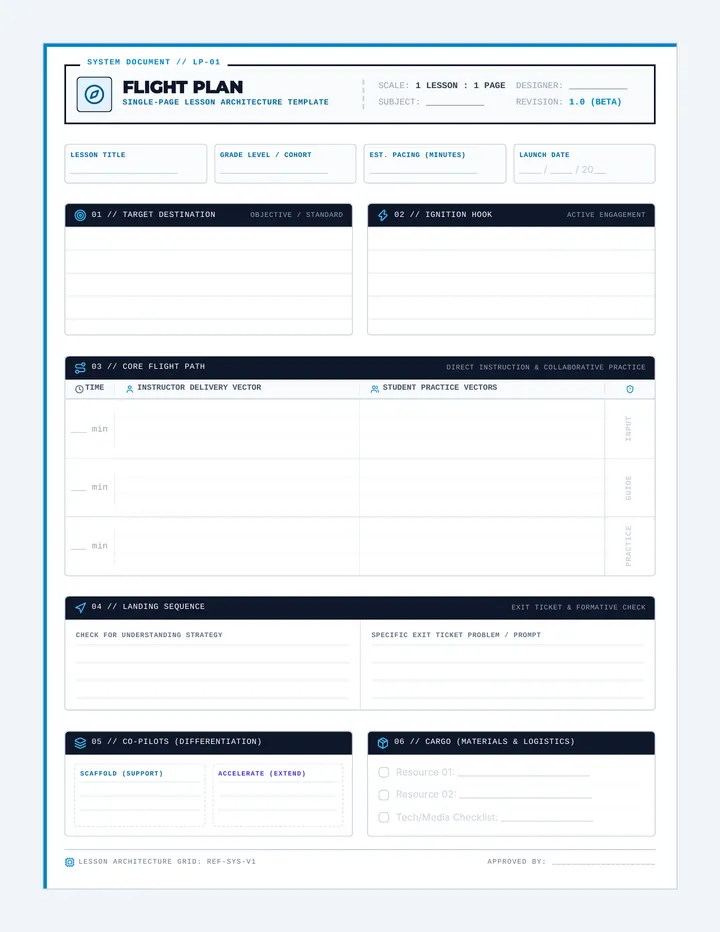
System Document // LP-01
Flight Plan
Single-Page Lesson Architecture Template
SCALE: 1 LESSON : 1 PAGE
DESIGNER: ___________
SUBJECT: ___________
REVISION: 1.0 (BETA)
Lesson Title ________________________
Grade Level / Cohort ________________________
Est. Pacing (Minutes) ________________________
Launch Date _____ / _____ / 20___
01 // Target Destination
Objective / Standard
02 // Ignition Hook
Active Engagement
03 // Core Flight Path
Direct Instruction & Collaborative Practice
Time
Instructor Delivery Vector
Student Practice Vectors
___ min
INPUT
___ min
GUIDE
___ min
PRACTICE
04 // Landing Sequence
Exit Ticket & Formative Check
Check for Understanding Strategy
Specific Exit Ticket Problem / Prompt
05 // Co-Pilots (Differentiation)
Scaffold (Support)
Accelerate (Extend)
06 // Cargo (Materials & Logistics)
Resource 01: ______________________________
Resource 02: ______________________________
Tech/Media Checklist: _____________________
LESSON ARCHITECTURE GRID: REF-SYS-V1
APPROVED BY: _____________________
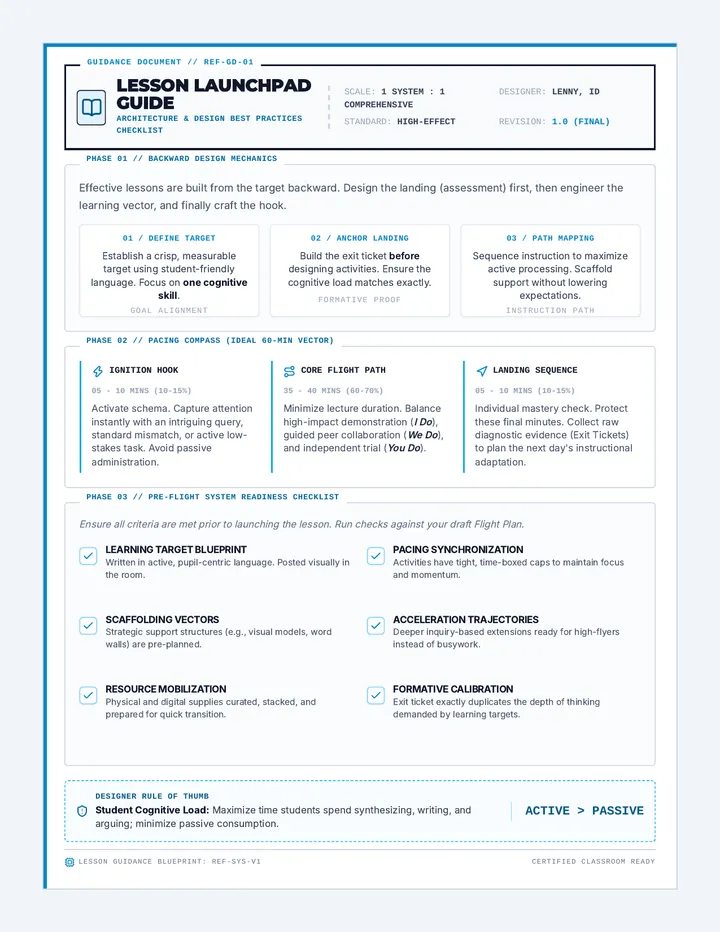
Lesson Launchpad Guide
Guidance Document // REF-GD-01
Lesson Launchpad Guide
Architecture & Design Best Practices Checklist
SCALE: 1 SYSTEM : 1 COMPREHENSIVE
DESIGNER: LENNY, ID
STANDARD: HIGH-EFFECT
REVISION: 1.0 (FINAL)
Phase 01 // Backward Design Mechanics
Effective lessons are built from the target backward. Design the landing (assessment) first, then engineer the learning vector, and finally craft the hook.
01 / Define Target
Establish a crisp, measurable target using student-friendly language. Focus on one cognitive skill.
Goal Alignment
02 / Anchor Landing
Build the exit ticket before designing activities. Ensure the cognitive load matches exactly.
Formative Proof
03 / Path Mapping
Sequence instruction to maximize active processing. Scaffold support without lowering expectations.
Instruction Path
Phase 02 // Pacing Compass (Ideal 60-Min Vector)
Ignition Hook
05 - 10 MINS (10-15%)
Activate schema. Capture attention instantly with an intriguing query, standard mismatch, or active low-stakes task. Avoid passive administration.
Core Flight Path
35 - 40 MINS (60-70%)
Minimize lecture duration. Balance high-impact demonstration (I Do), guided peer collaboration (We Do), and independent trial (You Do).
Landing Sequence
05 - 10 MINS (10-15%)
Individual mastery check. Protect these final minutes. Collect raw diagnostic evidence (Exit Tickets) to plan the next day's instructional adaptation.
Phase 03 // Pre-Flight System Readiness Checklist
Ensure all criteria are met prior to launching the lesson. Run checks against your draft Flight Plan.
Learning Target Blueprint
Written in active, pupil-centric language. Posted visually in the room.
Pacing Synchronization
Activities have tight, time-boxed caps to maintain focus and momentum.
Scaffolding Vectors
Strategic support structures (e.g., visual models, word walls) are pre-planned.
Acceleration Trajectories
Deeper inquiry-based extensions ready for high-flyers instead of busywork.
Resource Mobilization
Physical and digital supplies curated, stacked, and prepared for quick transition.
Formative Calibration
Exit ticket exactly duplicates the depth of thinking demanded by learning targets.
Designer Rule of Thumb
Student Cognitive Load: Maximize time students spend synthesizing, writing, and arguing; minimize passive consumption.
Active > Passive
LESSON GUIDANCE BLUEPRINT: REF-SYS-V1
CERTIFIED CLASSROOM READY