Hanukkah Current Event Worksheet
Current Event #11 Guided Reading & Reflection
Name: _______________________ Date: ___________
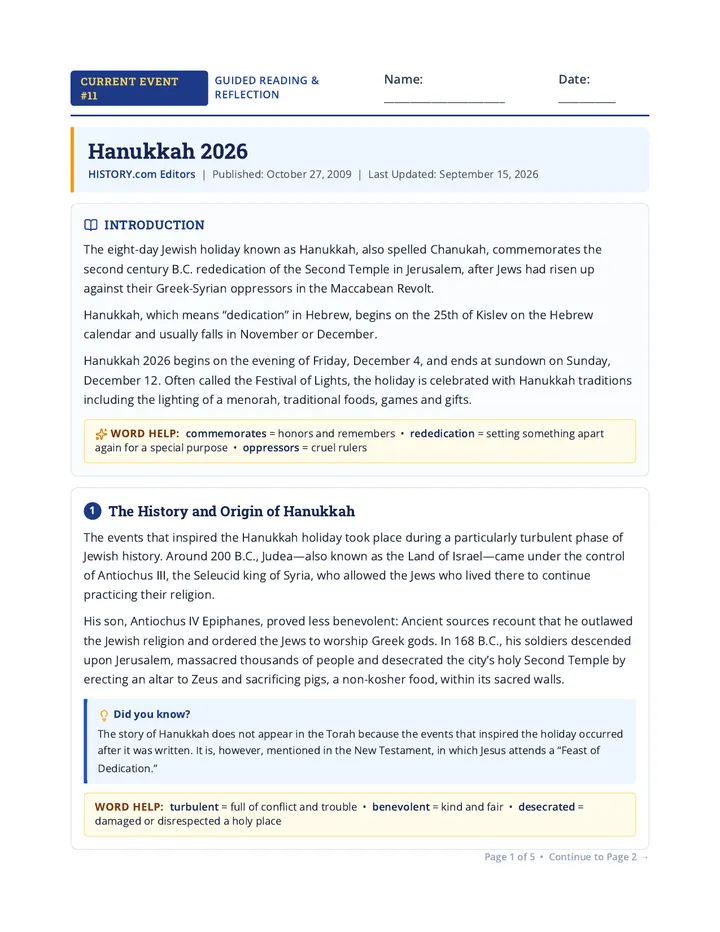
Hanukkah 2026
HISTORY.com Editors | Published: October 27, 2009 | Last Updated: September 15, 2026
Introduction
The eight-day Jewish holiday known as Hanukkah, also spelled Chanukah, commemorates the second century B.C. rededication of the Second Temple in Jerusalem, after Jews had risen up against their Greek-Syrian oppressors in the Maccabean Revolt.
Hanukkah, which means “dedication” in Hebrew, begins on the 25th of Kislev on the Hebrew calendar and usually falls in November or December.
Hanukkah 2026 begins on the evening of Friday, December 4, and ends at sundown on Sunday, December 12. Often called the Festival of Lights, the holiday is celebrated with Hanukkah traditions including the lighting of a menorah, traditional foods, games and gifts.
Word Help: commemorates = honors and remembers • rededication = setting something apart again for a special purpose • oppressors = cruel rulers
1
The History and Origin of Hanukkah
The events that inspired the Hanukkah holiday took place during a particularly turbulent phase of Jewish history. Around 200 B.C., Judea—also known as the Land of Israel—came under the control of Antiochus III, the Seleucid king of Syria, who allowed the Jews who lived there to continue practicing their religion.
His son, Antiochus IV Epiphanes, proved less benevolent: Ancient sources recount that he outlawed the Jewish religion and ordered the Jews to worship Greek gods. In 168 B.C., his soldiers descended upon Jerusalem, massacred thousands of people and desecrated the city’s holy Second Temple by erecting an altar to Zeus and sacrificing pigs, a non-kosher food, within its sacred walls.
Did you know?
The story of Hanukkah does not appear in the Torah because the events that inspired the holiday occurred after it was written. It is, however, mentioned in the New Testament, in which Jesus attends a “Feast of Dedication.”
Word Help: turbulent = full of conflict and trouble • benevolent = kind and fair • desecrated = damaged or disrespected a holy place
Page 1 of 5 • Continue to Page 2 →
Current Event #11: Hanukkah 2026 Section 1 (continued) – Section 3
1. The History and Origin of Hanukkah (continued)
Led by the Jewish priest Mattathias and his five sons, a large-scale rebellion broke out against Antiochus IV and the Seleucid monarchy. When Matthathias died in 166 B.C., his son Judah took the helm and became known as Judah Maccabee, or “the Hammer.”
Within two years, the Maccabees and other Jews had successfully driven the Syrians out of Jerusalem largely by relying on guerrilla warfare tactics. Judah called on his followers to cleanse the Second Temple, rebuild its altar and light the temple's menorah—the gold candelabrum whose seven branches, representing creation and the tree of life, were meant to be kept burning every night as a symbol of God’s light.
Word Help: took the helm = took charge as leader • guerrilla warfare = surprise attacks by small groups • candelabrum = a large branched candle holder
2
The Hanukkah ‘Miracle’
According to the Talmud, one of Judaism’s most central texts, Judah Maccabee and the other Jews who took part in the rededication of the Second Temple witnessed what they believed to be a miracle. Even though there was only enough untainted olive oil to keep the menorah’s candles burning for a single day, the flames continued flickering for eight nights, leaving them time to find a fresh supply.
This wondrous event inspired the Jewish sages to proclaim an annual eight-day festival. (The first Book of the Maccabees tells another version of the story, describing an eight-day celebration that followed the rededication but making no reference to the miracle of the oil.)
Word Help: Talmud = a major book of Jewish law and teachings • untainted = pure and clean • sages = wise religious leaders • proclaim = officially announce
3
Other Interpretations of the Hanukkah Story
Some modern historians offer a radically different interpretation of the story of Hanukkah. In their view, Jerusalem under Antiochus IV had erupted into civil war between two camps of Jews: those who had assimilated into the dominant Greek and Syrian culture that surrounded them and those who were determined to impose Jewish laws and traditions, even if by force.
Word Help: interpretation = a way of explaining what happened • assimilated = adopted the customs of another group • impose = force others to follow
Page 2 of 5 • Continue to Page 3 →
Current Event #11: Hanukkah 2026 Section 3 (continued) – Section 4
3. Other Interpretations of the Hanukkah Story (continued)
The traditionalists won out in the end, with the Hasmonean dynasty—led by Judah Maccabee’s brother Simon and his descendants—wresting control of the Land of Israel from the Seleucids and maintaining an independent Jewish kingdom for more than a century.
Jewish scholars have also suggested that the first Hanukkah might have been a belated celebration of the holiday Sukkot, which Jews had not had the chance to observe during the Maccabean Revolt. One of the Jewish religion’s most important holidays, Sukkot consists of seven days of feasting, prayer and festivities to honor the autumn harvest.
Word Help: dynasty = a line of rulers from the same family • wresting = taking by force • belated = happening later than usual
4
Hanukkah’s Rise in the US
From a religious perspective, Hanukkah is a relatively minor Jewish holiday that places no restrictions on working, attending school or other activities. However, it has grown in popularity over time. This is especially true in the United States, where Hanukkah and Passover are the two most celebrated Jewish holidays.
During the 19th century, the Maccabees became a popular subject of religious scholarship, Jewish magazines and newspapers, artistic performances and public pageants. The Maccabee family served as a example of keeping Jewish faith alive at a time when religious customs were increasingly hard to practice in the U.S., where Christians are the majority.
At the same time, Hanukkah offered a way for American Jews to participate in the winter holiday season and to tap into growing societal desire to shower children with gifts.
The story of Hanukkah took particular hold in the Reform Judaism movement. Two prominent rabbis in Cincinnati developed a child-centric celebration during Hanukkah to attract families back to the synagogue. They also encouraged gift-giving to mirror the Christmas custom.
Word Help: restrictions = rules that limit what you can do • prominent = well-known and important • synagogue = a Jewish house of worship
Page 3 of 5 • Continue to Page 4 →
Current Event #11: Hanukkah 2026 Section 4 (continued) – Section 5
4. Hanukkah’s Rise in the US (continued)
Similar festivities were soon popping up across the country. In recent decades, Hanukkah has exploded into a major commercial phenomenon with people decorating their homes and exchange presents in addition to observing a variety of other traditions.
Since 1979, millions have watched the annual lighting of the National Menorah in Washington, D.C. Politicians, including presidents and vice presidents, have attended the ceremony. Cities across America have emulated the event with their own local menorah lightings.
Word Help: commercial phenomenon = something very popular that involves buying and selling • emulated = copied or followed an example
5
Hanukkah Traditions and Foods
The Hanukkah celebration revolves around the lighting of a nine-branched menorah, known in Hebrew as the “hanukkiah.” After sundown on the first night of the holiday, one candle is lit by the shamash, or “helper” candle that rests in the menorah’s slightly elevated branch.
Each following night, another candle is added until all eight branches and the shamash burn bright. Jews typically recite blessings during this ritual and display the menorah prominently in a window as a reminder to others of the miracle that inspired the holiday.
In another allusion to the Hanukkah miracle of the oil, traditional Hanukkah foods are fried in oil. Potato pancakes, known as latkes, and jam-filled donuts, or sufganiyot, are particularly popular in many Jewish households. Another Hanukkah custom is playing with four-sided spinning tops called dreidels while betting chocolate coins known as Hanukkah gelt.
Gifting money, sometimes in the form of gelt, to children was a long-held Hanukkah tradition. Today, it is more common to exchange physical presents. Some families choose to give children eight gifts, one on each night of the holiday. Others opt for one large present or one night of gift-giving.
Word Help: prominently = easily seen • allusion = an indirect reminder or reference • opt = choose
Page 4 of 5 • Continue to Page 5 for Key Details & Reflection →
Key Details & Student Reflection
Current Event #11
Part 1: Key Details from the Article
1. WHAT is Hanukkah and when is it in 2026?
2. WHO led the rebellion in the Hanukkah story?
3. WHY do people celebrate for eight nights?
4. HOW do families celebrate today? (Name 2 traditions)
Part 2: Vocabulary Check
Pick one word from the Word Help boxes in the article. Write the word and explain what it means in your own words:
My Word:
What it means:
Part 3: Student Reflection
What was the most interesting fact or tradition you learned about Hanukkah? Why did it stand out to you?
Sentence Starters (if helpful): “One interesting fact I learned is…” | “This stood out to me because…”
One question I still have after reading this article:
Page 5 of 5 • Great job finishing Current Event #11!
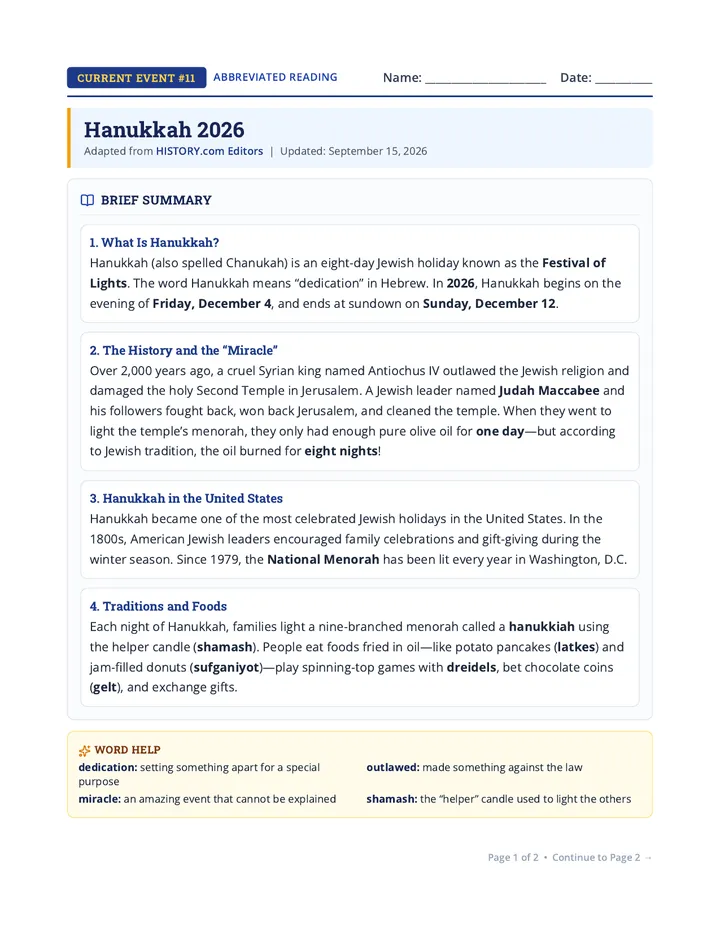
Hanukkah Abbreviated Worksheet
Current Event #11 Abbreviated Reading
Name: _______________________ Date: ___________
Hanukkah 2026
Adapted from HISTORY.com Editors | Updated: September 15, 2026
Brief Summary
1. What Is Hanukkah?
Hanukkah (also spelled Chanukah) is an eight-day Jewish holiday known as the Festival of Lights. The word Hanukkah means “dedication” in Hebrew. In 2026, Hanukkah begins on the evening of Friday, December 4, and ends at sundown on Sunday, December 12.
2. The History and the “Miracle”
Over 2,000 years ago, a cruel Syrian king named Antiochus IV outlawed the Jewish religion and damaged the holy Second Temple in Jerusalem. A Jewish leader named Judah Maccabee and his followers fought back, won back Jerusalem, and cleaned the temple. When they went to light the temple’s menorah, they only had enough pure olive oil for one day—but according to Jewish tradition, the oil burned for eight nights!
3. Hanukkah in the United States
Hanukkah became one of the most celebrated Jewish holidays in the United States. In the 1800s, American Jewish leaders encouraged family celebrations and gift-giving during the winter season. Since 1979, the National Menorah has been lit every year in Washington, D.C.
4. Traditions and Foods
Each night of Hanukkah, families light a nine-branched menorah called a hanukkiah using the helper candle (shamash). People eat foods fried in oil—like potato pancakes (latkes) and jam-filled donuts (sufganiyot)—play spinning-top games with dreidels, bet chocolate coins (gelt), and exchange gifts.
Word Help
dedication: setting something apart for a special purpose
outlawed: made something against the law
miracle: an amazing event that cannot be explained
shamash: the “helper” candle used to light the others
Page 1 of 2 • Continue to Page 2 →
Key Details & Student Reflection
Current Event #11
Part 1: Quick Check (Circle the best answer)
1. Why is Hanukkah celebrated for eight nights?
A. The Maccabees fought for eight years.
B. One day of oil burned for eight nights.
C. Hanukkah always starts on December 8.
D. Families eat eight kinds of donuts.
2. Why are traditional Hanukkah foods like latkes fried in oil?
A. To remember the miracle of the oil.
B. Because oil was invented in 1979.
C. To celebrate the autumn harvest.
D. Because they are eaten only in Washington, D.C.
Part 2: Key Details
1. When does Hanukkah 2026 begin and end?
2. Name two Hanukkah traditions or foods from the reading:
Part 3: Student Reflection
What is one interesting thing you learned about Hanukkah? Why did it stand out to you?
Sentence Starters: “One thing I learned about Hanukkah is…” | “I found this interesting because…”
Page 2 of 2 • Great job finishing Current Event #11!