Focus Ladder Progression Guide
Teacher Reference • Behavioral Scaffolding
Focus Ladder Progression Guide
4-Tier Continuum
How to Use This Ladder: Identify the student's current baseline across all three dimensions below. Set the initial target one step above baseline, and advance to the next tier once the student meets mastery criteria across 3 consecutive observation sessions.
| Measurement |
Tier 1: Foundation |
Tier 2: Building |
Tier 3: Emerging |
Tier 4: Mastery |
|
|
|
|
|
| On-Task Duration |
|
|
|
|
Continuous engagement during independent or small-group work.
|
3–5 Minutes
Short, chunked tasks with immediate visual timer and scheduled micro-breaks.
|
8–10 Minutes
Sustained work on 1–2 familiar steps before a brief check-in or stretch.
|
15–20 Minutes
Completes full assignment block with minimal pacing reminders.
|
25+ Minutes
Maintains focus across entire class work period and transitions smoothly.
|
|
Interval Checks
Momentary time sampling at fixed intervals (e.g., every 2 min).
|
50%–60% On-Task
On task at 5–6 of 10 two-minute checks during structured tasks.
|
70%–75% On-Task
On task at 7–8 of 10 checks; recovers quickly after brief distraction.
|
80%–85% On-Task
On task across 8+ of 10 intervals, including 3- to 5-minute check intervals.
|
90%+ On-Task
Consistently engaged across 9–10 of 10 intervals across varied subjects.
|
|
Prompt Levels
Adult support required to initiate or return to task.
|
Level 3–4 Support
Direct verbal cue + modeling or hand-over-hand start; 4+ prompts per block.
|
Level 2 Support
Gestural cue, desk tap, or visual card; 2–3 prompts per work block.
|
Level 1 Support
Proximity or indirect verbal check ("Check your timer"); ≤1 prompt per block.
|
Level 0: Independent
Self-monitors and redirects without adult prompting in 4 of 5 sessions.
|
Observable "On-Task" Definition
Eyes oriented toward instructional materials, teacher, or peer speaker; body seated or in designated workspace; hands manipulating task materials appropriately; voice quiet or contributing to the assigned activity.
Reinforcement Pairing
Pair each tier with specific praise ("You worked for 8 minutes straight!") and predictable reinforcement. Fade tangible rewards as internal stamina and self-monitoring grow in Tiers 3 and 4.
Focus Forward Toolkit • Goal Progression Page 1 of 2
Teacher Reference • Prompt Fading & Pacing
Prompt Hierarchy & Decision Rules
Least-to-Most
Standardized Prompt-Level Scale (For Data Collection)
0
Independent (Self-Initiated)
Student begins task within 30 seconds or redirects self after brief distraction without any adult cue.
1
Proximity / Indirect Environmental Cue
Adult moves near student's workspace, makes eye contact, or gives a whole-class reminder without naming the student.
2
Gestural / Visual Prompt
Adult points to the worksheet, taps the desk, or points to a visual schedule/timer card without speaking.
3
Direct Verbal Prompt
Adult gives a concise, neutral verbal redirection (e.g., "Maya, eyes on problem 3") or reads the first step aloud.
4
Modeling / Co-Initiation
Adult sits beside the student, models the first item, or provides physical guidance to orient materials and begin.
When to Advance, Hold, or Step Back
Advance Up 1 Tier
Student meets duration, interval, AND prompt criteria for 3 consecutive sessions or 4 of 5 school days.
Hold & Adjust Support
Student meets 1–2 criteria but struggles with stamina. Keep target steady and check task difficulty or break schedule.
Step Back 1 Tier
Student misses target across 3+ consecutive sessions or shows high frustration. Rebuild confidence at prior tier.
Practical Observation Tips for Busy Classrooms
- Use a silent vibrating timer (e.g., every 2 minutes) for interval checks so observation doesn't disrupt instruction.
- Wait 5 seconds before escalating from a Level 1/2 prompt to a Level 3 verbal prompt to avoid prompt dependency.
- Track one target block daily (e.g., 15-minute independent math) rather than attempting all-day continuous tracking.
Focus Forward Toolkit • Goal Progression Page 2 of 2
On-Task IEP Goal Bank
IEP Team Resource • Measurable Goals & Benchmarks
On-Task IEP Goal Bank
PLAAFP-Ready
Goal Area 1: Sustained On-Task Duration
Duration Recording
Annual Measurable Goal
By the end of the IEP annual period, when given a structured independent or small-group academic task and a visual timer, [Student] will sustain observable on-task behavior (eyes on materials, seated in workspace, actively working) for at least 15 consecutive minutes without task refusal or wandering, in 4 out of 5 consecutive observation sessions as measured by teacher duration logs.
Scaffolded Short-Term Objectives (Benchmarks)
Obj 1.1: Sustain on-task behavior for 5 consecutive minutes (with a scheduled 1-minute movement break) across 4 of 5 sessions.
Obj 1.2: Sustain on-task behavior for 10 consecutive minutes during familiar independent work across 4 of 5 sessions.
Obj 1.3: Sustain on-task behavior for 15 consecutive minutes across two different academic subjects in 4 of 5 sessions.
Goal Area 2: Interval-Based Task Engagement
Momentary Time Sampling
Annual Measurable Goal
By the end of the IEP annual period, during a 20-minute core instructional or independent work block, [Student] will demonstrate on-task behavior during at least 85% of 2-minute observation intervals (9 of 10 checks) across 3 consecutive data collection days, as measured by momentary time-sampling observation sheets.
Scaffolded Short-Term Objectives (Benchmarks)
Obj 2.1: Demonstrate on-task behavior during 60% of 2-minute intervals (6 of 10 checks) across 3 consecutive data days.
Obj 2.2: Demonstrate on-task behavior during 75% of 2-minute intervals (7–8 of 10 checks) across 3 consecutive data days.
Obj 2.3: Demonstrate on-task behavior during 85% of 2-minute intervals (9 of 10 checks) across 3 consecutive data days.
Focus Forward Toolkit • IEP Goal Bank Page 1 of 2
IEP Team Resource • Prompt Fading & Customization
Prompt Independence & Baseline Planner
Prompt Fading
Goal Area 3: Prompt-Fading & Independent Redirection
Prompt-Level Tally
Annual Measurable Goal
By the end of the IEP annual period, when off-task during a 15-minute independent work period, [Student] will initiate or return to task using no more than 1 Level-1 cue (proximity or indirect visual/verbal check)—eliminating direct verbal or physical prompts—in 4 out of 5 consecutive sessions as measured by adult prompt-level tallies.
Scaffolded Short-Term Objectives (Benchmarks)
Obj 3.1: Return to task within 10 seconds using 3 or fewer Level-2/3 prompts (gestural or concise verbal) in 4 of 5 sessions.
Obj 3.2: Return to task using 2 or fewer Level-1/2 prompts (proximity or gestural/visual card only) in 4 of 5 sessions.
Obj 3.3: Self-redirect or respond to at most 1 Level-1 cue per 15-minute block across 4 of 5 consecutive sessions.
IEP Team Customization & Baseline Record
Complete during IEP planning
Student Name & Grade:
Target Setting / Subject Block:
| Metric |
Current Baseline |
Annual Target |
Data Schedule |
| On-Task Duration |
|
|
|
| Interval Checks (%) |
|
|
|
| Prompt Level (0–4) |
|
|
|
Focus Forward Toolkit • IEP Goal Bank Page 2 of 2
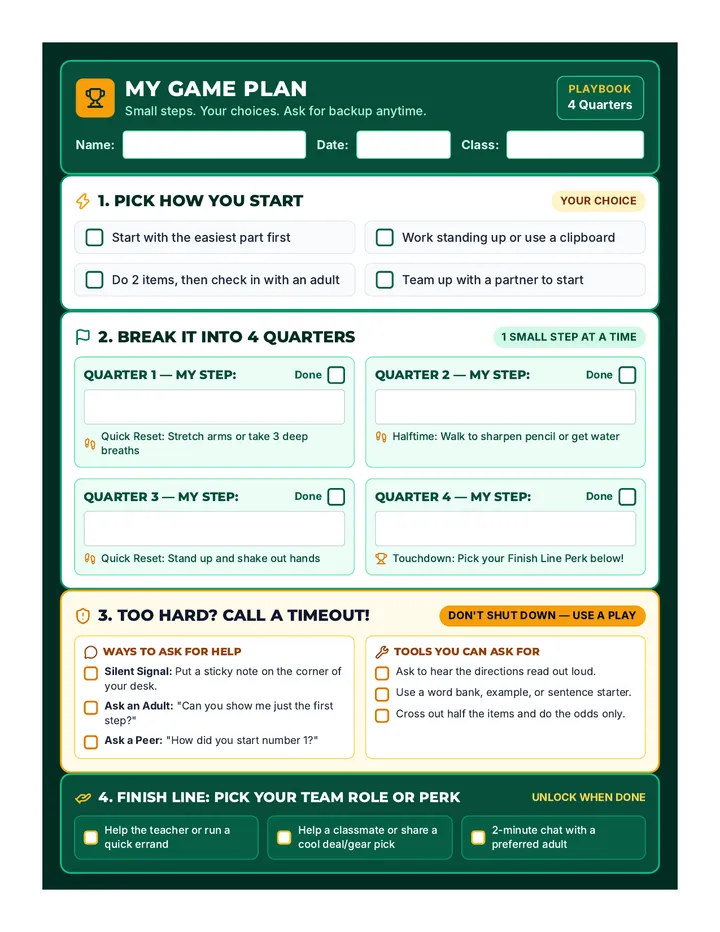
My Focus Goal Worksheet
Student Goal Tracker
My Focus Goal Worksheet
Step by Step
Name:
Date:
1 Pick My Focus Goal (Check one or fill in your target)
Focus Time
Stay on task for minutes without stopping.
Check-In Score
Be on task for out of check-ins.
Fewest Reminders
Get back on task with or fewer reminders.
2 Choose My Helper Tool (Check the tools that help you stay focused)
Desk timer
Step checklist
Quiet hand signal
Earned break
3 Track My Work Sessions
| Day / Date | Subject or Task | Time On Task
(minutes) | Check-Ins Met
(e.g., 7 / 10) | Reminders
(count) | Goal Met? |
| --- | --- | --- | --- | --- | --- |
| | | | | | Yes / Almost |
| | | | | | Yes / Almost |
| | | | | | Yes / Almost |
| | | | | | Yes / Almost |
| | | | | | Yes / Almost |
4 My Focus Check-Out
One thing that helped me stay on task:
My next step or new goal:
Focus Forward Toolkit • Student Self-Monitoring Progress happens one step at a time!