Task Initiation Slides Executive Function Series
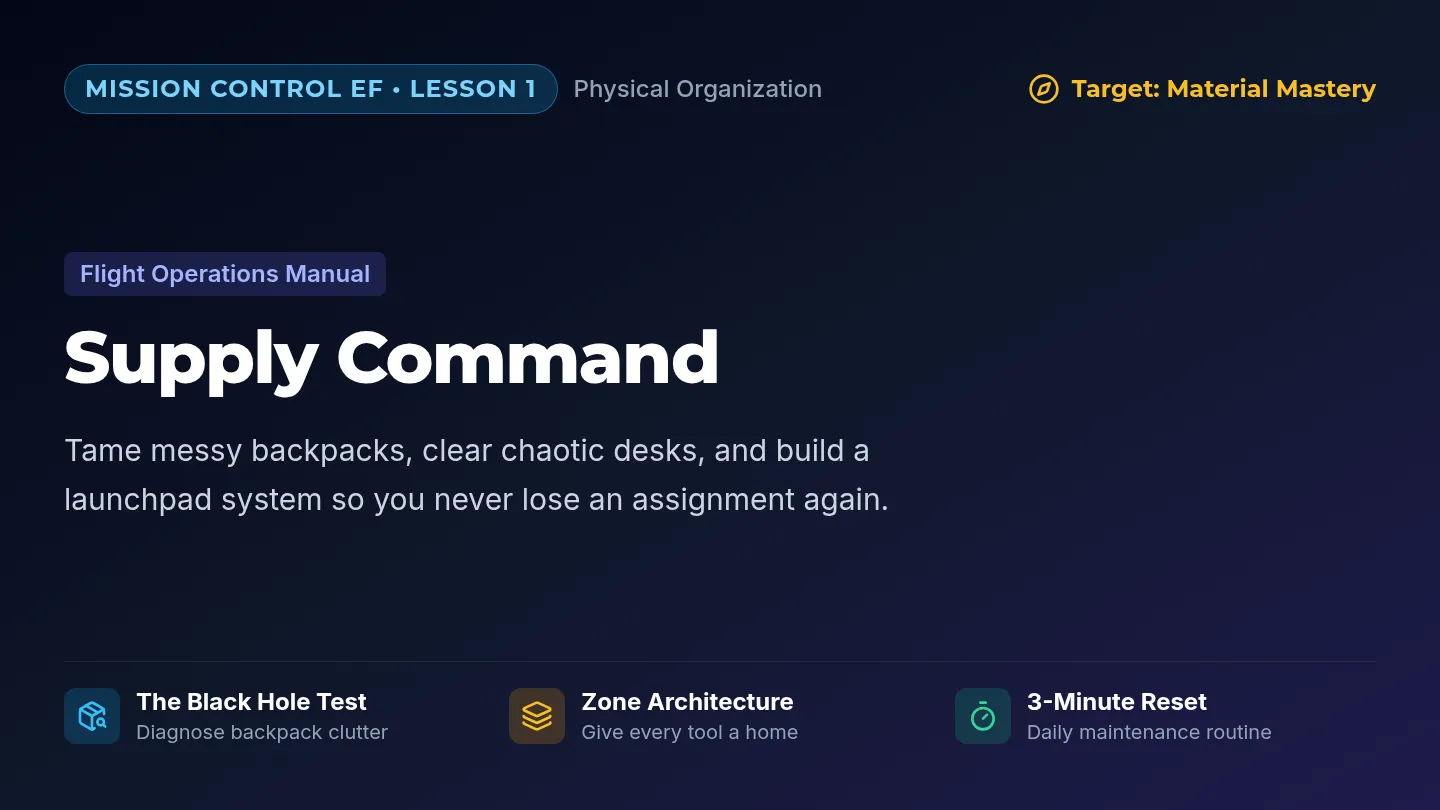
Launch Mode:
Mastering Task Initiation
How to beat brain freeze, shrink big tasks, and actually get started—even when you don't feel like it.
Warm-Up • Reading • First-Step Launchpad
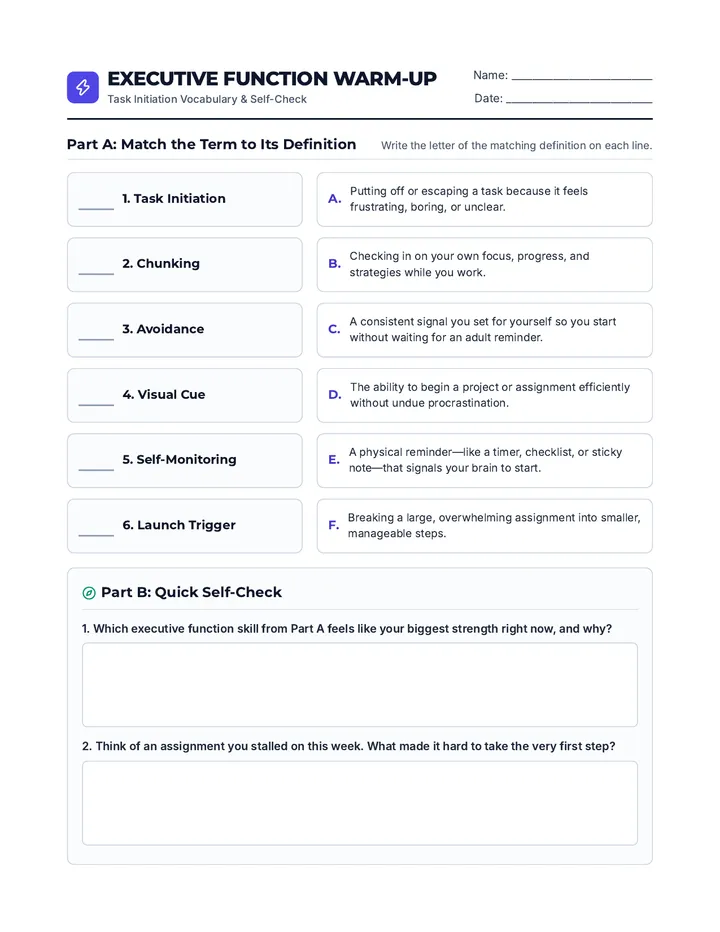
Warm-Up Match the Executive Function Skill
Brain Control Center Match-Up
Skills
1. Task Initiation
2. Working Memory
3. Planning & Prioritizing
4. Self-Monitoring
5. Cognitive Flexibility
Definitions
A. Holding info in your head while using it
B. Shifting gears when plans change
C. Starting a task without putting it off
D. Checking your own progress as you work
E. Deciding what steps come first
Core Concept
What Is Task Initiation?
Task initiation is your brain's ability to begin a job—even a boring, confusing, or difficult one—without getting stuck in delay mode.
Activation Energy
Like pushing a heavy boulder, starting takes the most energy. Once you're moving, momentum helps carry you forward.
Not Laziness!
Struggling to start isn't about being lazy. It's usually your brain feeling overwhelmed, unsure, or worried about messing up.
Spot the Roadblock
3 Reasons Your Brain Hits "Pause"
1. Too Big
The task feels like a giant mountain instead of one small step, so your brain shuts down.
2. Too Foggy
You don't know exactly what to do first, so you avoid starting to dodge the confusion.
3. Fear of Flops
Wanting it to be perfect makes starting feel risky—if you don't start, you can't fail yet.
Launch Strategy
Shrink It to a 2-Minute Micro-Step
Don't try to finish the whole assignment in your head. Just pick one tiny, concrete action that takes 2 minutes or less.
Too Big to Start
• "Write my science lab report"
• "Study for Friday's math test"
• "Clean my entire bedroom"
2-Minute Micro-Steps
• "Open the doc and type the title"
• "Solve just problem #1 on the review"
• "Put 5 clothes into the hamper"
Your Assignment Tool
The First-Step Launchpad
01
Name the Mission
Pick one real task you've been putting off.
02
Clear the Pad
Gather only the tools you need and silence distractions.
03
2-Min Micro-Step
Write the tiniest physical action to begin.
04
3-2-1 Launch!
Set a 5-minute timer and do just the first step.
Your Turn
Ready for Liftoff?
1 Complete the Reading & Comprehension Questions.
2 Fill out your First-Step Launchpad for a real task today.
3 Remember: Motion creates motivation—not the other way around!
Task Initiation Worksheet Launch Mode • Executive Function
Warm-Up & Reading: Task Initiation
Name: ___________________________
Date: _________________
Part 1
Executive Function Warm-Up: Match the Skill
Your brain has a "control center" called executive function. Write the letter of the matching definition on the blank line next to each skill.
Executive Function Skills
1. Task Initiation
2. Working Memory
3. Planning & Prioritizing
4. Self-Monitoring
5. Cognitive Flexibility
Definitions
A. Holding information in your head while you use it (like remembering multi-step directions).
B. Shifting gears and trying a new approach when a plan changes or doesn't work.
C. Getting started on a job or assignment without putting it off.
D. Checking your own progress and catching mistakes while you work.
E. Figuring out what steps are needed and deciding which ones come first.
Quick Brain Check
Which of the 5 skills above feels easiest for you right now? Which one feels trickiest? Explain in 2–3 sentences.
Turn to Page 2 for the reading passage and questions. Page 1 of 2
Part 2
Reading: Why Starting Is the Hardest Part
Read carefully, then answer Questions 1–3
Have you ever sat in front of a blank screen or an empty worksheet, knowing you need to start, yet somehow finding yourself sharpening three pencils, checking your phone, or staring at the ceiling instead? If so, you have met a challenge called task initiation .
Task initiation is your brain's ability to begin a task—especially one that feels boring, confusing, or hard—without getting stuck in delay mode. In science, it takes extra activation energy to get a chemical reaction going. Your brain works the same way. Pushing a heavy boulder from a dead stop takes way more effort than keeping it rolling once it's moving.
Many people think putting things off means someone is lazy. Brain scientists know that is rarely true. Usually, your brain hits "pause" for one of three reasons: the task feels too big (like a giant mountain), the first step is too foggy (you aren't sure what to do first), or you feel a fear of messing up (if you don't start, you can't fail yet).
The good news is you don't have to wait until you "feel motivated" to begin. In fact, motion creates motivation . By shrinking a big job into a tiny 2-minute micro-step —like opening your notebook and writing the title, or solving just problem #1—you lower the activation energy your brain needs. Once you take that first tiny step, momentum takes over and the rest of the work feels much lighter.
1. According to the reading, why does the brain most often hit "pause" before starting a task?
A. The person is simply being lazy.
B. The task feels too big, unclear, or risky.
C. The brain has run out of working memory.
D. Motivation must always come before action.
2. Explain the "activation energy" comparison from the passage in your own words. How is starting homework like pushing a boulder?
3. Imagine a friend says, "I have a 10-slide history project due Friday and I don't even know where to start." What 2-minute micro-step would you suggest to help them launch?
Next: Use the First-Step Launchpad to start a real task! Page 2 of 2
First Step Launchpad Assignment Task Initiation Assignment
The First-Step Launchpad
Name: ___________________________
Date: _________________
Choose one real assignment or task you have been putting off. Complete Steps 1–3 before you start, set a 5-minute timer, and then complete Step 4.
1 Name Your Mission
What are we launching?
Task / Assignment Name:
Due Date:
What roadblock is making it hard to start? (Check all that apply)
Too Big
Too Foggy
Fear of Flops
Distractions
2 Clear the Launchpad (Initial Setup)
Pre-flight checklist
Desk/workspace is cleared of clutter
Phone/extra browser tabs are put away
Exact materials/tools are in front of me
Directions/rubric are open and visible
Exact materials or links I need for this task:
3 Write Your 2-Minute Micro-Step
Make it tiny & concrete!
Write the tiniest physical action you can do in 2 minutes or less (e.g., "Open the doc, type the title, and write 1 bullet point").
4 3-2-1 Launch! (Post-Start Check-In)
Complete after 5-min timer
I kept going past 5 min!
I finished my micro-step
I still need help
Reflection: How did starting feel compared to thinking about starting?
Motion creates motivation — you just needed a launchpad! Launch Mode
Launch Mode Teacher Guide Teacher Facilitation Guide
Launch Mode: Task Initiation
Grade Band: Middle Grades (6–8)
Time: ~45 Minutes
Learning Objectives
Define task initiation and distinguish it from other executive function skills.
Identify common cognitive roadblocks (feeling overwhelmed, unclear first steps, fear of failure) that cause procrastination.
Apply the 2-Minute Micro-Step and First-Step Launchpad routine to begin a real academic or personal task.
45-Minute Pacing Guide
Time
Segment
Teacher & Student Actions
0–7 min
Warm-Up Match-Up
Display Slide 2. Students complete Part 1 of the Task Initiation Worksheet independently, then review answers together.
7–17 min
Mini-Lesson (Slides 3–5)
Introduce task initiation, activation energy, the 3 roadblocks, and 2-Minute Micro-Steps. Ask students to share examples of "too big" tasks.
17–28 min
Reading & Questions
Students read "Why Starting Is the Hardest Part" (Page 2 of worksheet) and answer Questions 1–3.
28–42 min
First-Step Launchpad
Walk through Slide 6. Students pick a real delayed task, complete Steps 1–3, run a 5-minute class timer, and complete Step 4.
42–45 min
Debrief & Wrap-Up
Show Slide 7. Poll who kept going after 5 minutes. Reinforce: "Motion creates motivation."
Key Misconception to Address
"Procrastination = Laziness": Middle-grades students often internalize shame when they can't start. Emphasize that task initiation is a brain skill, not a character flaw.
"I need to feel motivated first": Reframe motivation as something that shows up after 2–5 minutes of action, not before.
Differentiation Tips
Scaffolds: Provide a starter bank of micro-steps (e.g., "Write my name and date," "Read just the first paragraph") or pair students to brainstorm Step 3 aloud.
Extensions: Have students chain three 2-minute micro-steps together or track how their "activation energy" changes across a whole week.
Teacher Resource • Launch Mode Lesson Bundle Page 1 of 1
Task Initiation Answer Key Teacher Answer Key
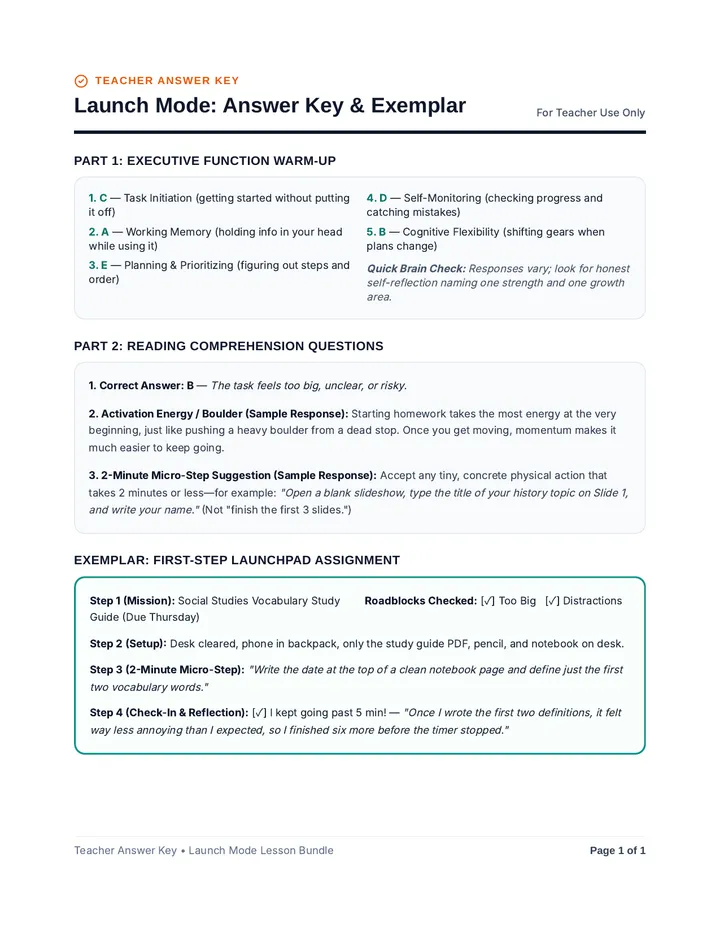
Launch Mode: Answer Key & Exemplar
For Teacher Use Only
Part 1: Executive Function Warm-Up
1. C — Task Initiation (getting started without putting it off)
2. A — Working Memory (holding info in your head while using it)
3. E — Planning & Prioritizing (figuring out steps and order)
4. D — Self-Monitoring (checking progress and catching mistakes)
5. B — Cognitive Flexibility (shifting gears when plans change)
Quick Brain Check: Responses vary; look for honest self-reflection naming one strength and one growth area.
Part 2: Reading Comprehension Questions
1. Correct Answer: B — The task feels too big, unclear, or risky.
2. Activation Energy / Boulder (Sample Response): Starting homework takes the most energy at the very beginning, just like pushing a heavy boulder from a dead stop. Once you get moving, momentum makes it much easier to keep going.
3. 2-Minute Micro-Step Suggestion (Sample Response): Accept any tiny, concrete physical action that takes 2 minutes or less—for example: "Open a blank slideshow, type the title of your history topic on Slide 1, and write your name." (Not "finish the first 3 slides.")
Exemplar: First-Step Launchpad Assignment
Step 1 (Mission): Social Studies Vocabulary Study Guide (Due Thursday)
Roadblocks Checked: [✓] Too Big [✓] Distractions
Step 2 (Setup): Desk cleared, phone in backpack, only the study guide PDF, pencil, and notebook on desk.
Step 3 (2-Minute Micro-Step): "Write the date at the top of a clean notebook page and define just the first two vocabulary words."
Step 4 (Check-In & Reflection): [✓] I kept going past 5 min! — "Once I wrote the first two definitions, it felt way less annoying than I expected, so I finished six more before the timer stopped."
Teacher Answer Key • Launch Mode Lesson Bundle Page 1 of 1