Executive Function Warmup Worksheet Executive Function Warm-Up
Task Initiation Vocabulary & Self-Check
Name: ___________________________
Date: ____________________________
Part A: Match the Term to Its Definition
Write the letter of the matching definition on each line.
1. Task Initiation
2. Chunking
3. Avoidance
4. Visual Cue
5. Self-Monitoring
6. Launch Trigger
A.
Putting off or escaping a task because it feels frustrating, boring, or unclear.
B.
Checking in on your own focus, progress, and strategies while you work.
C.
A consistent signal you set for yourself so you start without waiting for an adult reminder.
D.
The ability to begin a project or assignment efficiently without undue procrastination.
E.
A physical reminder—like a timer, checklist, or sticky note—that signals your brain to start.
F.
Breaking a large, overwhelming assignment into smaller, manageable steps.
Part B: Quick Self-Check
1. Which executive function skill from Part A feels like your biggest strength right now, and why?
2. Think of an assignment you stalled on this week. What made it hard to take the very first step?
Task Initiation Reading Guide Task Initiation Reading
Why Starting Is the Hardest Part (And How to Hack It)
Name: ___________________________
Date: ____________________________
Have you ever stared at a blank Google Doc for twenty minutes, opened three other tabs, checked your phone, and still not typed a single word? That isn’t laziness—it’s a breakdown in task initiation , the executive function skill that helps your brain cross the starting line.
1. The Activation Energy Trap
In chemistry, a reaction needs a burst of “activation energy” just to get going. Your brain works the same way. When an assignment looks huge, confusing, or boring—like a 5-page research paper or a dense math packet—your brain estimates how much energy it will take and hits the brakes. Instead of starting, you slip into an avoidance loop : you feel overwhelmed or frustrated, so you escape to something easy (like scrolling or chatting) for instant relief. The catch is that avoiding the task actually makes it feel even bigger later.
2. Shrink the Start Line (Break Tasks Down)
The fastest way to lower activation energy is chunking . Your brain rejects vague commands like “do my history project,” because it doesn’t know what your hands should do first. Instead, shrink the start line into a 2-minute micro-step : open the document, write the title, and list three rough bullet points. Once you are in motion for two minutes, your brain’s resistance drops sharply, making it much easier to keep going.
3. Make the Start Visible (Visual Supports)
Trying to hold every step in your head overloads your working memory. Visual supports —like a 3-item sticky-note checklist, a cleared workspace with only the materials you need, or a visible 10-minute countdown timer—offload that mental clutter. A timer creates a clear, low-pressure boundary: you don’t have to finish the whole assignment right now, you just have to work until the timer rings.
4. Beat Frustration & Build Independence
Even with a micro-step, you will still hit moments where you feel stuck or annoyed. Planning an If-Then reset in advance (“If I get stuck on problem #1, then I will skip to #2 or read one example before asking for help”) keeps frustration from turning into avoidance. Finally, pairing your work with a personal launch trigger —such as starting a 10-minute sprint right after plugging in your Chromebook—trains you to initiate tasks on your own, without waiting for a parent or teacher to remind you.
Reading Check & Application
Use the reading passage to answer each question below.
Name: ______________________
1. According to the passage, why do students often fall into an “avoidance loop” on big assignments?
A. They do not care about their grades or deadlines.
B. Their brain senses high effort or frustration and seeks instant relief elsewhere.
C. Visual timers make assignments feel more overwhelming than they are.
D. They prefer waiting until late at night when they have more energy.
2. What is the main purpose of creating a “2-minute micro-step”?
A. To finish an entire essay or problem set in under two minutes.
B. To avoid needing any checklists or timers while studying.
C. To lower activation energy so your brain can get into motion quickly.
D. To skip the hardest parts of an assignment permanently.
3. How do visual supports (such as a sticky-note checklist or countdown timer) help your brain start a task?
4. Write one realistic “If-Then” reset plan you could use the next time you feel stuck or frustrated on homework.
5. What is one personal “launch trigger” you could use after school to start your work without an adult reminder?
First Step Launchpad Worksheet First Step Launchpad
High School Task Initiation & Action Planning
Name: ___________________________
Date: ____________________________
Break It Down
Shrink a huge assignment into one 2-minute micro-step.
Visual Supports
Use timers, checklists, and clear cues to see the start line.
Manage Avoidance
Name the stuck feeling and use a quick reset instead of quitting.
Build Independence
Set your own launch trigger so you need fewer adult reminders.
Part 1: Scenario-Based Practice
Read each realistic school situation and map out the first move.
Scenario 1: The 5-Page History Paper Break Tasks Down & Visual Supports
You have a 5-page research paper due Friday. Every time you open a blank document, you feel overwhelmed by how much work it is and end up scrolling on your phone for 40 minutes.
1. What is one 2-minute micro-step to start?
2. Which visual support will keep you moving?
Scenario 2: The Frustrating Math Set Manage Avoidance
You look at tonight’s Algebra II problem set, get stuck on #1, feel immediately annoyed, and want to shove the whole packet into your backpack until tomorrow.
1. What avoidance trap is happening here?
2. What reset strategy gets you past feeling stuck?
Scenario 3: The Solo Study Block Build Independence
At home, you usually wait until a parent or teacher reminds you three times before you open your Chromebook to study for a biology quiz.
1. What self-trigger can replace adult reminders?
2. What will your first 5 minutes look like?
Part 2: Guided Launch Pad
Pick ONE real assignment you have been putting off and use this page to cross the starting line.
Name: ______________________
1. Assignment & Class
Due Date & Why I’ve Been Avoiding It
2. Break Tasks Down: Chunk & Shrink
List 3–4 medium chunks on the left and circle the easiest one. Then write ONE tiny 2-minute micro-step on the right.
A.
B.
C.
D.
My 2-Minute Micro-Step (Start Here):
3. Set Up Visual Supports
Check the visual cues you will put in front of you before you begin:
Visible countdown timer ( _____ mins )
3-step sticky-note checklist on desk
Clear desk to ONLY needed materials
Phone out of sight / Do Not Disturb
Other visual cue:
4. Manage Avoidance (If-Then Reset Plan)
If I feel stuck or frustrated, I will...
If I catch myself stalling, I will...
5. Build Independence & Launch Sprint
My Solo Launch Trigger (what cues me to start without an adult reminding me):
Start Time
Stop Time
After 5 Minutes (Check One)
Kept going Used reset Finished step
Part 3: Self-Monitoring Checklist
Track the strategies you use to begin tasks independently across 4 assignments or study sessions.
Name: ______________________
Initiation Strategy Tracker
Strategy Used to Start
Task 1
Task 2
Task 3
Task 4
Write Task Name & Date →
---
---
---
---
---
2-Minute Micro-Step
Broke a big task into one tiny first action
| | | | |
|
Visible Timer / Sprint
Used a 5–15 min timer to create a start line
| | | | |
|
Visual Checklist / Cue
Put 2–3 steps in sight and checked them off
| | | | |
|
Friction Fix
Removed distractions & prepped materials first
| | | | |
|
Stuck-Point Reset
Used a coping strategy instead of avoiding
| | | | |
|
Solo Launch
Started without a teacher or parent reminder
| | | | |
Independence Check-In
Task 1 Circle: Solo | 1 Cue | Needed Help
What helped me start:
Task 2 Circle: Solo | 1 Cue | Needed Help
What helped me start:
Task 3 Circle: Solo | 1 Cue | Needed Help
What helped me start:
Task 4 Circle: Solo | 1 Cue | Needed Help
What helped me start:
Reflection & Next Goal
Which initiation strategy helped you beat avoidance the most, and why?
One goal for starting tasks even more independently next week:
Task Initiation Teacher Guide Task Initiation Teacher Guide
Lesson Pacing, Facilitation Notes & Answer Key (Grades 9–12)
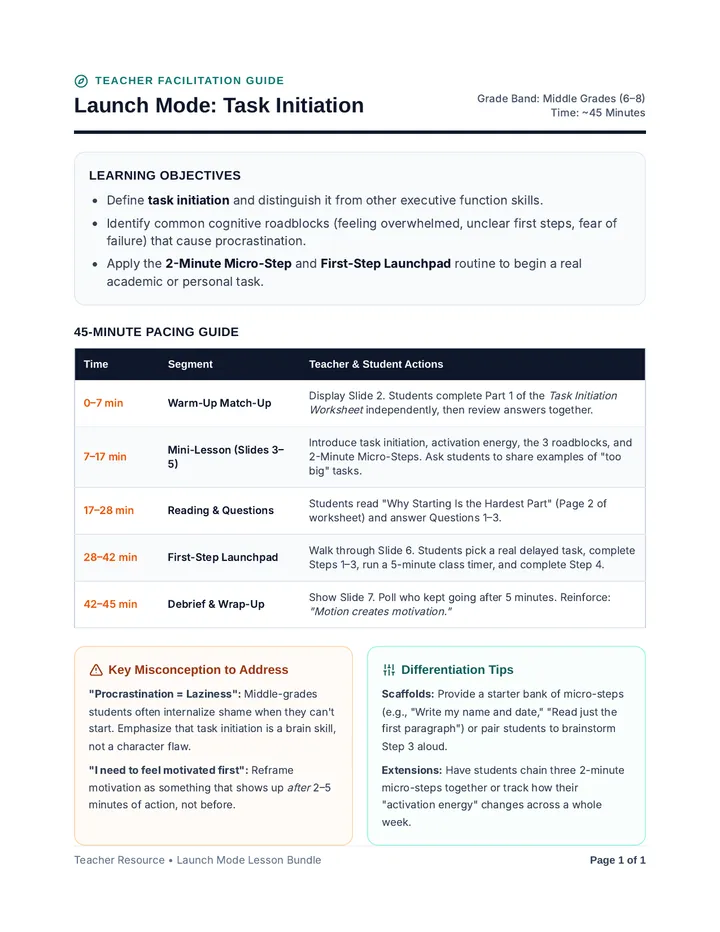
45–50 Min Lesson
Lesson Flow & Pacing
1. Warm-Up (5–7m) Distribute Executive Function Warmup Worksheet . Students match the 6 terms independently, then share one reflection in pairs.
2. Reading (15m) Read Task Initiation Reading Guide (partner read or whole-class). Students complete the 5 comprehension & application questions.
3. Launchpad (20m) Using First Step Launchpad Worksheet , review 1–2 scenarios together (Page 1), then have students pick a real pending assignment to set up and run a 5-minute launch sprint (Page 2).
4. Wrap-Up (5m) Introduce the Self-Monitoring Checklist (Page 3) for students to track independent starts across their next 4 assignments.
Support for Struggling Starters
Pre-highlight 2–3 micro-step examples (e.g., “Open doc & write heading”) so students don’t stall on planning.
Provide a physical sand timer or visible classroom countdown during the 5-minute launch sprint.
Extension & Independence
Challenge students to run a second 10-minute sprint without any teacher check-in using their personal launch trigger.
Have students pair up to test whether their 2-minute micro-step is specific enough to start immediately.
Answer Key
Executive Function Warm-Up (Part A Matching)
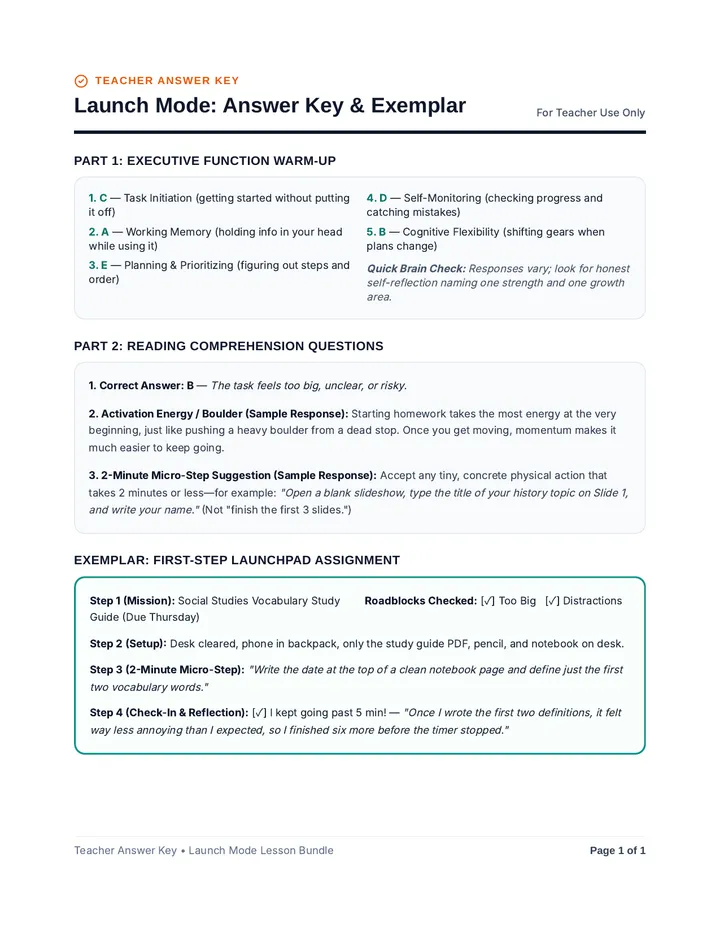
1. Task Initiation: D
2. Chunking: F
3. Avoidance: A
4. Visual Cue: E
5. Self-Monitoring: B
6. Launch Trigger: C
Task Initiation Reading Guide (Questions 1–5)
1. B — Their brain senses high effort or frustration and seeks instant relief elsewhere.
2. C — To lower activation energy so your brain can get into motion quickly.
3. Sample Response: Visual supports offload mental clutter from working memory, make the first steps concrete, and create a low-pressure time boundary (e.g., working until a 10-minute timer rings).
4. Sample Response: Student writes a specific trigger and reset action, such as: “If I get stuck on problem #1, then I will skip to #2 or review one class example before asking for help.”
5. Sample Response: Student identifies a consistent personal cue, such as: “Right after I put my backpack down and plug in my Chromebook, I will set a 10-minute timer.”