Direction Detectives Slides Case File #01
Direction Detectives
Mastering Multi-Step Sequences & Independent Written Directions
Today’s Mission: Read carefully, follow the order, and check every clue!
Spot the Mix-Up!
What happens if you follow directions out of order or skip a step?
Mixed-Up Order
1. Put on your shoes.
2. Put on your socks.
Uh-oh! Socks over shoes!
Detective Order
1. Put on your socks.
2. Put on your shoes.
Mission accomplished!
The 3-Step Detective Check
1
Read ALL the way through Don’t jump ahead! Read every word from start to finish first.
2
Spot the Action & Order Clues Look for verbs (circle, underline, draw) and sequence words.
3
Do One Step at a Time & Check Complete step 1 before step 2, then check off each step.
Sequence Signal Words
Detectives look for clue words that tell us WHEN to do each action:
Beginning First Start by…
Middle Next / Then After that…
Ending Finally Last of all…
Watch out for Before and Wait until — they can flip the order!
Guided Mission #1: 3-Step Freeze
Listen & Wait
Read all three steps silently. Wait for the teacher’s “Go!” signal!
1
First, stand up quietly behind your chair.
2
Next, clap your hands two times.
3
Finally, put both hands on your head and freeze.
Guided Mission #2: 4-Step Desk
4 Steps
Read all 4 steps in order, then complete them when your teacher says “Begin!”
STEP 1
Touch your nose with one finger.
STEP 2
Pick up a pencil with your other hand.
STEP 3
Draw a big star in the air.
STEP 4
Set your pencil down and sit quietly.
Read First, Act Second!
Detective Rule: Read ALL 4 lines before doing anything!
Touch both shoulders.
Count to five in a whisper.
Wave to a neighbor.
Skip steps 1–3! Just give a silent thumbs-up.
Discuss: Why did reading all the way to Step 4 save you from a trap?
Partner Challenge: Back-to-Back
Partner A: Reader
Read these 3 steps slowly, one at a time:
1. Draw a big circle in the air.
2. Draw two dots inside it.
3. Draw a smile underneath.
Partner B: Listener
Listen carefully without peeking!
Follow each step in order in the air or on a whiteboard.
Then switch roles!
Ready for Your Solo Case File?
Remember your Detective Habits:
Read EVERY direction before starting.
Spot sequence words (First, Next, Then, Finally).
Complete one step at a time and double-check!
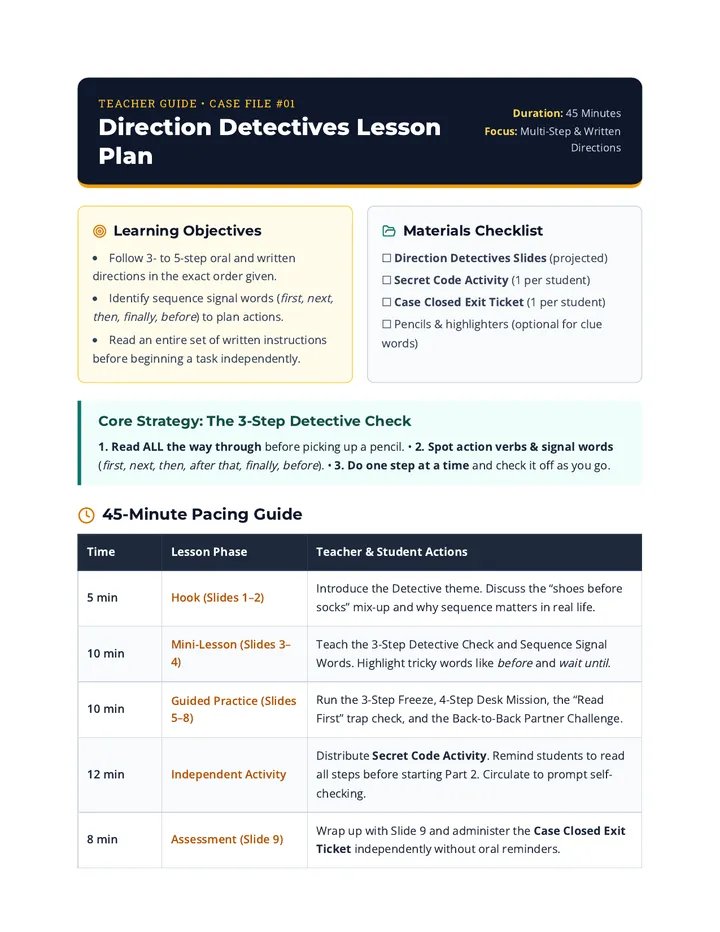
Direction Detectives Lesson Plan Teacher Guide • Case File #01
Direction Detectives Lesson Plan
Duration: 45 Minutes
Focus: Multi-Step & Written Directions
Learning Objectives
Follow 3- to 5-step oral and written directions in the exact order given.
Identify sequence signal words (first, next, then, finally, before ) to plan actions.
Read an entire set of written instructions before beginning a task independently.
Materials Checklist
☐ Direction Detectives Slides (projected)
☐ Secret Code Activity (1 per student)
☐ Case Closed Exit Ticket (1 per student)
☐ Pencils & highlighters (optional for clue words)
Core Strategy: The 3-Step Detective Check
1. Read ALL the way through before picking up a pencil. • 2. Spot action verbs & signal words (first, next, then, after that, finally, before ). • 3. Do one step at a time and check it off as you go.
45-Minute Pacing Guide
Time
Lesson Phase
Teacher & Student Actions
5 min
Hook (Slides 1–2)
Introduce the Detective theme. Discuss the “shoes before socks” mix-up and why sequence matters in real life.
10 min
Mini-Lesson (Slides 3–4)
Teach the 3-Step Detective Check and Sequence Signal Words. Highlight tricky words like before and wait until .
10 min
Guided Practice (Slides 5–8)
Run the 3-Step Freeze, 4-Step Desk Mission, the “Read First” trap check, and the Back-to-Back Partner Challenge.
12 min
Independent Activity
Distribute Secret Code Activity . Remind students to read all steps before starting Part 2. Circulate to prompt self-checking.
8 min
Assessment (Slide 9)
Wrap up with Slide 9 and administer the Case Closed Exit Ticket independently without oral reminders.
Facilitation Notes & Answer Keys
Page 2 • Teacher Reference
Differentiation & Supports
Visual / ELL Support: Have students circle action verbs (circle, draw, cross out ) in one color and underline sequence words before beginning.Chunking: Provide a sticky note or index card so students can cover steps below the one they are currently completing.Extension: Early finishers write a 4-step “Secret Mission” on the back of their sheet for a partner to solve.
Common Misconceptions
Jumping Ahead: Students start Step 1 before reading Step 4. Fix: Model keeping hands flat on the desk during the first read-through.Ignoring Spatial Words: Mixing up left/right or above/below . Fix: Point to grid directions aloud during Slide 6.Skipping Self-Checks: Assuming they finished after the last line. Fix: Require checkmark ticks next to each numbered step.
Answer Key: Secret Code Activity
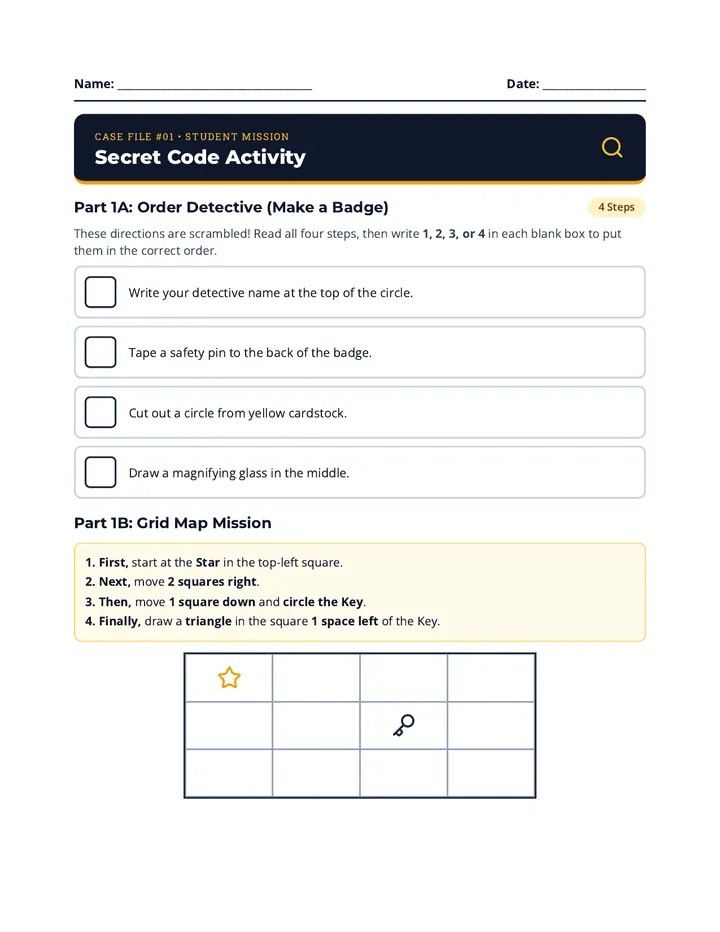
Part 1A — Badge Sequencing (Printed Order Top-to-Bottom): 2, 4, 1, 3 (1 = Cut out circle, 2 = Write name, 3 = Draw magnifying glass, 4 = Tape safety pin).
Part 1B — Grid Map Mission: Start at Star (Row 1, Col 1) → Move 2 squares right (Row 1, Col 3) → Move 1 square down (Row 2, Col 3, Key is circled) → Draw a triangle 1 square left of the Key (Row 2, Col 2).
Part 2 — Read-and-Do Secret Code (6 Steps): 1. Underline the word clue . • 2. Circle the number 7 . • 3. Shade the small square. • 4. Cross out the letter X . • 5. Draw a star inside the Drawing Box. • 6. Secret word formed by the remaining uncrossed letters (C – A – S – E ): CASE .
Answer Key: Case Closed Exit Ticket
Task 1 (Multiple Choice): B (First, Next, Finally shows the correct beginning-to-end order).
Task 2 (5-Step Independent Reading Challenge):
Step 1: Student’s initials written in the top-left corner of the Case Box.
Step 2: Exactly 2 stars drawn inside the oval.
Step 3: The odd number (9 ) is crossed out; 4 and 8 remain untouched.
Step 4: The word SOLVED is written on the blank line at the bottom.
Step 5: A checkmark is placed in the small box in the bottom-right corner.
Secret Code Activity Name: ____________________________________
Date: ___________________
Case File #01 • Student Mission
Secret Code Activity
Part 1A: Order Detective (Make a Badge)
4 Steps
These directions are scrambled! Read all four steps, then write 1, 2, 3, or 4 in each blank box to put them in the correct order.
Write your detective name at the top of the circle.
Tape a safety pin to the back of the badge.
Cut out a circle from yellow cardstock.
Draw a magnifying glass in the middle.
Part 1B: Grid Map Mission
1. First, start at the Star in the top-left square.
2. Next, move 2 squares right .
3. Then, move 1 square down and circle the Key .
4. Finally, draw a triangle in the square 1 space left of the Key.
Part 2: Read-and-Do Secret Code
Page 2 • Independent Mission
Detective Rule: Read ALL 6 steps from top to bottom before you start. Check off each box as you finish each step!
1. First, underline the word clue in the Detective Box below.
2. Next, draw a circle around the number 7 .
3. Then, shade in the small square .
4. After that, cross out the letter X .
5. Next, draw a star inside the empty Drawing Box.
6. Finally, write the 4 remaining uncrossed letters in order on the Secret Word lines.
clue
4 7 9
C A X S E
Drawing Box (for Step 5):
Secret Word:
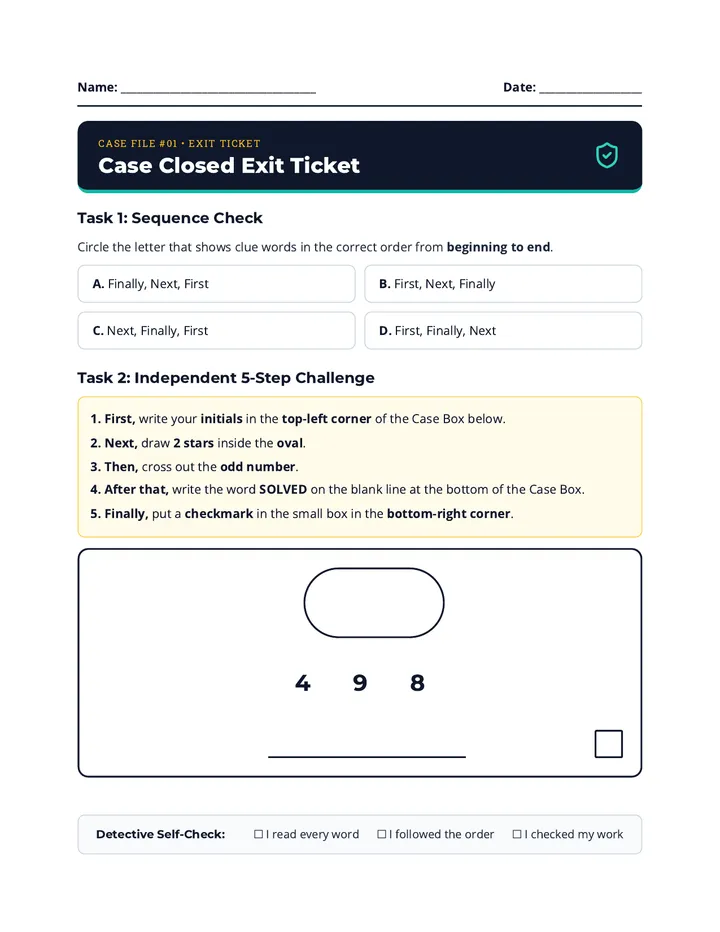
Case Closed Exit Ticket Name: ____________________________________
Date: ___________________
Case File #01 • Exit Ticket
Case Closed Exit Ticket
Task 1: Sequence Check
Circle the letter that shows clue words in the correct order from beginning to end .
A. Finally, Next, First
B. First, Next, Finally
C. Next, Finally, First
D. First, Finally, Next
Task 2: Independent 5-Step Challenge
1. First, write your initials in the top-left corner of the Case Box below.
2. Next, draw 2 stars inside the oval .
3. Then, cross out the odd number .
4. After that, write the word SOLVED on the blank line at the bottom of the Case Box.
5. Finally, put a checkmark in the small box in the bottom-right corner .
4 9 8
Detective Self-Check:
☐ I read every word ☐ I followed the order ☐ I checked my work