Executive Function Quiz NAME:
DATE:
PERIOD:
Subject: Executive Function
Executive Function Quiz
Select the most accurate response for each question below.
Which of the following is a primary benefit of having an organized space?
It allows you to spend more time looking for lost items.
A clear space helps you think more clearly and reduces panic.
It guarantees you will never have to do chores again.
Organization is mainly used to impress other people.
When following the 3-step organization plan, what is the very first thing you should do?
Buy new containers and dividers for your stuff.
Label every item in the room immediately.
Relocate items to their final homes.
Remove everything from the space you are organizing.
During the "Remove" phase, why is it important to "be honest" with yourself?
To decide if you truly need an item or if it should be discarded/donated.
To count how much money you spent on each item.
To make sure you keep absolutely everything you find.
To practice your storytelling skills.
NAME:
DATE:
PERIOD:
Executive Function Quiz • Page 2
What does it mean to "Relocate" items during the organization process?
Moving all your stuff to a different room permanently.
Giving every "Keep" item a specific "home" based on use.
Hiding items under the bed where they can't be seen.
Buying a new house to store your extra items.
What is a key strategy for the "Reorganize" step to ensure you can keep the space tidy?
Make it very difficult to put things back so you'll be careful.
Only use containers that you can't see through.
Arrange items logically and use labels to make them easy to return.
Stack everything in one large pile in the corner.
Working memory is often compared to what everyday object?
A giant filing cabinet with infinite drawers.
A clipboard with limited space for information.
A locked safe that never opens.
A telescope that sees far into the future.
Because working memory is limited, which strategy helps you remember more?
Trying to memorize everything at once without stopping.
Chunking information into smaller pieces and using repetition.
Closing your eyes and hoping for the best.
Watching television while you try to study.
NAME:
DATE:
PERIOD:
Executive Function Quiz • Page 3
Flexible thinking is described as being like a "Brain GPS" because it helps you:
Always find the shortest way home from school.
Calculate the exact speed of a moving car.
Adjust your plan and find new ways to solve a problem.
Tell other people exactly where they should go.
What is an effective way to use impulse control with your phone?
Keep it on your desk with the screen facing up.
Put it away out of sight, shut it off, or leave it in your locker.
Check it every five minutes just to be safe.
Turn the volume up as loud as possible.
How does boosted productivity affect your daily life?
It allows you to get more done with less effort.
It makes simple tasks take much longer to finish.
It guarantees that you will be tired all the time.
Productivity has no real effect on your stress levels.
System: EF-01 Assessment End of Assessment
Vocabulary Terminal Worksheet NAME:
DATE:
PERIOD:
Vocabulary Terminal
Match each key term from the mission files to its correct operational definition.
01 Matching
1
Organization
2
Working Memory
3
Impulse Control
4
Flexible Thinking
5
Productivity
6
Chunking
The "Brain GPS" that helps you adjust plans and find new ways to solve problems.
The act of arranging items logically and giving everything a specific "home."
The ability to stop yourself from acting on a sudden urge, like checking a phone.
Breaking large amounts of information into smaller, manageable pieces to remember them.
A "clipboard" for your brain that holds small amounts of information for a short time.
The measurement of how much you get done compared to the effort you put in.
02 Necessary Steps to Follow
Complete each sentence using the correct term from the mission files: Remove or Bring , Relocate , or Reorganize .
1. When I take everything out of my acordian folder to clear unneeded clutter, I am starting the ____________________________________________________ step.
2. When I decide that my pens should live in the blue cup and my paperclips should live in the small tray, I am beginning to ____________________________________________________ them.
3. When I put my papers in their subject labeled tab for example that says "History," I am completing the ____________________________________________________ step.
4. When I realize that adding something useful—like a locker shelf, extra pencils, or snacks—will help my production and organization, that is also part of the ____________________________________________________ step.
Today's Mission: Personal Organization Plan
Identify one space in your life (locker, backpack, desk, drawer, accordion folder) and plan your 3-step organization mission. For Step 1, decide what to remove (unnecessary clutter) OR what to bring in to boost your performance (useful tools like extra pens/pencils, a locker organizer, or talking with parents about keeping healthy snacks in your locker).
Space Chosen to Organize:
Step 1: Remove or Bring Remove clutter OR bring useful tools (pens, locker shelf, healthy snacks)
Step 2: Relocate Give every item an exact, convenient "home" based on daily use
Step 3: Reorganize Arrange logically, label tabs or bins, and make items easy to return
Executive Function Answer Key Answer Key
Executive Function Mastery: Quiz & Vocabulary
Executive Function Quiz (Multiple Choice)
A clear space helps you think more clearly and reduces panic.
Remove everything from the space you are organizing.
To decide if you truly need an item or if it should be discarded/donated.
Giving every "Keep" item a specific "home" based on use.
Arrange items logically and use labels to make them easy to return.
A clipboard with limited space for information.
Chunking information into smaller pieces and using repetition.
Adjust your plan and find new ways to solve a problem.
Put it away out of sight, shut it off, or leave it in your locker.
It allows you to get more done with less effort.
Vocabulary Terminal Worksheet
Part 1: Matching
Flexible Thinking: The "Brain GPS" that helps you adjust plans and find new ways to solve problems.Organization: The act of arranging items logically and giving everything a specific "home."Impulse Control: The ability to stop yourself from acting on a sudden urge, like checking a phone.Chunking: Breaking large amounts of information into smaller, manageable pieces to remember them.Working Memory: A "clipboard" for your brain that holds small amounts of information for a short time.Productivity: The measurement of how much you get done compared to the effort you put in.
Part 2: Necessary Steps to Follow
When I take everything out of my acordian folder to clear unneeded clutter... I am starting the Remove or Bring step.
When I decide that my pens should live in the blue cup... I am beginning to Relocate them.
When I put my papers in their subject labeled tab... I am completing the Reorganize step.
When I realize that adding something useful (like a locker shelf, extra pencils, or snacks) will help my production and organization... that is also part of the Remove or Bring step.
TEACHER RESOURCE - CONFIDENTIAL
Brain HQ Slides Executive Function Skills
Brain HQ
Executive Function Mastery
Focus • Organization • Memory
Key Benefits of Organization
Less Stress
No more panic when looking for supplies! Everything has a designated home.
Better Focus
A clear physical space helps your brain stay locked on task without distractions.
Save Time
Find homework, notes, and tools instantly without wasted searching time.
Boost Productivity
Get more done with less effort. Work smarter, stay calm, and finish faster.
Necessary Steps to Follow
1
REMOVE OR BRING
Remove clutter OR bring useful tools (extra pens/pencils, locker shelf, healthy snacks).
2
RELOCATE
Group items by use. Give every essential tool an exact, permanent home.
3
REORGANIZE
Arrange logically with labeled tabs, accordion folders, and bins for easy return.
"Make it easy and natural to put things back!"
Mental Strategies
Working Memory
Your brain's temporary clipboard has limited space. Help it hold information:
Chunking: Break large tasks into piecesRepetition: Rehearse steps to remember
Brain GPS
Flexible Thinking: Reroute when plans change and try alternate ways to solve problems.
Impulse Control
Distraction Management: Keep your phone out of sight during focused study sessions.
Mission Bonus • Self-Rewards
Completing a goal takes effort! Rewarding yourself for finishing a short-term goal reinforces positive habits.
Step 1
Set Small Goal
Pick a specific task (e.g., clean locker or organize folder).
Step 2
Choose Reward
Select a fun reward (15 mins gaming, snack, or break).
Step 3
Celebrate!
Enjoy your reward only after the mission is 100% complete.
Executive Function Reference Sheet Executive Function Reference Sheet
Executive Function Overview
Use this reference sheet to master key terminology and strategies. These are the core tools your brain uses to manage tasks, information, and daily organization.
Core Skill
Organization
The act of arranging items logically and giving everything a specific "home." This reduces panic and helps you find what you need quickly.
Core Skill
Working Memory
The brain's "clipboard." It holds small amounts of information for a short time while you use it. It has limited space and needs strategies like repetition and chunking.
Core Skill
Impulse Control
The ability to stop yourself from acting on a sudden urge (like checking your phone). It allows you to stay focused on your current goals.
Motivation Tool
Self-Reward
A small reward you give yourself for completing a short-term goal . This helps keep your brain motivated and makes hard work feel rewarding.
Operational Result
Productivity
The measurement of how much you accomplish compared to the effort you put in. Higher productivity means getting more done with less stress.
Necessary Steps to Follow: 3-Step Organization Plan
1. Remove or Bring
Take out clutter OR bring useful tools (extra pencils, locker shelves, healthy snacks) to help your school production and organization.
2. Relocate
Group similar items together. Give every item a specific, easy-to-reach "home" based on how often you use it.
3. Reorganize
Arrange items logically. Use labels, accordion folders, and containers to make it easy to put things back where they belong.
Key Strategy: Chunking
Breaking large, overwhelming tasks or amounts of information into smaller, bite-sized pieces to help your Working Memory process them more effectively.
Reference File: EF-REF Executive Function Study Resource
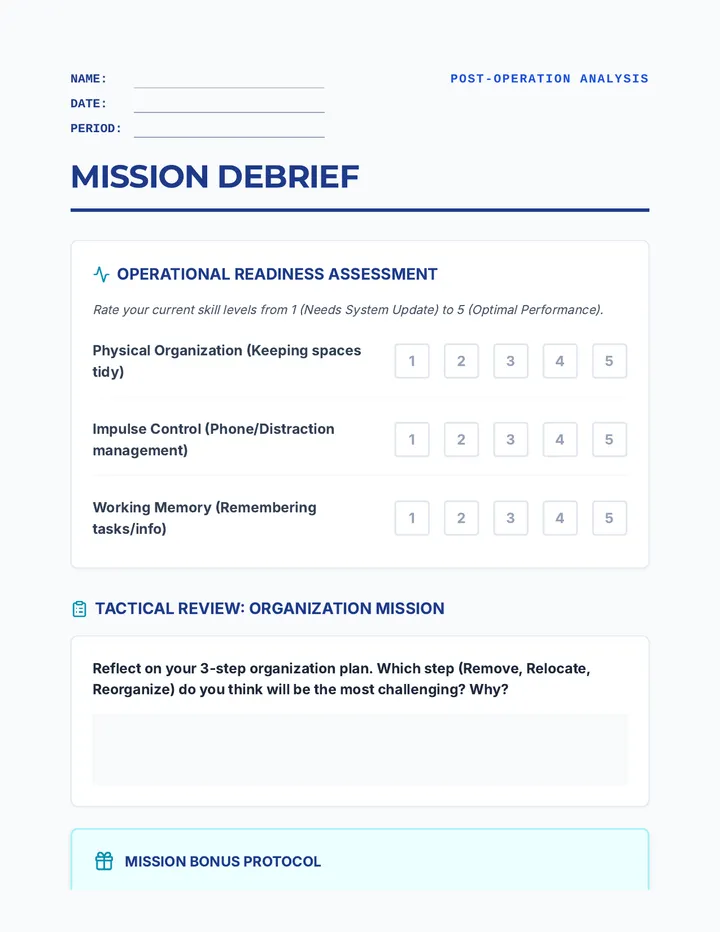
Mission Debrief Reflection Sheet NAME:
DATE:
PERIOD:
Post-Operation Analysis
Mission Debrief
Operational Readiness Assessment
Rate your current skill levels from 1 (Needs System Update) to 5 (Optimal Performance).
Physical Organization (Keeping spaces tidy)
1
2
3
4
5
Impulse Control (Phone/Distraction management)
1
2
3
4
5
Working Memory (Remembering tasks/info)
1
2
3
4
5
Tactical Review: Organization Mission
Reflect on your 3-step organization plan. Which step (Remove, Relocate, Reorganize) do you think will be the most challenging? Why?
Mission Bonus Protocol
What is a small reward you will give yourself once your organization mission is 100% complete? (Example: 15 mins of gaming, a special snack, listening to a favorite podcast)
Mental Strategy Protocol
Working Memory Boost
Identify one way you will use "Chunking" or "Repetition" this week:
Impulse Control Override
Where will you place your phone when you need 100% focus on a mission?
Operative Commitment
"I commit to maintaining my mission control systems and using my executive function tools to boost productivity and lower my stress levels."
SIGNATURE:
System Log: EF-DEBRIEF-01 Mission Debrief Confirmed