Workplace Communication Worksheet
Name:
Date:
Period:
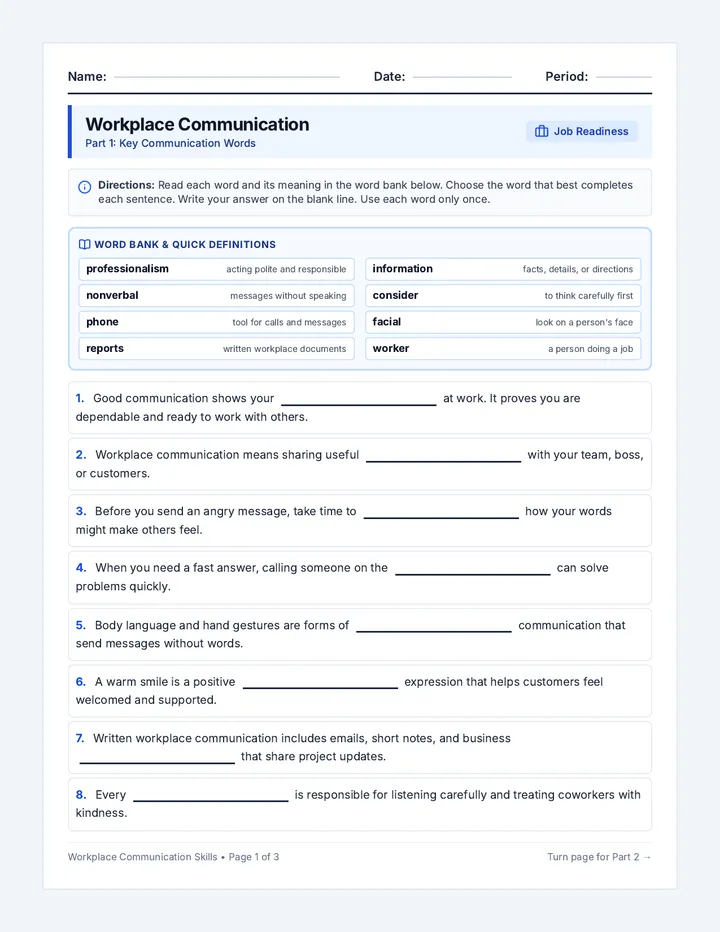
Workplace Communication
Part 1: Key Communication Words
Job Readiness
Directions: Read each word and its meaning in the word bank below. Choose the word that best completes each sentence. Write your answer on the blank line. Use each word only once.
Word Bank & Quick Definitions
professionalism acting polite and responsible
information facts, details, or directions
nonverbal messages without speaking
consider to think carefully first
phone tool for calls and messages
facial look on a person's face
reports written workplace documents
worker a person doing a job
-
Good communication shows your at work. It proves you are dependable and ready to work with others.
-
Workplace communication means sharing useful with your team, boss, or customers.
-
Before you send an angry message, take time to how your words might make others feel.
-
When you need a fast answer, calling someone on the can solve problems quickly.
-
Body language and hand gestures are forms of communication that send messages without words.
-
A warm smile is a positive expression that helps customers feel welcomed and supported.
-
Written workplace communication includes emails, short notes, and business that share project updates.
-
Every is responsible for listening carefully and treating coworkers with kindness.
Workplace Communication Skills • Page 1 of 3 Turn page for Part 2 →
Name:
Date:
Period:
Workplace Communication
Part 2: Verbal and Nonverbal Sorting
Skill Practice
Verbal
Using spoken words to talk and share ideas.
Positive Nonverbal
Body language that shows respect and listening.
Negative Nonverbal
Body language that looks bored, upset, or rude.
Communication Examples (12 Actions) Write 4 items in each column below
• Answering a question
• Nodding your head
• Rolling your eyes
• Asking for help
• Smiling at a coworker
• Staring at your phone
• Explaining a job task
• Making eye contact
• Clenching your fists
• Saying "thank you"
• Facing the speaker
• Slouching in chair
Verbal
Spoken Words
Positive Nonverbal
Polite & Helpful Actions
Negative Nonverbal
Unhelpful or Rude Actions
Workplace Communication Skills • Page 2 of 3 Turn page for Part 3 →
Name:
Date:
Period:
Workplace Communication
Part 3: Workplace Dos and Don'ts
Professional Habits
Directions: Read the 10 worker actions in the list below. Decide if each action is a good workplace choice (DO) or a poor workplace choice (DON'T). Write each action into the correct column on the chart.
Worker Actions to Categorize 5 Dos • 5 Don'ts
• Listen carefully without interrupting
• Yell or use sarcasm when angry
• Ask clarifying questions if confused
• Use slang, shortcuts, and emojis in work emails
• Proofread your messages before sending
• Stare at your cell phone during meetings
• Use polite words like "please" and "thank you"
• Lie, make excuses, or copy someone's work
• Keep private company information secret
• Rely totally on AI without checking the facts
DO (Professional Actions)
5 actions
DON'T (Unprofessional Actions)
5 actions
Workplace Communication Skills • Page 3 of 3 Activity Complete!
Workplace Communication Answer Key
Teacher Reference Special Education • Life & Job Skills
Worksheet Page 1 Key
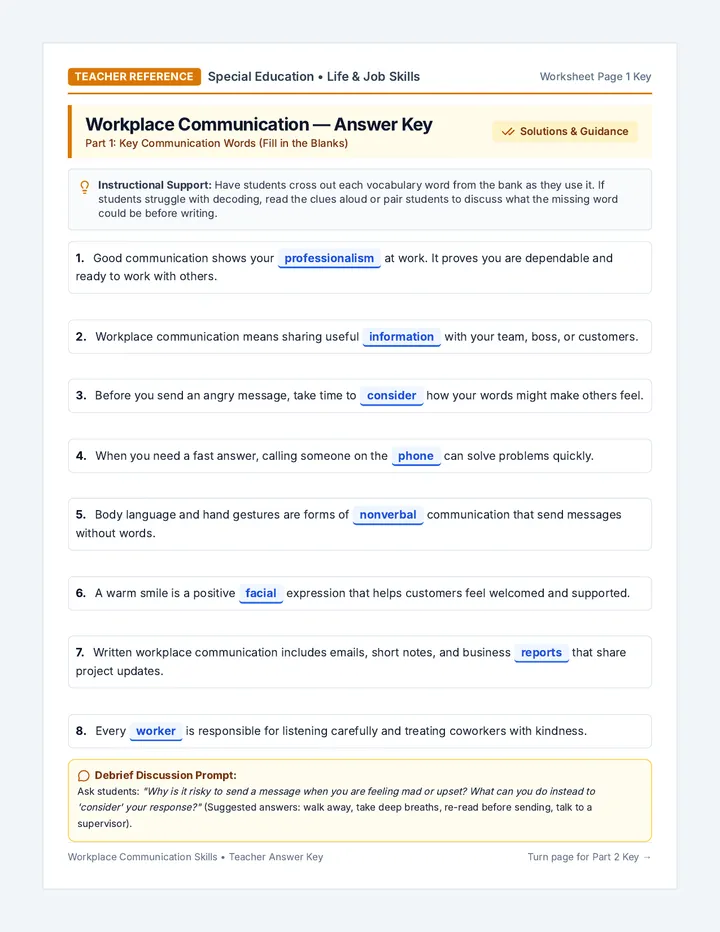
Workplace Communication — Answer Key
Part 1: Key Communication Words (Fill in the Blanks)
Solutions & Guidance
Instructional Support: Have students cross out each vocabulary word from the bank as they use it. If students struggle with decoding, read the clues aloud or pair students to discuss what the missing word could be before writing.
-
Good communication shows your professionalism at work. It proves you are dependable and ready to work with others.
-
Workplace communication means sharing useful information with your team, boss, or customers.
-
Before you send an angry message, take time to consider how your words might make others feel.
-
When you need a fast answer, calling someone on the phone can solve problems quickly.
-
Body language and hand gestures are forms of nonverbal communication that send messages without words.
-
A warm smile is a positive facial expression that helps customers feel welcomed and supported.
-
Written workplace communication includes emails, short notes, and business reports that share project updates.
-
Every worker is responsible for listening carefully and treating coworkers with kindness.
Debrief Discussion Prompt:
Ask students: "Why is it risky to send a message when you are feeling mad or upset? What can you do instead to 'consider' your response?" (Suggested answers: walk away, take deep breaths, re-read before sending, talk to a supervisor).
Workplace Communication Skills • Teacher Answer Key Turn page for Part 2 Key →
Teacher Reference Special Education • Life & Job Skills
Worksheet Page 2 Key
Workplace Communication — Answer Key
Part 2: Verbal and Nonverbal Sorting (Categorization)
Solutions & Guidance
Role-Play Suggestion: Have students demonstrate one positive nonverbal gesture (nodding, eye contact) and contrast it with a negative one (slouching, checking phone). Discuss what message the boss or customer receives in each case.
Verbal
Spoken Words
Answering a question
Asking for help
Explaining a job task
Saying "thank you"
Positive Nonverbal
Polite Body Language
Nodding your head
Smiling at a coworker