Lenny.com
Explore
Create
ActivitiesNewMathEnglish Language ArtsScience & EngineeringSocial StudiesGlobal LanguagesHealth & Physical EducationSpecial EducationCounseling & Life SkillsArts & CreativityESL
Lenny.com
Lenny.com
Explore
Create
ActivitiesNewMathEnglish Language ArtsScience & EngineeringSocial StudiesGlobal LanguagesHealth & Physical EducationSpecial EducationCounseling & Life SkillsArts & CreativityESL
Lenny.com
Lenny.com

Solutions

Lenny for EducatorsLenny for SchoolsLenny for Districts

Product

ExploreSign inCreateSupportAbout

Resources

Getting startedMTSS Acceleration Program

© 2026 Lenny Learning Inc.

TermsPrivacyAccessibility
LinkedInInstagramX
Lenny

Career & Vocational Goal Setting

Vocational interest inventories, job skill identification, and the development of measurable post-secondary employment goals. Equips transition-age students with the tools to navigate career pathways and workplace expectations.

Special EducationSensory Processing & RegulationSensory Preferences IdentificationSensory Tool UseCommunicating Sensory NeedsSensory Overload RecognitionDeep Breathing PracticeMovement Break UtilizationIndependent Calming Strategy UsePersonalized Calming RoutinePersonal Sensory Diet CreationProactive Sensory BreaksEmotion Intensity RecognitionDysregulation RecoveryPositive Behavior SupportUnderstanding Social StoriesPersonal Social Story CreationEmotional Regulation FrameworksPersonal Trigger IdentificationSelecting Regulation StrategiesReinforcement System ResponseSelf-Monitoring & RewardsLearning Positive AlternativesCross-Setting Skill GeneralizationSocial CommunicationEye Contact & Personal SpaceContext-Appropriate GreetingsAppropriate Volume & ToneConversation Turn-TakingTopic Maintenance in DiscussionEffective Help-SeekingBody Language InterpretationFacial Expression RecognitionIdioms & Figurative LanguageSocial Problem IdentificationSocial Solution GenerationSocial Decision EvaluationTask ManagementMinimal Prompting Task StartSelf-Talk for StartingStarter Strategies for Difficult TasksAge-Appropriate Task PersistenceStrategic Break ManagementSmooth Task TransitionsAdapting to Plan ChangesObstacle Problem-SolvingMulti-Day Project CompletionPlanning & OrganizationPhysical Material OrganizationVisual Schedule & Timer UseSequential Task BreakingTime Estimation SkillsTask PrioritizationDigital & Physical Workspace ManagementPersonalized Organization StrategiesDetailed Project PlanningMultiple Commitment BalancingAcademic Support StrategiesMath Manipulative UseVisual Math Problem RepresentationComplex Math Problem BreakdownText Highlighting & AnnotationVisualization While ReadingPredictions & Inferences from TextText Structure Graphic OrganizersWriting Graphic OrganizersSentence Frames & TemplatesStudy Guide CreationSpaced Repetition for MemoryAssistive Writing TechnologyWorking Memory SupportSingle-Step Direction FocusMulti-Step Direction FollowingInformation Chunking PracticeVisual Support Memory AidsMnemonic Device ApplicationEfficient Note-Taking SystemsGraphic Organizer Note-TakingNote Review & OrganizationSustained Complex Task AttentionAssistive TechnologySymbol-Word CommunicationAAC Device NavigationSpeech Recognition DictationDictation Text EditingText-to-Speech for ReadingDigital Calendar UseKeyboard Shortcuts NavigationProductivity App ManagementSelf-Advocacy SkillsCommunicating Learning NeedsRequesting AccommodationsAdvocating for Appropriate SupportsIEP & Student RightsUnderstanding IEP ComponentsMeaningful IEP Meeting ParticipationIDEA & Section 504 RightsProgress MonitoringTracking IEP Goal ProgressReflecting on AchievementData-Informed Instructional AdjustmentTransition PlanningCareer & Vocational Goal SettingExploring Post-Secondary OptionsIndependent Living Skills Planning

Sequences

Data Tool Mastery Slides

IEP Progress and Transition Planning

This sequence explores the implementation and monitoring of IEPs for 11th-grade students, focusing on data collection, progress reporting, secondary transition planning (ITP), and the ethical balance between legal compliance and educational quality. Students transition from being passive participants to active designers and evaluators of the IEP process.

11
Skill Detective Slides

Vocational Skills Readiness

A comprehensive sequence designed for 10th-grade Special Education students to build vocational readiness. It covers identifying soft skills, crafting resumes, completing applications, mastering workplace etiquette, and practicing mock interviews to prepare students for the transition to employment.

15
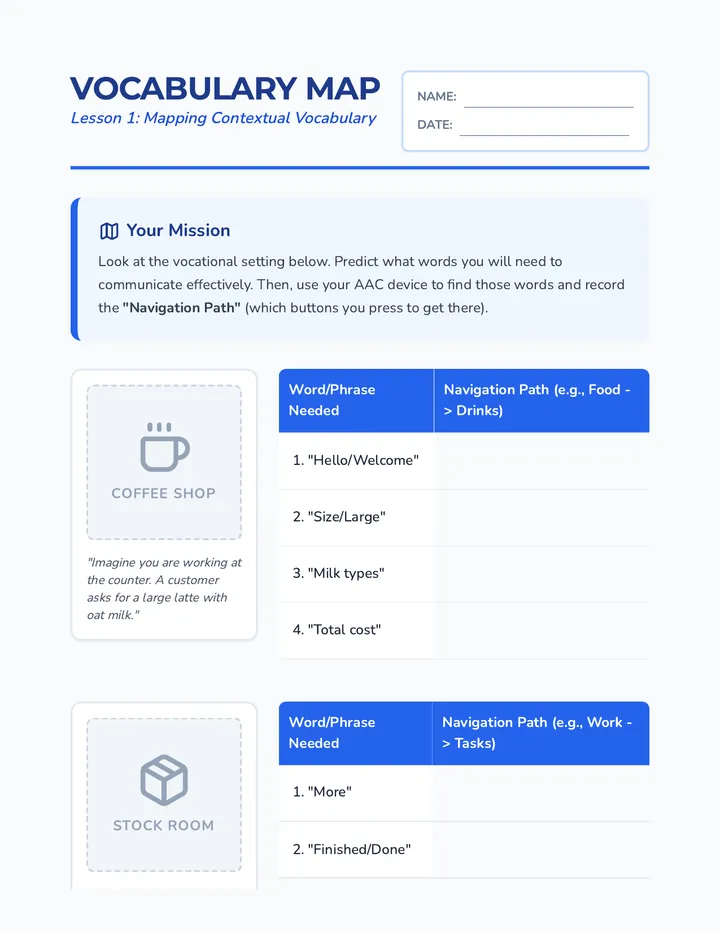
Vocabulary Map Worksheet

Navigating for Independence

This sequence prepares 10th-grade students for the transition to community and vocational life by mastering the navigation of Augmentative and Alternative Communication (AAC) devices. Students progress from identifying context-specific vocabulary to navigating complex, multi-folder social and professional interactions.

15
Spotting the Flood Slides

Clarity Creators

A self-advocacy sequence for 11th-grade students to manage working memory challenges by requesting single-step directions and professional modifications in fast-paced environments.

10
Curriculum Roadmap Slides

Next Steps Roadmap

A comprehensive curriculum for transition-age learners (18–22) to develop essential independence skills across six domains: daily living, finance, work, communication, health, and community.

8
Vocab Mapping Slides

Career Ready AAC Navigation

A comprehensive 5-lesson sequence designed for 11th-grade AAC users to master device navigation within vocational settings. Students progress from vocabulary mapping to high-stakes workplace simulations, focusing on speed, accuracy, and professional communication strategies.

13

Lessons

Your Voice IEP Lesson Plan

Your Voice Your IEP

A Tier 2 small group lesson for 10th graders designed to empower students with IEPs to actively participate in their educational planning through self-advocacy skills. Students will identify their strengths, challenges, and goals, and practice communicating them effectively in an IEP meeting context.

SP

Sierra Parce

5
Post-Secondary Options Framework Lesson Plan

Beyond Graduation

A 12th-grade special education workshop exploring college, vocational programs, and community resources to help students plan their post-secondary transition with confidence.

JW

Jeanette Wong

6
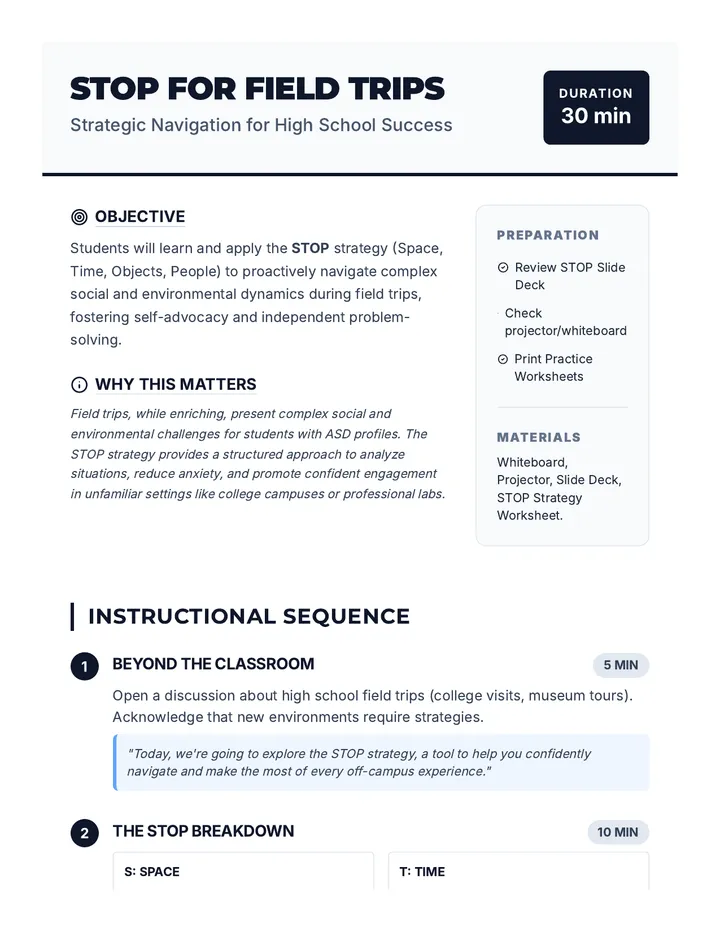
Field Trip Mastery Lesson Plan

Field Trip Mastery

This lesson introduces the 'STOP' strategy (Space, Time, Objects, People) to help high school students with ASD profiles navigate field trips, college visits, and professional events. It focuses on situational analysis, self-advocacy, and reducing anxiety in new environments.

D

dcummins

4
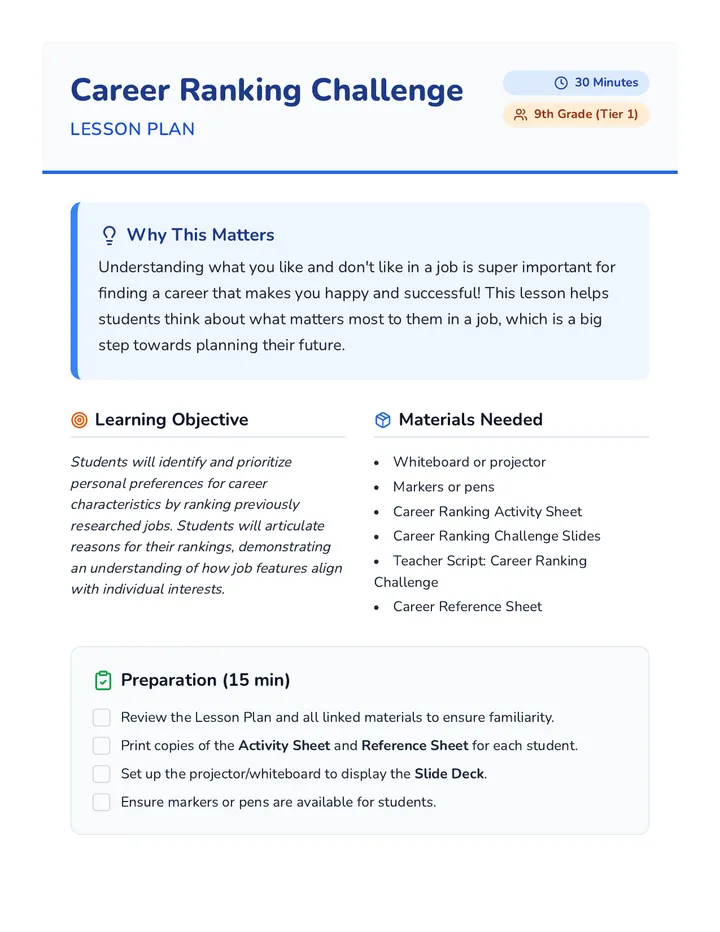
Career Ranking Challenge Lesson Plan

Career Ranking Challenge

An engaging 30-minute activity for 9th-grade students with intellectual disabilities and low reading levels to rank researched careers based on various job characteristics. This lesson helps students reflect on career preferences and understand the diversity of job roles.

AA

Annalise Abdelnour

5
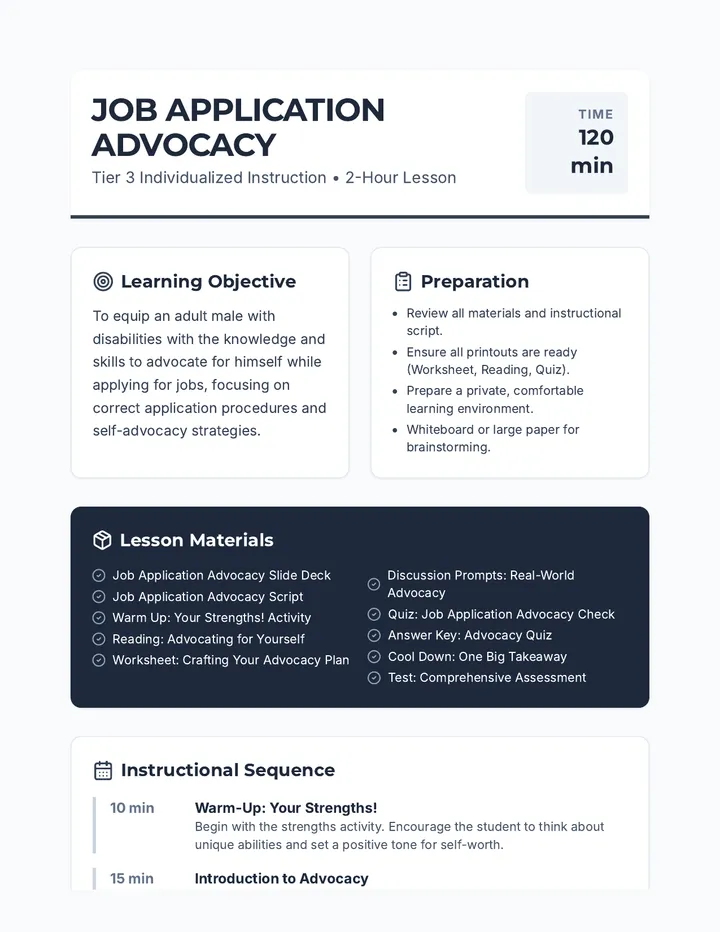
Job Application Advocacy Lesson Plan

Job Application Advocacy

A 2-hour individualized Tier 3 lesson designed to empower an adult male with disabilities to effectively advocate for himself during the job application process. The lesson focuses on identifying strengths, understanding disclosure and accommodations, and practical application strategies.

R

Ron

11
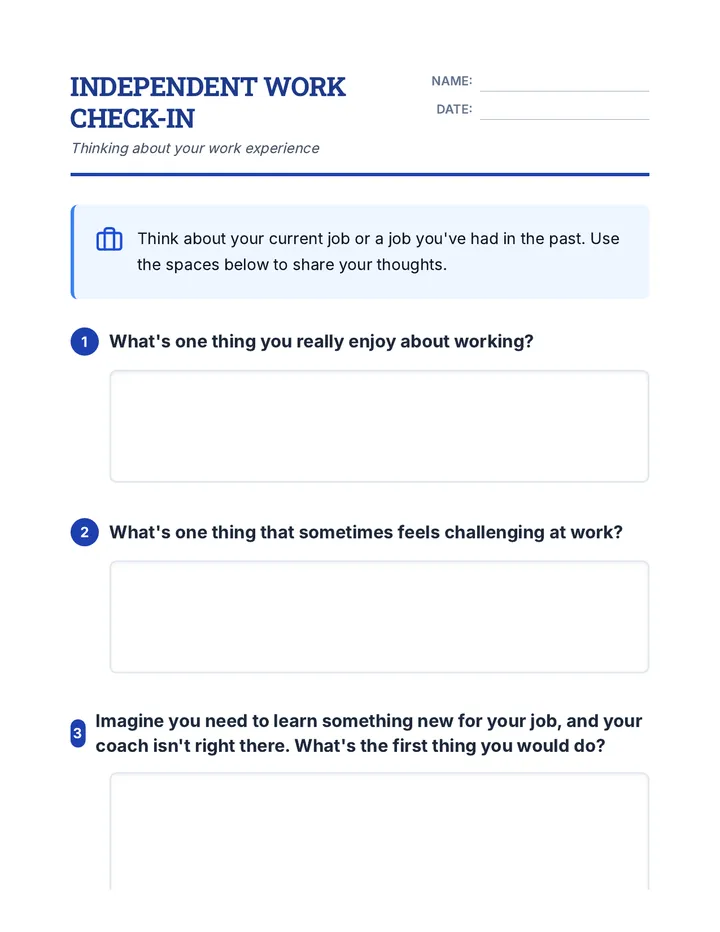
Independent Work Check-in Warm-Up

Your Independent Work Journey

A 2-hour individualized lesson for an adult male with disabilities focusing on developing strategies to maintain employment, learn new tasks independently, and stay on topic during work-related discussions.
R

Ron

11