Post-secondary education pathways, independent living requirements, and vocational training strategies for students with diverse needs. Targets career goal setting and the development of essential daily life skills for adult independence.
This sequence explores the implementation and monitoring of IEPs for 11th-grade students, focusing on data collection, progress reporting, secondary transition planning (ITP), and the ethical balance between legal compliance and educational quality. Students transition from being passive participants to active designers and evaluators of the IEP process.
A self-advocacy sequence for 11th-grade students to manage working memory challenges by requesting single-step directions and professional modifications in fast-paced environments.
A comprehensive unit for high school students exploring the collaborative nature of IEP meetings. Students will master the roles of team members, the legal timeline of special education, self-advocacy strategies, and conflict resolution techniques, culminating in a professional mock IEP simulation.
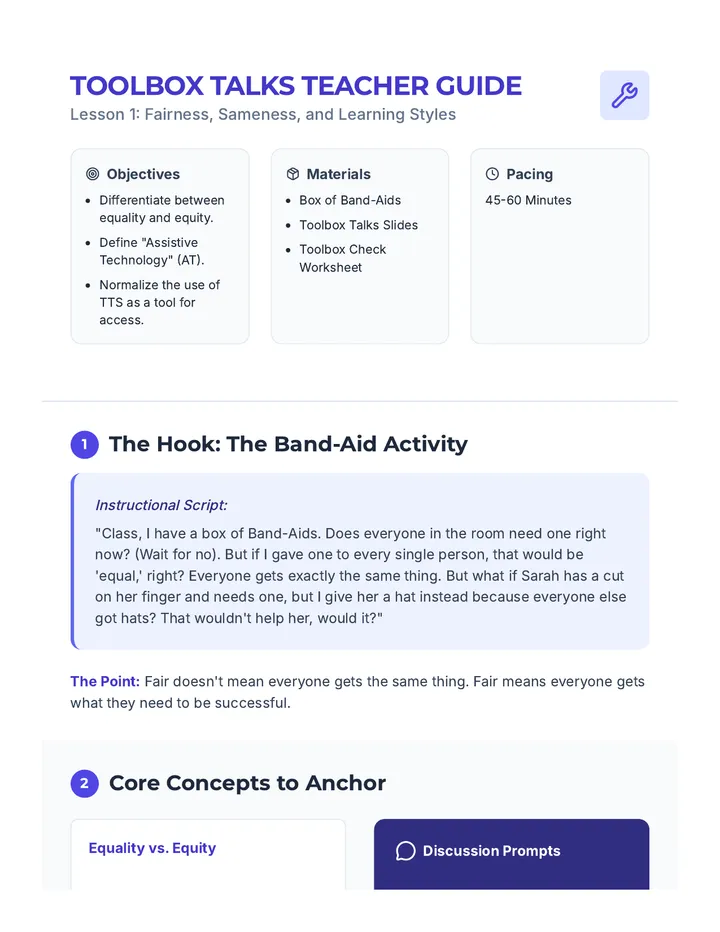
This sequence empowers 5th-grade students to understand, use, and advocate for Text-to-Speech (TTS) as a vital learning tool. It focuses on the distinction between fairness and sameness, identifying specific tasks where TTS is most effective, and building the social-emotional confidence to communicate needs to teachers and peers.
This sequence equips 12th-grade students with advanced technical skills in Text-to-Speech (TTS) technology. It moves beyond basic tool usage to professional-grade workflows, including auditory calibration, OCR conversion, immersion reading, mobile synchronization, and technical troubleshooting, preparing students for the heavy reading demands of post-secondary environments.
A comprehensive transition sequence for 12th-grade students focusing on the legal, professional, and practical aspects of using Text-to-Speech (TTS) and other assistive technologies in higher education and the workplace. Students learn to advocate for their rights under the ADA and Section 504 through role-play, professional writing, and portfolio building.