Blueprint Breakdown Slides Blueprint Breakdown
Project Pilots: Mission 01
"Every masterpiece starts with a single brick. Every project starts with a single step."
The Pile vs. The Castle
🧱
The Pile
Overwhelming, messy, and hard to start.
🏰
The Castle
Clear, structured, and finished.
How do we get from the pile to the castle? We use the Instructions .
Task Analysis
1
Read the Prompt
Don't just skim it. Highlight the "deliverables" (what you actually turn in).
2
Identify Hidden Tasks
A "History Report" isn't one task. It's research, outlining, drafting, and citations.
3
Granularity
Break tasks down until they take less than 45 minutes to finish.
The Deconstruction
"Write a 3-page research paper on a 20th-century invention."
Too Big (The Pile)
Research invention
Write paper
Do citations
Just Right (The Blueprint)
Choose 3 sources from database
Create bulleted outline
Write Intro Paragraph
Your Pilot Mission
Open your current project rubric.
Identify 3 tasks that seem simple but are actually "piles."
Goal: Turn those 3 piles into 9 small bricks.
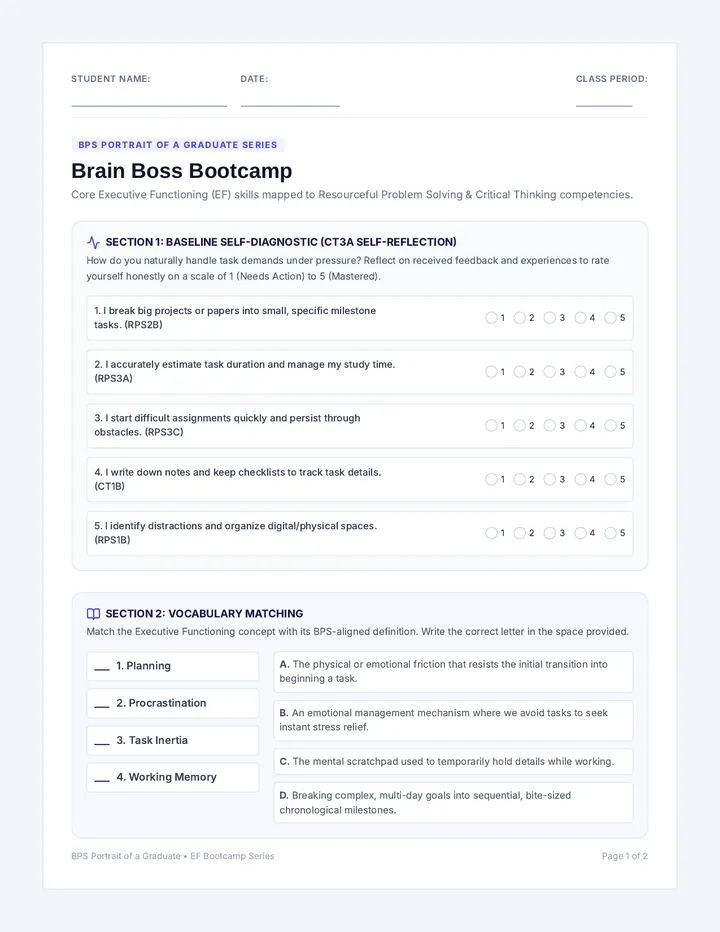
Blueprint Breakdown Worksheet Blueprint Breakdown Lab
Project Pilots // Mission 01: Task Analysis
NAME:
DATE:
Step 1: Identify "The Pile"
Select a long-term project or assignment you are currently working on in another class.
Project Title
Final Due Date
Step 2: The Deliverable Hunt
Look at your rubric or project prompt. What are the specific things you have to **DO** or **TURN IN**? List them below as "Big Tasks."
Step 3: Break it Into Bricks
Pick one big task from above and break it down into 5 "Micro-Tasks." Each task should take **less than 45 minutes** to complete.
Micro-Task Description Est. Time (Min) Energy Level (1-5)
Check for Granularity:
Is the task small enough to start without feeling scared?
Does it result in a clear, finished "thing"?
Reverse Planning Slides Project Pilots: Mission 02
Reverse Planning Gear
Start at the finish line. Work back to today.
The Dinner Challenge
You want dinner on the table at 6:00 PM sharp.
The Tasks
• Roast Chicken (90 min)
• Mashed Potatoes (30 min)
• Salad Prep (15 min)
• Table Setting (5 min)
The Problem
If you start everything at 5:00 PM, the chicken won't be ready until 6:30 PM. You must work backward from 6:00 PM to find your "Start Times."
Forward vs. Backward
Forward Planning
"I'll start today and see how far I get."
Risk: You run out of time at the end because you didn't see the finish line coming.
Backward Planning
"The deadline is Friday. That means I must finish the draft by Wednesday."
Benefit: Every task has a clear "must-be-done-by" date. No surprises.
The "Buffer" Principle
Life Happens.
Your internet goes down. You get a cold. You realize the task is harder than you thought.
Planning Time = Estimated Time + 20% Buffer
If you think it takes 5 days, plan for 6.
Mission Brief
Open your project blueprint.
Start with the due date and work backward to find the start date for every single brick.
Don't forget your Buffer!
Reverse Planning Worksheet Reverse Gear Calendar
Project Pilots // Mission 02: Backwards Design
NAME:
DATE:
How to Reverse Plan:
Write your Final Due Date in the last box.
Work backward : What must be done the day before? The week before?
Add a 20% Buffer (mark at least 2 "No-Task Days" for emergencies).
Step 4 (Oldest)
Start Date: ________
Step 3
Finish by: ________
Step 2
Finish by: ________
Step 1 (The End)
DUE DATE: ________
The Buffer Zone
Look at your timeline above. Where are the "High Risk" spots? (e.g., busy weekends, sports games, a difficult part of the project). Describe your plan for one potential delay.
Pilot Verification
Each step in my calendar is a "Brick" (small enough to do in <45 mins).
I have scheduled at least 2 days of "Buffer" where no work is planned.
My start date is realistic based on my current schedule.
I have accounted for other commitments (practice, homework, family).
Ignition Strategies Slides Project Pilots: Mission 03
Ignition Strategies
Overcoming the friction of starting.
Static vs. Kinetic Friction
The "Stuck" State
The energy required to get a heavy box moving is MUCH HIGHER than the energy needed to keep it sliding.
Momentum
Once you are in motion, your brain enters a "flow state" where work feels lighter.
Why do we procrastinate?
The Amygdala
Sees a big project as a "threat." It triggers a fight-or-flight response (usually flight—aka Netflix).
The Prefrontal Cortex
The "Pilot" who wants to work. It gets out-voted by the panic center.
"Procrastination is not laziness. It is **emotional regulation**."
The 5-Minute Rule
Step 1
Pick the task you've been avoiding.
Step 2
Set a timer for exactly 5 minutes.
Step 3
Promise yourself you can stop when it rings.
Spoiler: 80% of the time, you won't want to stop.
Ignition Test
We are going to test the 5-Minute Rule right now .
Pick one task from your project blueprint.
You are committing to 300 seconds of work.
That's it.
Ignition Log Worksheet The Ignition Log
Project Pilots // Mission 03: Task Initiation
NAME:
DATE:
The 5-Minute Rule Theory
The hardest part of any task is starting . The 5-Minute Rule tricks your brain's "panic button" (the amygdala) by committing to a tiny, non-threatening amount of work. Once the timer rings, you have permission to stop—but you usually won't.
Trial Runs: Overcoming the Friction
The "Dreaded" Task Start Mood (1-10) Did you keep going? Finish Mood (1-10) Example: Write Intro Paragraph
| |
Yes
No
| |
|
| | | |
|
| | | |
|
| | | |
Post-Ignition Reflection
Most students find that their "Start Mood" (dread) is much higher than their "Finish Mood" (satisfaction). Why do you think your brain tried to stop you from starting?
My Go-To Ignition Task
What is one specific "brick" you can always use to start a project?
My Momentum Reward
How will you celebrate a successful ignition?
Recalculating Routes Slides Project Pilots: Mission 04
Recalculating Routes
Navigating delays and adjusting your course.
"Recalculating..."
When a GPS misses a turn, it doesn't say "GIVE UP AND GO HOME."
"It simply finds a new way to get to the same destination."
Falling behind on a project isn't a failure. It's just a missed turn .
The Weekly Review
Every Sunday (or Monday), take 15 minutes to ask 3 questions:
What's Finished?
Celebrate the bricks you actually laid this week.
What's Missing?
Identify the tasks that were delayed without guilt.
The Pivot
How do I fit the missing bricks into next week's schedule?
How to Pivot
1. Trim the Scope
Is there a part of the project that isn't required? Cut it to save time.
2. Stack the Bricks
Can you do two related tasks at the same time? (e.g., citing while you research).
3. Use the Buffer
This is what your 20% margin was for! Move tasks into those empty days.
Weekly Check-In
Open your Weekly Review Log .
Look at the past 7 days. Honestly mark what's done and what needs a "recalculation."
"The only bad review is the one you don't do."
Weekly Review Log Worksheet Weekly Review Log
Project Pilots // Mission 04: Progress Monitoring
NAME:
WEEK:
The GPS Review
Missing a deadline is just a "missed turn." This review is your chance to recalculate your route. No guilt—just logic.
Step 1: The Audit
Bricks Laid (Finished)
Missed Turns (Delayed)
Step 2: Recalculating the Route
How will you handle your "Missed Turns" from Step 1? Choose a strategy for each one.
Delayed Task
Pivoting Strategy
Trim Scope
Use Buffer Day
Double Up
Delayed Task
Pivoting Strategy
Trim Scope
Use Buffer Day
Double Up
Step 3: Clear Skies Ahead
What is the #1 "Priority Brick" that MUST be laid next week to keep the project moving?
Estimated Ignition Time: _________ minutes
Ground Crew Slides Project Pilots: Mission 05
Ground Crew Support
"No pilot flies alone. Every mission needs a crew."
The Isolation Trap
When we keep a project secret, we only have to answer to ourselves.
"And ourselves are very easy to convince that we can start tomorrow."
Accountability is the bridge between intention and action .
Breaking the Cycle
Nagging vs. Accountability
Nagging
Focused on the past/failure.
Feels like an attack.
Unplanned and annoying.
"Why haven't you started yet?"
Accountability
Focused on the next step.
Feels like a partnership.
Planned and predictable.
"How can I help you start?"
Who is on your crew?
The Expert
Teacher or Coach
Check-ins on the Quality of the bricks.
The Support
Parent or Mentor
Check-ins on the Environment and needs.
The Peer
Study Buddy
Check-ins on Momentum (The "Body Double").
Ground Crew Contract
Identify two people you can recruit for your current project.
Define exactly how and when they should check in.
"Clear expectations prevent messy nagging."
Ground Crew Contract Worksheet Ground Crew Contract
Project Pilots // Mission 05: Accountability Systems
NAME:
DATE:
The Pilot's Oath
"I recognize that my brain sometimes needs a 'push' to start. I choose to recruit a Ground Crew to help me navigate my project. I will be clear about my needs so my crew can support me without nagging."
Crew Member #1
Name / Role
Check-in Frequency
Daily
Weekly Review
The "Support Ask"
Example: "Please text me at 4pm to ask if I've done my 5-minute ignition."
Crew Member #2
Name / Role
Check-in Frequency
Daily
Weekly Review
The "Support Ask"
Example: "Can we sit together for 30 mins to work in silence (Body Doubling)?"
Anti-Nagging Protocol
Sometimes support starts feeling like nagging. How will you communicate to your crew if you need them to change their style?
Script: If they are too intense
"I appreciate the help, but right now I'm feeling overwhelmed. Can we try checking in at [Time] instead?"
Script: If they forgot to check in
"Hey! I missed our check-in today. Can you ask me about my project tonight?"
Mission Ready
Sign below to finalize your project support system.
Pilot Signature
X
Ground Crew Witness