Chat Champions Lesson Plan Chat Champions
Teacher Facilitation Guide
Duration: 45 Minutes
Target: Pragmatic Language
Instructional Objectives
Students will initiate, maintain, and end conversations in role-play scenarios with 80% accuracy.
Students will demonstrate appropriate body language (eye contact, posture) and personal space (arm's length).
Students will interpret non-verbal cues (tone, facial expression) to adjust conversational responses.
Prep Checklist
Chat Champions Slides
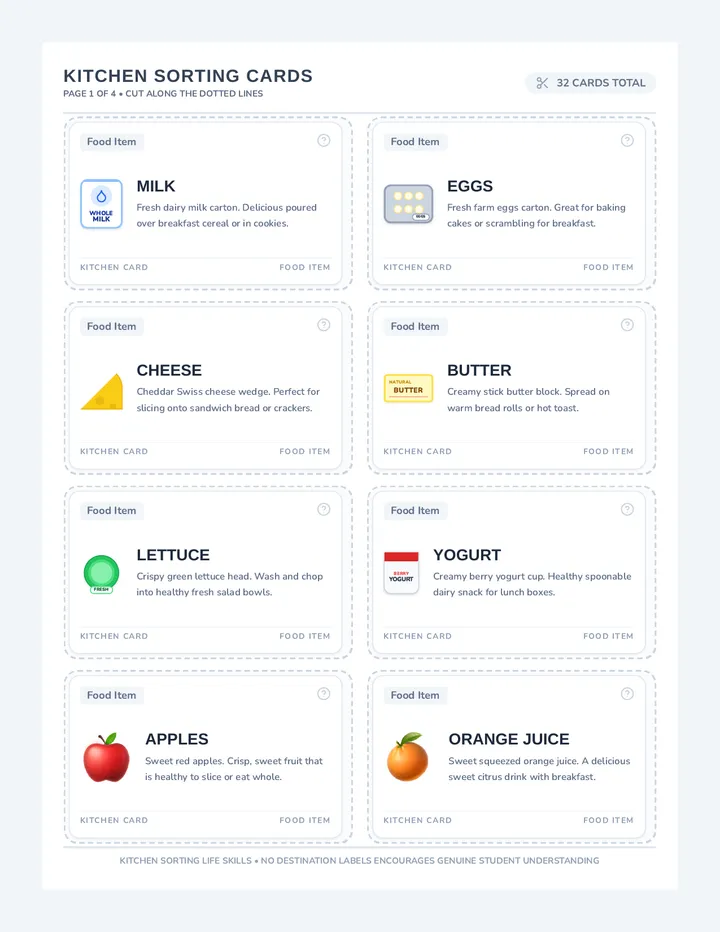
Conversation Starter Cards (Cut)
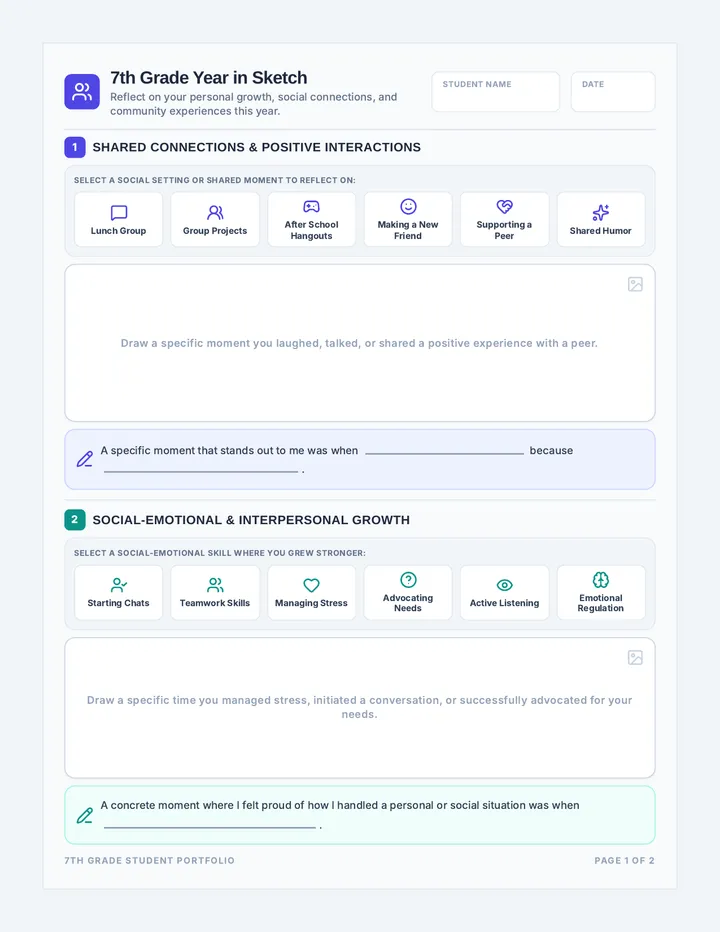
Cue Detective Worksheets
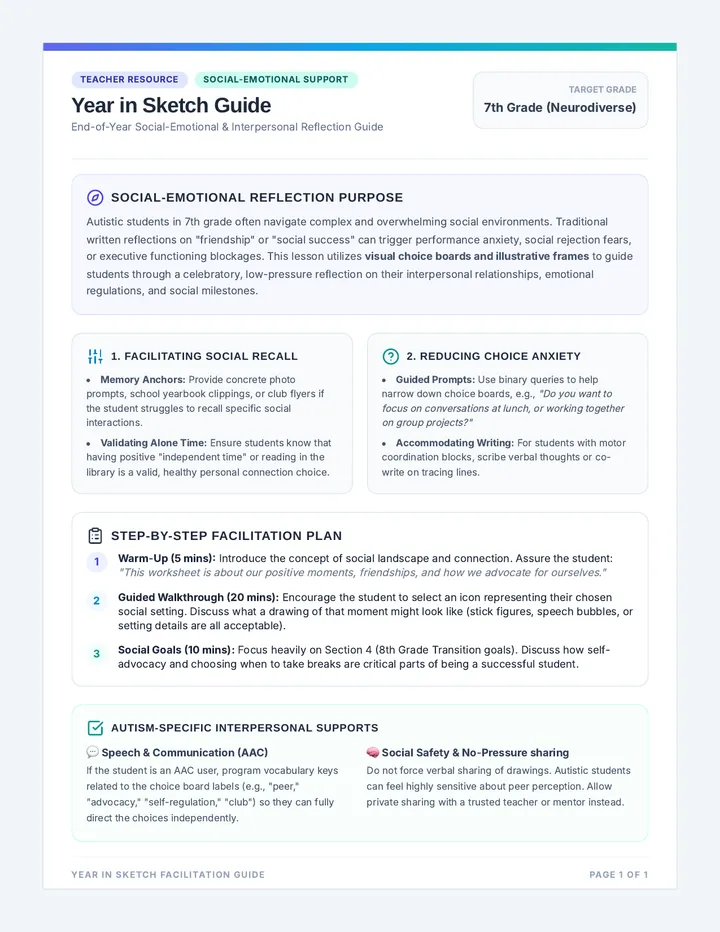
Conversational Data Log
Visual Timer
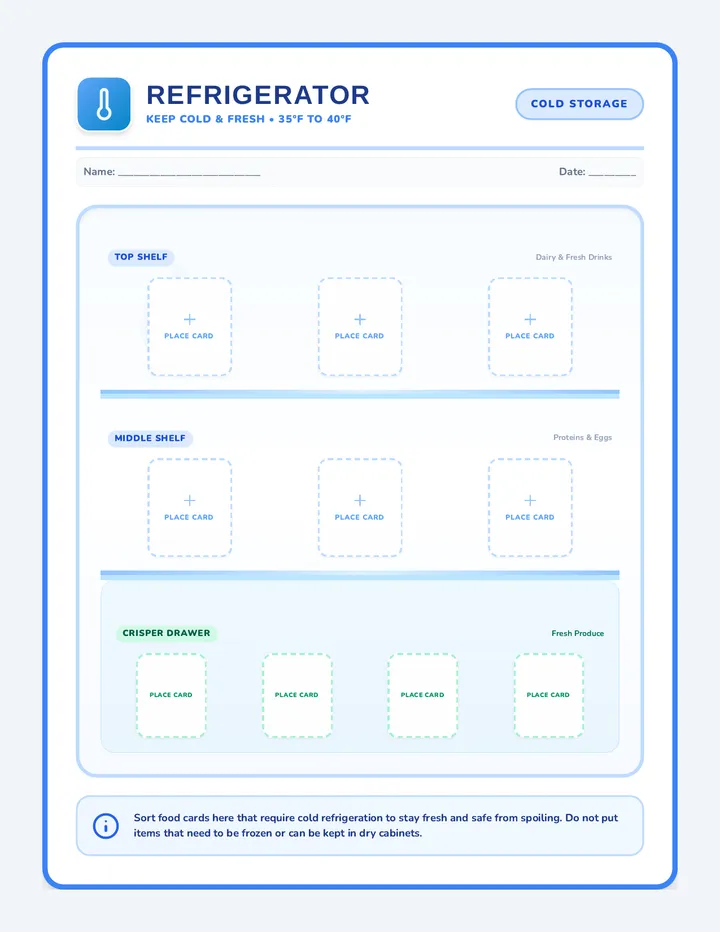
Personal Space "Hula Hoop" (Optional)
45-Minute Lesson Breakdown
5 Min
The Greeting Game
Students practice eye contact and personal space while greeting the teacher and one peer. Use "Arm's Length" visual cue.
Prompt: "Adam, remember to check your distance. Are you at arm's length?"
10 Min
Interactive Slides
Review "The Conversation Cycle": Open, Maintain (2 turns), Close. Discuss body language "Green Zone" vs. "Red Zone".
15 Min
Conversation Lab
Use Conversation Starter Cards . Students work in pairs to role-play scenarios. Focus on topic maintenance.
Teacher Action: Circulate and provide immediate verbal feedback on posture and turn-taking.
10 Min
The Cue Challenge
Complete the Cue Detective Worksheet . Practice identifying sarcasm and boredom through tone and expression videos/clips.
5 Min
Exit Ticket & Data
Quick reflection: "One thing I did well today was..." Teacher records data on the Conversational Data Log .
Support Strategies
Visual Supports
โข Point to "Conversation Cycle" poster.
โข Use hand gestures for "stop" and "go".
โข Personal space floor markers.
Verbal Prompts
โข "What else can you ask about [Topic]?"
โข "Check your posture."
โข "Is it your turn or my turn?"
Chat Champions Slides CHAT CHAMPIONS
Mastering the Art of Conversation
The Conversation Cycle
1
OPEN
"Hey, how's it going?"
2
MAINTAIN
"That's cool! What did you like about it?"
3
CLOSE
"I gotta go to class now, see ya later!"
How to START
Observe
โข Is the person busy?
โข Are they wearing headphones?
โข What are they doing?
Strategy
โข Give a compliment
โข Ask a "Wh-" question
โข Mention a shared class
The "Ping-Pong" Rule
My Turn:
I share a piece of information or ask a question.
Your Turn:
You comment or answer, then pass it back!
ME
YOU
The "Green Zone" (Body Language)
Eye Contact
Look at their eyes or their nose to show you are listening.
Fronting
Turn your shoulders toward the person you are talking to.
Personal Space
Keep one arm's length between you and the other person.
Reading the "Stop" Signs
If you see these, it might be time to change the topic or end the chat:
Distraction
They keep looking at their phone or the clock.
Turning Away
Their body is pointing toward the door or another person.
Short Answers
They only say "Yeah" or "Cool" without adding more.
Facial Cues
Raised eyebrows (confusion) or looking down (boredom).
Conversation Starter Cards Conversation Starter Cards
Social Toolkit Activity
Practice: Initiation & Maintenance
Scenario: The Lunch Table
How to Start:
"Hey, is anyone sitting here? What's for lunch today?"
Keep it Going:
"That looks good! Did you bring that from home or get it here?"
Scenario: Before Class
How to Start:
"Did you finish the homework for this class?"
Keep it Going:
"Yeah, it took me forever. Which part was the hardest for you?"
Scenario: The Bus Stop
How to Start:
"I like your shoes! Where did you get them?"
Keep it Going:
"I've been looking for a pair like that. Were they on sale?"
Scenario: School Club
How to Start:
"What game are you playing? Is it hard to learn?"
Keep it Going:
"I usually play [Game Name]. Have you ever tried that one?"
Scenario: Passing in Hall
How to Start:
"Hey [Name], how was your weekend? Do anything fun?"
Keep it Going:
"Nice! I just stayed home and relaxed. Ready for the test tomorrow?"
Scenario: Create Your Own
How to Start:
Keep it Going:
CUT CARDS PRACTICE TWICE
PRAGMATIC PROWESS โข UNIT 1
Cue Detective Worksheet CUE DETECTIVE
Case File: Non-Verbal Clues
Agent Name:
Date:
Part 1: The Face Evidence
Match the facial expression to the hidden meaning.
๐คจ
Evidence A
Raised eyebrow, tilted head.
๐
Evidence B
Eyes looking upward, heavy sigh.
๐ฅฑ
Evidence C
Hand over mouth, squinted eyes.
๐
Evidence D
Eyes crinkled, wide mouth.
Bored
Confused
Happy
Annoyed
Part 2: The Sarcasm Trap
Sometimes people say one thing, but their tone means the opposite. Read the scenarios and circle the real meaning.
1. You spill your water on your friend's desk. They roll their eyes and say, "Oh, great. That's exactly what I wanted to happen."
They are happy about the water.
They are annoyed that their desk is wet.
2. It's raining really hard outside. Your brother looks out the window and says, "Wow, what a beautiful day for a walk!"
He thinks the weather is bad.
He is excited to go outside.
Part 3: What's the Move?
What should you do next? Write your response plan below.
SCENARIO: You are talking about your favorite video game. Your friend keeps looking at the clock and hasn't said anything for two minutes.
My Detective Move: