Social Toolkit Lesson Plan Social Toolkit
Growing Strong: My Social Toolkit Lesson Plan
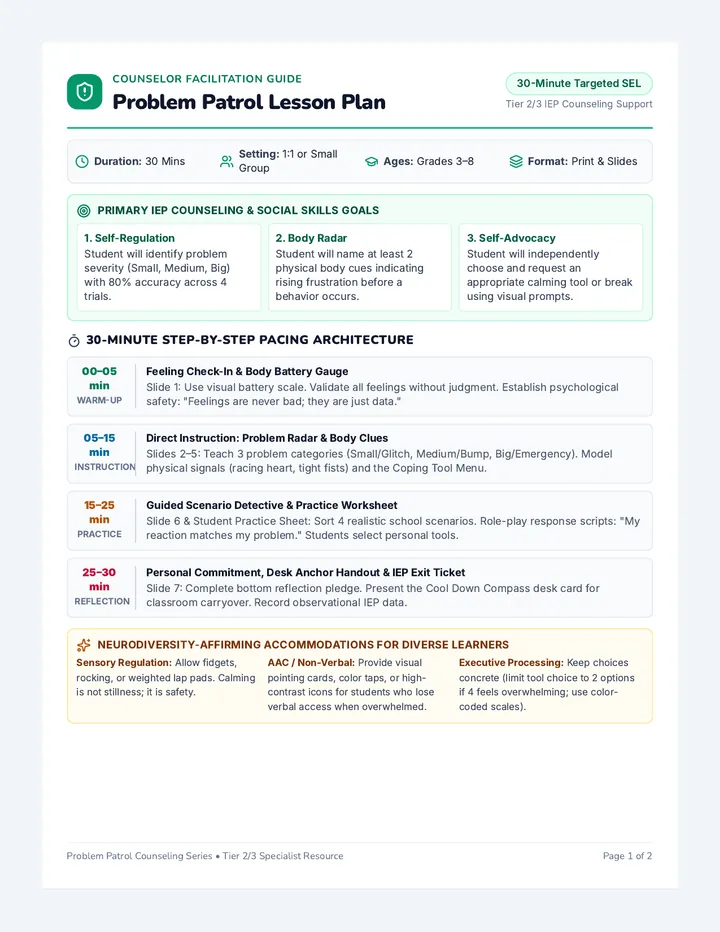
Audience: 8th Grade (Individual)
Format: 5 Sessions (30 min each)
Objective
To equip an 8th-grade student with Autism with practical strategies for distress tolerance, increasing flexibility, fostering a growth mindset, and developing self-advocacy skills for healthy peer relationships and boundaries.
Why This Matters
Developing these skills is crucial for navigating complex social situations, building resilience, and fostering positive, respectful interactions with peers, ultimately leading to greater confidence and well-being.
Preparation & Materials
PREP ACTIONS EST. TIME: 30 MIN
• Review the specific materials for the week (worksheets, cards, journal).
• Ensure the My Social Toolkit Slide Deck is ready for display.
• Adapt activities as needed to suit the student's individual sensory needs and preferences.
• Review the script/facilitation notes for smooth delivery.
Checklist
Whiteboard / Markers
Week Specific Worksheet
Reflection Journal
Slide Deck Access
5-Week Roadmap
WEEK 1: DISTRESS TOLERANCE
30 MINUTES
Intro (5m)
Define distress tolerance as handling tough feelings without escalation.
Activity (10m)
Discuss types of distress (anger, overload). Use Distress Tolerance Worksheet .
Practice (10m)
Practice deep breathing and sensory grounding techniques together.
Reflection (5m)
Assign Week 1 task in Reflection Journal .
WEEK 2: EMBRACING FLEXIBILITY
30 MINUTES
Check-in (5m)
Review last week's observations from the journal.
Definition (10m)
Define flexibility as adapting to changes in schedule or decisions.
Activity (10m)
Work through Flexibility Scenarios Activity together.
Reflection (5m)
Assign flexibility observation task in Reflection Journal .
WEEK 3: GROWTH MINDSET
30 MINUTES
Check-in (5m)
Discuss observations from the flexibility challenge.
Concept (10m)
Explain Fixed vs. Growth Mindset. Brain grows with effort.
Practice (10m)
Reframe "I can't" using Growth Mindset Journal Prompts .
Reflect (5m)
Assign "The Power of Yet" task in journal.
WEEK 4: SELF-ADVOCACY
30 MINUTES
Check-in (5m)
Review insights from growth mindset reflections.
Definition (10m)
Speaking up for needs and setting respectful boundaries.
Role-Play (10m)
Use Self-Advocacy Role-Play Cards for practice.
Reflect (5m)
Assign boundary reflection task in journal.
WEEK 5: INTEGRATION
30 MINUTES
Review (10m)
Connect all 4 skills. Discuss how they support each other.
Activity (10m)
Practice complex scenarios using a mix of all activity cards.
Planning (5m)
Discuss future use of the toolkit and celebrate progress.
Wrap (5m)
Final entries in the Reflection Journal .
Social Toolkit Slide Deck Your Social
Toolkit
Building skills for stronger friendships and happier days.
Distress Tolerance
Flexibility
Growth Mindset
Self-Advocacy
Teacher Note
Welcome the student. Explain that these "superpowers" help navigate social situations with confidence.
What is Distress Tolerance?
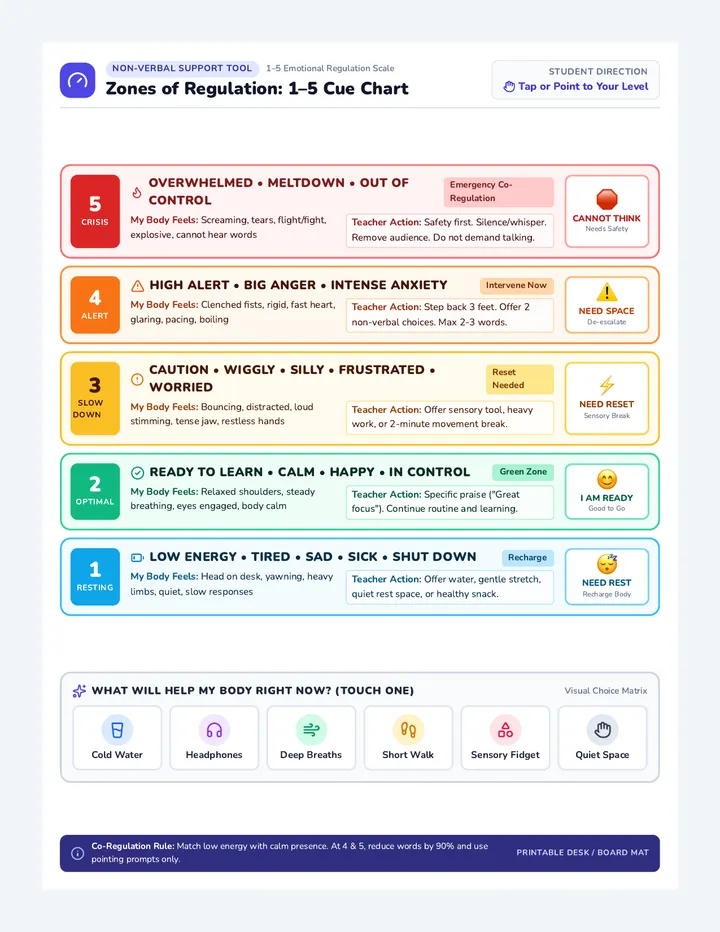
The ability to get through tough feelings without making things worse.
Distress
Uncomfortable feelings like anger, frustration, sadness, or sensory overload.
Tolerance
Learning to manage these feelings until they pass. Like riding out a storm!
Ask the student: "What does distress feel like in your body?" Emphasize that feelings are temporary waves.
Healthy Ways to Cope
Instead of...
Shouting or breaking things
Withdrawing completely
Try these Tools:
Deep breathing
Slow counting to 10
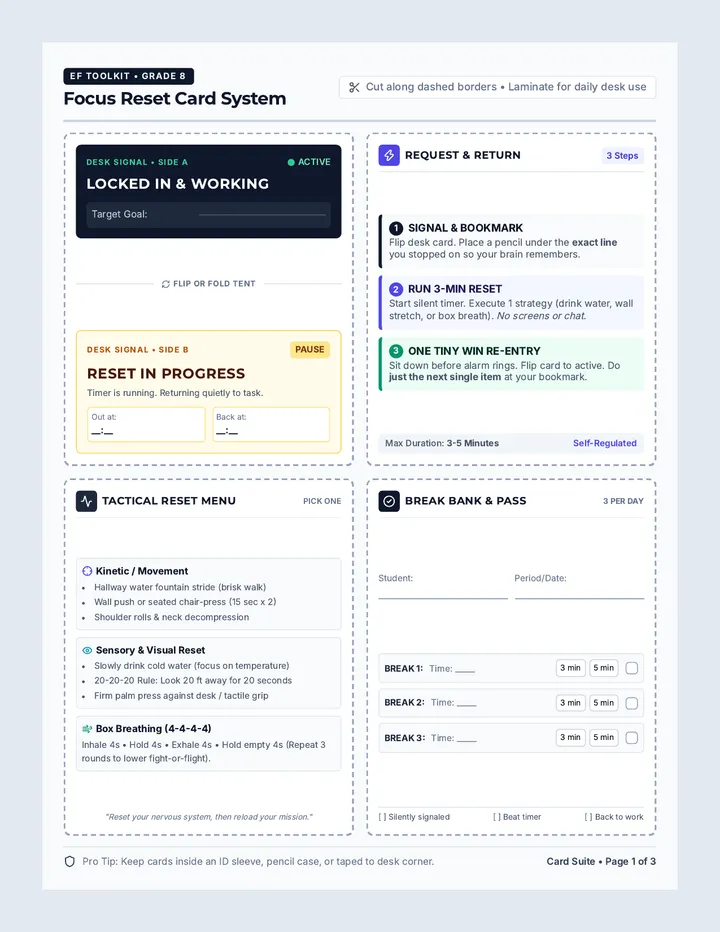
Taking a short break
Sensory tools (fidgets)
Pick one to practice right now!
Guide the student through 4-4-6 breathing. Encourage them to identify their favorite tool.
Bend, Don't Break
Flexibility is being able to ADAPT when plans change.
Life is unpredictable! Sometimes schedules shift, or friends have different ideas.
Adjust expectations
Try new solutions
Stay calm during shifts
"Think of a bendy straw vs. a dry twig. What happens when the wind blows?"
Why Be Flexible?
Less Stress
You won't get as upset when small things go differently than planned.
More Fun
You are open to new ideas and experiences that you might have missed.
Stronger Friendships
Compromising helps others feel heard and understood too.
Resilience
You can handle "bumps in the road" without crashing.
Discuss a recent change the student handled well. Reinforce it's a skill that takes practice.
The Power of "Yet"
Fixed Mindset
"I'm not good at this. I'll never learn."
Abilities are set in stone.
Growth Mindset
"I'm not good at this YET. But I can improve!"
Abilities grow with effort.
Explain: Your brain is like a muscle. When you work it hard, it gets stronger!
Distress Tolerance Worksheet Riding the Distress Wave
Distress Tolerance Toolkit • Week 1
Student Name
Date
"Sometimes big feelings come like waves. They can feel overwhelming, but they don't last forever. You can learn to ride them out without getting swept away."
Part 1: My Distress Detectives
1. What does distress feel like in your body?
(e.g., tight chest, shaky hands, racing heart, tense muscles, feeling hot)
2. What situations usually make you feel distressed?
(e.g., changes in plans, loud noises, disagreements with friends, confusing tasks)
3. On a scale of 1 to 10, what level of distress do you usually feel?
A Little Extremely
1
2
3
4
5
6
7
8
9
10
Part 2: My Coping Toolkit
Deep Breathing
Breathe in (nose) for 4 counts .
Hold for 4 counts .
Breathe out (mouth) for 6 counts .
Repeat 3-5 times.
Grounding (5-4-3-2-1)
5 things you can SEE 4 things you can TOUCH 3 things you can HEAR 2 things you can SMELL 1 thing you can TASTE
Part 3: Practice Time
Pick one skill from above to try this week. Describe it here:
What is one small step you can take to use this skill?
Weekly Reflection Journal Document My Social Toolkit
Weekly Reflection Journal
Name
Starting Date
Week 1: Distress Tolerance
Riding the Wave
1. This week, I noticed feelings of distress when...
2. When I felt distressed, I tried to use this coping skill:
3. How did it go? What did I learn about managing my distress?
Week 2: Embracing Flexibility
Bending, Not Breaking
1. This week, something changed or didn't go exactly as planned when...
2. I tried to be flexible by...
3. What was easy or hard about being flexible in that situation?
Week 3: Growth Mindset
The Power of Yet
1. This week, I faced a challenge or thought, "I can't do this!" when...
2. I tried to use a growth mindset by thinking/saying...
3. How did thinking with a growth mindset help me?
Week 4: Self-Advocacy
Your Voice Matters
1. This week, I thought about advocating for myself or setting a boundary when...
2. If I had advocated for myself, I would have said/done...
3. What is one small step I can take to speak up for my needs next week?
Week 5: Toolkit Mastery
Integrating Skills
1. Which of the skills (distress tolerance, flexibility, growth mindset, self-advocacy) did I use most this week?
2. Describe a time this week when I used *more than one* of these skills together.
3. Looking ahead, how will I continue to practice these skills to build stronger relationships?
Flexibility Scenarios Activity Bending with the Breeze
Flexibility Scenarios • Week 2
Student Name
Date
"Being flexible means you can adjust when things don't go exactly as planned. It's like a tree that bends in the wind instead of breaking. Let's practice finding flexible reactions!"
Scenario 1: Movie Night Mix-Up
You and your friend planned to watch a specific movie at your house on Friday night. On Thursday, your friend texts you: "Hey, my sister wants to watch that movie with her friends on Friday. Can we watch a different one instead, or maybe watch it Saturday?"
My Initial Feeling
A Rigid (Inflexible) Reaction
A Flexible Reaction (Options & Adaptation)
Scenario 2: Lunchtime Surprise
You always sit at the same table for lunch. Today, you walk into the cafeteria and see that your friends have already filled up your table, and there's no room for you. They wave and say, "Hey! Sorry, it's full!"
My Initial Feeling
A Rigid (Inflexible) Reaction
A Flexible Reaction (Options & Adaptation)
Scenario 3: Project Partner Puzzle
Your science teacher assigns a group project. You were hoping to work with your friend, Alex. However, the teacher announces the partners, and you are paired with Sarah, someone you don't usually work with.
My Initial Feeling
A Rigid (Inflexible) Reaction
A Flexible Reaction (Options & Adaptation)
Scenario 4: Game On, Or Not?
You and your friends are playing a video game you all agreed on. Suddenly, one friend suggests switching to a different game, and others agree, even though you were really looking forward to the first game.
My Initial Feeling
A Rigid (Inflexible) Reaction
A Flexible Reaction (Options & Adaptation)
Growth Mindset Journal Prompts The Power of "Yet"
Growth Mindset Journal • Week 3
Student Name
Date
The Big Idea
Your brain is like a muscle! When you practice something hard, you create new pathways. You might not be able to do something YET , but you can learn and improve.
Fixed vs Growth
Fixed: "I'm not good at this."YET . What can I try next?"
Prompt 1: My Challenge & Effort
Describe something that felt challenging for you recently:
What effort did you put into it? (What did you *try*?)
What is one new strategy you could try next time?
Prompt 2: Learning from a Mistake
Describe a mistake you made recently:
What did you learn from this mistake?
Prompt 3: The Power of "Yet"
Original Thought
"I can't do that."
With "YET"
"I can't do that yet!"
What is one small step you could take to move closer?
Self Advocacy Role Play Cards Activity Your Voice Matters
Self-Advocacy Role-Play Cards • Week 4
Role-playing helps you build the muscle for speaking up!
Instructions: Cut these cards out or read them one by one. You will be the student, and your teacher will play the role of the friend or classmate. Focus on communicating your needs clearly and respectfully.
Card 1: Noise Sensitivity
Scenario
You are studying in the library. Your friend starts tapping their pencil loudly and humming. It's distracting and overwhelming for you.
Your Goal
Politely ask your friend to stop or do something quieter.
What you could say/do
Card 2: Personal Space
Scenario
You are working on a project. Your classmate keeps leaning very close and touching your arm, which makes you uncomfortable.
Your Goal
Gently communicate that you need a little more space.
What you could say/do
Card 3: Changing Plans
Scenario
You planned to meet at 3:00 PM. At 2:50 PM, your friend texts: "Hey, can we meet at 4:30 PM instead?" You feel frustrated by the late change.
Your Goal
Express your feelings and ask for clearer communication next time.
What you could say/do
Card 4: Unwanted Topic
Scenario
Friends start discussing a topic that makes you very uncomfortable (like a stressful rumor or a movie you dislike).
Your Goal
Change the topic or politely excuse yourself.
What you could say/do
Card 5: Group Break
Scenario
Group discussion is intense and fast-paced. You feel overwhelmed and need a moment to process.
Your Goal
Ask for a short break or a moment of quiet.
What you could say/do
Card 6: Teacher Needs
Scenario
You have a new teacher. You want them to understand that you sometimes need a quiet space to work.
Your Goal
Politely explain your learning needs to your teacher.
What you could say/do