Mission Control Slides SYSTEM STATUS: READY
FOCUS ACADEMY
Active Pilot Training
MISSION CONTROL
Welcome to Focus Academy. Over the next 8 sessions, we will upgrade your brain's command center, defeat daily distractions, and unlock your hyperfocus superpower.
PILOT COHORT
7th Grade Executive Functioning
ESC TO MENU SESSION 1 - 8
DIAGNOSTICS
SESSION 01/08
System Discovery
Your Brain Blueprint
The ADHD brain isn't "broken"—it's a high-performance sports car with bicycle brakes! Today we examine your wiring and configure your custom settings.
Hyperfocus Engine
Incredible drive when highly interested or challenged.
Interest-Driven
Wired for novelty, urgency, passion, and play.
SYS_MAP_v1.0
High-Energy Core
Dopamine seeking active. Boost interest to engage drive.
MISSION OBJECTIVE: REFRAME ADHD AS A SYSTEM SETTING READY FOR CREW INPUT
DEFENSE_ACTIVE
SESSION 02/08
External Alerts
Phones, side chat, noisy workspace.
Internal Alerts
Daydreaming, physical hunger, anxiety.
Focus Fort Built
A physical space paired with custom sensory barriers.
Attention Armor
Building Your Focus Fort
Your brain has a high "Signal-to-Noise" ratio. Distractions get amplified. We will build a customized environment—your Focus Fort—to block sensory alerts.
1
Clean Sweep: Relocate visual and digital alerts from your desk.
2
Sound Shields: Use white noise or lo-fi beats to occupy background audio ears.
MISSION OBJECTIVE: IDENTIFY AND DEFLECT 3 CRITICAL DISTRACTIONS READY FOR CREW INPUT
TEMPORAL_RADAR
SESSION 03/08
Defeating Time Blindness
The Time Blindness Trap
ADHD brains experience time as "NOW" and "NOT NOW." This makes planning incredibly tricky. We need visual tools to make time visible!
Visual Timers
See time disappear literally to feel the urgency in a healthy way.
Time Multiplier Rule
Estimate how long a task takes, then multiply it by 1.5 for accuracy.
Pomodoro Flight Plan
25 Min
FOCUS ROCKET
5 Min
FUEL RECOVERY
PRO-TIP FOR ADHD
During fuel breaks, physically stand up and stretch. Do not open social media or game sites!
MISSION OBJECTIVE: MASTER THE ESTIMATE VS. ACTUAL EXPERIMENT READY FOR CREW INPUT
MOTIVATION_LINK
SESSION 04/08
ADHD Fuel System
"Do it because I said so" = Empty Fuel Tank
"Do it to unlock my future skill" = full power
INTEREST IS EXTREME FUEL FOR ADHD
Mission Objectives
Your Personal "Why"
When a task has personal relevance, your ADHD brain activates its reserves of intrinsic motivation. Today we connect boring classwork to your actual big dreams.
XP Mapping
Treat school subjects as side-quests that upgrade your character's real-world skill trees.
Value Anchoring
Connect chores and homework to ultimate personal independence.
MISSION OBJECTIVE: COMPLETE THE XP VALUE-TREE MAP READY FOR CREW INPUT
TASK_FRAGMENTER
SESSION 05/08
Overwhelm Deflector
Shattering Big Projects
When faced with a giant project, our brain perceives it as a massive threat and initiates procrastination shut-down. We combat this by reducing big goals to micro-steps.
The 5-Minute Micro-Step: Make the first step incredibly, laughably tiny.
Deliverables Only: Define exactly what "done" looks like before you start.
Task Fragmenting Model
GIANT TASK (e.g., "Write History Report") -> OVERWHELM DETECTED
Step 1: Open Google Doc
Step 2: Type 3 bullet lines
Step 3: Read 1 source page
Start so small that it is impossible to fail.
MISSION OBJECTIVE: BREAK A GIANT ACADEMIC ASSIGNMENT INTO 4 MICRO-STEPS READY FOR CREW INPUT
EMOTIONAL_SHIELDS
SESSION 06/08
Cognitive Deflection Shields
DISTORTED TRAP
"I completely blanked on the last quiz. I'm going to fail the entire year."
WARRIOR REFRAME
"One bad quiz isn't a pattern. I can use my Focus Fort next time to get on track."
Defeating Academic Anxiety
Anxiety Deflection Shields
Unmanaged anxiety drains mental energy, making focusing on hard tasks nearly impossible. Today we identify "Anxiety Traps" and practice active emotional grounding.
1
Catch the Thought: Label catastrophic thoughts as "Glitch Alerts."
2
Box Breathing: Slow physical heart rates to unlock prefrontal logical thinking.
MISSION OBJECTIVE: MASTER THE 4-7-8 GROUNDING MANEUVER READY FOR CREW INPUT
SYSTEM_SORT
SESSION 07/08
Structural Alignment
System Sort Protocols
Physical and digital clutter can overwhelm an ADHD brain before you even begin studying. We will set up a minimalist storage architecture that is easy to maintain.
Bag & Binder Audit
Empty your bag completely. Create exactly three core binders: Science/Math, Humanities, and Electives.
Digital Dashboard Clear
Close open tabs. Set up 1 unified schoolwork folder. Pin your grade portal to the bookmarks bar.
Minimalist Storage Rule
High Friction = Fail
If sorting requires more than 2 steps, you won't do it.
No-Barrier Sorting
Use open pockets, simple binders, and immediate drops.
MISSION OBJECTIVE: PERFORM A COMPLETE 10-MINUTE DESK CLEAN-OUT READY FOR CREW INPUT
GRADUATION_MODE
SESSION 08/08
Cohort Graduate
Command Center: Configured
ID: EF_CHAMPION_7TH
Focus Academy graduation
Launch Your Future Self
You have constructed your system. You have calibrated your Focus Fort, mastered your Time Radar, fragmented large tasks, and aligned your goals. It is time to launch!
Your Growth Mindset License
You will hit roadblocks. When you do, do not judge yourself. Simply check your diagnostics and run a system reboot!
MISSION CONTROL STATUS: GRADUATION SECURED. SYSTEMS CLEAR. READY FOR CREW INPUT
Brain Blueprint Facilitator Guide FOCUS ACADEMY // FACILITATOR COMPASS
Session 1: Brain Blueprint
SESSION 1 OF 8
Session Objective
Introduce students to the curriculum, frame ADHD as an interest-driven high-performance brain engine with unique "system settings" rather than a broken system, identify individual strengths, and establish group expectations.
Materials Needed
• Mission Control Slides (Slide 1-2)
• Student Workbook (Session 1)
• Writing utensils & highlighters
Timeline & Pacing Guide Total: 40 Minutes
00 - 08 Min Launch & Hook
08 - 20 Min Core Concepts
20 - 35 Min Active Blueprinting
35 - 40 Min System Calibration
1. Launch & Connection (8 Mins)
Say: "Welcome to Focus Academy, crew! You are here because you have a unique, lightning-fast brain. Sometimes, school asks us to drive our brains like bicycles, but we are actually piloting supersonic rocket ships. This school year is your mission. In this academy, we aren't going to try to fix you, because you aren't broken. We are going to build your personal Mission Control center so you can master your cockpit controls."
Prompt: Ask each student to share one thing they are intensely interested in (video games, sports, art, mechanics, etc.). Point out how effortlessly they focus on that topic—this is proof of their Hyperfocus Core.
2. Core Concepts (12 Mins)
Say: "Look at Slide 2. ADHD brains run on an interest-driven nervous system . We don't focus based on 'importance'; we focus based on novelty, interest, challenge, or urgency. When we are interested, our rocket engines fire at 100%. When we aren't, our engines won't even turn over. Our mission isn't to change our engines, but to learn how to create interest and manage our cockpit settings."
3. Active Blueprinting Activity (15 Mins)
Say: "Open your student workbook to Page 1. Let's run a system diagnostics test. Under 'Engine Strengths,' identify your superpowers—are you a quick creative thinker, a passionate problem-solver, or a hyperfocus master? Then under 'Cockpit Challenges,' let's label where your steering locks up (e.g., initiating tasks, staying organized, tracking time)."
Facilitator Tip: If a student struggles to identify strengths, ask: "What do your friends come to you for?" or "What's an activity where you feel completely in your element?"
4. Calibration & Exit Quiz (5 Mins)
Say: "To wrap up today's launch, fill out the System Calibration Quiz at the bottom of your sheet. This is a quick diagnostic check to make sure your telemetry is accurate."
Brain Blueprint Student Workbook FOCUS ACADEMY // PILOT LOGBOOK
SYSTEM 01: My Brain Blueprint
ORBITAL STATUS: COLD START
COHORT SESSION: 1
Pilot Name
Launch Date
Cohort Group
The Rocket Engine Analogy
An ADHD brain operates on interest, novelty, and passion. When you are interested, your rocket engine burns at 100% (hyperfocus). If you're bored, the starter motor locks up. Today we are learning how to pilot this powerful high-performance rocket!
Part A: System Diagnostic Report
Rate how each statement matches your experience on a scale of 1 to 5 (1 = Engine cold, 5 = Rocket launch speed!). Circle your level:
1. I can super-focus on things I love for hours without blinking.
1 2 3 4 5
2. I have massive creative ideas that pop out of nowhere.
1 2 3 4 5
3. I find starting boring tasks feels physically heavy.
1 2 3 4 5
My Rocket Strengths
Write down 2 superpowers of your fast-paced brain (e.g., hyperfocus, fast reading, big creativity, passion):
Cockpit System Challenges
Write down 2 areas where your controls slip (e.g., losing focus in boring classes, keeping track of papers):
Part B: System Calibration Quiz
1. What primary fuel drives an ADHD brain engine?
A Pure obligation or clinical orders
B Interest, novelty, challenge, and urgency
2. When you hit a boring task, your steering might slip because:
A Your system setup is naturally interest-driven
B Your brain is permanently offline and empty
TELEMETRY SECURE // CALIBRATION 01 ACTIVE PAGE 1 OF 1
Focus Fort Facilitator Guide FOCUS ACADEMY // FACILITATOR COMPASS
Session 2: Focus Fort
SESSION 2 OF 8
Session Objective
Help students distinguish between external triggers (notifications, background chatter) and internal triggers (hunger, racing thoughts, daydreams) and construct a personalized physical/digital "Focus Fort."
Materials Needed
• Mission Control Slides (Slide 3)
• Student Workbook (Session 2)
• Colored markers or highlighters
Timeline & Pacing Guide Total: 40 Minutes
00 - 05 Min System Link
05 - 15 Min Signal-To-Noise
15 - 35 Min Fort Architecture
35 - 40 Min System Check
1. System Link (5 Mins)
Say: "Welcome back to Mission Control! Last session, we analyzed our Brain Blueprints. Today, we are focusing on protecting our ship from external and internal asteroid storms—better known as distractions. If we don't activate our defensive shields, our rocket engine gets drained by alerts."
2. Signal-to-Noise Ratio (10 Mins)
Say: "Look at Slide 3. ADHD brains struggle to filter out background static. In engineering, we call this the Signal-to-Noise ratio. When the 'noise' is too high, we can't hear our cockpit guidance. There are two kinds of distractions: External (things we can touch, see, or hear around us) and Internal (things happening inside our head or body)."
Prompt: Ask students: "What is your #1 external distraction when studying at home?" (Expected: Phone, gaming consoles, siblings, pets). Then ask: "What is your #1 internal distraction?" (Expected: Mind-wandering, stress, sudden random thoughts).
3. Focus Fort Architecture (20 Mins)
Say: "Turn to Page 2 of your logbook. We are going to design your Focus Fort. This is a real physical or digital defense shield that you will set up at home or school to block triggers before they pull your engine off course."
Facilitator Tip: Guide students to think about tactile and audio elements (such as putting headphones on with 'white noise' even if not playing music, facing away from doors, or turning off school iPad notifications during home reading).
4. Calibration & Exit Quiz (5 Mins)
Say: "Let's run our calibration check. Complete the Focus Fort Quick Quiz at the bottom of the workbook page to confirm your shielding systems are active!"
Troubleshooting Flight Path
Students might feel hopeless about controlling distractions (e.g., "My house is always loud!"). Help them focus on micro-modifications: closing a door, placing an earplug, or timing study bursts when the house is quietest.
Focus Fort Student Workbook FOCUS ACADEMY // PILOT LOGBOOK
SYSTEM 02: Building a Focus Fort
ORBITAL STATUS: ORBITING DEBRIS
COHORT SESSION: 2
Pilot Name
Launch Date
Cohort Group
Defeating the Signal-to-Noise Ratio
An ADHD brain acts like a microphone that amplifies all sound. To get our work done, we have to lower the background noise and boost our focus "signal." Today we are building your custom Focus Fort : a workspace designed to deflect distractions!
Part A: Distraction Telemetry Map
Sort your distractions. Write down your top 2 external triggers (surroundings) and top 2 internal triggers (mind/body) that block your work:
External Alerts (Sights, Sounds, Objects)
Internal Alerts (Thoughts, Feelings, Body)
Part B: Build Your Focus Fort
Write down the concrete blueprint strategies you will use to construct your defense shields:
1. Physical Shield (Your Desk/Quiet Spot)
Where will you study, and what will you clear away from sight?
2. Sensory Shield (Audio & Tech Setup)
What sound setup or tech controls (Do Not Disturb) will you activate?
Part C: System Calibration Quiz
1. Why are background noises extra distracting for an ADHD brain?
A The brain has trouble filtering out low-priority background static
B The brain does not have any working auditory sensors at all
2. Which is an example of an internal distraction shield?
A Putting a notebook nearby to jot down unrelated thoughts and get them out of your head
B Turning off the Wi-Fi router in your living room
SHIELDING STATUS: DEFENSE SYSTEM ARMED PAGE 1 OF 1
Time Tamers Facilitator Guide FOCUS ACADEMY // FACILITATOR COMPASS
Session 3: Time Tamers
SESSION 3 OF 8
Session Objective
Introduce the concept of "time blindness" to reduce shame around poor planning. Teach active task estimation, explain how to use visual timers, and structure Pomodoro focus cycles.
Materials Needed
• Mission Control Slides (Slide 4)
• Student Workbook (Session 3)
• A visual timer (physical or digital display)
Timeline & Pacing Guide Total: 40 Minutes
00 - 05 Min Telemetry Sync
05 - 15 Min Temporal Radar
15 - 35 Min Time Multiplying
35 - 40 Min System check
1. Telemetry Sync (5 Mins)
Say: "Welcome back, pilot crew! Over the last two sessions, we designed our Blueprints and constructed our Focus Forts. Today we are tackling one of the sneakiest elements in the universe: Time. For our fast-paced brains, time is either a massive gap of 'NOW' or a distant blur of 'NOT NOW.' We call this Time Blindness."
2. The Temporal Radar (10 Mins)
Say: "Look at Slide 4. Because our brains don't feel time standardly, we need to make it visible. This is where visual timers and the Pomodoro Flight Plan come in. A Pomodoro cycle is a 25-minute rocket burn of focus, followed by a 5-minute fuel recovery. It helps us feel the boundaries of time without getting completely exhausted."
Prompt: Set a timer for 1 minute and ask everyone to close their eyes and raise their hand when they think 1 minute has passed. Let them see how widely different their internal clocks are!
3. Time Multiplying Experiment (20 Mins)
Say: "Open your workbooks to Session 3. In Part A, we will estimate how long typical daily school chores and tasks actually take. Then, we will apply the Time Multiplier Rule . Because our brains underestimate task lengths, we must multiply our initial estimates by 1.5 to find our true visual buffer time."
Facilitator Tip: Walk students through simple tasks like 'packing up my backpack' or 'writing down homework'—they usually think these take 10 seconds, but they actually take 3-5 minutes!
4. Calibration & Exit Quiz (5 Mins)
Say: "Finish your flight log entry today by completing the Time Tamer Quick Quiz at the bottom of the page."
Troubleshooting Flight Path
When doing Pomodoro cycles, ADHD students often struggle with the 5-minute break. They may load a YouTube video and 'get stuck.' Teach them to do physical breaks: grab water, do jumping jacks, or stretch to avoid visual hyperfocus traps.
Time Tamers Student Workbook FOCUS ACADEMY // PILOT LOGBOOK
SYSTEM 03: The Temporal Radar
ORBITAL STATUS: TEMPORAL SYNC
COHORT SESSION: 3
Pilot Name
Launch Date
Cohort Group
Taming "Time Blindness"
Do you feel like 10 minutes lasts for an hour, or an hour slips by in 10 minutes? ADHD brains experience time as "NOW" or "NOT NOW." This is called time blindness. We make time visible using visual clocks and applying our 1.5x buffer formula.
Part A: The Time Multiplying Experiment
Estimate how long these daily school assignments and activities take. Then multiply by 1.5 to configure your true visual buffer!
Study Task / Side-Quest
My Initial Estimate
Buffer (Estimate x 1.5)
Packing binder & backpack at the end of class
___________ mins
___________ mins
Completing a 10-question math homework page
___________ mins
___________ mins
Reading 5 pages of a history chapter & summarizing
___________ mins
___________ mins
Part B: My Pomodoro Flight Plan
A standard Pomodoro uses 25 minutes of focus and 5 minutes of rest. To avoid getting stuck in a screen distraction trap during your break, write down 2 healthy physical recovery activities you can do:
Part C: System Calibration Quiz
1. What is the definition of "Time Blindness"?
A An active difficulty feeling the passage of time accurately
B A physical optical condition that blocks visual calendar sight
2. Why do we multiply task estimations by 1.5?
A To build in a realistic safety buffer for focus shifts
B To artificially inflate math calculations for school grades
TEMPORAL RADAR ACTIVE // CALIBRATION 03 STATUS OK PAGE 1 OF 1
Mission Mastery Facilitator Guide FOCUS ACADEMY // FACILITATOR COMPASS
Session 4: Mission Mastery
SESSION 4 OF 8
Session Objective
Address the core motivation deficit in ADHD by helping students connect boring academic requirements to their high-interest future goals. Teach "XP Mapping" and values-alignment techniques.
Materials Needed
• Mission Control Slides (Slide 5)
• Student Workbook (Session 4)
• Markers/Pens
Timeline & Pacing Guide Total: 40 Minutes
00 - 05 Min Telemetry Sync
05 - 15 Min Fuel Diagnostics
15 - 35 Min XP Mapping
35 - 40 Min System check
1. Telemetry Sync (5 Mins)
Say: "Welcome back to Mission Control, team! Last session we mastered our Temporal Radar. Today we are looking at our core fuel tanks. If you've ever thought, 'Why am I learning this? This is pointless,' your motivation levels drop to zero. Today we learn how to fuel our own engine even when a class feels completely boring."
2. ADHD Fuel Diagnostics (10 Mins)
Say: "Look at Slide 5. Standard brains can push through boring tasks because they feel a logical obligation. But an ADHD brain requires intrinsic interest or personal relevance to release dopaminergic focus fuel. Without this, your engine feels completely empty. To generate fuel, we have to look at boring subjects like 'side-quests' in video games that give us necessary XP points to level up our real-world character."
Prompt: Ask students: "In your favorite video games, what is a boring side-quest you had to do just to unlock a cool power, tool, or area?" Help them connect this to school.
3. XP Mapping Activity (20 Mins)
Say: "Open your workbooks to Session 4. Let's do some character building. In Part A, list a class that feels like a waste of fuel. Then, in the next column, write down what skill tree it actually builds (e.g., Science builds logic and mechanical design; History builds political persuasion and reading strategic patterns). Finally, anchor it to your dream career or high-interest hobby."
Facilitator Tip: If a student says "I want to be a professional gamer, I don't need history," reframe history as "studying faction lore, resource logistics, and battlefield strategic command structures."
4. Calibration & Exit Quiz (5 Mins)
Say: "Verify your motivation calibrations by answering the Session 4 Quick Quiz at the bottom of the page."
Troubleshooting Flight Path
Watch out for cynical defenses. Students with ADHD are highly intuitive and might claim "school is a scam." Avoid arguing; instead, validate that some homework is boring, but treat it as a puzzle to solve: "How can you beat this boss level with the least energy possible?"
Mission Mastery Student Workbook FOCUS ACADEMY // PILOT LOGBOOK
SYSTEM 04: Mission & Fuel Mastery
ORBITAL STATUS: FUEL INJECTION
COHORT SESSION: 4
Pilot Name
Launch Date
Cohort Group
The XP Fuel System
Standard study instructions say "Do your homework because it is important." But an ADHD brain runs on dopamine and relevance . If a task has no connection to your real goals, your fuel tanks run completely dry. Today we are mapping school side-quests to your character's ultimate skill trees!
Part A: The School Subject XP Map
Select a class you struggle to focus on. Reframe that class as a "side-quest" that unlocks real-world character levels!
Boring Side-Quest (Class)
Example: "Writing essays in English class"
Real Skill Tree Unlocked (XP)
Example: "Persuading people; telling powerful stories"
My Ultimate Dream Goal
Example: "Designing indie video games & writing lore"
Part B: Core Value Anchor
When you grow up, what is the #1 value that matters most to you? (Select or write: Freedom/Independence , Creative Power , Leadership , or Expert Knowledge ). Explain why:
Part C: System Calibration Quiz
1. Why does an ADHD brain freeze up on boring assignments?
A The brain has low dopamine activation for tasks lacking immediate relevance
B The brain is completely lazy and permanently refuses to operate
2. How can "XP Mapping" help you complete history homework?
A By linking history patterns to strategic reasoning skills you want to level up
B By getting a cheat code that lets you copy someone else's worksheet
FUEL INJECTION SYSTEM: OPTIMIZED PAGE 1 OF 1
Chunking Champions Facilitator Guide FOCUS ACADEMY // FACILITATOR COMPASS
Session 5: Chunking Champions
SESSION 5 OF 8
Session Objective
Help students overcome project paralysis (executive dysfunction) when faced with large, complex assignments. Teach them how to break assignments into micro-steps using the "Chunking Champions" layout and the 5-Minute Kickstart.
Materials Needed
• Mission Control Slides (Slide 6)
• Student Workbook (Session 5)
• Timer clock display
Timeline & Pacing Guide Total: 40 Minutes
00 - 05 Min Telemetry Sync
05 - 15 Min Overwhelm Threat
15 - 35 Min Task Fragmenting
35 - 40 Min System check
1. Telemetry Sync (5 Mins)
Say: "Welcome back to Mission Control, team! Last session we calibrated our XP fuel system. Today we are tackling a giant obstacle: Overwhelm. Have you ever been assigned a massive project and immediately wanted to go sleep or play games? That isn't laziness—that's your brain's threat-detection system going haywire because the task feels too big!"
2. The Overwhelm Threat (10 Mins)
Say: "Look at Slide 6. When an ADHD brain sees a task like 'Write History Essay,' it perceives a massive, complicated rock block. To protect itself, the brain triggers procrastination. To defeat this, we use the Task Fragmenter . We break that massive rock into tiny bits of sand. Our secret weapon is the 5-Minute Micro-Step : starting a task so ridiculously small that our brain says, 'Oh, I can easily do that!'"
Prompt: Ask students: "If you have to clean your entire bedroom, what is a 5-minute micro-step you could start with?" (Expected: "Pick up 3 shirts off the floor," "Clear off my pillow").
3. Active Task Fragmenting (20 Mins)
Say: "Open your workbooks to Session 5. In Part A, we will take a massive project—like writing a multi-page science report or preparing a huge presentation—and shatter it. We will write down 4 sequential micro-steps. Then, in Part B, we will design a 5-Minute Kickstart step that takes less than five minutes of actual energy."
Facilitator Tip: Emphasize that Step 1 should NOT be "Write outline." It should be "Open Google Doc and type the title of my report." Lowering the activation threshold is key.
4. Calibration & Exit Quiz (5 Mins)
Say: "Let's calibrate our fragmentation systems by taking the Session 5 Quick Quiz at the bottom of the page."
Troubleshooting Flight Path
Chunking Champions Student Workbook FOCUS ACADEMY // PILOT LOGBOOK
SYSTEM 05: Task Fragmenting
ORBITAL STATUS: SHATTERED OBSTACLES
COHORT SESSION: 5
Pilot Name
Launch Date
Cohort Group
Defeating Project Paralysis
When you see a giant assignment, your brain registers it as a major "threat" and goes into freeze mode (procrastination). We defeat this threat response by shattering large projects into micro-steps , and starting with a ridiculously tiny 5-minute kickstart!
Part A: The Task Fragmenter Station
Write down a massive, stressful school assignment (e.g., "Write science project report"). Then break it down into 4 sequential micro-steps:
GIANT PROJECT:
Step 1: The Initial File / Doc Setup
Step 2: Collect 1 Piece of Data
Step 3: Sketch or Draft a Tiny Section
Step 4: Self-Proofread or Review
Part B: The 5-Minute Kickstart
Write down Step 1 again, but make it even smaller—so incredibly tiny it takes less than 3-5 minutes of focus. (Example: "Open word document, type header, hit save"). Write your micro-step here:
Part C: System Calibration Quiz
1. Why does an ADHD brain avoid giant, un-chunked school projects?
A The brain interprets massive undefined tasks as threats, triggering freeze responses
B The brain physically lacks the muscular cells needed to move toward a desk
2. What makes an effective "5-Minute Kickstart" step?
A It is so small, concrete, and easy that it bypasses our mental resistance
B It covers at least half of the entire project so we are mostly finished
SHATTER PROTOCOLS ACTIVE // STATUS SECURE PAGE 1 OF 1
Worry Warriors Facilitator Guide FOCUS ACADEMY // FACILITATOR COMPASS
Session 6: Worry Warriors
SESSION 6 OF 8
Session Objective
Address academic anxiety which frequently co-occurs with ADHD. Teach students to identify cognitive distortions ("Glitch Alerts") and apply logical reframes alongside somatic grounding maneuvers.
Materials Needed
• Mission Control Slides (Slide 7)
• Student Workbook (Session 6)
• Clear modeling space
Timeline & Pacing Guide Total: 40 Minutes
00 - 05 Min Telemetry Sync
05 - 15 Min Glitch Detection
15 - 35 Min Reframing Shields
35 - 40 Min System check
1. Telemetry Sync (5 Mins)
Say: "Welcome back to Mission Control, crew! Last session we mastered the Task Fragmenter. Today we are tackling emotional turbulence: Academic Anxiety. When we struggle with focus, we often build up a lot of worry about failure. This anxiety can actually shut down our logical thinking and freeze our rocket engines before we even begin."
2. Glitch Detection & distortion (10 Mins)
Say: "Look at Slide 7. An ADHD brain can generate catastrophic thoughts when things go wrong—like thinking, 'I blanked on this quiz, so I'm going to fail the entire grade.' We call these Glitch Alerts . They aren't facts; they are emotional storms. Today we learn how to activate our Deflection Shields to catch and reframe these worries."
Prompt: Ask students: "When you feel super stressed about school, what physical changes do you notice in your body?" (Expected: Sweaty palms, fast heartbeat, tight stomach, heavy breathing).
3. Active Shield Reframing (20 Mins)
Say: "Open your student logbooks to Session 6. In Part A, we will run some cognitive reframing drills. We will look at a common Glitch Alert, and design a Warrior Reframe to take the wind out of its sails. In Part B, we will practice the 4-7-8 Grounding Maneuver to physically slow down our heartbeat and get our executive prefrontal cortex back online."
Facilitator Tip: Model the 4-7-8 breathing cycle: Inhale for 4 seconds, hold for 7 seconds, exhale slowly for 8 seconds. Do this three times as a group.
4. Calibration & Exit Quiz (5 Mins)
Say: "Calibrate your emotional deflection shields by completing the Session 6 Quick Quiz at the bottom of the worksheet."
Troubleshooting Flight Path
Students with ADHD often feel silly doing breathing exercises. Don't force them or make a huge issue of it; instead, refer to it as an "emergency system cool-down sequence" that military pilots use to stay alive under pressure.
Worry Warriors Student Workbook FOCUS ACADEMY // PILOT LOGBOOK
SYSTEM 06: Worry & Anxiety Shields
ORBITAL STATUS: STEADY EMOTIONS
COHORT SESSION: 6
Pilot Name
Launch Date
Cohort Group
Deflecting Academic Anxiety
Because fast-paced brains feel school tasks intensely, academic stress can build up quickly. Anxiety sets off "Glitch Alerts" (over-worry thoughts) that freeze our engines. Today we are installing emotional deflection shields and practicing active heartbeat grounding!
Part A: Cognitive Deflection Reframes
Identify the "Glitch Alert" (worry trap), then write a realistic "Warrior Reframe" that uses logic to protect your engine:
Glitch Alert (The Catastrophe)
"I completely blanked on today's pop quiz. I am going to fail this entire class."
Warrior Reframe (The Truth)
Glitch Alert (All-or-Nothing)
"I didn't turn in yesterday's homework. The whole week is ruined so I won't bother trying."
Warrior Reframe (The Truth)
Part B: Emergency Cooling Maneuver
When you feel stress building, you must slow down your nervous system using 4-7-8 Breathing . Write down 2 physical triggers that warn you it is time to run an emergency cool-down sequence (e.g. chest tightness, restless feet, shallow breathing):
Part C: System Calibration Quiz
1. What is a "Glitch Alert" (cognitive distortion)?
A An exaggerated, anxious thought pattern that is not based on realistic facts
B A hardware technical error on a school Chromebook device
2. How does 4-7-8 Breathing help you focus?
A It physically lowers heart rate to re-engage logical brain operations
B It makes you hyperventilate so you can stay awake during boring lectures
SHIELDING COEFFICIENT: MAX STABILITY PAGE 1 OF 1
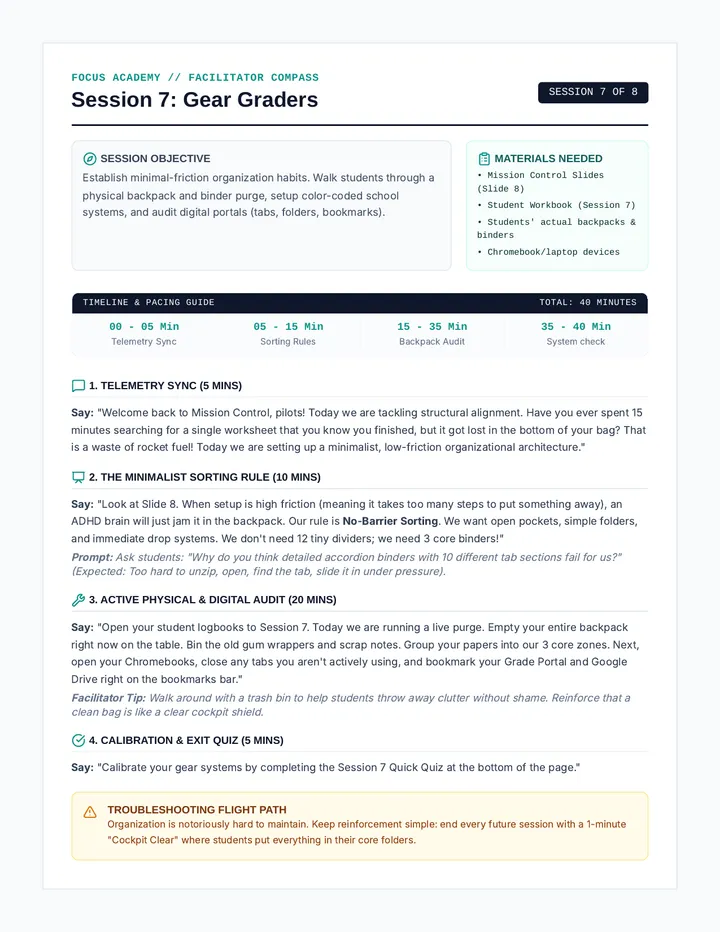
Gear Graders Facilitator Guide FOCUS ACADEMY // FACILITATOR COMPASS
Session 7: Gear Graders
SESSION 7 OF 8
Session Objective
Establish minimal-friction organization habits. Walk students through a physical backpack and binder purge, setup color-coded school systems, and audit digital portals (tabs, folders, bookmarks).
Materials Needed
• Mission Control Slides (Slide 8)
• Student Workbook (Session 7)
• Students' actual backpacks & binders
• Chromebook/laptop devices
Timeline & Pacing Guide Total: 40 Minutes
00 - 05 Min Telemetry Sync
05 - 15 Min Sorting Rules
15 - 35 Min Backpack Audit
35 - 40 Min System check
1. Telemetry Sync (5 Mins)
Say: "Welcome back to Mission Control, pilots! Today we are tackling structural alignment. Have you ever spent 15 minutes searching for a single worksheet that you know you finished, but it got lost in the bottom of your bag? That is a waste of rocket fuel! Today we are setting up a minimalist, low-friction organizational architecture."
2. The Minimalist Sorting Rule (10 Mins)
Say: "Look at Slide 8. When setup is high friction (meaning it takes too many steps to put something away), an ADHD brain will just jam it in the backpack. Our rule is No-Barrier Sorting . We want open pockets, simple folders, and immediate drop systems. We don't need 12 tiny dividers; we need 3 core binders!"
Prompt: Ask students: "Why do you think detailed accordion binders with 10 different tab sections fail for us?" (Expected: Too hard to unzip, open, find the tab, slide it in under pressure).
3. Active Physical & Digital Audit (20 Mins)
Say: "Open your student logbooks to Session 7. Today we are running a live purge. Empty your entire backpack right now on the table. Bin the old gum wrappers and scrap notes. Group your papers into our 3 core zones. Next, open your Chromebooks, close any tabs you aren't actively using, and bookmark your Grade Portal and Google Drive right on the bookmarks bar."
Facilitator Tip: Walk around with a trash bin to help students throw away clutter without shame. Reinforce that a clean bag is like a clear cockpit shield.
4. Calibration & Exit Quiz (5 Mins)
Say: "Calibrate your gear systems by completing the Session 7 Quick Quiz at the bottom of the page."
Troubleshooting Flight Path
Organization is notoriously hard to maintain. Keep reinforcement simple: end every future session with a 1-minute "Cockpit Clear" where students put everything in their core folders.
Gear Graders Student Workbook FOCUS ACADEMY // PILOT LOGBOOK
SYSTEM 07: Gear & Portal Sorting
ORBITAL STATUS: COCKPIT PURGE
COHORT SESSION: 7
Pilot Name
Launch Date
Cohort Group
No-Barrier Gear Architecture
Messy backpacks and cluttered desktops cause massive mental drag. ADHD brains require low-friction organization : systems that require fewer than two steps to file a paper. Today we purge our bags, set up a simple 3-binder physical system, and pin our key digital portals!
Part A: Physical Gear Purge & Simplify
After emptying your backpack completely, write down what you will store in each of your 3 simplified physical folders:
Zone 1: Humanities
(English, History, Social studies)
Zone 2: STEM
(Math, Science, Tech)
Zone 3: Electives
(Art, Language, Scrap papers)
Part B: Digital Dashboard Calibration
Open your Chromebook. Close all open browser tabs that are unrelated to active school assignments. Book-mark your key portal links right onto your browser's bookmarks bar. List 2 key portals you have bookmarked:
Part C: System Calibration Quiz
1. Why does an ADHD brain struggle with highly complex filing systems?
A High friction (unzipping, finding folders, sorting sheets) causes immediate drop-off
B Fast-paced brains have an allergy to paper products and digital drives
2. What is a key step in keeping your digital school portal clean?
A Closing unused tabs and bookmarking the portal right on the bookmarks bar
B Downloading every school file directly onto your personal desktop view
COCKPIT SYSTEM PURGE: COMPLETE PAGE 1 OF 1
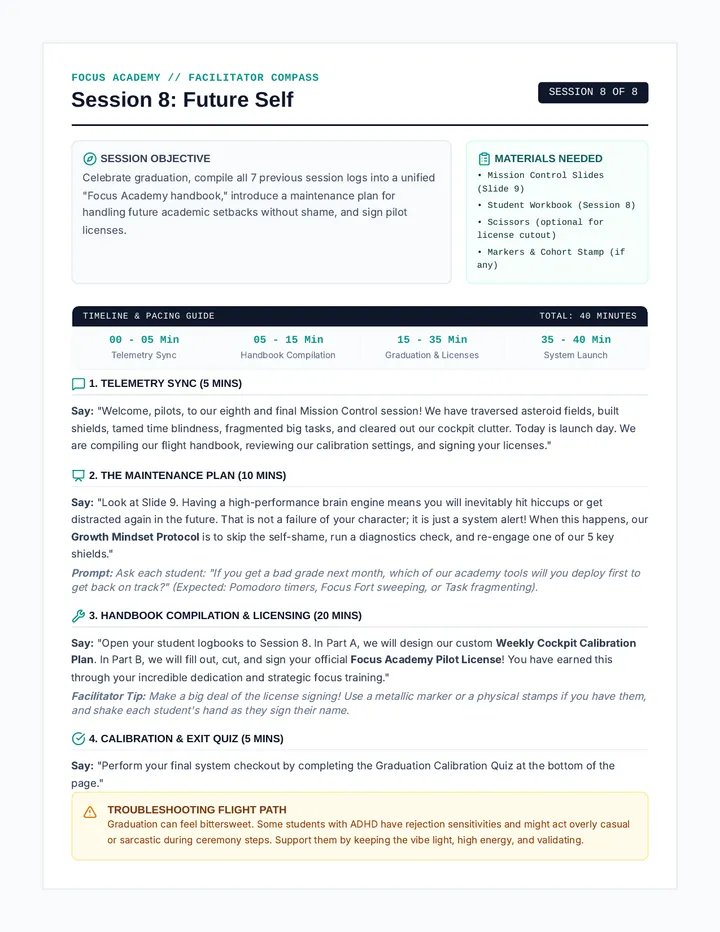
Future Self Facilitator Guide FOCUS ACADEMY // FACILITATOR COMPASS
Session 8: Future Self
SESSION 8 OF 8
Session Objective
Celebrate graduation, compile all 7 previous session logs into a unified "Focus Academy handbook," introduce a maintenance plan for handling future academic setbacks without shame, and sign pilot licenses.
Materials Needed
• Mission Control Slides (Slide 9)
• Student Workbook (Session 8)
• Scissors (optional for license cutout)
• Markers & Cohort Stamp (if any)
Timeline & Pacing Guide Total: 40 Minutes
00 - 05 Min Telemetry Sync
05 - 15 Min Handbook Compilation
15 - 35 Min Graduation & Licenses
35 - 40 Min System Launch
1. Telemetry Sync (5 Mins)
Say: "Welcome, pilots, to our eighth and final Mission Control session! We have traversed asteroid fields, built shields, tamed time blindness, fragmented big tasks, and cleared out our cockpit clutter. Today is launch day. We are compiling our flight handbook, reviewing our calibration settings, and signing your licenses."
2. The Maintenance Plan (10 Mins)
Say: "Look at Slide 9. Having a high-performance brain engine means you will inevitably hit hiccups or get distracted again in the future. That is not a failure of your character; it is just a system alert! When this happens, our Growth Mindset Protocol is to skip the self-shame, run a diagnostics check, and re-engage one of our 5 key shields."
Prompt: Ask each student: "If you get a bad grade next month, which of our academy tools will you deploy first to get back on track?" (Expected: Pomodoro timers, Focus Fort sweeping, or Task fragmenting).
3. Handbook Compilation & Licensing (20 Mins)
Say: "Open your student logbooks to Session 8. In Part A, we will design our custom Weekly Cockpit Calibration Plan . In Part B, we will fill out, cut, and sign your official Focus Academy Pilot License ! You have earned this through your incredible dedication and strategic focus training."
Facilitator Tip: Make a big deal of the license signing! Use a metallic marker or a physical stamps if you have them, and shake each student's hand as they sign their name.
4. Calibration & Exit Quiz (5 Mins)
Say: "Perform your final system checkout by completing the Graduation Calibration Quiz at the bottom of the page."
Troubleshooting Flight Path
Graduation can feel bittersweet. Some students with ADHD have rejection sensitivities and might act overly casual or sarcastic during ceremony steps. Support them by keeping the vibe light, high energy, and validating.
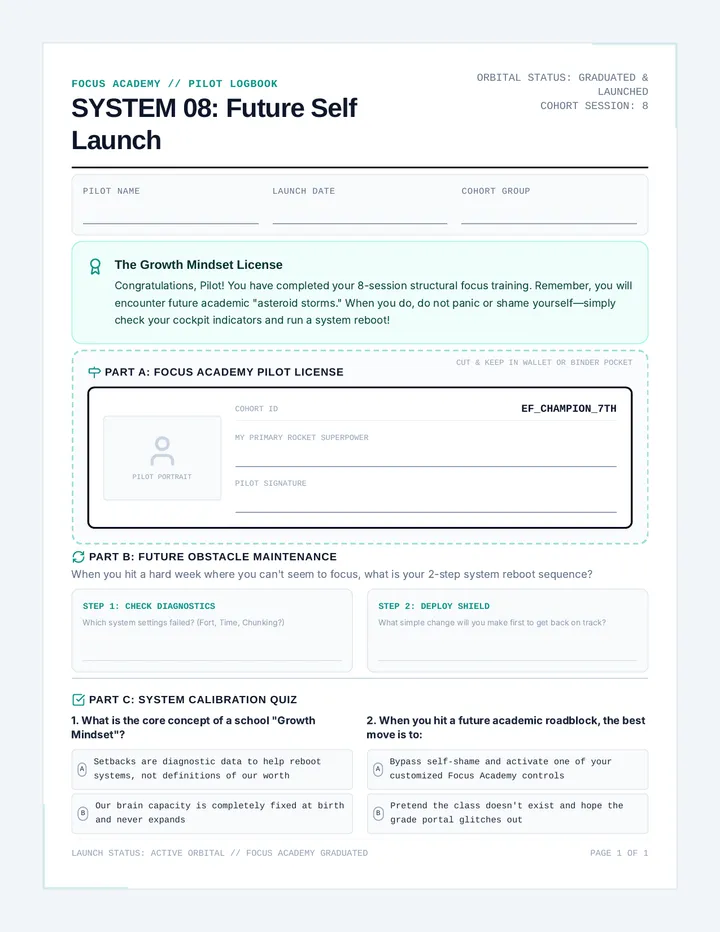
Future Self Student Workbook FOCUS ACADEMY // PILOT LOGBOOK
SYSTEM 08: Future Self Launch
ORBITAL STATUS: GRADUATED & LAUNCHED
COHORT SESSION: 8
Pilot Name
Launch Date
Cohort Group
The Growth Mindset License
Congratulations, Pilot! You have completed your 8-session structural focus training. Remember, you will encounter future academic "asteroid storms." When you do, do not panic or shame yourself—simply check your cockpit indicators and run a system reboot!
Cut & Keep in Wallet or Binder Pocket
Part A: Focus Academy Pilot License
Pilot Portrait
COHORT ID EF_CHAMPION_7TH
My Primary Rocket Superpower
Pilot Signature
Part B: Future Obstacle Maintenance
When you hit a hard week where you can't seem to focus, what is your 2-step system reboot sequence?
Step 1: Check Diagnostics
Which system settings failed? (Fort, Time, Chunking?)
Step 2: Deploy Shield
What simple change will you make first to get back on track?
Part C: System Calibration Quiz
1. What is the core concept of a school "Growth Mindset"?
A Setbacks are diagnostic data to help reboot systems, not definitions of our worth
B Our brain capacity is completely fixed at birth and never expands
2. When you hit a future academic roadblock, the best move is to:
A Bypass self-shame and activate one of your customized Focus Academy controls
B Pretend the class doesn't exist and hope the grade portal glitches out
LAUNCH STATUS: ACTIVE ORBITAL // FOCUS ACADEMY GRADUATED PAGE 1 OF 1