Convo Code Discussion CardsActive Social Intervention Convo Code Cards Practice waiting, listening, and coding your responses without interrupting. Level: Grades 6-8 Goal Focus: Turn-Taking (4/5 target) The Active Protocol Wait for the active speaker to fully finish and pause before responding. 1. Pause 2. Process 3. Play 01 Tech & Future Virtual vs. Reality Would you rather live in a highly realistic virtual world for a week or spend a week camping in the wilderness with no tech? Explain why. 3-5 players Wait 3s after speaker stops 02 School Life Classroom AI Do you think using Artificial Intelligence (AI) tools to write essays for school is helpful learning or a form of cheating? Where is the line? 3-5 players Focus on speaker's face 03 Survival Desert Island Duos If your group was stranded on a deserted island, which three items would you vote to bring? You must agree on all three items collectively. 3-5 players Agree & wait your turn 04 Culture Is Gaming a Sport? Should competitive e-sports/video gaming be officially included in the Olympic Games, or are sports strictly physical? Defend your view. 3-5 players No interrupting teammates 05 Psychology The Mind Reader If you could read the mind of one person in the world for 24 hours, who would it be and why? What would you hope to learn? 3-5 players Practice active head-nodding 06 Social Trends No Phone Challenge How long do you think you could actually survive without your phone? What would be the hardest part of the experience? 3-5 players Hold your breath before speaking Print on cardstock, cut along dotted lines, and laminate for reuse. Convo Code • Card Deck
Convo Code Self Reflection WorksheetStudent Mission Report My Convo Code Log Reflect on your active listening and turn-taking performance today. Name: Date: Step 1: Self-Reflection Radar Waiting for My Turn Did I wait for speakers to stop before opening my mouth? Rarely 1 2 3 4 5 Always Active Listening Did I look at the speaker or show physical signs of listening? Rarely 1 2 3 4 5 Always Controlling Urges Did I hold back thoughts instead of shouting them out immediately? Rarely 1 2 3 4 5 Always Step 2: The 5-Opportunity Checklist Think of exactly 5 times you could have interrupted someone today. Circle your self-assessment for each opportunity. OPPORTUNITY 1 Waited Interrupted OPPORTUNITY 2 Waited Interrupted OPPORTUNITY 3 Waited Interrupted OPPORTUNITY 4 Waited Interrupted OPPORTUNITY 5 Waited Interrupted Step 3: Conversation Analysis 1. Describe a moment during the task when you wanted to interrupt but stopped yourself. What did you do to help you wait? 2. Active listening means paying attention to the message, not just waiting for your turn. What did a peer say today that you found interesting or surprising? 3. Setting your Code: Write down one physical signal you will use next time (like crossing fingers, clasping hands, or taking 1 slow breath) to prevent interruption. Convo Code • Progress Monitoring Toolkit Page 1 of 1
Convo Code Rubric TrackerEducator Assessment Toolkit Turn-Taking Rubric Structured goal tracker for monitoring small-group conversational interruptions. Student Name: Target Goal: Wait turn in 4/5 opportunities IEP Goal / Accommodation Target "When participating in small group academic or social activities, the student will wait for her turn to speak without interrupting peers in 4 out of 5 opportunities across 3 consecutive sessions." Multi-Session Opportunity Logs Session & Date Trials (Opp 1-5) Score Qualitative / Context Notes Session 1 Date: ________ Y / N Y / N Y / N Y / N Y / N ___ / 5 Not Met Session 2 Date: ________ Y / N Y / N Y / N Y / N Y / N ___ / 5 TBD Session 3 Date: ________ Y / N Y / N Y / N Y / N Y / N ___ / 5 TBD Session 4 Date: ________ Y / N Y / N Y / N Y / N Y / N ___ / 5 TBD Session 5 Date: ________ Y / N Y / N Y / N Y / N Y / N ___ / 5 TBD Common Interruption Triggers Check the primary trigger observed when interrupting occurs: High Eagerness Impulsive Blurts Topic Hijacking Anxiety / Silence-fill Accommodations Used Check strategies implemented during observation: Visual Token Pre-cueing Signal Structured Prompt Peer Modeling Next Strategic Steps & Intervention Notes Convo Code • Progress Monitoring Tracker Page 1 of 1
Reaction Radar Scenario CardsEmotional Calibration Tool Reaction Radar Determine the size of the problem and calibrate your reaction to stay on task. Grades 6-8 Intervention Goal: Problem-Sizing (70% Target) The Radar Scale SMALL (Glitch) Fixed easily in 1-2 mins MEDIUM (Obstacle) Needs adult help or plan LARGE (Emergency) Danger or major crisis SCENARIO A Teacher Correction Formatting Critique Your science teacher marks up your lab report and asks you to rewrite the entire data section before they can grade it. Problem Size: Medium Accept & Draft SCENARIO B Non-Preferred Task The Reading Pivot You are deeply enjoying a drawing activity. The teacher rings the chime and announces it's time to start a long, difficult reading passage. Problem Size: Small Transition Fast SCENARIO C Frustrating Situation Dead Battery Glitch Your school laptop suddenly shuts down because it is dead. You realize your last 10 minutes of essay typing did not auto-save. Problem Size: Small Plug In, Redo SCENARIO D Social Friction The Eye Roll During class discussion, you share your opinion about a movie. You notice a peer across the circle rolling their eyes and laughing quietly. Problem Size: Small Ignore & Focus SCENARIO E Group Work Missing Pieces The group poster is due in 30 minutes, and your partner forgot their research notes at home, meaning you have to look up the data again. Problem Size: Medium Split Tasks Now SCENARIO F Task Criticism The Rough Draft Your partner criticizes your presentation slide, saying it looks "messy and childish" and demands that you re-upload different images. Problem Size: Small Deep Breath, Pivot Laminate and cut scenario cards. Practice during warmups or direct instruction. Reaction Radar • Cards
Reaction Radar Reflection WorksheetMy Mission Log Reaction Radar Log Reflect on how you sized up a challenge today and calibrated your reaction. Name: Date: Step 1: What was the Situation? Non-Preferred Task Hard work / task pivot Frustrating Event Something went wrong Criticism / Correction Teacher corrected me Step 2: Size of Problem vs. Size of Reaction Actual Problem Size S Small M Medium L Large My Initial Reaction S Small M Medium L Large Step 3: The De-escalation Blueprint 1. Briefly describe what happened and why it was frustrating or non-preferred: 2. What specific regulatory strategy did you use to calm your body and mind? 3. How did returning to the task make you feel afterward? What could you do next time to return even faster? Mission Outcome Checklist Were you able to successfully return to the task at hand? Yes, fully back on task Partially/Needs nudge Reaction Radar • Progress Monitoring Toolkit Page 1 of 1
Reaction Radar Rubric TrackerEducator Assessment Toolkit Reaction Radar Tracker Clinical incident log and scoring key to monitor problem-sizing and emotional calibration. Student Name: Target Goal: 70% Emotional Calibration IEP Goal / Accommodation Target "When presented with a problem (non-preferred task, frustrating situation, criticism/correction), the student will accurately state the size of the problem and determine the appropriate emotional response to return to the task at hand 70% of the time." 10-Incident Trial Probe Date & Task Trigger Type Sized Problem? Appropriate Rx? Back to Task? Met Goal? 1. Date: _______ Worksheet Non-Preferred Y / N Y / N Y / N Yes / No 2. Date: _______ Feedback Criticism Y / N Y / N Y / N Yes / No 3. Date: _______ Tech Glitch Frustration Y / N Y / N Y / N Yes / No 4. Date: _______ Transition Non-Preferred Y / N Y / N Y / N Yes / No 5. Date: _______ Correction Criticism Y / N Y / N Y / N Yes / No 6. Date: _______ Wait/Listen Frustration Y / N Y / N Y / N Yes / No 7. Date: _______ Partner Task Criticism Y / N Y / N Y / N Yes / No Tally (YES Probes) ____ / 10 Trials Percentage Rate ____ % Goal Status TBD (Target: 70%) Out-of-Calibration Actions Check behaviors observed during poor calibration: Refusal / Shutdown Verbal Protest Aggressive Gestures Elopement / Leaving Calibrated De-escalation Identify successful self-regulation attempts: Self-Talk Used Breathing Routine Break Requested Task Modified Strategic Accommodation Plans Reaction Radar • Rubric Tracker Page 1 of 1
Chat Craft Conversation BoardsExplicit Social Interaction Mat Chat Craft Flow Mat Use this visual blueprint to build active, reciprocal conversations with your teacher. Reciprocal Training Goal: 3/4 Connection Blocks The 4-Step Connection Chain BLOCK 1 The Launch Initiate with a friendly greeting or state a brand new topic. "Hey, how is your..." BLOCK 2 The Anchor Answer a question fully with a detailed response. "Yes, I really liked..." BLOCK 3 The Pivot Share a relevant comment or fact about the topic. "That reminds me of..." BLOCK 4 The Loop Add an extra related statement to extend the chat. "Also, we should..." Structured Topic Prompts TOPIC PROMPT 01 Screen Time & Movies Let's talk about viral movies or shows. Start the conversation by asking your teacher what they watched this weekend, then connect your answer. Target: Share 1 Comment Launch -> Anchor TOPIC PROMPT 02 Superpower Choices If your teacher could choose any superpower, what do you think they'd pick? Initiate the question, answer theirs, and add an extra detail about your own choice. Target: Add Related Statement Anchor -> Loop TOPIC PROMPT 03 The App Review Discuss the most popular apps or games this month. Share your honest opinion about an app you dislike, and ask your teacher if they agree. Target: Reciprocal Pivot Anchor -> Pivot TOPIC PROMPT 04 The Dream Cafeteria If you could redesign the school cafeteria lunch menu, what is the first meal you would add? Answer your teacher's pitch and add a related custom side item. Target: Answer & Extend Pivot -> Loop Lay this board on the table between student and educator to guide reciprocal turn flow during direct sessions. Chat Craft • Resource Mat
Chat Craft Reflection WorksheetStudent Chat Analysis My Chat Craft Log Evaluate how you initiated, commented, and extended your conversations today. Name: Date: Step 1: Which blocks did I construct? Select every step of the connection chain you completed during today's task: BLOCK 1 The Launch Initiated Chat BLOCK 2 The Anchor Answered fully BLOCK 3 The Pivot Shared Comment BLOCK 4 The Loop Extended Topic Reciprocity Level How balanced did the conversation feel? Were you giving and taking turns equally? 1 One-sided (Quiet) 2 Short responses 3 Balanced comments 4 Excellent loops Step 3: Conversation Analysis 1. Which conversation topic did you choose today? What comments or details did you share about it? 2. Which block in the chain was the hardest to build? (The Launch, The Anchor, The Pivot, or The Loop) Why? 3. What is one school-appropriate topic you'd like to initiate or ask your teacher about next time? Reciprocity Milestone Check Were you able to successfully share comments and extend the chat? Yes, fully met the loop Needs prompting/support Chat Craft • Reflection Sheet Page 1 of 1
Chat Craft Rubric TrackerEducator Assessment Toolkit Reciprocal Rubric Structured observation log for scoring student-to-teacher conversational flow. Student Name: Target Goal: 3/4 Connections per Session IEP Goal / Accommodation Target "When provided explicit social skills instruction and structured activities, the student will demonstrate improved reciprocal communication skills by appropriately initiating or responding within a structured conversation with the SPED resource teacher (e.g., greeting, sharing a comment, answering and adding a related statement) in at least 3 out of 4 opportunities per session." Multi-Session Connection Log Session & Date Opportunities (Opp 1-4) Score Primary Conversation Topic & Target Session 1 Date: ________ Y / N Y / N Y / N Y / N ___ / 4 TBD Session 2 Date: ________ Y / N Y / N Y / N Y / N ___ / 4 TBD Session 3 Date: ________ Y / N Y / N Y / N Y / N ___ / 4 TBD Session 4 Date: ________ Y / N Y / N Y / N Y / N ___ / 4 TBD Session 5 Date: ________ Y / N Y / N Y / N Y / N ___ / 4 TBD Conversation Behaviors Observed Select the actions completed independently during trials: Greeting / Launch Answering question Sharing comment Related statement Instructional Prompts Required Select scaffolding needed during conversation trials: Visual Flow Mat Direct Verbal Prompt Gestural Cue / Point None (Independent) Next Strategic Steps & Session Notes Chat Craft • Rubric Tracker Page 1 of 1
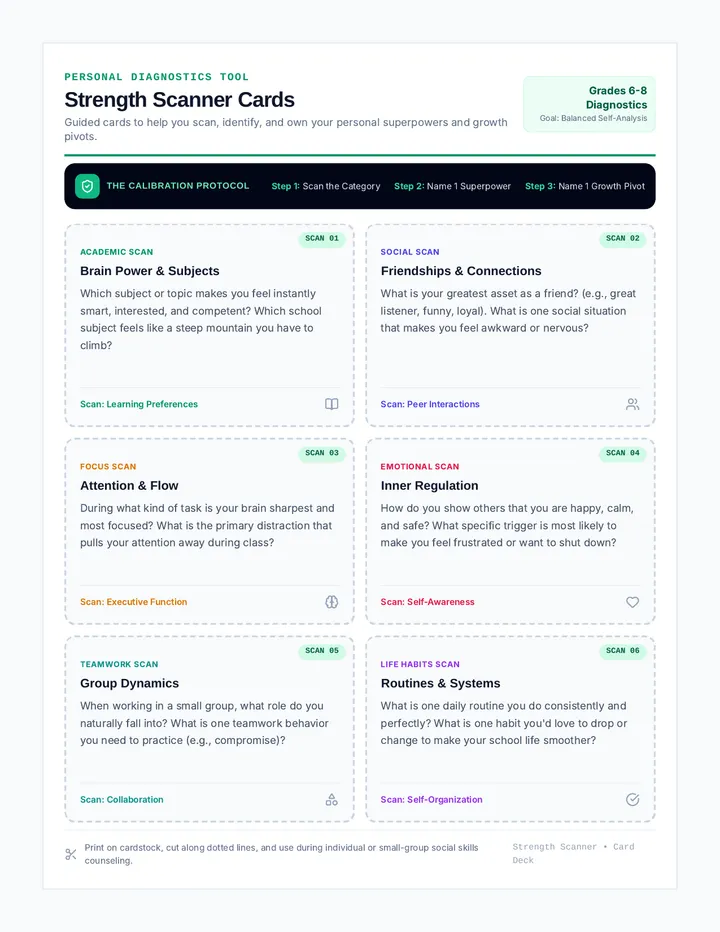
Strength Scanner Discovery CardsPersonal Diagnostics Tool Strength Scanner Cards Guided cards to help you scan, identify, and own your personal superpowers and growth pivots. Grades 6-8 Diagnostics Goal: Balanced Self-Analysis The Calibration Protocol Step 1: Scan the Category Step 2: Name 1 Superpower Step 3: Name 1 Growth Pivot SCAN 01 Academic Scan Brain Power & Subjects Which subject or topic makes you feel instantly smart, interested, and competent? Which school subject feels like a steep mountain you have to climb? Scan: Learning Preferences SCAN 02 Social Scan Friendships & Connections What is your greatest asset as a friend? (e.g., great listener, funny, loyal). What is one social situation that makes you feel awkward or nervous? Scan: Peer Interactions SCAN 03 Focus Scan Attention & Flow During what kind of task is your brain sharpest and most focused? What is the primary distraction that pulls your attention away during class? Scan: Executive Function SCAN 04 Emotional Scan Inner Regulation How do you show others that you are happy, calm, and safe? What specific trigger is most likely to make you feel frustrated or want to shut down? Scan: Self-Awareness SCAN 05 Teamwork Scan Group Dynamics When working in a small group, what role do you naturally fall into? What is one teamwork behavior you need to practice (e.g., compromise)? Scan: Collaboration SCAN 06 Life Habits Scan Routines & Systems What is one daily routine you do consistently and perfectly? What is one habit you'd love to drop or change to make your school life smoother? Scan: Self-Organization Print on cardstock, cut along dotted lines, and use during individual or small-group social skills counseling. Strength Scanner • Card Deck
Strength Scanner Reflection WorksheetStudent Diagnostics Log Personal Scan Report Identify your personal superpowers and map out constructive ways to grow. Name: Date: Step 1: Active Scan Domain Select the specific scanner card domain(s) you discussed or analyzed today: Academic Social Focus Emotional Teamwork Habits Step 2: Diagnostic Reflection 1. The Strength Scan: Write down at least one clear personal strength you identified in yourself today: 2. The Growth Pivot: Identify at least one area for improvement or a challenge you face in this domain: 3. The Action Step: What is one small, specific thing you can do this week to improve or manage this area? Personal Scan Acceptance I accept my strengths and am committed to working on my growth pivot. Student Sig: Strength Scanner • Diagnostic Reflection Page 1 of 1
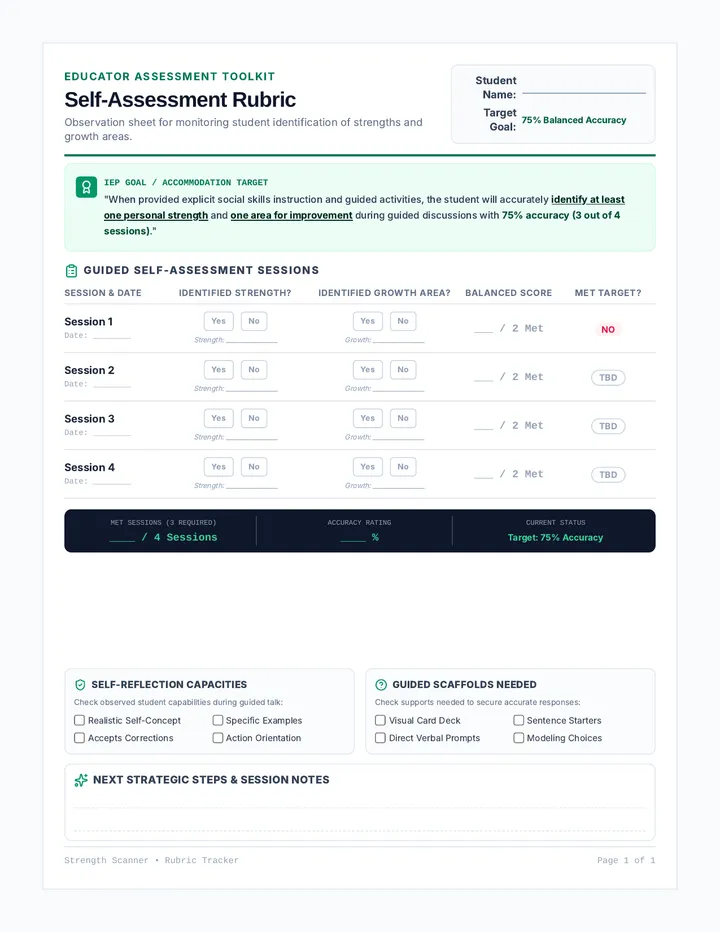
Strength Scanner Rubric TrackerEducator Assessment Toolkit Self-Assessment Rubric Observation sheet for monitoring student identification of strengths and growth areas. Student Name: Target Goal: 75% Balanced Accuracy IEP Goal / Accommodation Target "When provided explicit social skills instruction and guided activities, the student will accurately identify at least one personal strength and one area for improvement during guided discussions with 75% accuracy (3 out of 4 sessions)." Guided Self-Assessment Sessions Session & Date Identified Strength? Identified Growth Area? Balanced Score Met Target? Session 1 Date: ________ Yes No Strength: ________________ Yes No Growth: ________________ ___ / 2 Met NO Session 2 Date: ________ Yes No Strength: ________________ Yes No Growth: ________________ ___ / 2 Met TBD Session 3 Date: ________ Yes No Strength: ________________ Yes No Growth: ________________ ___ / 2 Met TBD Session 4 Date: ________ Yes No Strength: ________________ Yes No Growth: ________________ ___ / 2 Met TBD Met Sessions (3 Required) ____ / 4 Sessions Accuracy Rating ____ % Current Status Target: 75% Accuracy Self-Reflection Capacities Check observed student capabilities during guided talk: Realistic Self-Concept Specific Examples Accepts Corrections Action Orientation Guided Scaffolds Needed Check supports needed to secure accurate responses: Visual Card Deck Sentence Starters Direct Verbal Prompts Modeling Choices Next Strategic Steps & Session Notes Strength Scanner • Rubric Tracker Page 1 of 1