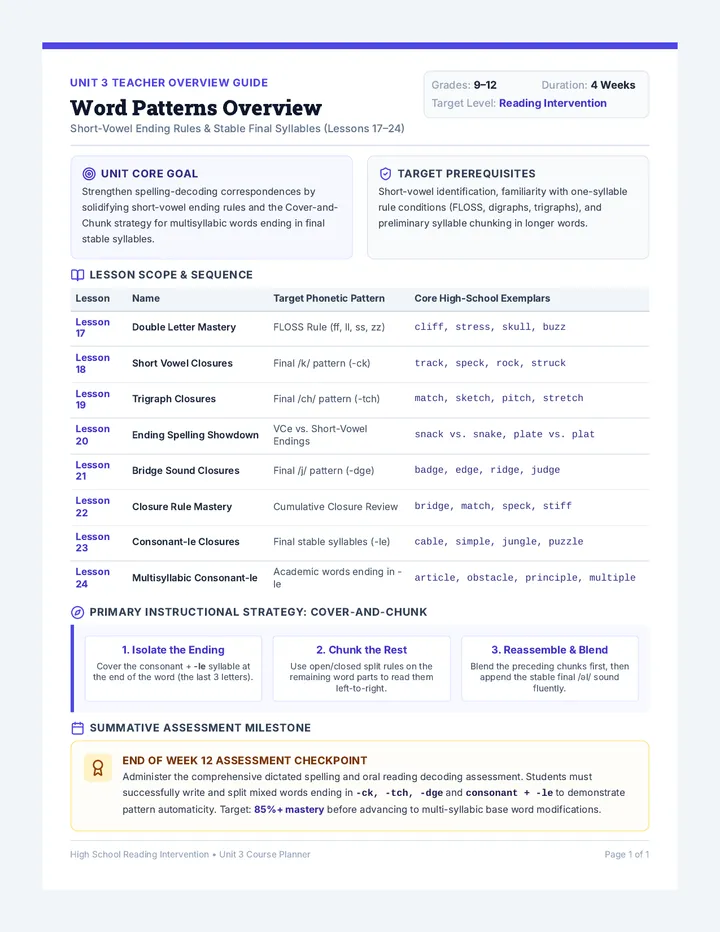
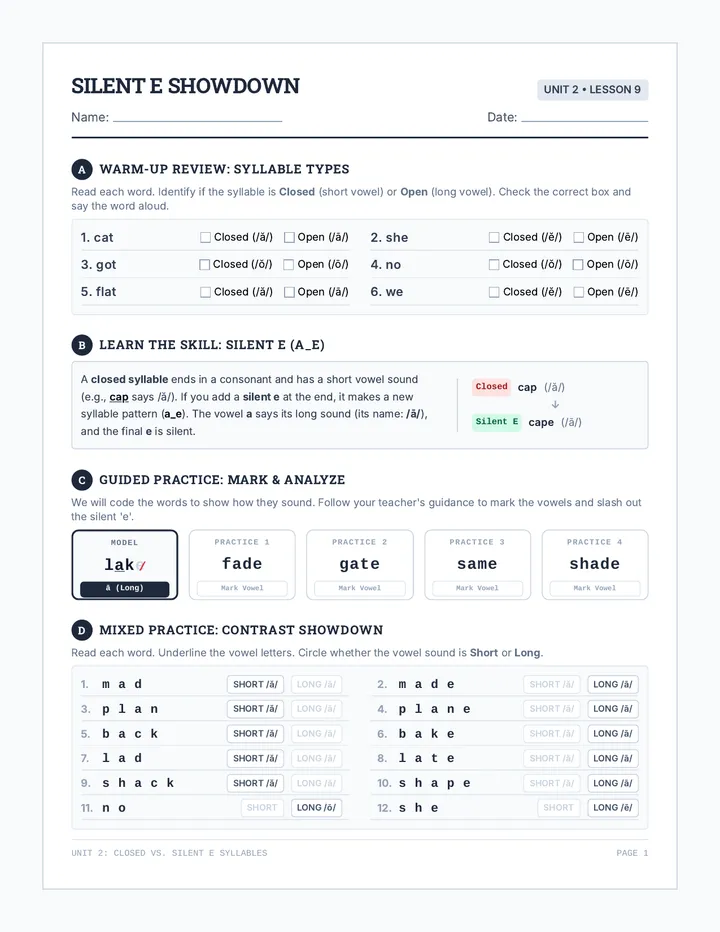
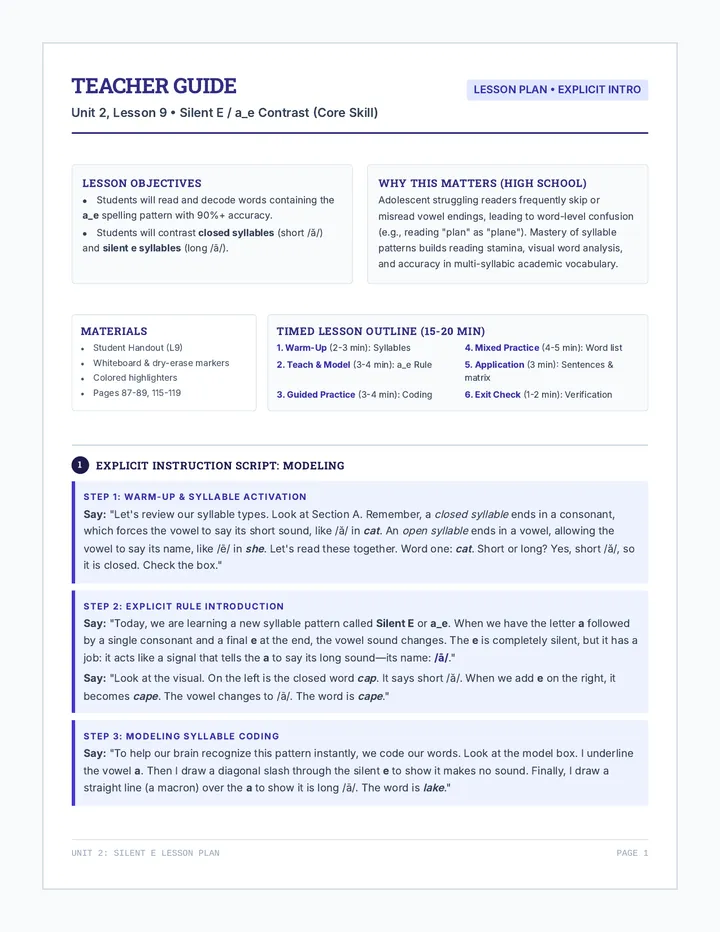
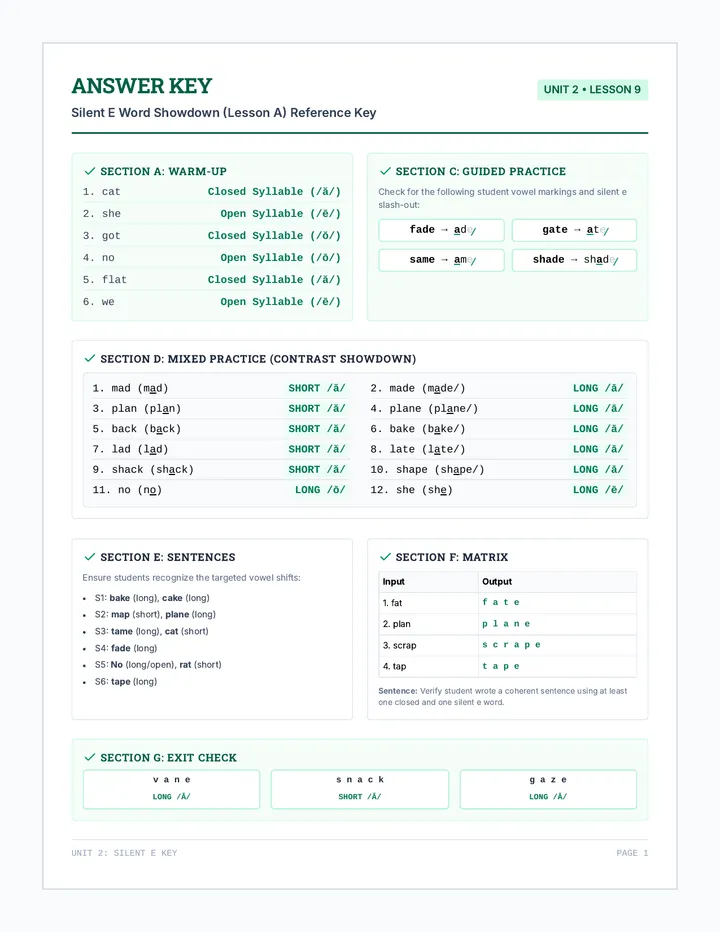
SMART Critique Worksheet SMART Goal Blueprint
Lesson 01: Foundations
Lab Member
Date
The Resolution Reality Check
Every January, millions of people make resolutions like "I'm going to get healthy" or "I'll be better at school." By February, 80% have failed. Why? Because they aren't **SMART**.
S Specific
M Measurable
A Achievable
R Relevant
T Time-bound
Activity 01: The Critique Lab
Identify which SMART component is missing from these weak goals and explain why.
Weak Goal #1: "I want to be better at math by the end of the year."
Primary Missing Element(s)
Specific
Measurable
Time-bound
The Diagnosis (Why is it weak?)
Weak Goal #2: "I will read 10,000 pages of Harry Potter by tomorrow."
Primary Missing Element(s)
Measurable
Achievable
Relevant
The Diagnosis (Why is it weak?)
Activity 02: The Repair Shop
Take a weak goal and rebuild it using all five SMART components. Your goal should be so clear that a stranger could measure it without asking you questions.
Original Draft
"I want to participate more in class."
Rebuild: Make it Specific & Measurable
Exactly what will you do? How many times? In which class?
Time-bound
By what date or timeframe?
Relevant
Why does this goal matter for your IEP or life?
The Final Polished SMART Goal
Self-Check: Does your goal have all 5 letters?
SMART Lab Presentation The Progress Lab: Module 01
SMART Goal
Blueprint
How do we define success and measure our progress toward it?
The Resolution Reality
"I want to get healthy this year."
This is the most common New Year's Resolution. Why do 80% of people fail by February?
It's too vague.
There's no way to "count" health.
There is no deadline.
THE DIAGNOSIS
The goal wasn't SMART .
Cracking the SMART Code
S
Specific
What exactly do you want to accomplish? No vagueness!
M
Measurable
How will you track it? Use numbers, counts, or dates.
A
Achievable
Is it possible? Don't plan to fly to Mars by Tuesday.
R
Relevant
Does this actually matter for your learning or life?
T
Time-bound
When is the finish line? Set a specific end date.
Case Study: Math Master
Let's Compare
The "Vague" Goal
"I want to do better in math class this semester."
Not measurable
"Better" is an opinion
The "SMART" Goal
"By June 1st, I will turn in 100% of my algebra homework on time for 4 consecutive weeks."
Specific (Algebra homework)
Measurable (100% / 4 weeks)
Workshop Challenge
Grab your SMART Critique Worksheet. We are going to find the "Broken Goals" in the lab and fix them.
Step 1
Diagnose the issue
Step 2
Rebuild the goal
Step 3
Peer Audit
SMART Workshop Teacher Guide Teacher Facilitation Guide
Lesson 01: SMART Goal Blueprint
Sequence: The Progress Lab
Time
50-60 Minutes
Materials
Slides, Critique Worksheets, Student IEP "Cheat Sheets" (optional)
Objective
Students will critique and rewrite 2 goals to meet 5/5 SMART criteria.
10 Min
The Resolution Hook
Use Slide 2 to discuss failed New Year's resolutions. Ask students to share a resolution they or someone they know made that didn't stick.
"Why is 'getting healthy' a bad goal? If I eat one apple today, did I achieve it? If I run for 1 minute? We need numbers to know when we've won."
15 Min
SMART Breakdown
Walk through the SMART acronym (Slide 3). Emphasize **Measurability**—it's the 'M' that makes IEP goals legal and fair. Use the Case Study (Slide 4) to show a direct comparison.
Look For:
Students understanding that "Better" is subjective, but "80% accuracy" is objective.
Common Pitfall:
Students often confuse 'Achievable' with 'Easy'. Remind them that goals should be a stretch, but possible.
20 Min
Critique & Repair Lab
Students work on the SMART Critique Worksheet . Walk around and challenge students who write a "Measurable" goal that is still too vague.
Probing Questions:
"If a substitute teacher walked in, would they know exactly how to grade your goal?"
"What instrument would you use to measure this? A stopwatch? A checklist? A calendar?"
"Why does this goal matter for your future self?"
10 Min
The "Stranger Test"
Have students trade papers. The peer acts as a "Stranger" who has to explain exactly how they would measure the other person's goal. If they have to ask a question, the goal isn't SMART enough yet.
Differentiation Strategies
Support (Scaffolding)
Provide a word bank of measurable verbs (e.g., "Write," "Identify," "Solve," "Initiate") to replace vague ones like "Learn" or "Understand."
Extension (Challenge)
Have students look at a real (de-identified) IEP goal and attempt to map it against the SMART criteria to find any potential weaknesses.
IEP Anatomy Slides Module 02
Anatomy
of a
Goal
IEP Components 101
"Every IEP goal is a formula. Once you know the formula, you own the goal."
The Goal Formula
By [Date],
Timeframe
given [Condition],
Support/Setting
[Student] will
Subject
[Behavior]
Specific Action
with [Criteria].
The Measurement
The "Dead Man" Test
A behavior must be an active action.
"If a dead man can do it, it's NOT a behavior."
"Not talking back"
Fails test: A dead man can not talk back.
"Expresses disagreement calmly"
Passes test: Requires active skill.
Criteria: The Finish Line
Accuracy
"With 80% accuracy" or "4 out of 5 trials."
Time
"Within 5 minutes of a prompt" or "For 20 minutes."
Consistency
"Across 3 consecutive weeks" or "During every class period."
Goal Lab: Syntax Remix
Time to use the formula. We're going to build Mad Libs goals that are grammatically legal but totally ridiculous.
Let's Code Some Goals
Goal Formula Workshop Worksheet The Goal Architect
Lesson 02: Syntax Workshop
Goal Formula
Time + Condition + Action + Criteria
Architect Name
Verification Date
Part 01: The Component Kit
Every IEP goal is built from these four parts. Match the component to its job by drawing a line.
By [Date]
Given [Condition]
[Student] will [Behavior]
with [Criteria]
...The tools or setting the student gets.
...The finish line (How we score it).
...The time limit for the whole goal.
...The observable action the student does.
Part 02: Syntax Mad Libs
Create two goals. They can be silly, but they MUST follow the exact IEP syntax formula. Refer to your Component Kit above!
Blueprint A: Professional Goal
By Date
, given
Condition (a tool)
Student Name
will
Behavior (observable action)
with
Criteria (score/accuracy)
Blueprint B: Ridiculous/Funny Goal
By Date
, given
Strange Support
Student Name
will
Absurd Action
with
Impossible Criteria
Self-Audit Checklist
Passes Dead Man Test?
Numbers included?
No vague words?
Data Detective Slides Module 03
Data
Collection Lab
How do we prove we're making progress?
The "Prove It" Principle
"I'm working really hard on my reading."
"I read 142 words per minute with 3 errors."
Which one is data? Which one is opinion?
WHY WE COLLECT DATA:
To prove the school is helping you.
To see if your goal is too easy or too hard.
To celebrate your wins with real evidence.
The Data Toolkit
Frequency
Counting how many times a behavior happens.
Example: Hand-raising
Duration
Timing how long a behavior lasts.
Example: Independent Reading
Rubrics
Rating the quality of a task on a scale.
Example: Writing a Paragraph
Observation Mode
We are going to track the Subject (your teacher) during a 2-minute "Teaching Performance."
Get Tally Sheet
Set Stopwatches
Collect Evidence
Observation Lab Report Worksheet Observation Lab
Field Report #03
Researcher ID
Timestamp
Mission Briefing
You are a data collector. Your goal is to monitor the "Subject" (the teacher) during their 2-minute presentation. You must record Frequency and Duration data with surgical precision.
Test A: Frequency Count
Tally every time the subject performs the target behavior.
Target Behavior: Using the word "OK"
Total Count
Target Behavior: Gesturing with hands
Total Count
Test B: Duration Timing
Use a stopwatch to time how long the subject stays in the "Presentation Zone."
Target: Subject is standing in the front 5 feet of the room
Start Time
Stop Time
Total Time
Observer Reflection
Was it hard to track both at once? Why?
Post-Observation Analysis
1. If you were the teacher, how would this data help you improve?
2. Why is "Frequency" better than just saying "They talk a lot"?
Trend Tracker Slides Module 04
Visualizing
Growth
Making sense of the numbers through data analysis.
The Power of the Picture
Raw numbers are hard to read. A graph tells the story of your progress instantly.
Graphs help us see:
Is it working?
Do we need to change?
Where is the finish line?
Week 1 Week 3 Week 5 Week 7
Reading the Story of Data
Growth Trend
Scores are moving toward the goal. The instruction is working!
The Plateau
Scores are flat. Time to try a new strategy or more support.
Regression
Scores are going backward. An emergency change is needed.
The Graphing Challenge
You are going to take raw scores from a real IEP goal and plot them. Your job is to decide:
"Should this student get a new teacher or just a new strategy?"
Sample Data Set
Week 122%
Week 225%
Week 323%
Week 424%
Status: PLATEAU
Graphing Growth Activity Worksheet Growth Grapher
Lesson 04: Data Visualization
Case File #
99-DATA-PLT
The Raw Evidence
Below is data for an 8th grader working on their goal: "Given 10 algebraic equations, student will solve with 80% accuracy."
Wk 1
20%
Wk 2
30%
Wk 3
20%
Wk 4
50%
Wk 5
60%
Wk 6
60%
Wk 7
90%
GOAL
80%
Plot the Growth
100%
80%
60%
40%
20%
0%
Wk 1 Wk 2 Wk 3 Wk 4 Wk 5 Wk 6 Wk 7
TARGET: 80%
The Lab Summary
Identify the Trend
Growth Trend
Plateau Trend
Regression Trend
Teacher Advisory:
Based on your graph, should the teacher change how they are teaching this student? Explain your choice using evidence from the scores.
Personal Blueprint Presentation Slides Final Module 05
Your
Progress
Blueprint
Taking ownership of your growth.
The Summative Challenge
You are no longer a student in the lab—you are the Architect.
"Design a goal so clear that a total stranger could track your progress with 100% accuracy."
YOUR MISSION:
1
Pick an Academic or Social Skill.
2
Write a SMART Goal using the syntax.
3
Create a tracking tool (Frequency or Duration).
Inspiration Menu
Academic
Reading words/minute
Turning in homework
Using correct punctuation
Completing math steps
Organization
Cleaning locker/desk
Using a daily planner
Arriving to class on time
Having materials ready
Advocacy
Asking for help
Staying in the zone
Peer collaboration
Self-calming steps
Ready for Production?
Open your Personal Growth Blueprint. You are about to write a goal that you will actually track for the next two weeks.
Start Building
Personal Growth Blueprint Worksheet Personal Growth Blueprint
Summative Capstone Project
Lead Architect
Implementation Phase
FY-2026-B
01
The SMART Syntax Draft
Official Formula
Draft your personal goal below. Ensure it includes: Timeframe + Condition + Student Name + Behavior + Criteria.
Specific
Measurable
Achievable
Relevant
Time-bound
02
The Data Tracking Tool
Custom Tracker Interface
Design how you will count or time your goal. Create columns for "Date," "Tally/Time," and "Notes."
Tactical Strategy:
What strategy or tool will you use to help you hit your target? (e.g., a timer, a reminder app, a check-list)
The "Why" Factor:
How does achieving this goal improve your experience as a student or your future self?
Certified Blueprint
Authorized for Implementation
Teacher/Case Manager Signature
IEP Participation Rubric Teacher Resource Teacher Assessment Resource
The Progress Lab: Summative Rubric
IEP Participation Guide
The Final Product: Personal Growth Blueprint
This sequence concludes with students drafting a goal and a tracking system. This serves a dual purpose: meeting 8th-grade self-advocacy standards and providing a "draft" goal that can be used in their actual upcoming IEP meetings.
Blueprint Evaluation Rubric
Criteria Exceeds (Master Architect) Meets (Practicing Analyst) Needs Work (In Training) Goal Syntax (SMART) Includes all 5 SMART components with high specificity. Avoids all vague language. Passes the "Dead Man Test." Includes all 5 SMART components. Mostly specific, though 1-2 words might be slightly subjective. Missing 1 or more SMART components. Goal remains too vague to measure accurately. Tracking Tool Design Tracker is perfectly matched to the goal (e.g., duration for timing). Includes space for dates, counts, and notes. Professional layout. Tracker is functional and correctly matched to the goal type. Layout is clear and usable. Tracker doesn't match the goal type (e.g., tallying a duration goal). Missing clear labels. Self-Advocacy & "Why" Articulates a clear connection between the goal and long-term life/academic success. Proposes a specific strategy for growth. States why the goal is important and identifies a basic strategy to achieve it. Cannot articulate why the goal matters or how they plan to achieve it.
IEP Meeting Preparation
Use these prompts when reviewing the Final Blueprint with the student to prepare them for their actual IEP meeting.
Prompt A: Presenting the Goal
"When you talk to the team, can you explain what 'given [condition]' means for you? Why is that specific support helpful?"
Prompt B: The Data Ownership
"Show the team your tracker. Tell them: 'I want to track this myself because it helps me see when I'm winning.'"
Goal Feedback Notes
Architect Revision Required?
The Progress Lab © 2026 // Transition Services Division