A 4x6 desk mat visual for a 7th-grade student with Autism, featuring a brain vs. mouth 'Social Filter' prompt with specific examples for sharing opinions on hobbies and interests.
A quick-reference validation guide for staff. Features two color-coded cards with specific empathetic phrases for general validation and reactive behavior responses. Optimized for landscape printing and lanyard use with clear visual cues.
A set of large-format visual recipe task cards for 3-Ingredient Apple Muffins, with one card per page. Designed for easy viewing in a classroom or kitchen, these cards feature bold line-art illustrations, a tools checklist, and step-by-step baking instructions.
A clean, sophisticated one-page word wall list for Middle and High School students focusing on medial /y/ words. It features phonetic transcriptions using Noto Sans for better rendering, Lucide icons, and concise definitions in a professional grid layout. Revised to fit on a single page with improved contrast.
Introductory slides for teaching microwave cooking, now with photo-style ingredient galleries and a modern "real-world" aesthetic to engage students in life skills.
A teacher and caregiver guide providing instructional strategies, safety tips, and discussion prompts for teaching microwave mug recipes to students with developmental needs.
A highly visual shopping list using realistic ingredient frames and clear measurement labels to help students identify ingredients and track their progress.
An updated visual recipe for a microwave mug cookie, featuring realistic photo-style ingredient frames and specific measurement icons to support independent cooking and identification.
An updated visual recipe for a chocolate mug cake, using realistic photo-style ingredient frames and specific measurement icons to help students identify materials and practice cooking independently.
A data collection worksheet for the Cocoa Conductor experiment. Uses large visual icons and simple circling/matching tasks to help students identify heat conduction and differentiate between conductors and insulators.
A visual lab sheet for the Cocoa Conductor experiment, designed for students with intellectual disabilities. Features clear icons, step-by-step instructions, and simplified response areas for identifying temperature and making predictions.
A visual presentation for students with intellectual disabilities to introduce the Cocoa Conductor experiment, with large text, clear icons, and key vocabulary definitions.
A teacher's guide for the Cocoa Conductor science experiment, featuring facilitation steps, vocabulary support, and instructional strategies for students with intellectual disabilities.
The complete teacher's answer key for the unit rate and ratio quiz, revised to fit each problem on its own page with added instructional notes and corrected units ($/ticket). Features high-contrast formatting and clear visual hierarchy for easy checking. Black and white theme optimized for teachers to annotate.
A comprehensive 4-page summative assessment covering unit rates and ratios, with each problem occupying a full page for maximum clarity and handwriting space. Designed with high-contrast formatting and essential scaffolding for students with special education needs. Features standardized footers and name fields.
Teacher guide with complete answer keys and facilitation tips. Revised for better layout and expanded answer contexts.
A high-contrast, visually engaging presentation. Revised with integrated checklist and brain break slides, and improved layout for better accessibility. Final version fixes text bleed and alignment issues.
A scaffolded writing worksheet with sentence frames and a visual word bank. Final version features improved layout for sentence frames and increased contrast for accessibility. Optimized for single-page layout.
A visual graphic organizer that uses a factory analogy to help students identify cell organelles and compare plant versus animal cell structures. Optimized for single-page layout.
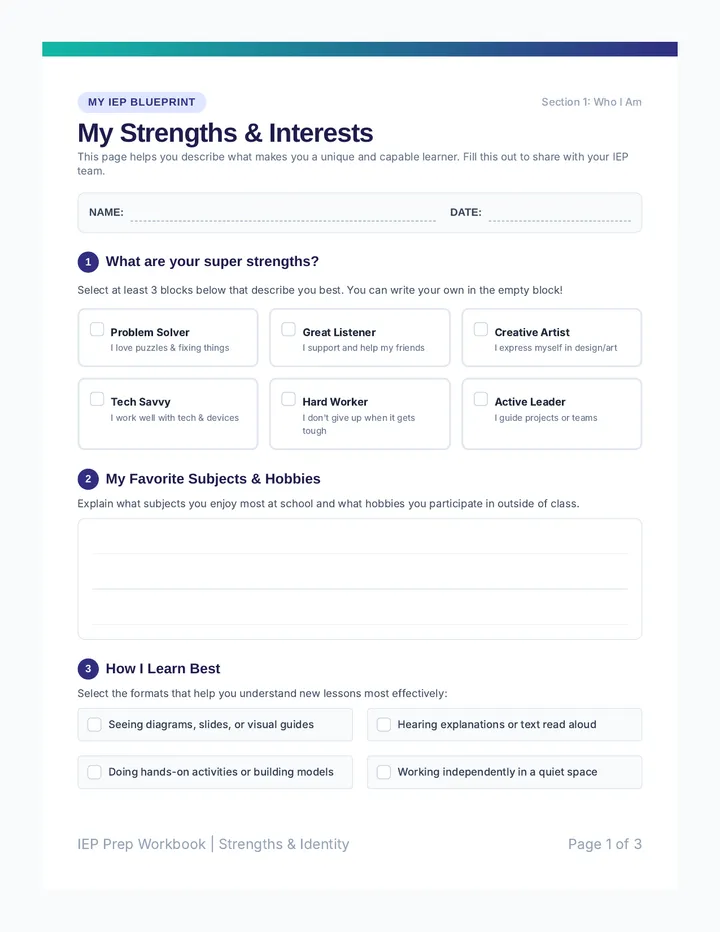
A behavioral support document featuring a lesson checklist, a visual First/Then board, and a menu of thematic brain break activities for students. Final version optimized for single-page printing.
A visual anchor chart (poster) for the classroom or student desk that breaks down the arrival process into three clear, actionable steps.
A reflective student worksheet for identifying barriers to punctuality and brainstorming personal strategies for on-time arrival.
A visual presentation for a 1-on-1 or small group session with a student, emphasizing the importance of punctuality and practical steps for arriving on time.
A data collection sheet for teachers to track student arrival times, on-time status, and behavioral notes to monitor progress toward IEP goals.
A comprehensive teacher guide for supporting students with tardiness issues, featuring IEP goals, classroom strategies, and implementation steps.
Revised exit ticket for NC.6.EE.1-2 with improved legibility for student handwriting by using white backgrounds for work areas. Step instructions have been enlarged for better accessibility, and the layout has been tightened to ensure a clean, one-page printout. Scaffolding remains optimized for students with IEPs.
Final task cards for NC.6.EE.1-2 with optimized layout to ensure all four cards fit on a single page. Card headers have been redesigned for clarity, answer boxes are now clearly marked, and all scaffolded input areas feature high-contrast text and borders for reliable printing. Variable casing has been standardized (lowercase n and g) to prevent student confusion.
Revised worksheet for NC.6.EE.1-2 with fixed step numbering (1-4) in the substitution rule, improved superscript alignment in the example, and high-contrast text for student work areas. Problems are kept together on one page using break-inside-avoid.
Revised slide deck for NC.6.EE.1-2 with corrected exponent rendering, removed video placeholder in favor of a detailed visual comparison slide, and adjusted layouts to prevent overflow. All text is 24px or larger.
A revised teacher guide for a lesson on NC.6.EE.1 and NC.6.EE.2. Fixed LaTeX rendering issues, improved page breaks, and added color-coding for bases and exponents to match instructional strategies.
A visual anchor chart for a classroom wall that reinforces 'Green Signal' vs 'Red Signal' concepts. Scaled to fit perfectly on a single portrait page.
A cut-and-paste sorting activity where students categorize middle school behavior scenarios. Updated to ensure page breaks are clean and answer choices are uniformly styled.
A social narrative handout using a traffic light metaphor to explain the concepts of expected (green signal) and unexpected (red signal) behaviors in a middle school context. Re-formatted to fit a single page.
A weekly aggregation tool for teachers and IAs to summarize behavioral incident data. It includes space for quantitative totals and qualitative pattern analysis to inform student support strategies.
A practical reference guide for Instructional Assistants that defines specific behaviors to track (On-Task, Regulation, Compliance) and provides a standardized intensity scale for consistent data entry.
A streamlined incident log designed for Instructional Assistants to quickly record classroom behavior data. Includes coded categories for transitions, regulation, and compliance with a simple intensity scale.
A professional teacher's guide for facilitating restorative conversations after a behavioral incident. It includes the purpose of reflection, implementation steps, and a restorative questioning framework.
A detailed, two-page restorative reflection form designed to help students analyze the impact of their actions, take another's perspective, and identify concrete steps for repairing harm after a specific incident.