Reading Launchpad Teacher Guide
Tier 3 Literacy Intervention Framework
Reading Launchpad
Grades 4–5 Intensive
Instructional Action Guide
Target Learner Profile & Diagnostic Baseline
Reading Level: 1.8 – 2.4 (Early Gr 2 equivalent)
Existing Assets & Mastered Skills
- • Syllable chunking & breakdown strategies understood
- • Basic short/long single-vowel grapheme knowledge intact
- • Responsive to structured, gamified 1-on-1 / paired routines
Critical Intervention Targets
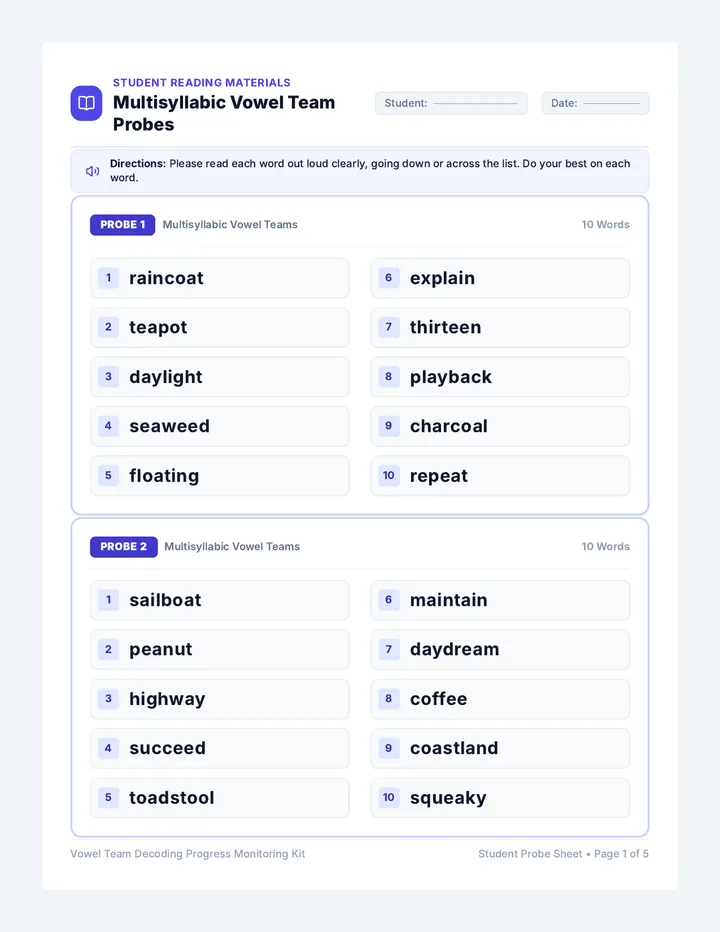
- • Vowel teams & diphthongs (oi, oy, ou, ow, au, aw)
- • Rate & automaticity stall reading comprehension
- • Significantly below-grade vocabulary storage & retrieval
Executive Functioning & Attention Scaffolds
1 6-8 Min Micro-Blocks
Sustained attention drops quickly. Switch task modality every 6–8 minutes to prevent fatigue and behavioral escalation.
2 Tactile Multi-Sensory
Incorporate sliding counters, highlighters, finger tracking, and whisper phones to ground motor energy into reading actions.
3 Dopamine Feedback
Use visible rapid progress (WCPM speed graphs, coin counters, daily win tokens) to satisfy the ADHD reward circuit.
The 30-Minute Daily Intervention Architecture
Daily 5-Phase Sequence
| Pacing | Phase & Focus | Specific Strategy & Student Action |
|---|
| 0–5 min | 1. Phonics Sprint | Flash targeted vowel team sound cards (e.g., oi/oy). 60-second word-slicing sprint with dry-erase markers. |
| 5–12 min | 2. Fluency Drills | Echo Reading & Choral Reading with a controlled 100-word passage. Focus on phrasing and prosody; track personal high score. |
| 12–22 min | 3. Shared Novel Study | Teacher interactive read-aloud alternating with choral reading from high-interest novel (The Wild Robot). Visual sketch stop at climax. |
| 22–27 min | 4. Vocab & Retell | One "Power Word" 4-square card (definition, sketch, sentence). Quick 2-sentence oral retell using SWBST graphic organizer. |
| 27–30 min | 5. Success Log | Log accuracy score in student chart; grant immediate point/stamp for focus stamina and cooperative behavioral goal. |
Part 1: Instructional Framework & Session Architecture Reading Launchpad • Page 1
Module 01
Vowel Teams & Diphthongs Scope
Priority Phonics Deficit
4-Cluster Explicit Scope & Sequence
Cluster 1: The /oi/ Sound Weeks 1–2
Graphemes: oi (middle) | oy (end)
Key Rule: "oi in the middle of a syllable; oy at the end of a syllable."
Target Words: coin, boil, join, spoil, boy, toy, enjoy, destroy
Cluster 2: The /ow/ Sound Weeks 3–4
Graphemes: ou (beginning/mid) | ow (mid/end)
Key Rule: "The band-aid sound: shout /ou/! Watch out for ow making long /o/."
Target Words: loud, out, cloud, round, cow, clown, town, growl
Cluster 3: The /aw/ Sound Weeks 5–6
Graphemes: au (middle) | aw (end or before l, n)
Key Rule: "Yawn sound: open jaw drop. aw likes to stand at the end."
Target Words: launch, haunt, sauce, fault, saw, paw, crawl, dawn
Cluster 4: /oo/ & Complex Teams Weeks 7–8
Graphemes: oo (moon) vs oo (book) | ew, ue
Key Rule: "Test the two sounds of oo: does it sound like moo or look?"
Target Words: scoop, tooth, wood, stood, chew, clue, rescue
Leveraging Known Syllable Breakdown to Decode Polysyllabic Words
Since both students already grasp basic syllable division, treat the new vowel team as one indivisible magnetic unit. Teach them the "Spot, Dot, and Chop" multisyllabic routine:
Step 1: Spot & Dot
Put a green dot under every vowel team unit: poison
Step 2: Chop Syllables
Draw a physical slash between consonants: poi | son
Step 3: Blend & Check
Read chunk 1 (poi), chunk 2 (son) → poison!
High-Engagement ADHD Phonics Games (3-Minute Sprints)
Vowel Team Laser Tag
Tape 4 large vowel team index cards (OI, OY, OU, OW) on the wall. Read a word aloud. Students shine a dollar-store mini laser pointer (or bean bag toss) at the matching team before writing it.
Syllable Smash (Play-Doh)
Place 2 or 3 small balls of modeling clay on the table for each syllable chunk. As students pronounce each syllable chunk (sound - proof), they physically smash that ball flat.
Part 2: Systematic Phonics Scope & Multisensory Routines Reading Launchpad • Page 2
Module 02
Fluency & Vocabulary Bridge
Rate & Word Storage
The Working Memory Bottleneck in 5th Grade Readers
When a student at the 2.0 reading level decodes word-by-word, 90% of their working memory is expended merely recognizing letter-sound correspondences. By the end of a sentence, their cognitive buffer is wiped clean, destroying comprehension. To fix comprehension, we must automate word retrieval and build phrasing prosody without triggering performance anxiety.
3 Non-Threatening Fluency Protocols
A Echo Reading
Teacher reads 1 sentence with exaggerated pitch, emotion, and natural pauses. Student tracks with finger and immediately mimics the exact intonation.
Best for: Sentence Boundaries
B Choral Reading
Teacher and both students read a short passage in absolute unison. The student with behavioral sensitivity avoids feeling singled out while piggybacking on your cadence.
Best for: Lowering Anxiety
C Personal Beat-Your-Best
Read an 80-word decodable passage for 60 seconds. Count words correct. Repeat after 2 days. The goal is strictly beating their own prior day, never each other.
Best for: Motivation & Stamina
Tier 2 Vocabulary Engine: The 4-Corner Anchor
Do not assign dictionary definitions. Pre-teach only 2 critical Tier 2 words per novel chapter using this visual 4-corner framework:
Corner 1: Student-Friendly Translation
"Peculiar" = weird, surprising, not normal at all.
Corner 2: Kinesthetic Gesture / Quick Doodle
Students make a silly face or tilt their glasses sideways.
Corner 3: "Would You Rather" Context Prompt
"Would you rather eat a peculiar pizza with marshmallows or normal cheese?"
Corner 4: Morphological Link
peculiar (adj) → peculiarly (adv)
Comprehension Anchor: Low-Cognitive-Load "SWBST" Chain
S Somebody
Who is main character?
W Wanted
What did they desire?
B But
What went wrong?
S So
How did they solve it?
T Then
How did it wrap up?
Part 3: Fluency Automation, Tier 2 Vocabulary, and Comprehension Chains Reading Launchpad • Page 3
Module 03
High-Interest Novel Blueprint
Hi-Lo Selection
#1 Primary Pick
The Wild Robot by Peter Brown
GRL: R | Lexile: 740L
Why It Fits 5th Graders Reading at Gr 2 Level with ADHD:
- Bite-Sized Chapters: 80+ mini-chapters (many are only 1.5 to 2.5 pages long). Each chapter provides a discrete, self-contained dopamine completion win.
- Accessible Syntax, High Maturity: Sentences are short, direct, and unbloated, but the survival and artificial intelligence themes feel sophisticated and age-respectful.
- Generous Visuals: Rich black-and-white spot illustrations anchor visual working memory on almost every spread.
Dual-Delivery Classroom Strategy: Teacher Read-Aloud: Teacher reads odd-numbered or action-heavy chapters aloud to build rich grade-level comprehension.
Student Shared Reading: Students chorally read or partner-read the short dialogue and observation chapters (e.g., Chapter 3: "The Ocean Waves", Chapter 8: "The Pinecones").
Alternative High-Interest Matches
A Boy Called Bat
GRL: O | ~2.8
By Elana K. Arnold
Neurodivergent Hook: Bat is an autistic boy obsessed with animals who nurtures a baby skunk. Characters with executive function differences make both boys feel seen and deeply engaged.
Zoey & Sassafras
GRL: N | ~2.2
By Asia Citro
Exact Decoding Match: Matches their current 2.0 independent decodability. Magical creatures (dragons, monsters) paired with scientific method experiments keep 5th-grade interest elevated.
The Graphic Novel Visual Bridge
For students with ADD/ADHD, graphic novels provide vital visual context that relieves working memory load. Interleave 1 graphic novel chapter weekly alongside the core novel:
• InvestiGators (John Patrick Green): High visual humor, puns, speech bubbles.
• Hilo: The Boy Who Crashed to Earth (Judd Winick): Comic action, sci-fi robot themes.
Part 4: High-Interest / Low-Readability Literature & Graphic Novel Bridge Reading Launchpad • Page 4
Module 04
Behavior, Pacing & Progress
Management Toolkit
Physical & Environmental Accommodations Checklist
Whisper Phones (Auditory Feedback) PVC elbow pipes allow ADHD readers to hear their own phoneme errors without teacher interrupting.
Highlighter Reading Strips Narrow transparent colored overlays block out competing text, instantly solving visual tracking jumps.
Wobble Stool / Resistance Bands Tie an exercise band around desk legs for foot kicking; channels hyperactivity away from verbal disruption.
Visual Sand Timer (5-Minute) Externalizes time perception. Students see exactly how much work remains in the sprint before the break.
6-Week Bi-Weekly Assessment Milestones
| Interval | Phonics Probe Target | WCPM Target | Comprehension Goal |
|---|
| Baseline | Diphthongs: < 20% accuracy | 42–50 WCPM (Gr 2) | Frustrated by multi-sentence retell |
| Week 2 | oi / oy mastery > 85% in isolation | 50–55 WCPM | Identifies "Somebody" & "Wanted" reliably |
| Week 4 | ou / ow mastery > 85% in text | 58–64 WCPM | SWBST 3-sentence summary with picture cue |
| Week 6 | au / aw & multisyllable blend > 80% | 68–75 WCPM | Independent 1-chapter retell without prompt |
Behavioral Resistance & De-escalation Micro-Protocol
A.
If student shuts down or refuses to read aloud: Immediately drop to Choral Reading or Neurological Impress Method (you read smoothly while pointing, student whispers along). Never insist on solo performance when anxiety spikes.
B.
If student becomes hyperactive or off-task: Shift to the "Play-Doh Syllable Smash" or standing board work. Physical movement instantly resets executive alertness without shame.
C.
Exit Ticket Ritual: End every single 30-minute block on a definite win. Have them read 3 words they mastered that day and hand them their physical progress token.
Part 5: Environmental Accommodations, Benchmarking Milestones & Behavioral Support Reading Launchpad • Page 5