PLAAFP Builder Document
Special Education Resource
PLAAFP Writer's Blueprint
EdPlan 3-Box Format
Writing Present Levels of Academic and Functional Performance (PLAAFP) statements for EdPlan requires a balance of objective data, student strengths, and clear disability impacts. Use this blueprint to transform disorganized raw notes into defensible, high-leverage compliance statements.
1
Box 1: Strengths of the Student
Goal: Combine positive personal attributes with quantifiable baselines and what works in the classroom.
What to Include:
- Academic baselines (Reading, Math, Writing)
- General classroom averages for comparison
- Interests, positive peer interactions, motor skills
- Effective strategies (e.g., visual timers, graphic organizers)
Professional Phrasing:
- "Demonstrates a relative strength in..."
- "Compared to a classroom average of [X], [Student]..."
- "Academically, [Student] currently performs at..."
- "Instructional accommodations such as..."
2
Box 2: Parental Concerns
Goal: Maintain compliance while avoiding redundant or premature documentation.
Required EdPlan Compliance Statement:
"Please refer to the Parent Input portion of this IEP"
*Note: This standard statement ensures that parental feedback is consolidated in its dedicated section, avoiding duplicate logs that can cause compliance conflicts.
3
Box 3: Disability Impact & Progress
Goal: Identify high-leverage growth areas and explicitly connect the disability to curriculum barriers.
What to Include:
- Specific learning/processing gaps
- Highest-leverage foundational skills needed
- Executive functioning / focus barriers
- Impact statement (How it limits curriculum progress)
Professional Phrasing:
- "These deficits directly impact the student's ability to..."
- "To build foundational competence, [Student] requires..."
- "This processing gap manifests in..."
- "Impacts participation in general education by..."
Page 1 of 3 • Present Levels Framework
Special Education Case Study
Exemplar Transformation
Specific Learning Disability
The Scenario: See how unorganized raw notes for a 5th-grade student (Marcus) with a Specific Learning Disability (SLD) in reading and writing are synthesized into highly professional, compliant IEP language.
BOX 1: STRENGTHS & BASELINES Marcus (Grade 5)
Marcus is a socially collaborative, expressive student who displays strong verbal reasoning skills and participates enthusiastically in whole-group discussions. He works cooperatively in small peer groups, demonstrating positive social interactions and age-appropriate speech-language and gross/fine motor skills (independent typing speed of 12 WPM).
Academically, Marcus possesses solid single-digit math fact fluency (90% accuracy). When provided with graphic organizers and assistive technology such as speech-to-text, his independent task completion increases significantly from 60% to 90%.
Baseline & Comparative Classroom Data:
- Oral Reading Fluency: 92 WPM / 94% accuracy (Class Average: 120 WPM)
- Reading Comprehension: 55% accuracy (Class Average: 80%)
- Written Expression: 3 sentences in 10 mins (Goal: 5-8 sentences)
- Writing Mechanics: 68% spelling / punctuation accuracy
- Math Calculations: 45% multi-digit multiplication (Class Average: 75%)
- Fine Motor/Typing: 12 WPM independent keyboarding rate
BOX 2: PARENTAL CONCERNS
"Please refer to the Parent Input portion of this IEP"
BOX 3: DISABILITY IMPACT & PROGRESS BARRIERS
Marcus's diagnosed Specific Learning Disability in reading comprehension and written expression significantly impacts his processing of written language and execution of written output. Marcus displays processing vulnerabilities that directly affect his reading comprehension when faced with dense, un-scaffolded, grade-level academic texts. This deficit frequently manifests as task-related frustration (e.g., putting his head on his desk or sighing) and delayed independent task initiation, requiring 5-7 minutes to start tasks without direct prompting.
High-Leverage Remediation Priorities:
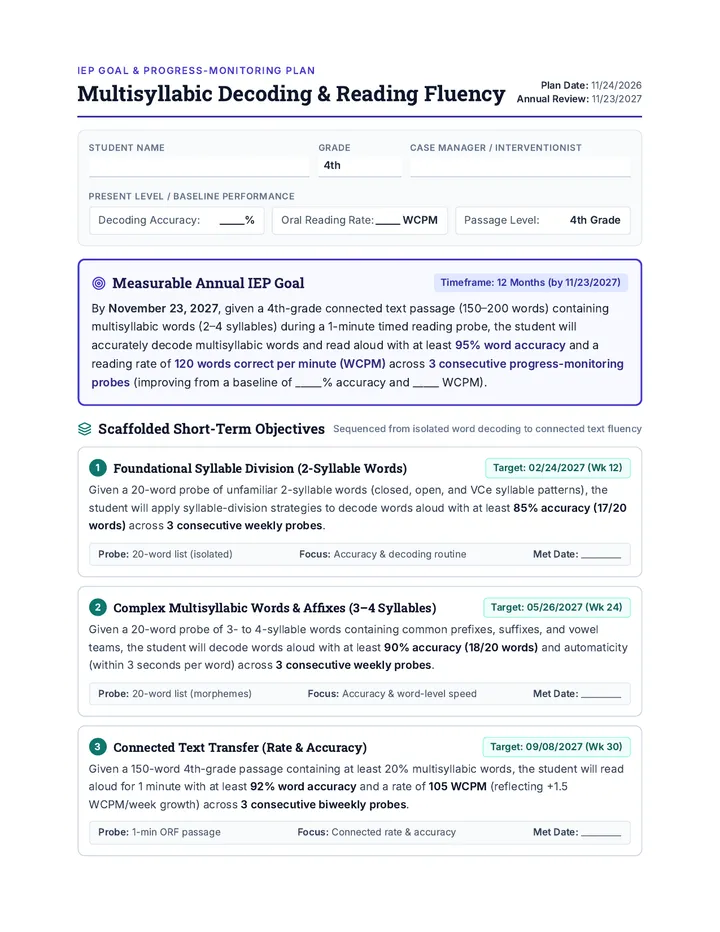
- Reading Fluency: Multi-syllabic decoding strategies and active reading self-monitoring techniques to close the 28 WPM fluency gap.
- Writing Mechanics: Structured sentence-combining skills and editing checklists to target spelling accuracy and resolve run-on structures.
- Self-Regulation: Developing self-advocacy and initiation strategies (utilizing a visual timer and self-monitoring card) to reduce prompt dependency from 5-7 minutes down to under 2 minutes.
Disability Impact Statement: Marcus's processing and output deficits limit his involvement and progress in the general education curriculum by preventing him from independently accessing grade-level informational texts and producing cohesive, multi-sentence written explanations in subject areas such as English Language Arts, Science, and Social Studies without specialized instruction and accommodations.
Page 2 of 3 • Exemplar Case Study
Teacher Tool
PLAAFP Drafting Worksheet
Interactive Prep Sheet
Student Profile Setup:
Student Name
Grade / Date
Tip: Keep a clean draft here before pasting into EdPlan. Ensure all baseline numbers have an explicitly stated classroom target or peer average for comparison.
1 Box 1: Strengths, Baselines, & Effective Strategies Include: Academics, Baselines, Class Averages, Motivators
2 Box 2: Parental Concerns Standard EdPlan Sentence Required
"Please refer to the Parent Input portion of this IEP"
3 Box 3: Disability Impact & High-Leverage Growth Areas Include: SLD Processing Deficit, Gaps, Core Academic Barriers
Page 3 of 3 • Present Levels Drafting Sheet