Child Labor Retell Teacher Script
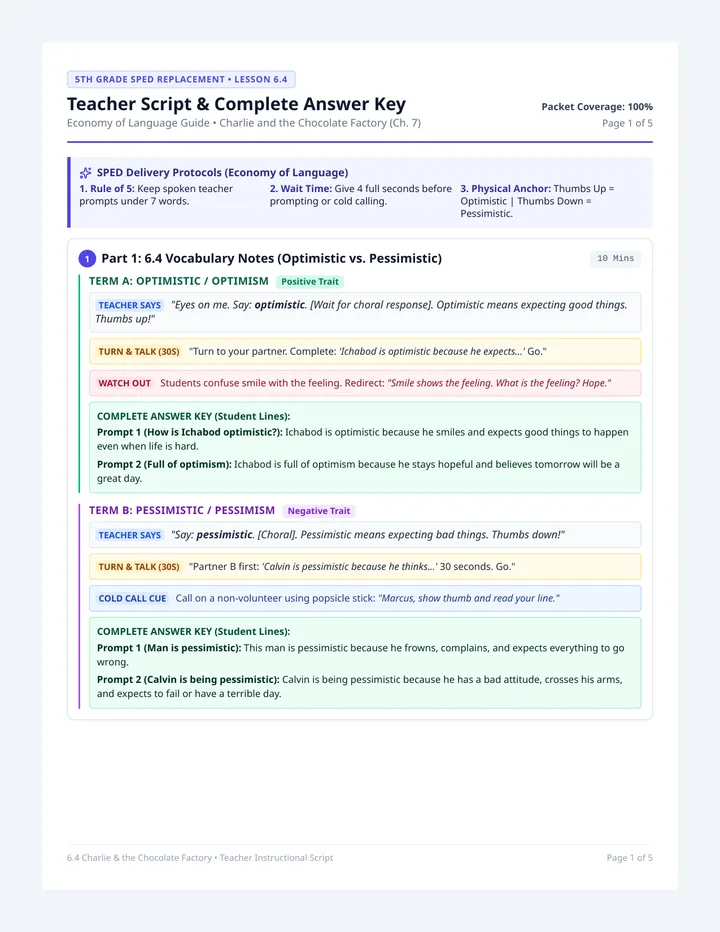
5th Grade SPED Replacement • Lesson 6.3
Teacher Script: Grammar & Retell
Core Focus: Economy of Language
Target: Cognitive & Comm. Impairments
!
1. 5-7 Word Rule: Keep teacher talk under 7 words per prompt. Zero extraneous verbiage.
2. Visual Anchoring: Point before speaking. Tap the word or symbol on board first.
3. 3-Second Processing: Give 3 full seconds of silent wait time before prompting response.
[SAY] Teacher Line [CALL] Cold/Choral [TURN & TALK] Partner [ALERT] Student Struggle [KEY] Correct Answer
PART 1: DO NOW — IRREGULAR SUBJECT-VERB AGREEMENT (8 MIN) Steps: 1. Pronoun Replacement • 2. Verb Match
Standard Instructional Delivery Script:
[SAY] "Pencils up. Sentence 1. Track Aminah and I."
[SAY] "Aminah and I equals... what pronoun?"
[CALL: CHORAL] Wait 2 seconds. Signal snap: "We!"
[SAY] "Write WE above. Singular or plural?"
[CALL: COLD CALL] Call struggling student: "Plural."
[SAY] "We doesn't OR We don't? Circle."
[CALL: CHORAL] "Don't!"
[ALERT: #3 Our Dog] Students hear 'Our' and pick plural. Teacher Fix: "Look at the NOUN. Dog. Just one dog. One dog = IT. It doesn't."
DO NOW ITEM-BY-ITEM ANSWER KEY & PRONOUN MATCH
-
Aminah and I ➔ WE | Correct: don't
-
We ➔ WE (Plural) | Correct: are
-
We ➔ WE (Plural) | Correct: have
-
I ➔ I (1st Person) | Correct: am
-
Our dog ➔ IT / HE | Correct: doesn't
-
Brother ➔ HE | Correct: is
-
Our house ➔ IT | Correct: is
-
You ➔ YOU (Rule: Takes plural) | Correct: have
Grammar Song Cue & Answers
[SAY] "Sing it. Point to the blanks."
"If it's SINGULAR add -S,
or an -ES to the VERB.
If the subject's PLURAL,
The VERB stays the SAME."
Challenge Key (Check Desk Work)
- • Ahmad (Sing.) ➔ error: want ➔ wants
- • he works and (Sing.) ➔ error: focus ➔ focuses
- • Ms. Garcia (Sing.) ➔ error: appreciate ➔ appreciates
- • Students (Plur.) ➔ error: studies ➔ study
- • Every teacher (Sing.) ➔ error: know ➔ knows
Lesson 6.3 Facilitation Script • Page 1: Do Now Transition to Reading Notes: 30-second silent desk swap
Part 2: Reading Notes & Modeling
Retell Anchor & "We Do"
Time: 12 Minutes
Hook & Novel Connection (Economy of Language) Charlie and the Chocolate Factory Connection
[SAY] "Track me. In Charlie, who works in Wonka's factory?"
[CALL: COLD CALL] Call one student: "Oompa Loompas."
[SAY] "They work locked inside. Real history was similar. Real children worked in dangerous factories. Today, we read why."
Reading Notes Fill-in-the-Blanks (Model on Document Camera) Pacing: 3 Min
[SAY] "Pencil on line 1. 'Retell questions ask you to...' Fill in: SUMMARIZE."
[SAY] "Line 2: 'report back a...' Fill in: KEY DETAIL or FACT."
[SAY] "Line 3: 'Our...' Fill in: ANNOTATIONS help us answer."
*Visual Anchor Cue: Point directly to the board card: RETELL = WHAT HAPPENED IN SHORT WORDS.
WE DO: "WHAT IS CHILD LABOR?" Active Annotation & Summary Item
Step 1: Read & Box Key Words (Model Live)
[SAY] "Read sentence 1 with me: 'Child labor is work that harms children or keeps them from school.' Box HARMS and NO SCHOOL."
[TURN & TALK] 30 Seconds Sentence Stem Required
[SAY] "Turn to your partner. Complete this stem: 'Child labor is work that...' Partner A speaks first. 30 seconds. Go."
Teacher Listen-For: Students say "harms kids" or "stops them from school." If silent, tap desk and point to the two boxed words.
Step 2: Summary Question Breakdown
[SAY] "Look at Question 1. We need the BEST SUMMARY. A summary covers the WHOLE section, not just one small fact."
[ALERT: Trap Options] Choice B & C are true, but they are only tiny details (why they work / illegal jobs). Teacher prompt: "Is that the whole section or one piece?"
[KEY: Correct Option A] "Child labor is when children are forced to work in harmful situations or can't attend school." Matches our two boxed anchor words directly.
Lesson 6.3 Facilitation Script • Page 2: Reading Direct Instruction Transition to Partner Practice: Stand, stretch 5 seconds, sit with partner
Part 3: Guided Partner Practice
"You Do - Partners" Protocol & Keys
Time: 14 Minutes
Partner Reading Routine: Partner A reads 1 paragraph aloud • Partner B underlines 2 key words • Switch.
Target: High Engagement
PASSAGE 1: "THE HISTORY OF CHILD LABOR" & CAUSE/EFFECT BOXES Questions 2 & 3
Summary Question #2 Script:
[SAY] "Reread paragraph 2. Why were kids hired?"
[CALL: COLD CALL] "They were cheap."
[SAY] "Eliminate answers missing machines or danger."
[KEY #2]: Choice A: "Children worked operating machines in factories, where they did dangerous jobs for long hours and often became sick."
Flow Chart / Box Question #3 Script:
[TURN & TALK] "Look at Box 1 and Box 3. What happened in between? 20 seconds. Tell partner."
[ALERT] Students choose 'Adults do not want to work' because it sounds logical, but it is NOT in text.
[KEY #3]: "Factories open in England and the United States." (Shows historical timeline order).
PASSAGE 2: "WORKING TO END CHILD LABOR" Questions 4 & 5
[SAY] "Track heading: 'Working to End Child Labor.' What is the goal of this section? One word."
[CALL: CHORAL] Signal: "Laws!" or "Stop it!"
Question #4 (Best Summary): [ALERT] Choice C only names Britain and US without saying laws passed.
[KEY #4]: "People were against child labor and laws were eventually passed to protect children from working long hours and dangerous jobs."
Question #5 (Text Support Evidence): Students must find the law that finally passed in the US.
[KEY #5]: "Then, in 1938, Congress passed the Fair Labor Standards Act."
Mid-Lesson CFU Check (Teacher Circulation Cue):
If student is stuck: "Point to paragraph 3. Find the date 1938. What law passed?"
If student finishes fast: "Underline the three ages in the 1938 law (16, 14, 18)."
Lesson 6.3 Facilitation Script • Page 3: Partner Practice Transition to Independent Work: Desks separate, silence cue (fist in air)
Part 4: Independent Work & Closure
"Child Labor Today" & Rewrite
Time: 14 Minutes
[SAY] "Pencils moving silently. 6 minutes independent work. Read 'Child Labor Today'. Go."
Circulate immediately to lowest 3 SPED readers to prompt tracking.
Silent Solo Mode
INDEPENDENT ITEMS: ANSWER KEY & MISCONCEPTION FIXES Complete Keys
Summary of "Child Labor Today"
[ALERT] Students write: "Child labor is bad." (Too short, no facts).
[MODEL ANSWER - 2 Sentences]: "Today, laws stop children from working in factories, but children still work on farms outside school hours. Child labor is still a problem because some laws are not enforced."
Farm Work & Whole Article Summary
Why do children still work on farms?
[KEY]: Choice D: "Laws allow children to work on farms when they are not in school."
Most important detail for WHOLE article:
[KEY]: Choice C: "Child labor is when a child works in a dangerous situation or must work instead of attending school."
Challenge: How do subheadings help the reader? [KEY]: Subheadings tell the reader the main idea of each section before they read, helping them locate facts quickly.
Closing Routine: Everybody Rewrites (5 Min) Mastery Check
[SAY] "Pencils down. Eyes on board. What is an EXTRANEOUS detail?"
[CALL: CHORAL] "Extra detail we don't need!"
[SAY] "Canada having less child labor is extraneous. Do not write it. Use this frame to write your summary:"
Sentence 1: Today, laws protect children from [ factory work ].
Sentence 2: However, children still work on [ farms ] and laws are [ not enforced ].
[ALERT] Non-verbal/severely impaired students: Provide word bank strip: LAWS, FACTORIES, FARMS, ENFORCED.
Lesson 6.3 Facilitation Script • Page 4: Independent & Rewrite Exit: Collect packets, distribute HW 6.3
Reference Guide & Master Key
6.3 Homework: Retell & S-V Agreement
Text: Child Labor Around the World
SPED Homework Support Strategy (1-Minute End-of-Class Preview):
[SAY] "Open your HW. Look at the Kenyan school boxes on page 2. Box 2 is missing. The cause was school fees. Star Box 2 now."
HOMEWORK MASTER ANSWER KEY & GRADING GUIDE 100% Complete
SECTION 1: "A GLOBAL PROBLEM" Paragraphs 1-2
Important detail in summary choice: [KEY]: Choice A: "They work in extreme heat for 14 hours a day."
Written Summary of "A Global Problem":
Model Answer: Around the world, 250 million children work dangerous jobs for pennies a day instead of going to school. This global problem exists in countries like Brazil, Pakistan, and Indonesia.
SECTION 2: "REAL KIDS, REAL LIVES" Paragraphs 3-6
Best summary sentence choice:
[KEY]: Choice B: "Around the world, real kids work long hours away but dream of attending school."
*Rationale: Choice B captures both the working condition and their shared longing for education.
SECTION 3 & 4: "FROM WORK TO SCHOOL" & "ENDING CHILD LABOR" Kenya Case Study
Why did Kenyan parents send their kids to work instead of school?
Model Answer: The Kenyan government charged school fees of up to $350 per year. Since families earned only $1 a day, they could not afford the fees and sent children to work instead.
Flow Chart Missing Box:
Sequence: Debts ➔ [ EMPTY BOX ] ➔ Parents can't pay ➔ Kids sent to work [KEY]: Choice B
Text: "Schools in Kenya charged fees." (Direct cause of inability to pay).
FINAL HW ITEM: FULL ARTICLE SUMMARY Entire Text Synthesis
[MODEL 3-SENTENCE SUMMARY]: "Millions of children around the world are forced to work long, dangerous hours for low pay because of extreme poverty and expensive school fees. While children dream of going to school, many cannot attend until governments ban fees. Today, international organizations and citizen protests are fighting to end child labor through free education."
✔+ (Exceeds): All multiple choice correct + 2-3 complete summary sentences with capitalization/periods.
✔ (Meets): Misses ≤ 1 MC + includes who/what in written summary.
✔- (Reteach): Left summaries blank or picked detail trap answers.
Lesson 6.3 Facilitation Script • Page 5: Master Key & HW Reference Designed for High-Structure Special Education Delivery