Academic Regulation Skill Guide
Tier 2 / Executive Function Intervention
Academic Regulation Curriculum Guide
Target: Grades 6–8
Focus: Overwhelm & Work Avoidance
Task Overload
Nervous Dysregulation
Avoidance / Freeze
Taught Skill Re-entry
Work avoidance in middle school is rarely defiance; it is a neurological flight response triggered when cognitive load outpaces perceived capability. This 8-lesson sequence replaces avoidance reflexes with concrete somatic, cognitive, and procedural actions.
Phase 1 Detect Body radar & early escalation cues
Phase 2 Reset Somatic down-regulation in under 90s
Phase 3 Launch Task slicing & micro-initiation
Phase 4 Persevere Cognitive reframe & dignified repair
1
Module 1: Interoception & Early Warning Systems
Lesson 1.1
The Body Dashboard: Mapping Physical Stress Signals
20 min • Direct + Modeling
Skill Objective
Identify at least 2 distinct physical indicators before emotional shut-down occurs.
Middle School Metaphor
"Check Engine Light: Dashboard alerts happen miles before engine smoke."
Targeted Practice
Complete a personalized "My Body Warning Map" (jaw clenching, hot ears, shallow breath).
Lesson 1.2
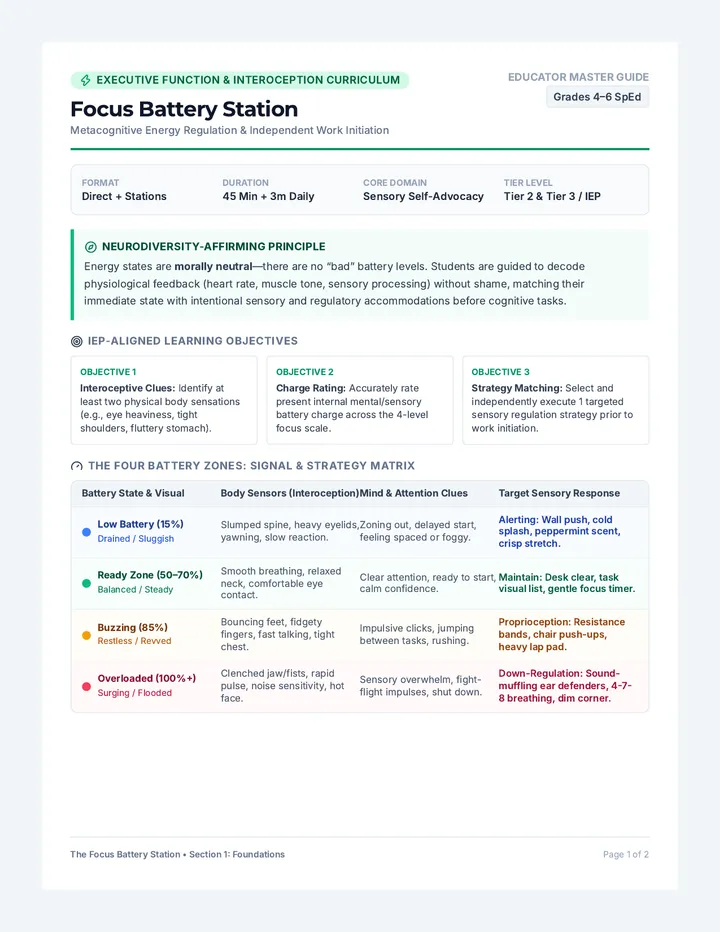
The 4-Zone Arousal Gauge: Catching The Yellow Zone
25 min • Guided Simulation
Skill Objective
Differentiate between Green (Ready), Yellow (Overload Warning), and Red (Shutdown/Lock).
Intervention Secret
Intervene strictly at Level 2 (Yellow); once in Red (amygdala hijack), logic teaching fails.
Concrete Takeaway
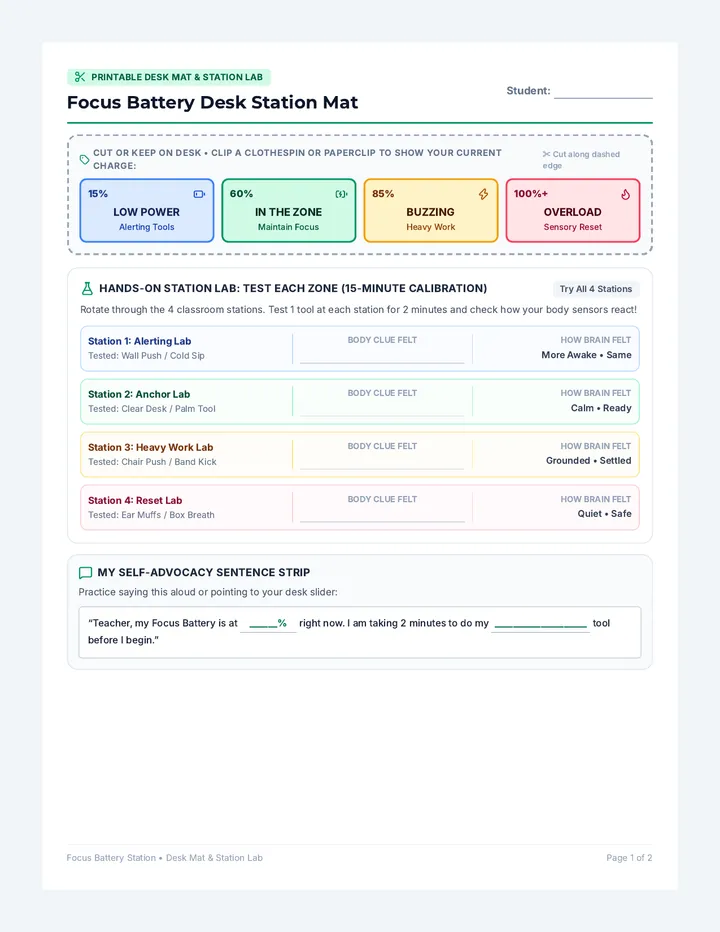
Student-kept desk slider card with discreet non-verbal color indicators.
2
Module 2: Somatic Reset & Down-Regulation
Lesson 2.1
The Stealth Reset: Physiological Sigh & Box Breathing
15 min • Somatic Drill
Skill Objective
Deploy 3 consecutive double-inhale physiological sighs without drawing peer attention.
Physiology Explained
Double inhale re-inflates collapsed alveoli; prolonged exhale stimulates vagus nerve brake.
Practice Protocol
"Two sharp nose sniffs + slow silent mouth release." Drill during low-stress baseline.
Lesson 2.2
Tactile Anchors: Proprioceptive Desk Resets
20 min • Hands-on Lab
Skill Objective
Ground racing thoughts through 30 seconds of heavy work or tactile focal anchoring.
3 Discreet Tools
1. Isometric chair push-up • 2. Palm-to-palm compression • 3. Texturized tactile strip.
Exit Performance
Student selects their #1 tactile anchor and demonstrates it under timed mock task load.
Academic Self-Regulation Framework • Tier 2 Intervention Sequence Page 1 of 3 (Modules 1 & 2)
Action Phasing: Initiation & Frustration Recovery
Core Work-Avoidance Defeaters
Once somatic calm is restored, work avoidance must be countered with explicit task-engineering skills. These modules build the procedural stamina to start terrifying tasks and bounce back from stuck points.
3
Module 3: Overcoming The Start Cliff (Task Initiation)
Lesson 3.1
Task Slicing: The "Window-of-One" Technique
25 min • Strategy Practice
The Root Barrier
Visual field overwhelm: 20 problems on a page register as an insurmountable mountain.
The Execution Tool
Folding or blank paper overlay: isolate strictly Problem #1. Cover all remaining items.
Student Rule
"You do not have a 20-problem sheet. You only have a 1-problem index card."
Lesson 3.2
The 3-Minute Ignition Contract
20 min • Behavioral Shaping
The Concept
Lower the bar to pure initiation. Commit to work for exactly 180 seconds, nothing more.
Dignity Clause
If distress remains high after 3 min, student has earned an approved 60-second breathing pass.
Key Neurological Win
85% of students continue working once momentum overcomes initial activation energy friction.
Lesson 3.3
The Precision Help Script: Bypassing "I Don't Get It"
20 min • Role-Play & Scripting
Avoidance Defense
Vague cries of "I don't get any of this" mask specific sticking points and prompt freeze.
Taught 3-Part Script
"I understand [X], I completed [Y], but I am stuck deciding between [Z]."
Discreet Cue Card
Pre-printed question starter card placed on desk corner to request targeted teacher scaffolding.
4
Module 4: Cognitive Flexibility & Frustration Recovery
Lesson 4.1
Glitch vs. Crash: Sizing the Academic Problem
25 min • Perspective Sorting
Cognitive Distortion
Catastrophizing: 1 wrong formula feels like an entire ruined quarter and total personal failure.
The Sizing Formula
A Glitch (1-2 min fix, pencil stroke) vs. A Detour (need 1 question answered) vs. A Crash.
Practice Task
Sort 10 realistic middle school hurdles into "Glitch" vs "Detour" to calibrate reaction size.
Lesson 4.2
The Self-Talk Pivot: Replacing The Inner Saboteur
20 min • Reframe Workshop
Automatic Thought
"I'm too dumb for this. Everyone else is done already."
Taught Pivot Statement
"My brain is stretching right now. Fast doesn't mean smart; sticking with it does."
Student Anchor
Create a customized 3x5 "Pocket Coach" index card with 2 personal power reframes.
Lesson 4.3
The Dignified Re-Entry: Bouncing Back After Shut-Down
25 min • Recovery Protocol
The Secondary Trap
Shame spiral: after shutting down or putting head down, student avoids returning due to embarrassment.
The Re-Entry Plan
Non-verbal teacher cue (silent pencil tap), 3-step physical reset (water sip, posture, single task).
Post-Class Check-in
30-second low-stakes debrief: "You caught yourself and reset. That is real grit."
Academic Self-Regulation Framework • Tier 2 Intervention Sequence Page 2 of 3 (Modules 3 & 4)
Intervention Delivery & Co-Regulation Toolkit
Educator implementation scripts, pacing timeline, and de-escalation response protocols
Classroom Protocol
Recommended 4-Week Intervention Progression
Small Group or 1:1 Coaching (2x 25 min/week)
Week 1: Awareness
Lessons 1.1 & 1.2
Baseline data collection. Student maps body warning signals and installs the desk slider.
Week 2: Somatic Calm
Lessons 2.1 & 2.2
Direct instruction of physiological sigh & tactile grounding. In-session mock stress trials.
Week 3: The Start Engine
Lessons 3.1 & 3.2
Bring real classwork. Practice task slicing and 3-minute ignition contracts with timer.
Week 4: Stamina & Repair
Lessons 4.1 & 4.3
Glitch sorting, self-talk pocket card, and dignified re-entry practice with classroom teachers.
Educator Co-Regulation Response Matrix (When The Student Freezes)
| Escalation Stage | Avoid Saying (Fuels Dysregulation) | Say This Instead (Fosters Re-Regulation) |
|---|
| Early Clenching / Staring Off (Yellow Zone) | "You haven't even written your name yet. Come on, everyone else is on #3." | "I see your radar flashing. Take 2 physiological sighs. I'll slide this paper to hide #2 through #10." |
| Pencil Dropped / "I Can't Do This" | "It's not that hard if you just pay attention. Stop giving up so easily." | "This feels like a giant wall right now. Give me 3 minutes on just the first word. Then we decide." |
| Head Down / Verbal Shut-down (Red Zone) | "Put your head up right now or this is a zero and a referral to the office." | "Nervous system reset needed. Drink water. I'm tapping your desk once—when ready, just do Problem 1a." |
The Dignified 90-Second Classroom Re-Entry Protocol
Step 1: Cool Off Zero demands for 60 seconds. Sensory drink of cold water or tactile thumb press.
Step 2: Micro-Slice Teacher quietly places a single index card exposing strictly ONE step or item.
Step 3: Low-Stakes Start Student writes first word or circle. Teacher steps away (reduces hovering pressure).
Step 4: Silent Affirmation Brief sticky note or silent thumbs up: "You reset your brain. Proud of that grit."
Student Generalization Rubric (Weekly Tracker)
Rate 1 (Needs Prompt) to 3 (Autonomous)
Flags yellow zone before red
Uses sigh / desk reset
Slices task to 1 problem
Re-enters after frustration
Academic Self-Regulation Framework • Tier 2 Intervention Sequence Page 3 of 3 (Delivery Toolkit)