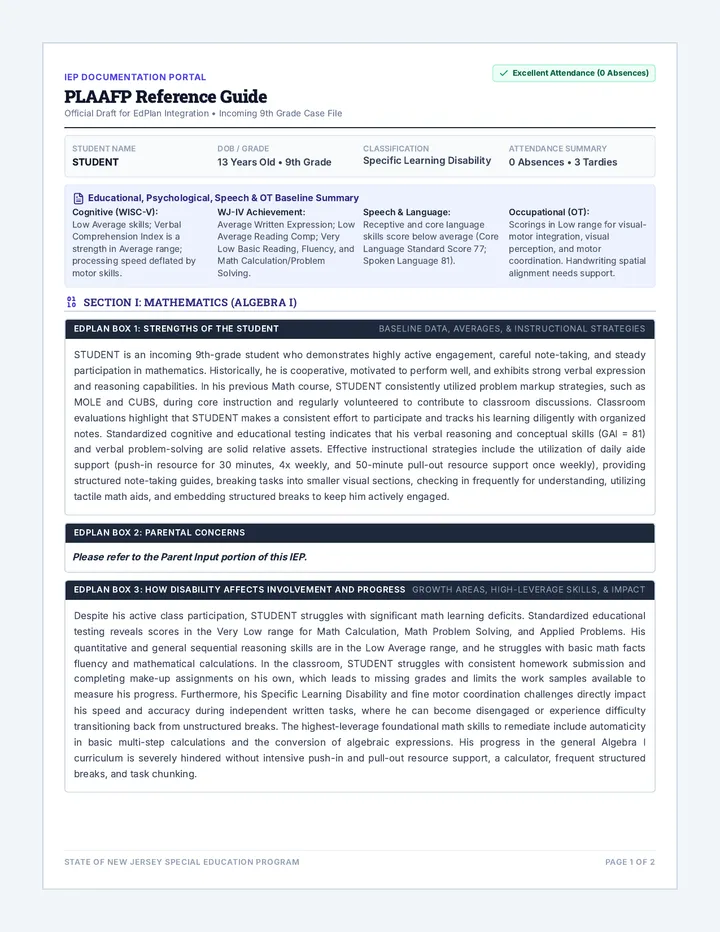
Curriculum Access & Performance Barriers: Although she has solid baseline math facts, her Communication Impairment hinders her ability to decode and analyze the linguistic structures of complex algebraic word problems (corroborated by her WJ-IV Applied Problems score of 78). Her ADHD manifests as severe task initiation and follow-through barriers at home, leading to a 30% homework completion rate. It also causes rapid focus decay and cognitive fatigue during independent testing, resulting in a test average of 46% compared to her highly scaffolded 85% classwork performance.
High-Leverage Remediation Focus: To bridge her performance gap, specialized instruction must prioritize high-leverage foundational goals: (1) verbal-to-algebraic translation strategies (scaffolding linguistic mathematical terms into algebraic equations), and (2) Solving Multi-Step Linear Equations (8.EE.C.7) using color-coded graphic organizers and permanent visual checklists to relieve cognitive load.
Student 2 • Math Present Levels Draft Dossier Page 1 of 2
IEP Writing Rationale
Data Discrepancy Breakdown & Specially Designed Instruction (SDI)
Analytical View For Educator File
FSIQ (Potential) 104 Average Range
WJ-IV Calc (Mechanics) 89 Low Average
WJ-IV Applied (Concept) 78 Low Range
Discrepancy Analysis: Student 2's potential is completely solid (FSIQ 104). However, there is an 11-point gap between mathematical calculations (89) and applied verbal problems (78). This is a textbook signature of a **Communication Impairment**, where the linguistic overhead of interpreting math word problems acts as a bottleneck on her average cognitive capabilities.
| Barrier Identified | Clinical Impact | SDI Implementation Accommodation |
|---|---|---|
| Homework Completion at 30% | Task initiation deficit; executive function breakdown at home without structured class cues. | Scaffolded home checklists, modified homework length (even problems only), and daily check-ins. |
| Math IA 3 Standard Deviations below mean | Cognitive fatigue during lengthy independent testing; high linguistic load in assessment questions. | Deconstruct long assessments into 10-minute mini-blocks with structured motor/sensory breaks. |
| Linear Equation (8.EE.C.7) deficit (30%) | Working memory overloading during multi-step algebraic operations. | Permanent use of color-coded linear equation templates and procedural flowcharts. |
Recommended Measurable Annual IEP Math Goals
To remediate the high-leverage foundational deficits identified in the Present Levels:
Student 2 • Math Present Levels Draft Dossier Page 2 of 2
Objective 2.3 (Academic Error Correction Self-Advocacy)
Given a returned assessment scoring below 80%, Student 1 will utilize the teacher-offered correction protocol to rewrite and self-correct errors, to this extent: 100% of eligible assessments across a 9-week grading period.
Student 1 • Goals & Objectives Portfolio Page 1 of 2
IEP Goal & Objective Builder
Compliant with EdPlan Grammar: {Given [Condition], STUDENT will [Behavior], to this extent [Criteria]}
Target Area Math • Algebra & Word Problems
Drafting Standard: Goals target Student 2's severe performance deficits in solving multi-step linear equations (8.EE.C.7) and the linguistic translation barriers associated with her Communication Impairment.
Goal 1: Multi-Step Linear Equations (Academic) CCSS.MATH.8.EE.C.7
Annual Measurable Goal Text
Given an 8th-grade multi-step linear equation in one variable, Student 2 will solve the equation for the variable utilizing a color-coded algebraic template, to this extent: 80% accuracy in 4 out of 5 consecutive independent trials as measured by curriculum-based evaluations and student work.
Objective 1.1 (Algebraic Simplification Mechanics)
Given an 8th-grade linear equation with variables on both sides, Student 2 will use the distributive property and combine like terms to simplify both sides, to this extent: 85% accuracy in 4 out of 5 consecutive trials.
Objective 1.2 (Variable Isolation Operations)
Given a simplified linear equation, Student 2 will perform inverse addition, subtraction, multiplication, and division operations to isolate the variable, to this extent: 80% accuracy in 4 out of 5 consecutive trials.
Objective 1.3 (Mechanical Solution Verification)
Given a solved algebraic equation, Student 2 will substitute her solved numerical value back into the original equation to check for equality, to this extent: 80% accuracy across 4 consecutive trials.
Goal 2: Mathematical Word Problem Translation (Linguistic) CI / ADHD Focus
Annual Measurable Goal Text
Given an 8th-grade mathematical word problem and a translation key mapping key math verbs to operators, Student 2 will translate the word problem into a solvable multi-step algebraic equation, to this extent: 80% accuracy on 4 out of 5 consecutive work samples.
Objective 2.1 (Math Verb Mapping)
Given an 8th-grade word problem, Student 2 will highlight key mathematical linguistic phrases (such as "difference of", "product of", "divided by") and write down their matching mathematical operator (+, -, *, /), to this extent: 90% accuracy in 4 out of 5 trials.
Objective 2.2 (Variable and Expression Setup)
Given a highlighted word problem, Student 2 will define the unknown quantity as a variable and construct a mathematical expression representing the scenario, to this extent: 80% accuracy in 4 out of 5 trials.
Objective 2.3 (Complete Equation Translation)
Given a math word problem and her student-generated expressions, Student 2 will map the entire linguistic problem into a single complete algebraic equation, to this extent: 80% accuracy in 4 out of 5 trials.
Student 2 • Goals & Objectives Portfolio Page 2 of 2