Hustle Proof Anchor Chart
Literacy Strategy Guide
How to Build Hustle Proof Evidence
When reading, we can't just guess. We need proof. Use this 3-color highlight strategy to trace key details and back up your arguments like a professional.
The 3-Color Evidence Code
Yellow Code: The "What"
Highlight definitions, main claims, or key facts. Ask yourself: What is this article actually about?
Pink Code: The "Why" (The Positives)
Highlight benefits, advantages, or positive outcomes. Ask yourself: Why would someone want to do this?
Blue Code: The "But" (The Risks)
Highlight challenges, risks, or negative downsides. Ask yourself: What are the dangers or warning signs?
Cite It Like a Pro: Sentence Frames
Option A: Direct Quote
According to the text, "..."
The author states, "..."
Option B: Connecting the Proof
This evidence proves that ___.
This means that ___ because...
The Evidence Checklist Did you find 1 Yellow, 1 Pink, and 1 Blue detail in the text?
Hustle Proof Student Worksheet
Name:
Date:
Class Period:
Part 1: Read & Highlight
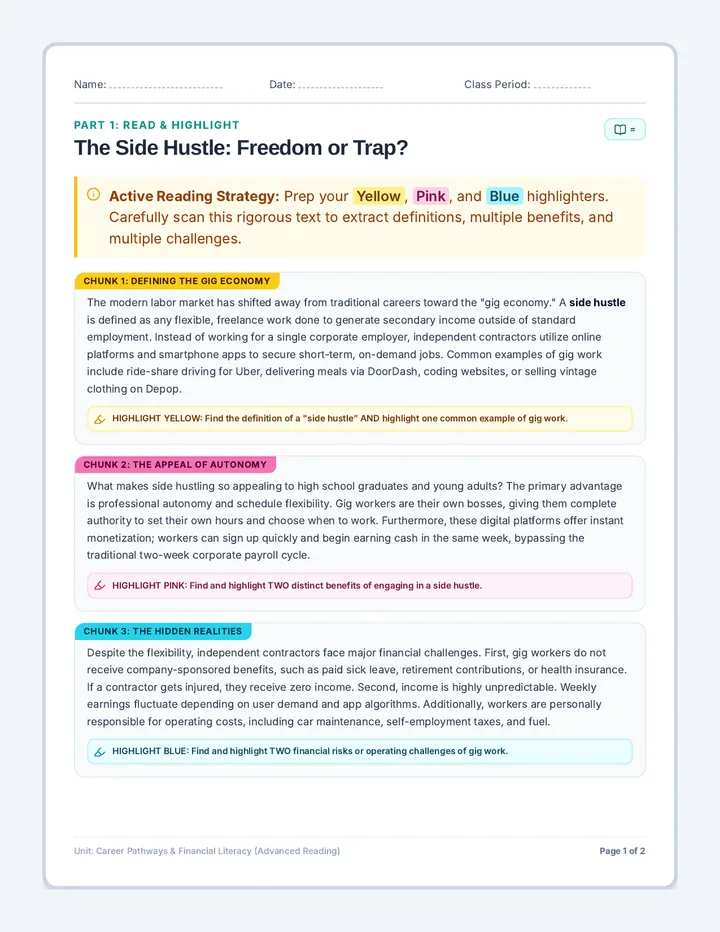
The Side Hustle: Freedom or Trap?
=
Active Reading Strategy: Prep your Yellow, Pink, and Blue highlighters. Carefully scan this rigorous text to extract definitions, multiple benefits, and multiple challenges.
Chunk 1: Defining the Gig Economy
The modern labor market has shifted away from traditional careers toward the "gig economy." A side hustle is defined as any flexible, freelance work done to generate secondary income outside of standard employment. Instead of working for a single corporate employer, independent contractors utilize online platforms and smartphone apps to secure short-term, on-demand jobs. Common examples of gig work include ride-share driving for Uber, delivering meals via DoorDash, coding websites, or selling vintage clothing on Depop.
HIGHLIGHT YELLOW: Find the definition of a "side hustle" AND highlight one common example of gig work.
Chunk 2: The Appeal of Autonomy
What makes side hustling so appealing to high school graduates and young adults? The primary advantage is professional autonomy and schedule flexibility. Gig workers are their own bosses, giving them complete authority to set their own hours and choose when to work. Furthermore, these digital platforms offer instant monetization; workers can sign up quickly and begin earning cash in the same week, bypassing the traditional two-week corporate payroll cycle.
HIGHLIGHT PINK: Find and highlight TWO distinct benefits of engaging in a side hustle.
Chunk 3: The Hidden Realities
Despite the flexibility, independent contractors face major financial challenges. First, gig workers do not receive company-sponsored benefits, such as paid sick leave, retirement contributions, or health insurance. If a contractor gets injured, they receive zero income. Second, income is highly unpredictable. Weekly earnings fluctuate depending on user demand and app algorithms. Additionally, workers are personally responsible for operating costs, including car maintenance, self-employment taxes, and fuel.
HIGHLIGHT BLUE: Find and highlight TWO financial risks or operating challenges of gig work.
Unit: Career Pathways & Financial Literacy (Advanced Reading) Page 1 of 2
Name:
Date:
Class Period:
Part 2: Build Your Proof
The Evidence Organizer & Synthesis
Definition & Example (Yellow) Chunk 1
A side hustle is defined as
One common example of gig work is
Two Benefits (Pink) Chunk 2
Benefit 1: One primary advantage of side hustles is
Benefit 2: A second benefit highlighted in the text is
Two Challenges (Blue) Chunk 3
Challenge 1: One significant financial risk of gig work is
Challenge 2: Gig workers are also personally responsible for
Part 3: Personal Synthesis Connection Real-World Reflection
Think about your own hobbies, skills, or interests (like gaming, art, driving, sports, or cooking). If you had to start a side hustle today, what would it look like for you?
If I started a side hustle, I would choose to because I am interested in .
One challenge or risk I would need to prepare for is .
Goal: Synthesize text concepts to outline your own realistic career options! Page 2 of 2
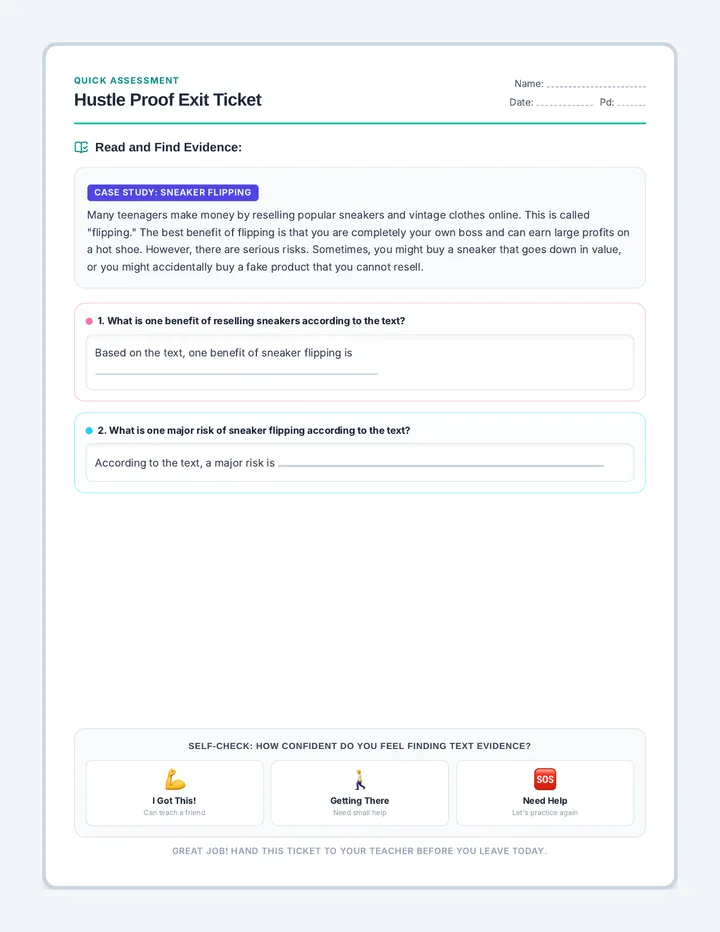
Hustle Proof Exit Ticket
Quick Assessment
Hustle Proof Exit Ticket
Name:
Date:
Pd:
Read and Find Evidence:
Case Study: Sneaker Flipping
Many teenagers make money by reselling popular sneakers and vintage clothes online. This is called "flipping." The best benefit of flipping is that you are completely your own boss and can earn large profits on a hot shoe. However, there are serious risks. Sometimes, you might buy a sneaker that goes down in value, or you might accidentally buy a fake product that you cannot resell.
1. What is one benefit of reselling sneakers according to the text?
Based on the text, one benefit of sneaker flipping is
2. What is one major risk of sneaker flipping according to the text?
According to the text, a major risk is
Self-Check: How confident do you feel finding text evidence?
💪 I Got This! Can teach a friend
🚶 Getting There Need small help
🆘 Need Help Let's practice again
Great Job! Hand this ticket to your teacher before you leave today.
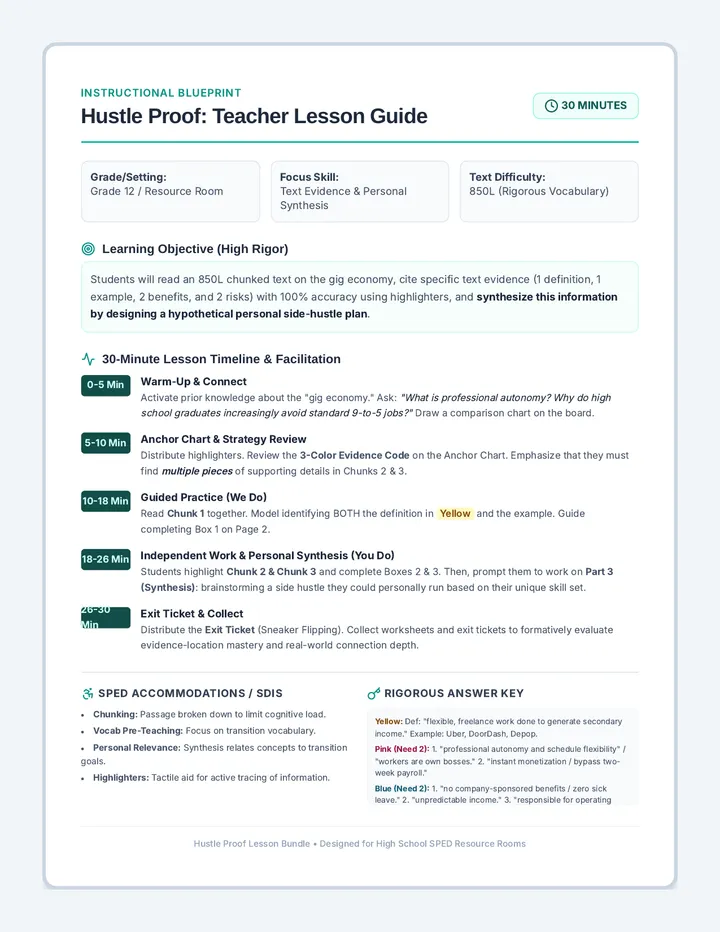
Hustle Proof Teacher Guide
Instructional Blueprint
Hustle Proof: Teacher Lesson Guide
30 Minutes
Grade/Setting: Grade 12 / Resource Room
Focus Skill: Text Evidence & Personal Synthesis
Text Difficulty: 850L (Rigorous Vocabulary)
Learning Objective (High Rigor)
Students will read an 850L chunked text on the gig economy, cite specific text evidence (1 definition, 1 example, 2 benefits, and 2 risks) with 100% accuracy using highlighters, and synthesize this information by designing a hypothetical personal side-hustle plan.
30-Minute Lesson Timeline & Facilitation
0-5 Min
Warm-Up & Connect
Activate prior knowledge about the "gig economy." Ask: "What is professional autonomy? Why do high school graduates increasingly avoid standard 9-to-5 jobs?" Draw a comparison chart on the board.
5-10 Min
Anchor Chart & Strategy Review
Distribute highlighters. Review the 3-Color Evidence Code on the Anchor Chart. Emphasize that they must find multiple pieces of supporting details in Chunks 2 & 3.
10-18 Min
Guided Practice (We Do)
Read Chunk 1 together. Model identifying BOTH the definition in Yellow and the example. Guide completing Box 1 on Page 2.
18-26 Min
Independent Work & Personal Synthesis (You Do)
Students highlight Chunk 2 & Chunk 3 and complete Boxes 2 & 3. Then, prompt them to work on Part 3 (Synthesis): brainstorming a side hustle they could personally run based on their unique skill set.
26-30 Min
Exit Ticket & Collect
Distribute the Exit Ticket (Sneaker Flipping). Collect worksheets and exit tickets to formatively evaluate evidence-location mastery and real-world connection depth.
SPED Accommodations / SDIs
- Chunking: Passage broken down to limit cognitive load.
- Vocab Pre-Teaching: Focus on transition vocabulary.
- Personal Relevance: Synthesis relates concepts to transition goals.
- Highlighters: Tactile aid for active tracing of information.
Rigorous Answer Key
Yellow: Def: "flexible, freelance work done to generate secondary income." Example: Uber, DoorDash, Depop.
Pink (Need 2): 1. "professional autonomy and schedule flexibility" / "workers are own bosses." 2. "instant monetization / bypass two-week payroll."