Control Center Desk Cards ADHD Transition Support System
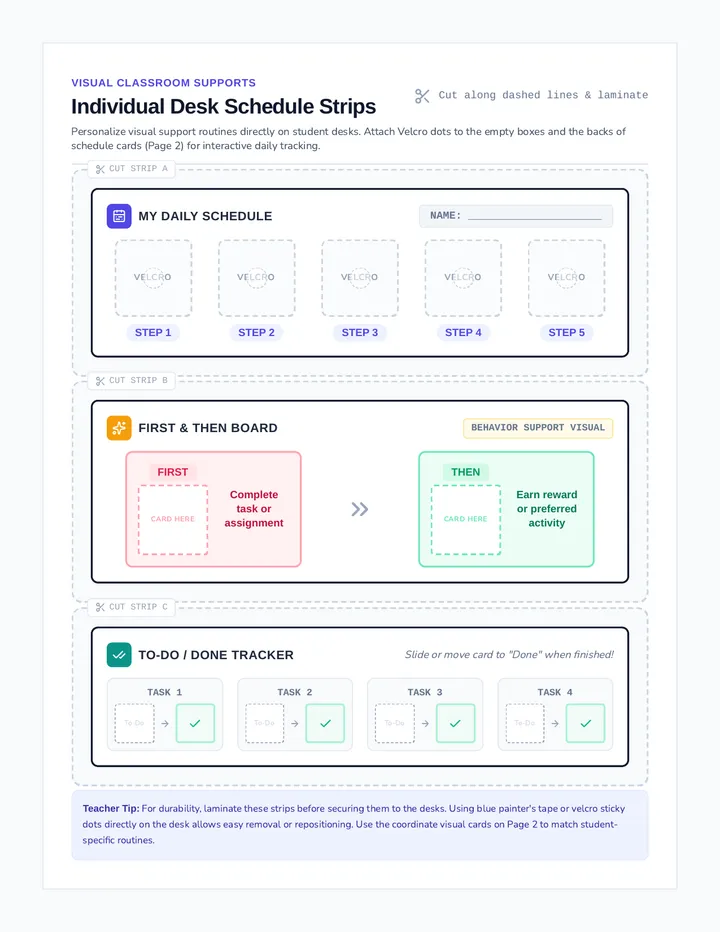
Cut along dotted lines to laminate individually, or use as a single desktop console sheet.
My Desk Control Panel
Internal Engine Status Check
Zones Navigation
Idle Blue
Low Energy
Tired, sad, bored, or slow response.
Reset Action:
Stretch, cold water, move.
Optimal Green
System OK
Focused, calm, positive, ready.
Reset Action:
Keep pace, support others.
Alert Yellow
High Temp
Anxious, hyper, jittery, frustrated.
Reset Action:
Somatic break, slow breath.
Overload Red
Critical Alert
Explosive, overwhelmed, out of control.
Reset Action:
Safe spot, silence, pause.
Somatic Sensory Anchor
Interrupt overwhelming thoughts by shifting concentration strictly to your physical surroundings.
5 Objects I can visually locate in this classroom
4 Tactile textures I can physically touch right now
3 Distinct noises I can isolate and hear
2 Scent elements I can identify around me
1 Deep physical belly breath to lock in concentration
Engine Cool-Down (Box Breath)
Slow your heart rate physically. Trace this box with your finger while pacing your breathing.
Inhale 4s
Hold 4s
Exhale 4s
Hold 4s
Trace & Pace
Cognitive Override Protocol (CBT Loop Interrupter)
01 / Trigger
The Spark
An event occurs (e.g., hard math test, loud hallway).
Notice what triggers you.
02 / Signal
The Alarm
Physical warnings: heavy chest, clenched fist, heat.
Identify physical warning signs.
03 / Override
The Switch
Change the mental loops: "I can step away. I am safe."
Choose a logical override phrase.
04 / Safe Launch
The Cool Down
Initiate proactive reset: walk to library, deep breathing.
Safely ground before explosive outbursts.
Personalized Override Dashboard
Laminate this sheet to write down customizable daily metrics with a fine dry-erase marker.
My Escape Spot:
Support Person:
New Horizons Transition Workbook New Horizons: Transition Workbook
Charting my path, finding my spaces, and managing my systems.
Student:
Date:
Internal Stress System Check (Scale 1-5)
Transitioning to a new school is a massive system upgrade. Rate how much each of these environmental triggers worries you (1 = Minimal Alarm, 5 = Critical Alert).
Navigating Hallways & Finding Classes Level: ____
1 2 3 4 5
Managing Loud Cafeteria / Social Spaces Level: ____
1 2 3 4 5
Processing Long Homework Assignments Level: ____
1 2 3 4 5
Classroom Speaking / Group Projects Level: ____
1 2 3 4 5
Mapping My Safe Zones
Knowing where to reset is critical to preventing over-escalation. Sketch a map or write details about your primary designated transition anchor zones (e.g., Guidance Counselor, Library Corner, Outdoor Benches, or Resource Office).
Anchor Location Plan (A/B)
Sketch a quick map of the path from your locker/main class to your safe zones.
Sketch Map or Paste Floor Plan Here
My Identified Calm Anchors
Detail your primary safe spaces & how you get permission to go there.
Primary Zone A (e.g., Counselor):
Backup Zone B (e.g., Library):
The Handover Rule (How to request walk):
Self-Regulation Principle: Spotting patterns early prevents sudden outbursts. An outburst is often an executive system overload. Checking your status hourly makes you the driver of your engine.
Self-Advocacy & Trigger Override Plans
Developing professional tools to articulate my sensory and processing limits.
Workbook • Page 2
My Trigger Codes (What Sparks Overload?)
We can stop outbursts before they occur by knowing our trigger codes. Check the items below that represent your personal sparks:
Vague/Ambiguous Instructions Not knowing what step to take next.
Sensory / Loud Noise Spikes Class transitions, fire drills, screaming.
Unexpected Time Shifts Pop quizzes, changing teachers, schedule swaps.
Feeling Put on the Spot Unprepared public speaking or cold-calling.
Perceived Criticism / Failures Making math mistakes, low marks on tests.
Uncomfortable Seating / Lighting Bright fluorescent lights, squeaky desks.
My Self-Advocacy Scripts
Expressing overwhelm out loud is very difficult during high stress. Fill in these "Advocacy Pass cards" to help communicate your requests instantly and non-verbally with teachers.
Pass Option A: Sensory break
"Teacher, right now my sensory engine is in the Yellow/Red Zone. I need to activate a 3-minute sensory cooldown by walking to:"
Co-Pilot Safety Blueprint Co-Pilot Safety Blueprint
Collaborative Crisis Prevention & Restorative Protocol
Student-Educator Compact
Co-Pilot (Student):
Navigator (Educator):
Emergency Safe Space:
Escalation Phase Interventions (The Safety Plan)
Phase 1: Green Zone • Normal Processing
Student routine: Actively checks status dashboard hourly. Educator action: Delivers explicit instructions; checks understanding; provides visual agendas.
Phase 2: Yellow Zone • Rising Temp (Agitation / Restlessness)
Student routine: Initiates Somatic Grounding or Box Breathing. Educator action: Prompts the student to reference their desk control panel non-verbally; offers option to use sensory passes.
Phase 3: Red Zone • Critical Overload (Outburst Imminent)
Student routine: Silently exits to the designated "Emergency Safe Space" using the physical pass. Educator action: Grants instant exit without negotiation. Avoids direct physical blocks, loud commands, or arguing.
Collaborative Post-Crisis Reflection (Restorative CBT)
Completed collaboratively *only* when the student's engine has cooled down fully to Green or Blue. The objective is system repair and analysis, not punishment.
1. Trigger Analysis: What event sparked the power surge?
Identify the moment things became unmanageable (e.g., tough lesson, noisy space, feeling ignored).
2. Somatic Clues: What physical warning signs did we miss?
Describe physical warnings (clenched teeth, racing heart, fast breath, feeling warm).
3. Environmental Check: What can the educator adjust?
Suggest changes to the physical environment or communication structure to prevent a reoccurrence.
4. Restoration: How can we repair social/academic systems?
Detail plans to make up work or apologize to classmates to restore mutual respect.
System Restored & Ready
"We agree to respect this blueprint. The safety plan holds during crises. The restorative protocol holds during cool-downs."
Student
Educator
Date