Flight Director Manual Flight Director Manual
Mission Control: 9-Week Executive Functioning Curriculum
Target Grade
Grade 9
Curriculum Intent
This program is designed for students whose academic challenges stem from **Executive Functioning (EF)** deficits rather than intentional defiance. By framing these skills as "Mission Control" for the brain, we reduce stigma and empower students to view their struggles as technical glitches that require specific protocols to solve.
Session Specs
Duration: 20 MinutesFrequency: 2x Per WeekTotal Weeks: 9 Weeks
Target Competencies
Initiation
Planning
Engagement
Monitoring
Advocacy
Mission Timeline (Weeks 1-5)
Week Session 1 (Content & Strategy) Session 2 (Practice & Reflection) 1 Pilot School Intro to EF: "The Pilot vs. The Plane." Self-assessment of strengths. Task Initiation Hack: The 2-Minute Launch Protocol. 2 Fuel Cells Energy mapping. When is my brain most "online"? Pomodoro Intro: Setting visual timers for short bursts. 3 Flight Paths "Backwards Design": Start at the deadline and work back. Graphic Organizer: The "Project Breakdown" Worksheet. 4 Sensor Array Internal vs. External distractors. Identifying "Flight Noise." The Focus Check-in: Self-monitoring every 5 minutes. 5 Ejection Seat Recognizing the "Yellow Alert" (frustration). Role-play: Requesting a 2-minute "Reset Break" professionally.
Mission Timeline (Weeks 6-9)
Week Session 1 (Content & Strategy) Session 2 (Practice & Reflection) 6 Turbulence Training The "Wall of Awful": Why some tasks feel impossible. Problem-solving case studies: Dealing with confusing directions. 7 Navigation Logs Note-taking for fast brains: Visual mapping and keywords. Live Lab: Practice note-taking during a 5-minute video. 8 Simulations Master Scenario: A teacher gives 3 tasks at once. What now? Simulation: Balancing work and a loud environment. 9 Certification Review of personal "Cheat Sheets" and best strategies. The Graduation Debrief: Sustaining these habits in 10th grade.
The "Quick Start"
Always begin each session with a 1-minute "Mindful Boot-up." Have the student take 3 deep breaths or name 3 things they see. This signals to the brain that the session has begun, aiding task initiation.
Scripting
When doing role-plays, provide the student with "Script Cards." For 9th graders, knowing *exactly* what to say reduces the social anxiety of asking for help or a break.
Pilot Logbook Workbook Mission Control
Pilot
Logbook
The Personal Flight Manual for Executive Functioning & Success.
Pilot Name
_________________________
Launch Date
_________________________
Week 01
Pilot School
The "Activation Gap"
The hardest part of a mission is often the first 30 seconds of liftoff. This is called the "Activation Gap." It's not laziness—it's your brain's engine needing a specific sequence to fire up.
What does it feel like when you can't "start"? (Check all that apply)
Brain feels "fuzzy"
Thinking about how hard it is
Staring at the page
Distracted by phone/room
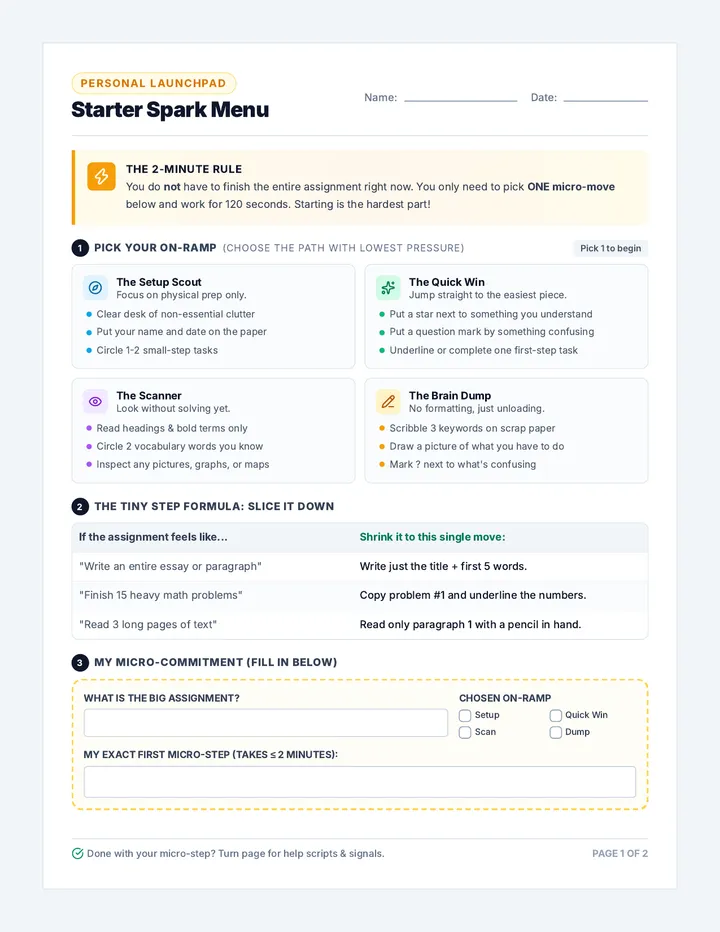
The 2-Minute Launch Protocol
1
Set a timer for 120 seconds.
You only have to work for 2 minutes. You can quit after that if you want.
2
Do the "micro-task."
Example: Don't "write the essay," just "open the document and type the title."
My First "Micro-Task" for Today:
Week 03
Flight Paths
Backwards Mapping
Big projects are like deep space missions. We can't see the end from the start. We have to map the path backward from the deadline.
Target Date (The Deadline)
Step 3: Final Polish
Checking for errors, formatting, submitting.
Step 2: The Main Engine
Drafting, researching, or building the project.
Step 1: Launch Prep (Start Today)
What is the very first tiny thing I need?
Mission Control Intro Slides Level 01
Mission
Control
Taking command of your brain's navigation system.
01 Who's Flying the Plane?
The Engine
This is your intelligence, your creativity, and your skills. It's powerful.
Mission Control
This is Executive Functioning . It decides where to fly, when to takeoff, and how to stay on course.
Even the best engine can't fly without a Pilot.
Executive function is the "Pilot" of your brain.
Liftoff Protocols
How to beat the "Activation Gap"
The 2-Min Rule
Commit to only 120 seconds. Anyone can do anything for 2 minutes.
Micro-Tasks
Don't write the essay. Just write the title. Shrink the task.
Clean Deck
Clear your desk of 1 distractor before you begin. Clear eyes, clear flight.
Mission Check: Which protocol will you try today?
Pilot Protocol Cards Pilot Quick-Cards
Handy desk references for Mission Control protocols.
Teacher Note: Cut these cards out and laminate them. Have the student keep them in their binder or taped to their desk. They provide "scripts" and "reminders" for moments when the student's executive function is low and they need a quick protocol to follow.
Emergency Protocol
Requesting a Reset
Use this when you feel frustrated or "stuck"
"Excuse me [Teacher Name], I am feeling a bit frustrated and stuck. Can I take a 2-minute reset break to clear my head? I'll be back at my desk in 2 minutes to try again."
Set a timer on your watch/phone
Drink water or do 3 box-breaths
Launch Protocol
The 2-Minute Push
Use this when you can't start a task
STEP 1 Clear the deck (1 distractor gone)
STEP 2 Identify 1 MICRO-TASK
STEP 3 Set timer for 120 seconds & GO
"Just 120 seconds. That's all."
Navigation Check
Internal Radar Check
Ask yourself these 3 questions every 10 mins
Eyes: Where are they?
Are they on my work or something else?
Mind: Where is it?
Am I thinking about the task or a daydream?
Action: Am I moving closer?
Is what I'm doing right now helping finish?
System Log
Interactive Log-In
How to take notes when things move fast
1. NO SENTENCES
Use keywords and symbols. (e.g., & for 'and', @ for 'at', ? for 'confused')
2. VISUALS
Draw circles around big ideas. Use arrows to show how things connect.
3. THE "GOLD NUGGET"
What is the 1 thing the teacher definitely wants me to know?
Turbulence Training Scenarios Worksheet Mission: Turbulence Training
Problem-Solving Case Studies & Role-Play Scenarios
Case File 01
The "Wall of Awful"
Sometimes, even a simple task like "open your book" feels impossible. It's not because you're lazy—it's because you've built a **Wall of Awful** out of past failures, frustration, and fear. To get over it, you don't need "motivation," you need a **CLIMBING TOOL**.
Scenario A: The Confusing Command
"The teacher just explained a 3-step project. You were listening, but your brain 'glitched' during Step 2. Now everyone is working, and you have no idea what to do next. You feel your face getting hot and you want to put your head down."
The Crash (What NOT to do)
Avoid the task, pull out your phone, or tell the teacher "I don't care about this."
The Climb (Pilot Protocol)
Use the "Requesting Info" script. Ask a peer or the teacher: "I missed the second step, could you repeat that?"
My Problem-Solving Plan:
Scenario B: The Loud Hangar
"You are in a group project. Two people are talking about a movie, and one is actually working. You want to help, but the noise makes it impossible to focus. You are starting to feel annoyed at your group."
The Crash
Get angry and yell at them to shut up, or leave the group without saying anything.
The Climb
Put on noise-canceling headphones (if allowed) or say: "Hey guys, I'm having a hard time focusing on this part. Can we save the movie talk for lunch?"
My Problem-Solving Plan:
Mission Debrief
Think of a time this week you hit the "Wall of Awful." What happened?