Topic Spotters Slide Deck Meaning Detectives • Mission 1
Speech & Language Group
What is a Topic?
Learn how to catch the 1 or 2 words that tell who or what the whole text is about.
👀 Look for Repeated Words
☂️ The Big Umbrella
🗣️ Say It in 1-2 Words
RULE
The Topic is the Umbrella
Visual Anchor
A TOPIC IS...
• Only 1 or 2 words
• The broad who or what
• Names the general subject
Example:
"Volcanoes"
A TOPIC IS NOT...
• A full sentence
• A tiny detail or fact
• An opinion or feeling
Non-Example (Too Long):
"Volcanoes erupt with hot melted lava and ash."
Detective Word-Check: Count on your fingers: 1 word or 2 words only! 🖐️
STRATEGY
3 Clues to Spot the Topic
Detective Toolkit
1
Title Clue
Look at the headline or title at the top. The topic is usually right there!
Title: "All About Dolphins"
2
Repeated Words
What word does the author repeat again and again throughout the text?
Word echoes: "dolphins... dolphins"
3
First Sentence
Check the very first sentence. Who or what does it introduce first?
"Dolphins are intelligent ocean mammals..."
🎯 The Golden Question: Ask yourself, "Who or what is this whole text talking about?"
SPEAK
Our Speech Turn Routine
Structured Practice
👂
1. Listen & Read
Keep eyes on the clues while the passage is read aloud.
🤔
2. Think & Count
Identify the topic. Check: is it 1 or 2 words only?
🎤
3. Say Your Frame
Use our speech frame when it is your designated turn.
Official Speech Sentence Starter:
"The topic is [ 1 or 2 words ]."
PRACTICE
Detective Challenge: Name the Topic
Group Trial
Read the Clues:
"Sea turtles are large reptiles that live in warm oceans. Sea turtles swim thousands of miles each year. Mother sea turtles crawl onto sandy beaches to lay their eggs."
Repeated word alert: Sea turtles (3 times!)
OPTION A Sea turtles lay eggs on the beach.
Too long! (Sentence)
OPTION B Sea turtles
✓ 2 words (Topic!)
Topic Spotters Student Pack Meaning Detectives • Level 1
Topic Spotters Practice
Name:
Date:
☂️
TOPIC RULE: Only 1 or 2 Words!
The topic is the big umbrella. It tells the general WHO or WHAT the text is about.
Finger Count 1 or 2 Words Max 🖐️
Part A: Read and Find the Topic (Who or What?)
Passage 1 Clue: Look for repeated words
"Honeybees live together in huge nests called hives. Honeybees fly from flower to flower gathering sweet nectar. When honeybees return home, they make sweet honey."
Circle the best Topic (1-2 words only):
A) Honeybees
B) How hives work
C) Bees make sweet honey in summer
Passage 2 Clue: Check the first sentence
"Skateboarding is a popular sport around the world. Many riders practice skateboarding tricks at local concrete parks. Wearing a helmet keeps riders safe during skateboarding."
Circle the best Topic (1-2 words only):
A) Helmets keep riders safe
B) Skateboarding
C) Doing cool tricks at parks
Passage 3 Clue: Who or what is the subject?
"Tornadoes are powerful spinning columns of wind. Tornadoes can touch down during severe thunderstorms. When a tornado warning sounds, people move into a storm shelter."
Circle the best Topic (1-2 words only):
A) Moving into storm shelters
B) Tornadoes
C) Powerful storms happen in spring
🗣️
Speech Practice Sentence Frame: "I read Passage ___. The topic is [ 1 or 2 words ] because it tells who or what."
Say Aloud
Meaning Detectives • Level 1
Topic Sort & Speech Talk
Name:
Date:
🎯 Goal: Test each card. Is it 1-2 words (TOPIC) or a full sentence (NOT A TOPIC)? Check YES or NO
Detective Card (Read Aloud) Word Count Is it a TOPIC? Why or Why Not? 1. "Outer space" 2 words YES NO It names the broad what in 2 words. 2. "Astronauts explore planets in space." 5 words YES NO Too long; it is a whole sentence. 3. "Penguins" 1 word YES NO Short umbrella word (who).
Topic Spotters Speech Guide SLP Clinical Guide • Lesson 1
Topic Spotters Facilitation Plan
Target Population Grade 6 • ASD & Language Disorders
Targeted Speech & Language Objectives
Expressive / Receptive Language:
Given a short informational passage and visual anchors, student will state or identify the topic in 1-2 words across 4 of 5 trials with 80% accuracy.
Pragmatics & Discourse:
During peer speech rounds, student will wait for their conversational turn and utilize the designated sentence frame with ≤1 visual cue.
30-Minute Group Session Roadmap
5 MIN
Warm-Up & Metaphor Introduction:
Display Slide 1-2. Hold up an actual umbrella or point to the visual. Explain: "An umbrella covers everything underneath. A topic covers the whole text, but it only takes 1 or 2 words!"
10 MIN
Direct Modeling & The 3 Clues:
Review Slide 3. Teach finger counting: count words on fingers immediately after speaking to self-monitor word count limit (stopping run-on explanations common in ASD).
10 MIN
Structured Oral Practice & Sorting:
Distribute Student Pack. Guide students through Passages 1-3. Require each student to vocalize the frame: "The topic is ___." Rotate speaker/checker roles on Page 2.
5 MIN
Quick Check & Data Logging:
Administer self-rating and log prompt levels on data sheet. Praise specific behaviors (e.g., "Great job waiting for your turn and using 2 words!").
Visual & Verbal Cueing Hierarchy (Least to Most Support)
Level 0: Indep. Student answers with no assistance.
Level 1: Visual Cue Point to umbrella or hold up 1-2 fingers.
Level 2: Verbal Cue "Remember, who or what in only 2 words."
Level 3: Direct Model "The topic is Honeybees. Say Honeybees."
Meaning Detectives Series • Lesson 1 Facilitation Guide Page 1 of 2
SLP Clinical Guide • Lesson 1
Scripts & Answer Key
Clinical Reference
Clinical Scripting & Error Correction Routines
Common Error 1: Student states a full sentence or entire detail High Frequency
Student says: "Honeybees fly around flowers and make sweet honey for their hives."
SLP Correction Script: "You told me a lot of great facts! But hold on—remember our umbrella rule. Can you shrink all of that into just 1 or 2 words? Who was that whole sentence about? ... That's it, Honeybees !"
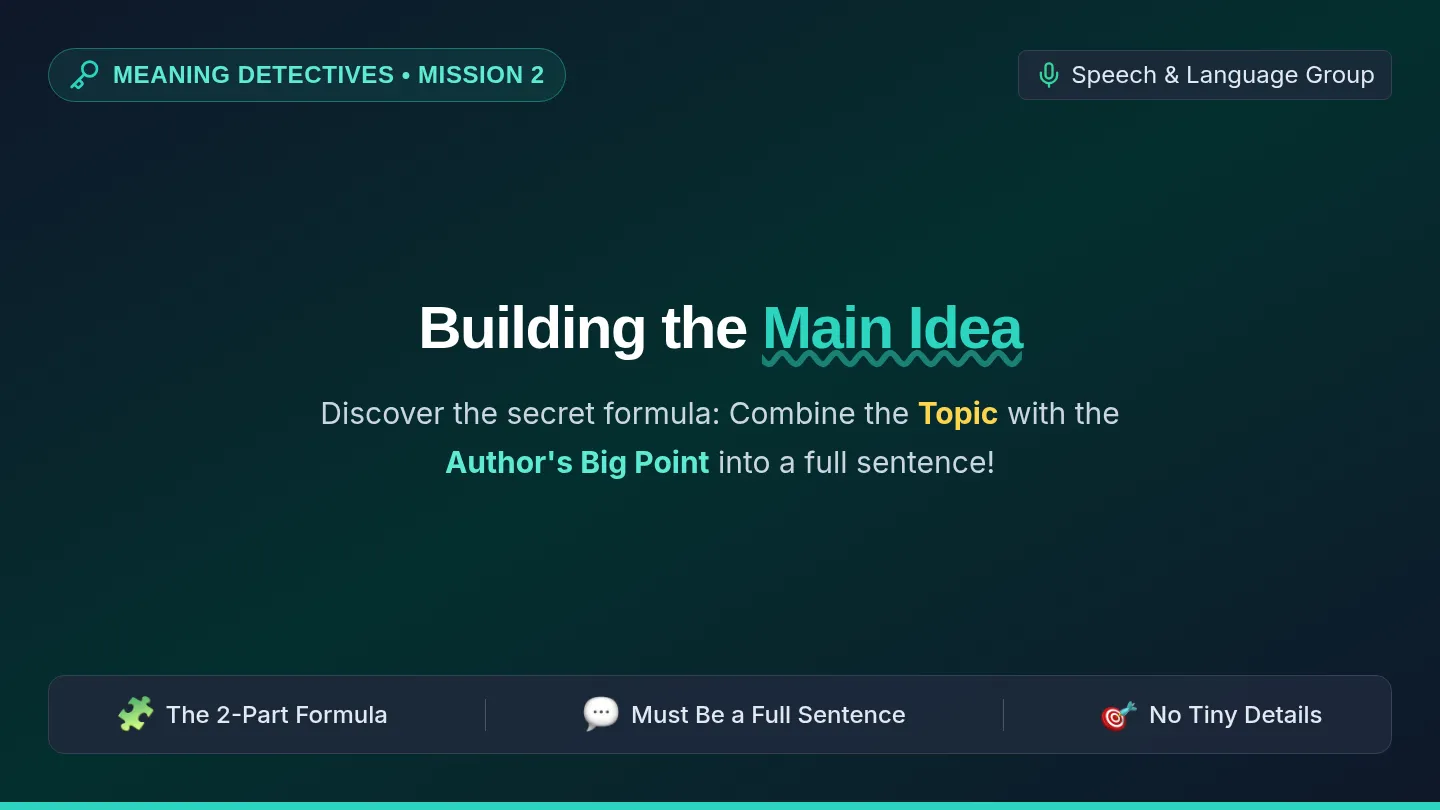
Main Idea Makers Slide Deck Meaning Detectives • Mission 2
Speech & Language Group
Building the Main Idea
Discover the secret formula: Combine the Topic with the Author's Big Point into a full sentence!
🧩 The 2-Part Formula
💬 Must Be a Full Sentence
🎯 No Tiny Details
FORMULA
The Main Idea Equation
Visual Blueprint
Part 1
TOPIC
Who or what (1-2 words)
Part 2
BIG POINT
What does the author want us to know about it?
=
Result
MAIN IDEA
One complete sentence!
In Action: "Bees" + "help plants grow by pollinating" = "Bees help plants grow by pollinating them."
Detective Test: Does it make a complete sentence on its own? If yes, it's a Main Idea! ✅
COMPARE
Spot the Difference
Side-by-Side
☂️
TOPIC
• Length: 1 or 2 words only
• Tells: WHO or WHAT
• Sentence? NO , just a label
Example:
"Exercise"
💡
MAIN IDEA
• Length: One full sentence
• Tells: Topic + Key Point
• Sentence? YES , complete thought
Example:
"Exercise keeps our heart and muscles strong."
Remember: A topic is a label . A main idea is a full message !
SPEAK
Pass the Detective Mic
Speech Routine
1️⃣
Speaker 1: Name Topic
Catch the 1-2 words that name who or what.
"The topic is [ ___ ]."
2️⃣
Speaker 2: Build Main Idea
Add the big point to make a complete sentence.
"The main idea is that [ Topic ] [ Big Point ]."
Turn-Taking Rule: Wait for your peer to finish before building your sentence!
CHALLENGE
Group Trial: Canine Helpers
Live Practice
Passage Clues: 3 Sentences
"Guide dogs are trained to assist people who are blind. Guide dogs safely guide their owners across busy streets and through crowded doorways. These devoted dogs give their human partners independence."
Main Idea Makers Practice Pack Meaning Detectives • Level 2
Main Idea Formula Builder
Name:
Date:
➕
The Detective Formula:
Topic (1-2 words) + Big Point = Main Idea (Full Sentence)
Complete Thought ✅
Part A: Read the Clues & Complete the Equation
Case 1 Subject: Caring for Earth
"Recycling paper and plastic saves natural resources. Recycling also cuts down on trash that goes into landfills. When communities recycle, they create a cleaner and healthier planet."
1. The Topic (1-2 words only):
2. What does author say about it?
3. Combined Main Idea (Full Sentence):
"The main idea is that recycling ."
Case 2 Subject: Ocean Exploration
"Deep-sea submersibles are special underwater craft that dive into the darkest ocean depths. These submersibles have thick steel walls that protect scientists from intense water pressure. They let researchers discover brand new sea creatures."
1. The Topic (1-2 words only):
2. What does author say about it?
3. Combined Main Idea (Full Sentence):
"The main idea is that deep-sea submersibles ."
🗣️ Speech Check: Read your finished Main Idea sentence out loud to your speech partner.
Page 1 of 2
Meaning Detectives • Level 2
Avoid the Detail Traps
Name:
Date:
⚠️
Detective Alert: Don't Get Trapped by Tiny Details!
A detail is true, but it only tells ONE small fact. The Main Idea covers the WHOLE text.
Part B: Select the Topic & the True Main Idea
Passage A: Desert Camels 3 Sentences
"Camels have unique body features that help them survive extreme desert heat. Their long double eyelashes shield their eyes from blowing sand. Camels can also store fat in their humps so they can travel for weeks without food or water."
1. Which is the TOPIC? (1-2 words only):
A) Camels have humps
B) Camels
C) Desert sand storms
2. Which is the MAIN IDEA? (Full sentence covering the whole text):
A) Camels have double eyelashes to block blowing sand. [Tiny Detail]
B) Camels have special body features that help them survive in the desert. [Main Idea]
C) Desert animals like to travel together. [Not in text]
Passage B: Library Programs 3 Sentences
"Public libraries offer many exciting services beyond borrowing books. Visitors can use high-speed computers, attend 3D-printing workshops, and join after-school gaming clubs. Libraries have become vibrant centers for learning new skills."
Main Idea Makers Speech Guide SLP Clinical Guide • Lesson 2
Main Idea Makers Facilitation Plan
Focus Target Syntactic Formulation & Detail Filtering
Clinical Rationale: The "Detail Hyper-Focus" in ASD
Autistic learners frequently exhibit weak central coherence , latching onto vivid or highly specific sensory details (e.g., camel eyelashes or 3D printers) rather than extracting the overarching global gestalt. The two-part formula provides an external executive function anchor to compel synthesis before oral expression.
30-Minute Group Session Roadmap
5 MIN
Quick Warm-Up & Topic Review:
Flash the Umbrella visual. Ask 2 quick warm-up questions (e.g., "What is the topic rule?" → "1 or 2 words!"). Remind students that topics are just the starting block.
10 MIN
Formula Introduction & Interactive Modeling:
Walk through Slides 2-3. Emphasize: [Topic] + [Big Point] = [Complete Sentence]. Model the "Pass the Mic" routine (Slide 4) with a co-therapist or student volunteer.
10 MIN
Guided Formula Practice & Trap Elimination:
Students open Practice Pack Page 1. Scaffold writing or dictating the 2 components. Transition to Page 2 to practice rejecting true but isolated minor details.
5 MIN
Oral Synthesis & Progress Logging:
Each student delivers their completed main idea sentence using the oral frame. Rate sentence syntax and semantic completeness on the IEP tracking rubric.
Scaffolded Cueing Levels for Sentence Formulation
Level 0: Indep. Formulates Topic + Big Point with no help.
Level 1: Visual Formula Points to formula equation graphic.
Level 2: Sentence Cloze "The main idea is that camels ___."
Level 3: Full Model SLP models entire sentence; student echoes.
Meaning Detectives Series • Lesson 2 Facilitation Guide Page 1 of 2
SLP Clinical Guide • Lesson 2
Scripts & Answer Key
Clinical Reference
Clinical Scripting: Busting the Detail Trap
Trap Scenario: Student picks an interesting but isolated fact Typical ASD Trap
Student says: "The main idea is that camels have double eyelashes."
SLP Rerouting Script: "Is that fact true? Yes, it is! But here is the detective test: does the whole passage talk only about eyelashes? No, it also talks about humps and desert heat. Eyelashes are just one clue leg. What big message holds all the legs together?"
Fragment Scenario: Student provides a predicate phrase without topic Syntax Deficit
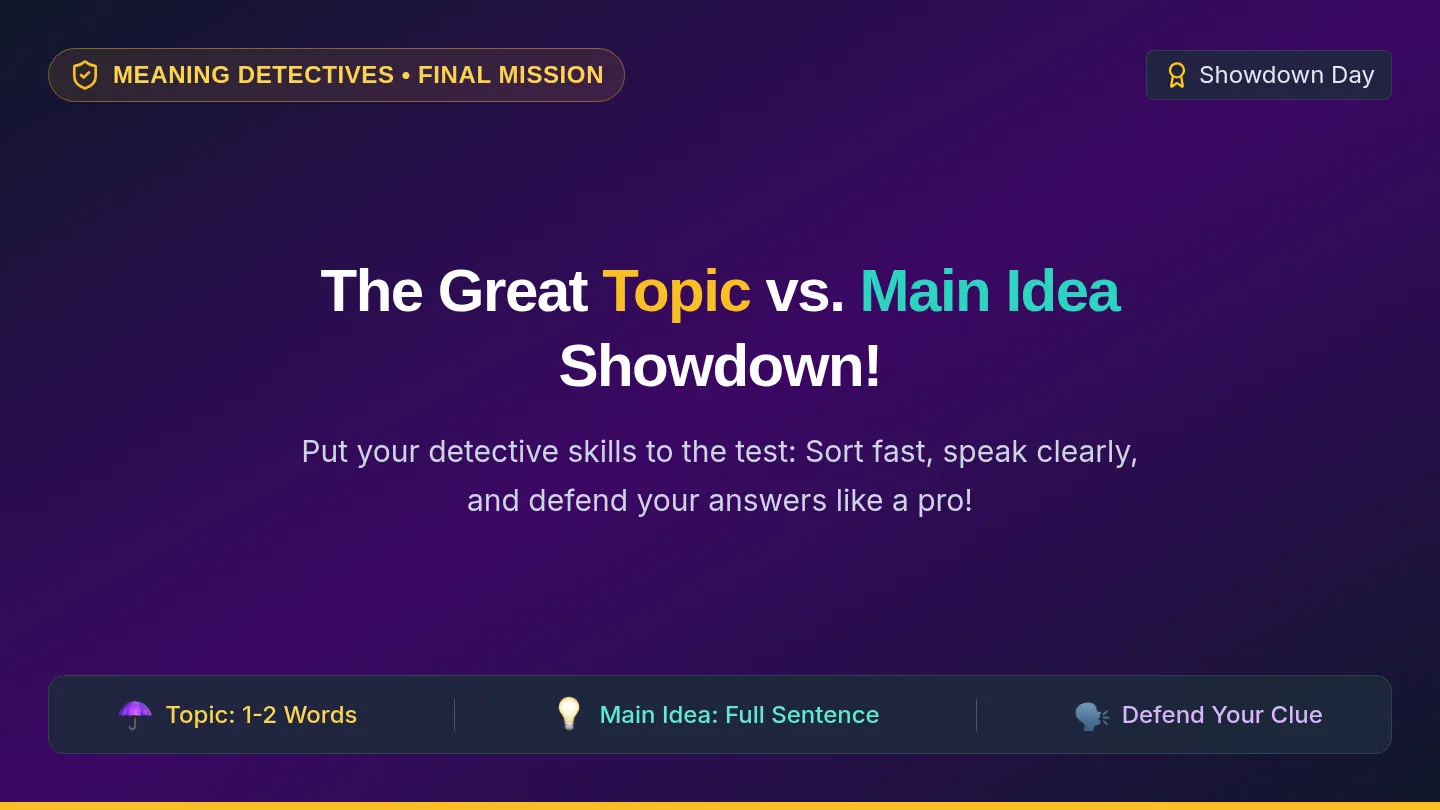
Concept Showdown Slide Deck Meaning Detectives • Final Mission
Showdown Day
The Great Topic vs. Main Idea Showdown!
Put your detective skills to the test: Sort fast, speak clearly, and defend your answers like a pro!
☂️ Topic: 1-2 Words
💡 Main Idea: Full Sentence
🗣️ Defend Your Clue
RULE MATRIX
The Ultimate Checklist
Quick Reference
Detective Clue
☂️ TOPIC
💡 MAIN IDEA
How long is it?
Only 1 or 2 words
One full complete sentence
What does it tell?
The general WHO or WHAT
Topic + Author's Big Point
Can it stand alone?
No, it is just a label
Yes, it expresses a full thought
Example:
"Mars rovers"
"Mars rovers explore the red planet to find signs of water."
⭐ First step on every trial: Count the words on your fingers!
ROUND 1
Rapid Fire Clue Test
Hold Up Your Card
Clue Card A:
"Solar energy"
Word Count: 2 words
THIS IS A TOPIC! ☂️
Clue Card B:
"Solar panels absorb sunlight to generate clean electricity for homes."
Structure: Full Sentence
THIS IS A MAIN IDEA! 💡
When your turn arrives, announce: "Topic" or "Main Idea" !
SPEAK
Defend Your Clue Frame
Structured Discourse
☂️
Defending a TOPIC:
"I know this clue is a topic because it is only 1 or 2 words and names the who or what."
Example: "Coral reefs" → 2 words only!
💡
Defending a MAIN IDEA:
"I know this clue is a main idea because it is a full sentence that connects topic + big point."
Example: "Coral reefs provide shelter for sea life."
Pragmatic Goal: Clear voice, eye contact with partner, and complete sentence defense!
Mission Accomplished
Master Meaning Detectives
🎓🔍
You Are Certified Meaning Detectives!
You now know how to catch the 1-2 word topic umbrella and build the complete main idea sentence anytime, anywhere!
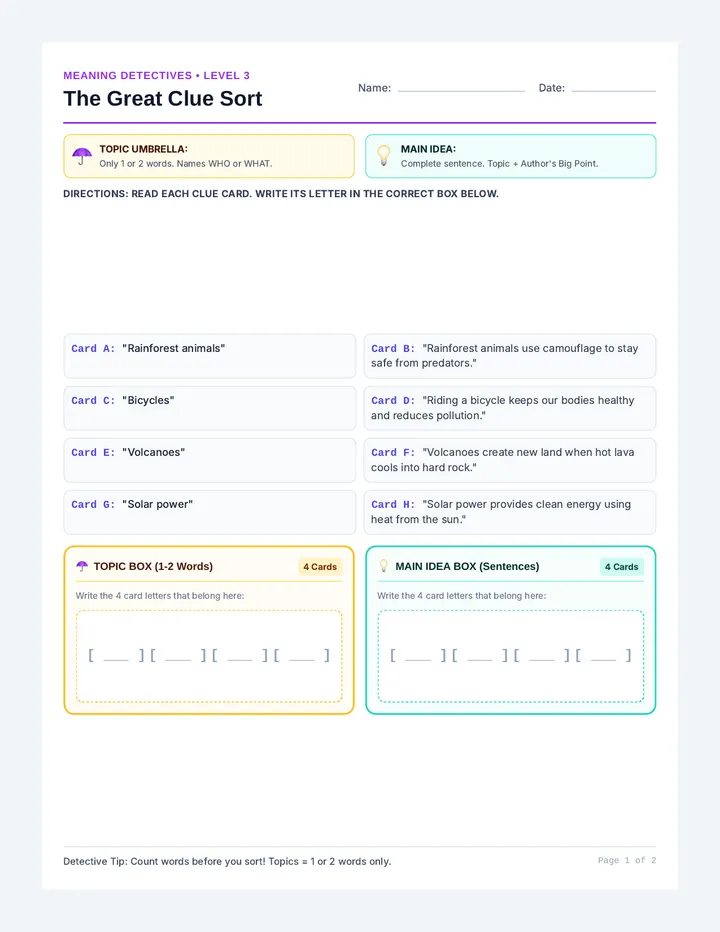
Discrimination Showdown Worksheet Meaning Detectives • Level 3
The Great Clue Sort
Name:
Date:
☂️
TOPIC UMBRELLA: Only 1 or 2 words. Names WHO or WHAT.
💡
MAIN IDEA: Complete sentence. Topic + Author's Big Point.
Directions: Read each clue card. Write its letter in the correct box below.
Card A: "Rainforest animals"
Card B: "Rainforest animals use camouflage to stay safe from predators."
Card C: "Bicycles"
Card D: "Riding a bicycle keeps our bodies healthy and reduces pollution."
Card E: "Volcanoes"
Card F: "Volcanoes create new land when hot lava cools into hard rock."
Card G: "Solar power"
Card H: "Solar power provides clean energy using heat from the sun."
☂️ TOPIC BOX (1-2 Words) 4 Cards
Write the 4 card letters that belong here:
[ ___ ] [ ___ ] [ ___ ] [ ___ ]
💡 MAIN IDEA BOX (Sentences) 4 Cards
Write the 4 card letters that belong here:
[ ___ ] [ ___ ] [ ___ ] [ ___ ]
Detective Tip: Count words before you sort! Topics = 1 or 2 words only. Page 1 of 2
Meaning Detectives • Level 3
Match & Defend Your Answer
Name:
Date:
Part A: Match Each Topic with its Full Main Idea
1. Volcanoes
→
A) Hardened cooled lava forms brand new land formations over time.
[ ___ ]
2. Bicycles
→
B) Riding on two wheels strengthens health and protects our air.
[ ___ ]
3. Solar power
→
C) Sunlight provides renewable electricity for buildings and homes.
[ ___ ]
4. Rainforest animals
→
D) Camouflage features help creatures hide from jungle danger.
[ ___ ]
🗣️
Part B: Speech Partner Defense Routine
Take 2 Turns Each
Speaker Defense Frame:
"I know clue [ A - H ] is a [Topic / Main Idea] because it is [ 1-2 words / a full sentence ]."
Checker Response Frame:
"I agree with your clue! It matches our detective rule because [ explain clue reason ]."
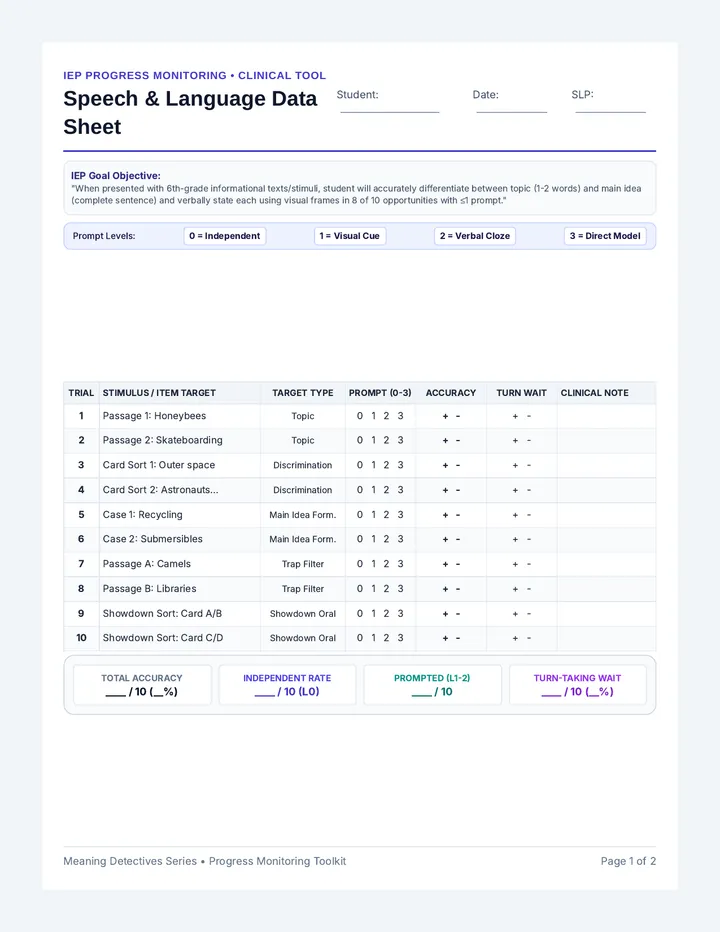
Progress Monitoring Toolkit IEP Progress Monitoring • Clinical Tool
Speech & Language Data Sheet
Student:
Date:
SLP:
IEP Goal Objective:
"When presented with 6th-grade informational texts/stimuli, student will accurately differentiate between topic (1-2 words) and main idea (complete sentence) and verbally state each using visual frames in 8 of 10 opportunities with ≤1 prompt."
Prompt Levels: 0 = Independent 1 = Visual Cue 2 = Verbal Cloze 3 = Direct Model
Trial Stimulus / Item Target Target Type Prompt (0-3) Accuracy Turn Wait Clinical Note 1 Passage 1: Honeybees Topic 0 1 2 3 + - + - 2 Passage 2: Skateboarding Topic 0 1 2 3 + - + - 3 Card Sort 1: Outer space Discrimination 0 1 2 3 + - + - 4 Card Sort 2: Astronauts... Discrimination 0 1 2 3 + - + - 5 Case 1: Recycling Main Idea Form. 0 1 2 3 + - + - 6 Case 2: Submersibles Main Idea Form. 0 1 2 3 + - + - 7 Passage A: Camels Trap Filter 0 1 2 3 + - + - 8 Passage B: Libraries Trap Filter 0 1 2 3 + - + - 9 Showdown Sort: Card A/B Showdown Oral 0 1 2 3 + - + - 10 Showdown Sort: Card C/D Showdown Oral 0 1 2 3 + - + -
Total Accuracy ____ / 10 (__%)
Independent Rate ____ / 10 (L0)
Prompted (L1-2) ____ / 10