Story Sleuths Slides Detail Detectives HQ • Lesson 1
Small Group Intervention
Narrative Clue Mission
Story Sleuths
Listen to the story read-aloud and crack the case by answering the 5 Key Detail Questions!
1 Listen Closely
•
2 Spot the Clues
•
3 Answer 3 of 5 for Mastery
Detective Toolkit
The 5 Clue Questions
Unlock Any Story
WHO?
Person or Animal
The character in the story
WHAT?
Action or Thing
The event, problem, or object
WHEN?
Time or Season
Morning, night, date, or year
WHERE?
Place or Setting
House, forest, school, ocean
HOW?
Way or Steps
The method or feeling
Goal: When you listen to the story, track these five clues in your mind!
Teacher Read-Aloud Case
The Mystery of the Midnight Whistle
Narrative Text
Late on Friday night, ten-year-old Maya and her sheepdog Bramble heard a high, shrill whistle echoing through Whispering Woods.
Maya grabbed her brass lantern and clicked it on. She discovered that a lost silver steam whistle was stuck inside an old hollow oak tree.
Maya solved the puzzle by gently using a curved willow branch to nudge the whistle loose so the wind stopped blowing through it.
Follow along as your teacher reads aloud. Did you hear all 5 clues?
Guided Investigation • Part 1
Cracking Clues 1 & 2
Small Group Discussion
?
Question 1: WHO
Who heard the mysterious shrill whistle?
Detective Clue Match:
Maya and her dog Bramble
?
Question 2: WHERE
Where did the sound echo?
Detective Clue Match:
In Whispering Woods
Look for the character (person/animal) and the setting (location)!
Guided Investigation • Part 2
Cracking Clues 3, 4 & 5
Connecting Details
?
WHAT
What did Maya find inside the oak tree?
A lost silver steam whistle
?
WHEN
When did Maya and Bramble hear it?
Late on Friday night
?
HOW
How did Maya nudge the whistle loose?
By using a curved willow branch
Remember: You need 3 out of 5 correct to pass each mission checkpoint!
Ready for Action
Individual • Small Group
Now It's Your Turn, Detectives!
Your teacher will read your printable case file aloud. Use your Story Sleuths Worksheet to record your answers.
Step 1
Listen Closely
Keep ears open as teacher reads
Step 2
Match Clue Words
Who, What, When, Where, How
Step 3
Target: 3 of 5
Score at least 3 to earn your badge
Detail Detectives Small Group Program Get ready with your pencil!
Story Sleuths Worksheet Detail Detectives • Case File #1
Narrative Read-Aloud Investigation
Name: ___________________
Date: _____________
WHO Person / Animal
WHAT Action / Thing
WHEN Time / Day
WHERE Place / Setting
HOW Way / Steps
Read-Aloud Story: The Lost Compass of Seabreeze Cove
Listen • Track Details
Early on Saturday morning, ten-year-old Mateo and his golden retriever, Sunny, ran down to the rocky shore of Seabreeze Cove. Mateo was searching for his grandfather’s vintage brass pocket compass, which had slipped out of his jacket during yesterday’s storm. The tide was low, revealing shiny wet seaweed and smooth tide pools. Sunny barked softly and trotted toward a narrow crevice between two large granite boulders. Mateo knelt down and carefully used a long wooden driftwood stick to slide the compass out from the narrow rocks without scratching the glass. He jumped for joy and hugged Sunny tightly.
QUESTION 1 • WHO Character Clue
1 point
Who went to the rocky shore to search for the compass?
Hint: Think about the person and animal who searched together.
QUESTION 2 • WHERE Setting Clue
1 point
Where did Mateo and Sunny go to find the compass?
Hint: What was the name of the place by the water?
Detail Detectives • Lesson 1 Narrative File Page 1 of 2
Case File #1 Continued: Solving the Remaining Clues
Student Name: ___________________
QUESTION 3 • WHAT Object / Event Clue
1 point
What item was Mateo trying to find in the rocks?
Hint: Describe the special lost object that belonged to his grandfather.
QUESTION 4 • WHEN Time Clue
1 point
When did Mateo and Sunny go down to the cove?
Hint: Look back at the time of day and the day of the week.
QUESTION 5 • HOW Process / Method Clue
1 point
How did Mateo get the compass out of the narrow rock crevice?
Hint: What tool or action did he use to slide it out?
Case File Scoring & Progress Monitoring
Target Goal: 3 out of 5 questions answered correctly
[ ] Met Target (3, 4, or 5/5) [ ] Needs Practice (0, 1, or 2/5)
Score ___ / 5
Detail Detectives • Lesson 1 Narrative File Page 2 of 2
Story Sleuths Teacher Guide Teacher Facilitation • Lesson 1
Story Sleuths Teacher Guide
Target Group: 3 Students (including Noe)
Target IEP Goal Benchmark
Given a grade-level text read aloud and a written prompt with 5 questions, the student answers at least 3 out of 5 questions correctly across progress monitoring probes.
Session Criteria: 3/5 correct (60% accuracy benchmark).
SDI 4-Tier Prompting Hierarchy
Tier 1 (Independent): Student writes response with no adult support.Tier 2 (Visual Prompt): Point to the color-coded clue box on worksheet.Tier 3 (Verbal Cue): "Remember, WHO means a person or an animal."Tier 4 (Reread Chunk): Reread only the single sentence containing the clue.
Read-Aloud Script with Interactive Pauses
Read at 110-120 WPM with expressive phrasing
"Early on Saturday morning, ten-year-old Mateo and his golden retriever, Sunny, ran down to the rocky shore of Seabreeze Cove." Teacher Pause 1: "Think to yourself: Did we just hear WHEN, WHO, and WHERE? Keep those in your clue bank!"
"Mateo was searching for his grandfather’s vintage brass pocket compass, which had slipped out of his jacket during yesterday’s storm. The tide was low, revealing shiny wet seaweed and smooth tide pools." Teacher Pause 2: "Ask: WHAT is the special object Mateo needs to find?"
"Sunny barked softly and trotted toward a narrow crevice between two large granite boulders. Mateo knelt down and carefully used a long wooden driftwood stick to slide the compass out from the narrow rocks without scratching the glass. He jumped for joy and hugged Sunny tightly." Teacher Pause 3: "Notice HOW Mateo got it out safely. What tool and action did he take?"
Answer Key & Acceptable Responses
Q1: WHO
Mateo (or Mateo and his dog Sunny)
Q2: WHERE
Seabreeze Cove (or rocky shore / boulders)
Q3: WHAT
A vintage brass pocket compass (or grandfather's compass)
Q4: WHEN
Saturday morning (or early morning)
Q5: HOW
By using a driftwood stick to slide it out
Detail Detectives • Lesson 1 Teacher Guide Page 1 of 2
IEP Data Collection System
Small Group Data Tracker • Session 1
Date: ______________ | Observer: __________________
Prompt Codes: IND = Independent • VIS = Visual Anchor • VERB = Verbal Prompt • MOD = Modeled
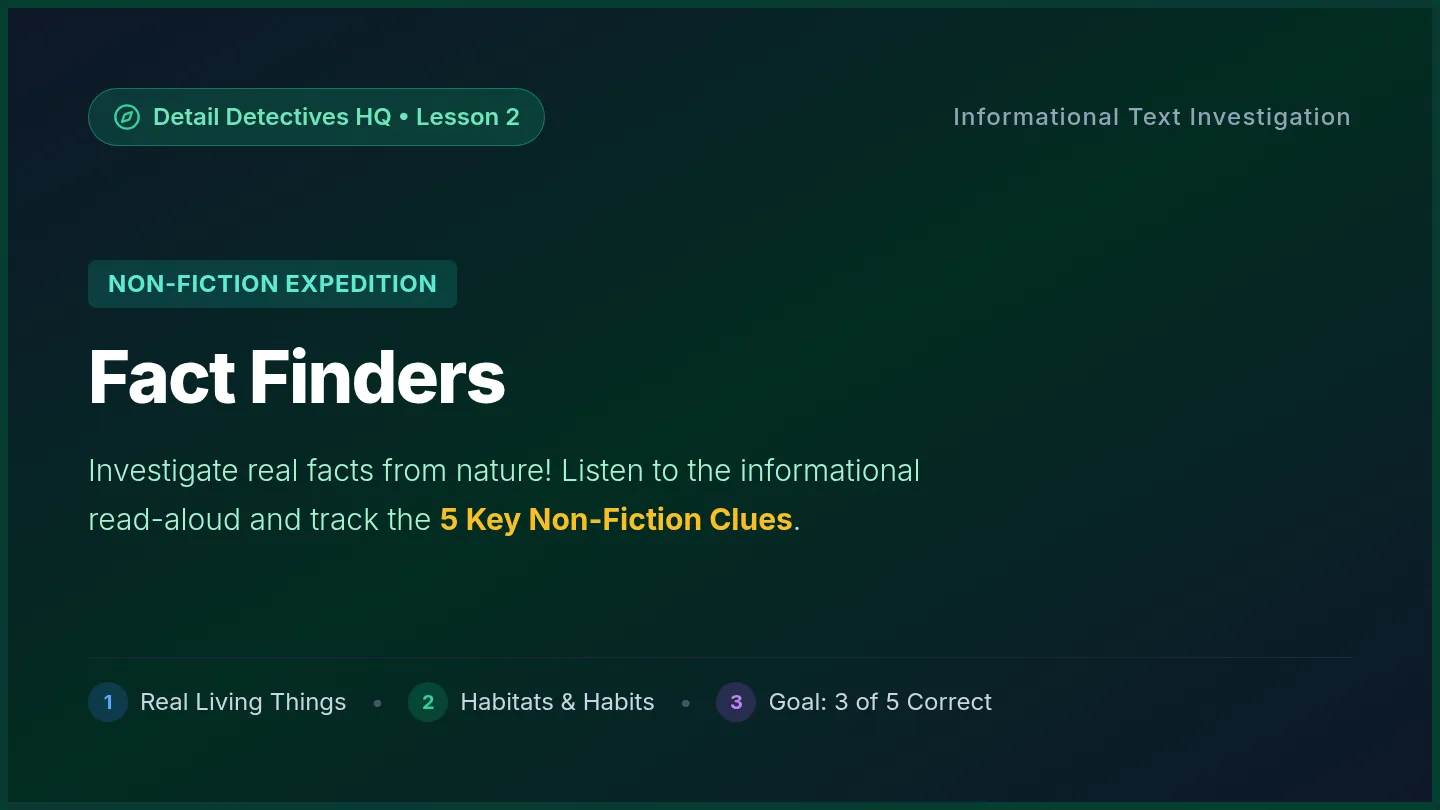
Fact Finders Slides Detail Detectives HQ • Lesson 2
Informational Text Investigation
Non-Fiction Expedition
Fact Finders
Investigate real facts from nature! Listen to the informational read-aloud and track the 5 Key Non-Fiction Clues.
1 Real Living Things
•
2 Habitats & Habits
•
3 Goal: 3 of 5 Correct
Clue Code Shift
Questions in Non-Fiction
True World Facts
WHO?
Animal or Person
The creature or scientist being studied
WHAT?
Action or Trait
What the creature builds, eats, or does
WHEN?
Season or Time
Daytime, winter, migration time
WHERE?
Habitat or Region
Ocean, pond, forest, tundra
HOW?
Method or Defense
How it survives, hides, or travels
Detective Tip: In science texts, WHO is often an incredible animal!
Informational Read-Aloud Demo
The Master of Ocean Disguise
Science Article
The Giant Pacific Octopus lives deep in the cold waters of the Pacific Ocean.
During the dark hours of the night, this clever hunter explores the seafloor for crabs and clams.
When hungry sharks swim close by, the octopus defends itself by rapidly squeezing pigment cells in its skin to transform its color and texture into a rough jagged stone.
Listen carefully as your teacher reads aloud. Can you identify all 5 non-fiction facts?
Fact Check • Small Group Talk
Reviewing the Octopus Clues
Evidence Match
WHO Giant Pacific Octopus
WHERE Pacific Ocean seafloor
WHEN During dark night hours
WHAT Hunts crabs and clams
HOW Squeezing skin pigment cells
All five questions answered directly from key details!
Notice how each question word connects to a specific piece of evidence in the text!
Mission Ready
Fact Finders Worksheet
Next Case: The Busy Beaver Builders!
Listen to the informational read-aloud about North American beavers. Record your answers on the Fact Finders Worksheet.
IEP Mastery Checkpoint:
Answer at least 3 out of 5 questions correctly to achieve your detective goal!
Detail Detectives Small Group Program Ready pencils and listening ears!
Fact Finders Worksheet Fact Finders • Case File #2
Informational Science Investigation
Name: ___________________
Date: _____________
WHO Animal / Person
WHAT Action / Trait
WHEN Season / Time
WHERE Habitat / Place
HOW Method / Process
Read-Aloud Article: Nature's Master Engineers
Informational Text
North American beavers are nature’s hardest working animal builders. These furry mammals make their homes across freshwater streams, rivers, and ponds in North America. During the crisp autumn months, beavers work tirelessly before the cold winter freezes the water. They build large wooden dams across fast-moving streams to create calm, deep ponds where their families will be safe from predators like wolves. Beavers cut down young birch and willow trees with their strong, orange chisel-like teeth. Then, they transport heavy rocks and sticky riverbed mud by tucking them firmly against their chests with their dexterous front paws.
QUESTION 1 • WHO Animal Subject Clue
1 point
Who is the hard-working animal builder described in the article?
Hint: Name the specific furry mammal species from the text.
QUESTION 2 • WHERE Habitat Setting Clue
1 point
Where do these animals build their homes?
Hint: Look for the freshwater water bodies mentioned in the passage.
Detail Detectives • Lesson 2 Informational File Page 1 of 2
Case File #2 Continued: Non-Fiction Clues
Student Name: ___________________
QUESTION 3 • WHAT Action / Structure Clue
1 point
What do beavers build across fast-moving streams?
Hint: What large wooden structure creates a calm pond?
QUESTION 4 • WHEN Season Clue
1 point
When do beavers work tirelessly before the water freezes?
Hint: Name the season of the year named in the text.
QUESTION 5 • HOW Method / Process Clue
1 point
How do beavers transport heavy rocks and sticky mud?
Hint: Explain how they hold the materials against their bodies.
Case File Scoring & Progress Monitoring
Target Goal: 3 out of 5 questions answered correctly
[ ] Met Target (3, 4, or 5/5) [ ] Needs Practice (0, 1, or 2/5)
Score ___ / 5
Detail Detectives • Lesson 2 Informational File Page 2 of 2
Fact Finders Teacher Guide Teacher Facilitation • Lesson 2
Fact Finders Teacher Guide
Target Group: 3 Students (including Noe)
Informational Text SDI Scaffolds
In non-fiction passages, students often confuse the subject (WHO ) with the animal's home (WHERE ). Provide explicit verbal contrast: "The beaver is the living builder (WHO), while the stream or pond is where they live (WHERE)."
Differentiating "WHAT" vs "HOW"
WHAT asks for the finished product or event (the wooden dam). HOW asks for the physical technique or steps used to do it (carrying rocks and mud against their chest with paws).
Read-Aloud Script with Interactive Pauses
Read with clear emphasis on science vocabulary
"North American beavers are nature’s hardest working animal builders. These furry mammals make their homes across freshwater streams, rivers, and ponds in North America." Teacher Pause 1: "Think: What creature are we learning about (WHO), and what watery environments do they live in (WHERE)?"
"During the crisp autumn months, beavers work tirelessly before the cold winter freezes the water. They build large wooden dams across fast-moving streams to create calm, deep ponds where their families will be safe from predators like wolves." Teacher Pause 2: "Notice the time of year (WHEN) and what they construct (WHAT)!"
"Beavers cut down young birch and willow trees with their strong, orange chisel-like teeth. Then, they transport heavy rocks and sticky riverbed mud by tucking them firmly against their chests with their dexterous front paws." Teacher Pause 3: "Spot HOW they carry heavy building supplies. Watch the physical actions!"
Answer Key & Acceptable Responses
Q1: WHO
North American beavers (or beavers)
Q2: WHERE
Freshwater streams, rivers, ponds
Q3: WHAT
Large wooden dams
Q4: WHEN
Autumn (or before winter freeze)
Q5: HOW
Tucking rocks/mud against chests with paws
Detail Detectives • Lesson 2 Teacher Guide Page 1 of 2
IEP Data Collection System
Small Group Data Tracker • Session 2
Date: ______________ | Observer: __________________
Prompt Codes: IND = Independent • VIS = Visual Anchor • VERB = Verbal Prompt • MOD = Modeled
Goal Target: ≥ 3 / 5 Correct
Question Detail Student 1: Noe (IEP Focus)
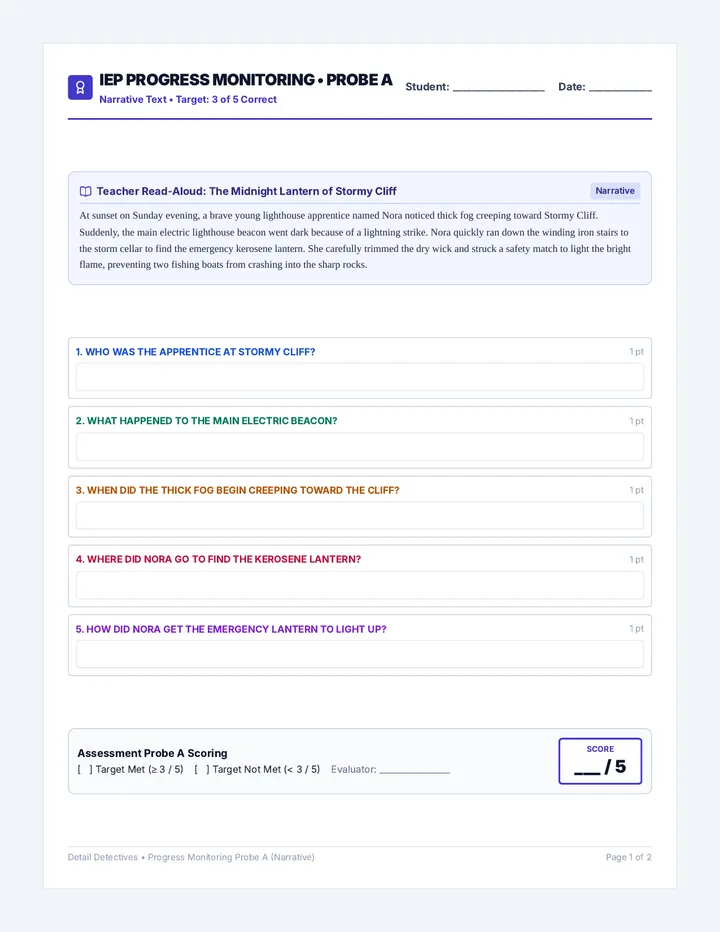
Progress Mastery Probes IEP Progress Monitoring • Probe A
Narrative Text • Target: 3 of 5 Correct
Student: ___________________
Date: _____________
Teacher Read-Aloud: The Midnight Lantern of Stormy Cliff Narrative
At sunset on Sunday evening, a brave young lighthouse apprentice named Nora noticed thick fog creeping toward Stormy Cliff. Suddenly, the main electric lighthouse beacon went dark because of a lightning strike. Nora quickly ran down the winding iron stairs to the storm cellar to find the emergency kerosene lantern. She carefully trimmed the dry wick and struck a safety match to light the bright flame, preventing two fishing boats from crashing into the sharp rocks.
1. WHO was the apprentice at Stormy Cliff? 1 pt
2. WHAT happened to the main electric beacon? 1 pt
3. WHEN did the thick fog begin creeping toward the cliff? 1 pt
4. WHERE did Nora go to find the kerosene lantern? 1 pt
5. HOW did Nora get the emergency lantern to light up? 1 pt
Assessment Probe A Scoring
[ ] Target Met (≥ 3 / 5) [ ] Target Not Met (< 3 / 5) Evaluator: ________________
Score ___ / 5
Detail Detectives • Progress Monitoring Probe A (Narrative) Page 1 of 2
IEP Progress Monitoring • Probe B
Informational Text • Target: 3 of 5 Correct
Student: ___________________
Date: _____________
Teacher Read-Aloud: The Desert Camel's Secret Armor Informational
Dromedary camels are large desert mammals that survive in the scorching sands of the Sahara Desert. In the middle of summer when temperatures exceed 115 degrees, finding fresh water is nearly impossible. To survive these harsh conditions, camels store dense fat inside their mounds to nourish their bodies for weeks without food. Camels protect their eyes from blowing sandstorms by blinking a clear third eyelid that sweeps across the eyeball like a windshield wiper.
1. WHO is the desert mammal described in the passage? 1 pt
2. WHAT do camels store inside their mounds for nourishment? 1 pt
3. WHEN do temperatures exceed 115 degrees in the passage? 1 pt
4. WHERE do these camels live and survive? 1 pt
5. HOW do camels protect their eyes from blowing sandstorms? 1 pt
Assessment Probe B Scoring
[ ] Target Met (≥ 3 / 5) [ ] Target Not Met (< 3 / 5) Evaluator: ________________
Score ___ / 5
Detail Detectives • Progress Monitoring Probe B (Informational) Page 2 of 2
Progress Tracker Guide Special Education IEP Toolkit
Progress Monitoring Log & Data Graph
Student: Noe (IEP Focus)
Annual Review Date: ______________
Formal IEP Goal Statement Criterion: 3/5 on 3/4 Probes
"By the next annual IEP, with specifically designed instruction, practice and feedback, after a grade level text is read aloud, and given a written prompt to answer 5 questions (i.e., who, what, when, where, how) about key details in the text, Noe will answer 3 out of 5 questions correctly, on 3 out of 4 progress monitoring assessments."
4-Cycle Progress Monitoring Record Goal Met = At least 3 probes ≥ 3/5
Probe # Date • Text Type Who What When Where How Score Goal Met? Probe 1 Date: _______ Narrative (Probe A) [ ] [ ] [ ] [ ] [ ] __/5 [ ] YES (≥3) [ ] NO (<3) Probe 2 Date: _______ Informational (Probe B) [ ] [ ] [ ] [ ] [ ] __/5 [ ] YES (≥3) [ ] NO (<3) Probe 3 Date: _______ Narrative Alternate [ ] [ ] [ ] [ ] [ ] __/5 [ ] YES (≥3) [ ] NO (<3) Probe 4 Date: _______ Informational Alternate [ ] [ ] [ ] [ ] [ ] __/5 [ ] YES (≥3) [ ] NO (<3)
Visual Progress Monitoring Chart
Plot data points (1 to 5) across assessment dates
5 (100%)
••••
4 (80%)
••••
3 (60%) ☆
——— IEP MASTERY THRESHOLD (TARGET LINE) ———
2 (40%)
••••