Cool Down Code Lesson Guide LEVEL 1
The COR Behavioral Group
June: Empathy & Support #1
Cool Down Code
Self-Regulation, Triggers & Cool-Down Breaks
Objective
Clients will identify personal physiological warnings of anger, practice 4-4-4-4 square breathing, and functionally request a cool-down break before escalation using gaming and media metaphors.
Materials
• Self-Regulation Anchor Chart
• Timer & Fortnite-Style "Shield/Reset" Cards
• Whiteboard / Markers
Group A Procedure
Transition clients to the main social skills group table. Seat them with partners. Review the group's "Safe Space" boundaries and open up with a discussion on popular competitive video games.
Introduction
Introduce "The Overheat Meter." Compare body warning signs (clenched fists, fast heart) to Anger's head catching fire in Disney's Inside Out or weapon overheating meters in Apex Legends or Fortnite .
Clarifying Questions:
When you get eliminated near the end of a match, what does your internal engine feel like?
How is a cool-down break like popping a "Shield Potion" in Fortnite?
Activity: Gaming Reset
Draw a 4x4 gaming gamepad boundary box on the board. Model and practice "Square Breathing" as a team "System Reboot": inhale 4s, hold 4s, exhale 4s, hold 4s. Repeat 3 times.
Next, have clients complete their individual Self-Regulation Anchor Charts to map out their custom level 1-5 physical warning meters.
Role Play #1: Structured Scenarios
Structured Task Cards
BCBA hands out role-play cards. Role-player A acts out the annoying prompt. Role-player B must identify one physical warning sign, say: "My overheat meter is rising, I need a quick reset," and do 2 square breaths.
A teammate "accidentally" destroys your legendary block build in Roblox.
Your partner snatches the Nintendo Switch controller right as you face a Legend of Zelda boss.
A peer spoils the massive twist ending of the latest Spider-Man or Marvel movie.
The BCBA calls "Minecraft/Console recreation time is officially over, power down."
A peer laughs at your custom-designed Roblox skin or anime character tier list.
Role Play #2: Interactive (Open-Ended)
The Overheated Co-Op
Scenario: Set up a cooperative multiplayer round of an active card game styled as "Among Us" or "Overcooked". Assign one peer role-player to act "toxic" (backseat-gaming, spamming "SUS" accusations, or blaming everyone for a game loss). Group members must play. If their internal heat reaches Level 3 or higher, they must tap their "Reset Card", stand up to do 3 rounds of Square Breathing, and restart.
Closure
Gather the group. Ask each client to identify their "Overheat Limit" warning signs and what video game character they resemble when they are fully chilled (Level 1).
BCBA Notes & Modification
For clients highly focused on gaming, use visual "Mana bars" or "Health gauges" to represent emotional levels.
Self Regulation Anchor Chart The Cool Down Code
Self-Regulation Anchor Chart
Clash Control System
My Internal Heat Levels
LVL 5
Exploding (Danger Zone)
Yelling, throwing, slamming doors, completely offline.
ACTION: Immediate break. Walk to safe zone.
LVL 4
Boiling (High Alert)
Clenched fists, fast breathing, mean comments, hot face.
ACTION: Request break. Say: "I need 2 minutes."
LVL 3
Simmering (Warning Signs)
Heavy breathing, eye-rolling, zoning out, muscle tension.
ACTION: Do 3 rounds of Square Breathing.
LVL 2
Alert (Slightly Annoyed)
Tapping feet, sighs, losing focus, thinking negative thoughts.
ACTION: Notice the trigger and change posture/stretch.
LVL 1
Chilled (Ready to Learn)
Relaxed muscles, listening, smiling, body is calm.
ACTION: Keep working. Keep being a team player.
Square Breathing
Trace the square with your finger to slow down your heart. Repeat 3 times.
Inhale (4s)
Hold (4s)
Exhale (4s)
Hold (4s)
"Feel your lungs expand and contract completely."
My Personal Signals
Write your personal physical alert signs in the fields below.
My Level 3 Physical Warning Sign:
My Go-To Coping Strategy:
Name:
Date:
CLASH CONTROL • L1
Coping Quest Board Game Cool Down Quest
The Reboot Board Game
Clash Control System • L1
How to Play: Use a coin (Heads = move 1, Tails = move 2) and small tokens (paperclips or bottlecaps). Players take turns traversing the track, executing the coping challenges, and earning Shield Potions (🛡️) to reboot their internal engines!
START
SYSTEM ONLINE
Engine at Level 1.
COPE
Take 1 slow square breath.
+1 🛡️ Potion
TRIGGER
Teammate steals your Minecraft diamonds.
Overheat Lvl +1
MEDIA
What color does Anger turn in Inside Out? Answer to move +1.
REBOOT
Demonstrate a 4-second hold breath.
Reset Heat!
TRIGGER
Your headset wire gets snagged & yanked.
Go back 1 tile
INVENTORY DECK
Collect 3 Shield Potions to Win
🛡️
🛡️
🛡️
Landing on COPE grants you 1 Potion. Landing on TRIGGER adds +1 to your Heat Level. If heat reaches 3, you must use a Potion or do a 10-second deep breathing hold!
TRIGGER
The Wi-Fi drops mid-download.
Lose 1 Turn
COPE
Name 2 body parts where you feel heat.
+1 🛡️ Potion
COPE
Share your favorite relaxing song.
+1 🛡️ Potion
MEDIA
Name a Marvel character who struggles to stay calm.
MEDIA
Name 2 emotions from Inside Out 2.
TRIGGER
A teammate blames you for losing Valorant round.
Go back 2 tiles
COPE
Trace a square breathe shape in air.
+1 🛡️ Potion
TRIGGER
Your Roblox avatar gets stuck in wall glitch.
No roll next turn
COPE
Close eyes and count to 5 slowly.
+1 🛡️ Potion
FINISH
SYSTEM REBOOT
Fully recharged. Win!
Name:
Date:
CLASH CONTROL • COPE GAME
Speak Up Stand Out Lesson Guide LEVEL 2
The COR Behavioral Group
June: Empathy & Support Plan 4
The "Social Mechanic" Alignment Lab
Differentiating Passive, Aggressive, and Assertive Communication Styles
Objective
Clients will differentiate between passive, aggressive, and assertive styles, and construct custom "I-Statements" to express boundaries calmly and effectively.
Materials Needed
• 3 Buckets/Hoops: Turtle, Shark, Owl
• Beanbags / Soft Foam "Style" Tokens
• Block Engine: Labeled "I feel..." blocks
Group A Procedure
Gather clients in a semi-circle at the whiteboards or a large open floor area. Designate three floor markers/hoops for "Passive (Turtle)," "Aggressive (Shark)," and "Assertive (Owl)". Instruct clients to step to or face the style modeled by the BCBA.
Introduction: The Test Drive
The BCBA physically models three different driving styles of communication:
Passive (Turtle): Avoiding eye contact, whispering.
Aggressive (Shark): Yelling, pointing, glaring, leaning over.
Assertive (Owl): Calm, upright posture, direct eye contact.
Clarifying Questions:
Why does being passive make us feel ignored?
How does being aggressive shut down a conversation?
Activity: Assembly Line
The group acts as "Social Mechanics" putting together a broken communication engine.
The Style Toss: BCBA reads a toxic statement (e.g. "You always break my stuff!"). Clients toss a beanbag into the correct hoop (Shark or Turtle).
Build Assertive Engine: Match 60-second timer to stack blocks:
\[ \text{[I feel]} \rightarrow \text{[Emotion]} \rightarrow \text{[when you]} \rightarrow \text{[Behavior]} \rightarrow \text{[Next time]} \]
Custom Tune-Up: Use dry-erase markers right on the blocks to customize the script!
Role Play #1: Structured Scenarios
Structured Task Cards
Clients practice in pairs. Partner A acts in a passive or aggressive style; Partner B must align the blocks on the floor and read their assertive script out loud.
A peer drops your custom Minecraft poster on the floor and steps on it.
Your teammate locks you out of the Shared Google Slides document.
Someone streams loud music on Discord while you are trying to play a ranked Valorant match.
Assertive Action Map Assertive Action Map
Interactive Graphic Organizer
Clash Control System • L2
Client Name:
Date:
Part 1 Style Collision: Map the Outcomes
Imagine a classmate borrows your expensive drawing set (or project materials) and returns them broken or ruined. Compare the three communication pathways below:
Passive Path
"It's fine, don't worry about it..." (while feeling boiling mad inside)
Result / Consequence:
Aggressive Path
"You always break my stuff! You're an idiot, I hate you!" (yelling/pointing)
Result / Consequence:
Assertive Path
"I'm disappointed you broke my set. I need you to replace it before borrowing again."
Result / Consequence:
Part 2 I-Statement Construction Lab
I feel [Emotion]
when you [Behavior]
Next time, please [Request]
1 Scenario: A peer plays their TikTok videos at full volume without headphones next to you.
I FEEL...
WHEN YOU...
NEXT TIME, PLEASE...
2 Scenario: Your teammate takes all the credit for a presentation you spent hours writing.
I FEEL...
WHEN YOU...
NEXT TIME, PLEASE...
Clash Control Social Skills Series Empowered Communication
Communication Style Poster Communication Style Guide
Visual Alignment Reference
Clash Control System • L2
The Communication Test Drive
Identify how your internal social mechanic is aligned. Your body language and tone of voice tell the entire team how you drive!
🐢
Turtle (Passive)
"I Hide Away"
Avoiding eye contact (looking at the floor/shoes).
Whispering or using an extremely quiet, mumble voice.
Shrinking down (hunched shoulders, crossed arms).
"I guess we can do whatever you want... it doesn't matter anyway..."
🦈
Shark (Aggressive)
"I Take Control"
Yelling or speaking with a hostile, sarcastic volume.
Pointing fingers, staring intensely, glaring, or slamming.
Leaning over someone, crossing physical boundaries.
"Get out of my way! You're ruining this round, do exactly what I tell you!"
🦉
Owl (Assertive)
"I Balance Both"
Calm, clear voice with a balanced, neutral tone.
Upright, open posture and direct (but relaxed) eye contact.
Utilizing direct "I-Statements" to request reasonable solutions.
"I feel frustrated when you take my gear. Next time, please ask me first."
RULE OF THE OWL: Respect yourself by speaking up, and respect others by keeping your engine cool!
Assertive Arena Game Assertive Arena Alignment Game
L2 Social Mechanic Game
🎮 Mechanic's Mission (2-4 Players): Use a small eraser or coin as your game piece. Flip a coin (Heads = 2 spaces, Tails = 1 space). When you land on a Broken Engine space, you must "tune up" the statement into a healthy, assertive I-Statement to pass!
I-Statement Engine "I feel [Emotion] when you [Behavior]. Next time, please [Request]."
01
START LINE
Grab your wrench and align your gears! Gain 2 Engine Coins.
02
Screaming Shark
"You broke my custom Minecraft build! You're an idiot!"
🔧 Tune up to Assertive
03
Tool Box Upgrade
Demonstrate the "Owl" body language posture (upright, calm).
⚡ Gain 1 Engine Coin
06
Hiding Turtle
(Whispering) "I hate group work but I guess I will do all of it..."
🔧 Tune up to Assertive
05
Bypass Gate
Spend 1 Engine Coin to bypass space 6 and go straight to 7!
04
Hiding Turtle
"It's fine that you ripped my poster. I didn't want it anyway..."
🔧 Tune up to Assertive
07
Glaring Shark
"Get out of my way right now before I make you move!"
🔧 Tune up to Assertive
08
Post-Check
Contrast the physical posture of a Turtle vs. an Owl.
🦉 Act it out to proceed
09
MASTER SHOP
You made it! You are now a Certified Social Mechanic!
Mechanic's Active Workspace & Scorecard
💰 Engine Coin Ledger
P1
P2
P3
P4
Track your coins as you complete alignments!
✍️ Draft an I-Statement:
Use this space to practice writing your alignment scripts during the game!
Print & Cut Wrench Tokens (Use during gameplay)
ENGINE COIN
ENGINE COIN
ENGINE COIN
ENGINE COIN
ENGINE COIN
Clash Control Social Skills Series Social Mechanic Alignment Game
Split the Difference Lesson Guide LEVEL 3
The COR Behavioral Group
June: Empathy & Support #3
Split the Difference
Win-Win Negotiation, Compromise & Collaborative Decision Making
Objective
Clients will learn to define win-win compromise, utilize the "Give-and-Take" formula during standard disagreements, and make collaborative group decisions.
Materials
• Scenario Compromise Cards
• Play-budget worksheets / chips
• Group Contract Templates
Group A Procedure
Have the group transition to collaborative desks (clusters of 3-4). Instruct clients to sit opposite their partner. Distribute play tokens representing "negotiation chips" to visualize trade-offs.
Introduction
Explain "Win-Win" vs. "Lose-Lose" outcomes. Define compromise not as "losing," but as finding a middle ground where both individuals get a piece of their preference.
Clarifying Questions:
Why does demanding 100% of your way lead to group arguments?
How does compromise keep friendships strong?
Activity: The Trade-Off
Give pairs a $100 budget sheet. Person A wants all-pizza. Person B wants a video game rental. They have 4 minutes to negotiate a "shared budget" where both must sign off.
Use the "Give and Take" cards to guide the physical trade of tokens until an even agreement is met.
Role Play #1: Structured Scenarios
Structured Task Cards
Clients utilize the cut-out role play scenario cards. Partner A acts rigid about their interest; Partner B must offer a compromise solution using the phrase: "I hear you want X. I want Y. How can we compromise?"
Deciding on a joint research topic when you disagree on the topic.
Selecting a music playlist or radio station during a long group van ride.
Sharing a single group iPad/PC when both have different favorite sites.
Deciding where to order takeout lunch with your group of friends.
Dividing household clean-up tasks with a roommate or sibling.
Role Play #2: Interactive (Open-Ended)
The Ultimate Party Planner
Scenario: Instruct the entire group that they must cooperatively plan an end-of-unit social party. They have a strict budget: they can only choose 1 main snack, 1 cooperative video game, and 1 music genre. Assign two clients as "Extremists" (e.g., demanding expensive caviar snacks or highly obscure music). The group must host an active town-hall style negotiation to convince them to compromise and sign a group contract.
Compromise Cards Compromise Cards
Printable Role-Play Scenarios
Clash Control System • L3
BCBA or clients: Cut along the dashed lines to separate these cards. In pairs, practice using the Give-and-Take formula to negotiate a balanced, win-win resolution for each conflict.
Gaming #1
The Console Clash
Person A: Wants to play a competitive squad match in Fortnite on the social group console.
Person B: Wants to build their dream custom city together in Roblox or Minecraft . There is only one console.
WIN-WIN SOLUTION:
Media #2
The Project Panic
Person A: Wants to do your group presentation on Marvel Cinematic Universe movies.
Person B: Wants to focus the presentation on Star Wars or anime series like Demon Slayer .
WIN-WIN SOLUTION:
Soundtrack #3
Soundtrack Showdown
Person A: Wants to stream the epic Minecraft orchestral lofi soundtrack during group planning.
Person B: Wants to stream upbeat tracks from the Spider-Man: Into the Spider-Verse movie. One speaker.
WIN-WIN SOLUTION:
Movie Night #4
The Pizza & Screen Puzzle
Person A: Wants to order pepperoni pizza and watch a suspenseful sci-fi action movie.
Person B: Wants cheese pizza and wants to watch a funny animated film (like Inside Out 2 ).
WIN-WIN SOLUTION:
Recreation #5
Smash Bros Showdown
Person A: Wants to sit on the single recreation couch to play Super Smash Bros with a classmate.
Person B: Wants to sit on the same couch to watch a live Esports stream of the Valorant tournament.
WIN-WIN SOLUTION:
Transit #6
The Switch Squeeze
Person A: Wants to play Mario Kart 8 co-op in the back row of the group transit van.
Person B: Wants to play single-player Zelda: Tears of the Kingdom and doesn't want to share the screen.
WIN-WIN SOLUTION:
Clash Control System • Level 3 Cooperative Action Suite
Play Budget Worksheets The Trade-Off Budget
Pair Negotiation Lab
Clash Control System • L3
Partner A:
Partner B:
The Challenge: A Shared $100 Budget
You and your partner have been awarded a $100 reward budget for your team! However, your preferences are in conflict: Partner A wants to maximize high-tier gaming content, while Partner B wants to load up on food, drinks, and snacks. You cannot afford everything on the menu. Negotiate and build a final budget you both agree to sign off on.
The Reward Menu
🍔 Food & Drink Rewards
Large 2-Topping Pizza $20
Premium Sweet Dessert Platter $15
Pitcher of Specialty Soda/Ice Tea $10
🎮 Gaming & Gear Rewards
1-Hour Arcade Play Pass (Per Person) $15
Epic In-Game Cosmetic Skin Pack $20
Premium VR Headset Rental (Shared) $15
Our Negotiated Budget
Selected Item
Qty
Cost ($)
TOTAL (Max $100):
$
Part 2 The Negotiation Log
Use the "Give & Take" Script Formula:
"I hear you want to get [item]. I really want to get [item]. How can we compromise on our budget?"
1. What item or items did you compromise on or "give up" to make this budget work?
2. How did this final budget benefit BOTH of you? (A true "win-win" outcome)
Partner A Signature
Partner B Signature
Clash Control Social Skills Series Negotiation & Give-and-Take
Ultimate Party Planner
Group Town Hall Lab
Clash Control System • L3
The Challenge: Town Hall Compromise
Your entire group is hosting an end-of-unit social party! However, your teacher has established a strict budget of exactly 10 Chips. To make matters harder, there are "Extremists" in your group who are loudly demanding niche, high-cost options. Work together to compromise and create a party program that satisfies everyone!
The Pricing Sheet
🍕 MAIN SNACK (Choose 1)
Standard Chips & Soda 2 Chips
Pizza & Wings Feast (Popular) 4 Chips
Niche Caviar & Hors d'oeuvres 6 Chips
🎮 GROUP GAME (Choose 1)
Standard Trivia Quiz Contest 2 Chips
Super Smash Arena (Popular) 4 Chips
Highly Niche 90s Retro Game 6 Chips
🎵 MUSIC GENRE (Choose 1)
Complete Silence (Free) 0 Chips
Modern Pop & Lofi Hits (Popular) 4 Chips
Classical Harpsichord Solo 6 Chips
Group Contract Template Cooperative Alliance Agreement
Group Contract Template
Clash Control System • L3
Project / Activity:
Date:
"We, the undersigned group members, pledge to work collaboratively, listen to each other's ideas with respect, and use the Split-the-Difference method to compromise whenever our preferences clash."
Part 1 Our Shared Vision
What is our final group goal, and how does everyone contribute?
Part 2 Rules of Compromise
Active Listening
Every member finishes speaking completely without interruption. No speaking over others.
Give-and-Take Rule
No single person gets 100% of their way. Everyone compromises on a detail to gain a team win.
Focus on Problem
When we disagree, we attack the problem, never the person. Keep statements calm and objective.
Equal Vote
Every single member gets an equal voice. Nobody is ignored or marginalized.
Part 3 Deadlock protocol
If we reach a major disagreement and cannot find a middle ground, we agree to resolve it by: (Check all that apply)
Majority Vote
Turn-Taking
Coin Flip
Mediator Help
Part 4 Our Decisions & Trade-Offs
Topic / Clash Area
What We Agreed & How We Compromised
Clash 1:
Clash 2:
Clash 3:
Co-Signers: This contract is active only when signed by all members
Signature
Signature
Signature
Signature
Clash Control Social Skills Series Cooperative Alliance Contract
Draw the Line Lesson Guide LEVEL 4
The COR Behavioral Group
June: Empathy & Support #4
Draw the Line
Physical, Emotional, and Time-Based Boundaries
Objective
Clients will identify and categorize physical, emotional, and time boundaries, and deliver structured assertive scripts when boundaries are crossed.
Materials Needed
• Boundary Mapping Organizer
• Red, Green, and Blue Floor Hoops
• Boundary Script Prompts Poster
• Boundary Shield Showdown Game
Group A Procedure
Transition clients to the whiteboard circle. Place three hula-hoops or colored floor markers in the center: RED (Physical), VIOLET (Emotional), and BLUE (Time-Based). Instruct clients to orient themselves or toss a soft token to the matching zone modeled by the BCBA.
Introduction: Safety Fences
Define a boundary as an invisible safety fence. Teach the three major types of boundaries: Physical (body and personal items), Emotional (private feelings and social energy), and Time-Based (your schedule and limits).
Clarifying Questions:
How do you know when a physical boundary is crossed?
Is saying "no, I can't hang out today" a healthy boundary?
Activity: Laser Grid Sorting
The group acts as "Social Mechanics" sorting broken boundaries in a "Laser Grid" layout of floor hoops.
BCBA reads out toxic situations. Clients must physically jump into or toss a beanbag into the correct hoop: Red (Physical) , Violet (Emotional) , or Blue (Time-Based) .
Active Custom Alignment: Once in the correct hoop, clients have 15 seconds to look at the poster and deliver their custom "Boundary Shield" script!
Role Play #1: Boundary Shield Showdown
Active Board Game
Distribute the Boundary Shield Showdown Game . Clients roll a die/flip a coin and navigate the board. When they land on "Boundary Busters" (Snooping Goblin, Close-Talker Shark, 11 PM Zombie, Venter Specter), they must deploy the correct script.
Physical Shield: "Please don't stand so close, because I need some personal space."
Emotional Shield: "Please don't ask about that, because I want to keep that private."
Time Shield: "Please don't call me after 9 PM, because I need to wind down and sleep."
Boundary Blueprint Organizer My Boundary Blueprint
Interactive Boundary Mapping
Clash Control System • L4
Client Name:
Date:
A healthy boundary is like a personal perimeter. Use the sections below to map out your comfort zones. Write your personal rules and limits in the spaces provided.
1. Physical Boundaries (Space & Belongings)
What are your comfort rules regarding your body, personal workspace, and items? (e.g., borrowing rules, sitting distances, touch comfort).
2. Emotional Boundaries (Privacy & Energy)
What topics or private details do you prefer to keep to yourself? How do you limit absorbing other people's negative moods or stress?
3. Time-Based Boundaries (Schedule & Limits)
How do you protect your rest, study hours, or down-time? (e.g., when do you stop replying to texts? How long can you do a team project?).
My Boundary Script Laboratory
Construct an assertive, ready-to-use script you can say out loud when someone crosses your blueprint boundaries:
When someone crosses my boundary, I will look them in the eye and say:
Clash Control Social Skills Series Empowered & Self-Aware
Boundary Script Prompts Visual Boundary Script Prompts
Visual Reference Guide
Clash Control System • L4
A boundary is like an invisible safety fence. Stating your boundary assertively keeps your relationships healthy and your personal space safe.
THE BOUNDARY SHIELD FORMULA
Please don't [Action] because I need [Reason]
1. Physical Boundaries (Body, Space & Things)
Personal Bubble
Use this when someone enters your personal space, touches you without consent, or takes your belongings.
Example A: Personal Space "Please don't stand so close, because I need some personal space."
Example B: Borrowing Goods "Please don't take my sketch pad, because I need to keep my work private."
2. Emotional Boundaries (Privacy, Energy & Feelings)
Mental Energy
Use this when someone asks overly intrusive questions, or when you are too tired to listen to heavy topics.
Example A: Personal Questions "Please don't ask about that, because I need to keep that private right now."
Example B: Heavy Venting "Please don't share that drama, because I need to focus on my own studies."
3. Time-Based Boundaries (Schedules & Limits)
Schedule Limits
Use this when someone makes demands on your schedule, calls you too late, or asks you to stay past your limit.
Example A: Late Night Calls "Please don't call me after 9 PM, because I need to wind down and sleep."
Example B: Over-Demanding Sibling "Please don't ask me to clean now, because I need to finish my project first."
How to Receive a Boundary Respectfully
When someone sets a boundary with you, it is not an insult. They are telling you what they need to feel safe. Agree to the boundary immediately without being defensive.
STEP 1: ACT Take 1 step back & nod
STEP 2: SPEAK "Thanks for telling me."
STEP 3: DO Stop the action immediately
Clash Control Social Skills Series Assertive Boundary Defense
Boundary Shield Showdown Game Boundary Shield Showdown
L4 Active Game
🎮 How to Play (2-4 Players): Use a coin or pencil eraser as your token. Take turns rolling a die (or flipping a coin: Heads = 2 spaces, Tails = 1 space). When you land on a Boundary Buster space, you must recite a correct Boundary Shield Script to pass!
Script Cheat Sheet "Please don't [Action], because I need [Reason]."
01
START BARRIER
Grab your player token. Gain 2 Shield Coins!
02
Snooping Goblin
"A peer reads your chat logs without asking."
🛡️ Deploy Physical Shield
03
Power Up!
Practice saying a firm, calm "No."
⚡ Gain 1 Shield Coin
06
11 PM Zombie
"A friend spams Discord at midnight with questions."
🛡️ Deploy Time Shield
05
Shield Gate
Spend 1 Shield Coin to jump forward to space 8!
04
Close-Talker Shark
"A peer stands so close your shoulders rub."
🛡️ Deploy Physical Shield
07
Venter Specter
"A peer vents about intense drama when you're tired."
🛡️ Deploy Emotional Shield
08
Respect Check
A peer says "Please don't touch my phone."
🤝 Accept boundary to pass
09
VICTORY CASTLE
You made it! You are an official Boundary Champion!
Active Player Sheet & Score Card
💰 Shield Coin Ledger
P1
P2
P3
P4
Tally your coins as you land on space items!
✍️ Draft Your Favorite Shield Script:
Use this box to draft a custom script for a boundary buster you struggle with in real life!
Print & Cut Shield Tokens (Use during gameplay)
SHIELD COIN
SHIELD COIN
SHIELD COIN
SHIELD COIN
SHIELD COIN
Clash Control Social Skills Series Boundary Shield Board Game
Bridge the Gap Lesson Guide LEVEL 5
The COR Behavioral Group
June: Empathy & Support #5
Bridge the Gap
Relationship Repair, Misunderstandings, and Sincere Apologies
Objective
Clients will learn and execute the 4-step "Relationship Repair" formula to take responsibility, validate others, apologize sincerely, and build a forward plan after a conflict.
Materials
• Relationship Repair Trackers
• Sincere Apology Script Cards
• Whiteboard Markers
Group A Procedure
Have the group transition to the comfortable rug or sofa area. Create a calm, reflective atmosphere. Review standard active listening mechanics (quiet body, head nods, validating tone) before speaking.
Introduction
Discuss "Fake Repairs" ("I'm sorry, BUT you did it first," or "Sorry if you got mad"). Contrast this with a "Sincere Repair" that takes ownership and validates the other person's emotions.
Clarifying Questions:
How can you tell when someone is fake apologizing?
Why is it hard to say "I was wrong" to a friend?
Activity: The 4 Repair Pillars
Write the 4 Steps of a Real Repair on the board: 1. Action (what I did), 2. Impact (how it made you feel), 3. Apology (saying sorry), 4. Forward Plan (how to prevent it next time).
Practice transforming weak "sorry" comments into structured 4-step repairs.
Role Play #1: Structured Scenarios
Structured Task Cards
Clients work with partners to practice repairing a specific conflict that already occurred. One partner acts as the aggrieved peer; the other stands tall, makes direct eye contact, and delivers the 4-step apology.
Apologizing to a friend after losing your temper during a video game match.
Apologizing to your project partner for forgetting to submit your part of the slides.
Repairing a fight with your brother after accusing them of stealing your keys.
Apologizing to your group leader for slamming your book and walking away.
Repairing a misunderstanding with a friend after canceling on them at the last second.
Role Play #2: Interactive (Open-Ended)
The Post-Game Patch
Scenario: Set up an active scene of a highly competitive card game (e.g., Uno or Exploding Kittens) that ended with shouting, bragging, and bad feelings. Once game play concludes, clients must take initiative to walk over, sit down with their teammate, and use the 4-Step Repair formula to patch the relationship before exiting the social skills program.
Daily Harmony Tracker Daily Harmony Tracker
Daily Self-Assessment & Reflection
Clash Control System • L5
Client Name:
Week Of:
Use this tracking sheet at the end of each day. Reflect honestly on your conflicts, how you communicated, and whether you made sincere efforts to repair misunderstandings.
Day
Had Conflict?
My Style Used
Did I Repair? (4 Steps)
Harmony Rate
Monday
[ ] Yes [ ] No
Passive Aggressive Assertive
[ ] Yes [ ] No [ ] N/A
Tuesday
[ ] Yes [ ] No
Passive Aggressive Assertive
[ ] Yes [ ] No [ ] N/A
Wednesday
[ ] Yes [ ] No
Passive Aggressive Assertive
[ ] Yes [ ] No [ ] N/A
Thursday
[ ] Yes [ ] No
Passive Aggressive Assertive
[ ] Yes [ ] No [ ] N/A
Friday
[ ] Yes [ ] No
Passive Aggressive Assertive
[ ] Yes [ ] No [ ] N/A
Weekly Reflection & Breakthroughs
Describe one conflict you handled with a 4-step repair this week. What was the plan, and how did it change your relationship?
Clash Control Social Skills Series Empathetic Accountability
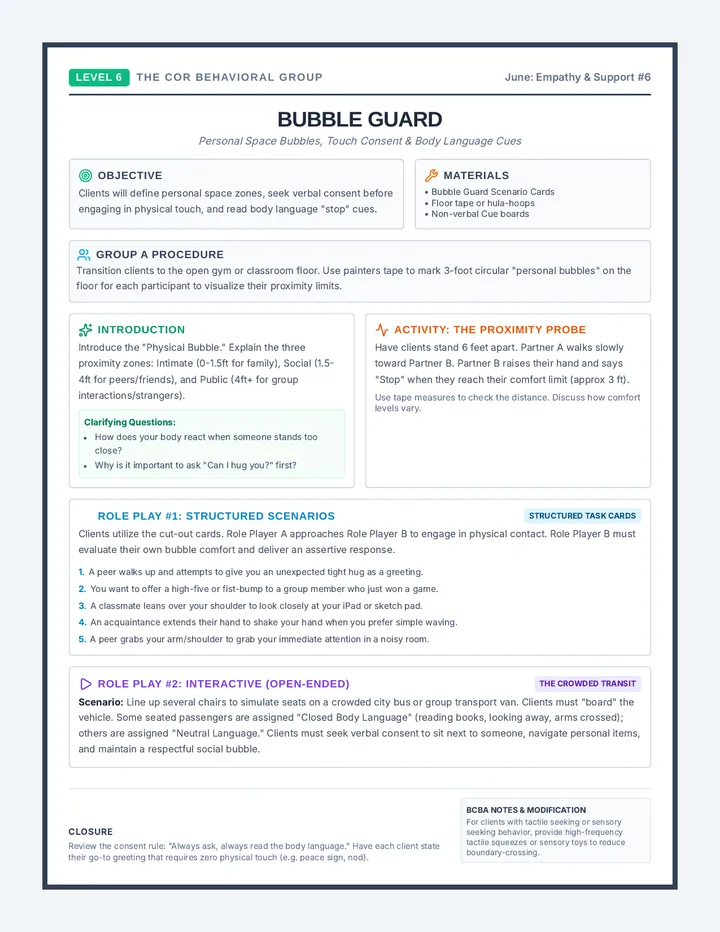
Bubble Guard Lesson Guide LEVEL 6
The COR Behavioral Group
June: Empathy & Support #6
Bubble Guard
Personal Space Bubbles, Touch Consent & Body Language Cues
Objective
Clients will define personal space zones, seek verbal consent before engaging in physical touch, and read body language "stop" cues.
Materials
• Bubble Guard Scenario Cards
• Floor tape or hula-hoops
• Non-verbal Cue boards
Group A Procedure
Transition clients to the open gym or classroom floor. Use painters tape to mark 3-foot circular "personal bubbles" on the floor for each participant to visualize their proximity limits.
Introduction
Introduce the "Physical Bubble." Explain the three proximity zones: Intimate (0-1.5ft for family), Social (1.5-4ft for peers/friends), and Public (4ft+ for group interactions/strangers).
Clarifying Questions:
How does your body react when someone stands too close?
Why is it important to ask "Can I hug you?" first?
Activity: The Proximity Probe
Have clients stand 6 feet apart. Partner A walks slowly toward Partner B. Partner B raises their hand and says "Stop" when they reach their comfort limit (approx 3 ft).
Use tape measures to check the distance. Discuss how comfort levels vary.
Role Play #1: Structured Scenarios
Structured Task Cards
Clients utilize the cut-out cards. Role Player A approaches Role Player B to engage in physical contact. Role Player B must evaluate their own bubble comfort and deliver an assertive response.
A peer walks up and attempts to give you an unexpected tight hug as a greeting.
You want to offer a high-five or fist-bump to a group member who just won a game.
A classmate leans over your shoulder to look closely at your iPad or sketch pad.
An acquaintance extends their hand to shake your hand when you prefer simple waving.
A peer grabs your arm/shoulder to grab your immediate attention in a noisy room.
Role Play #2: Interactive (Open-Ended)
The Crowded Transit
Scenario: Line up several chairs to simulate seats on a crowded city bus or group transport van. Clients must "board" the vehicle. Some seated passengers are assigned "Closed Body Language" (reading books, looking away, arms crossed); others are assigned "Neutral Language." Clients must seek verbal consent to sit next to someone, navigate personal items, and maintain a respectful social bubble.
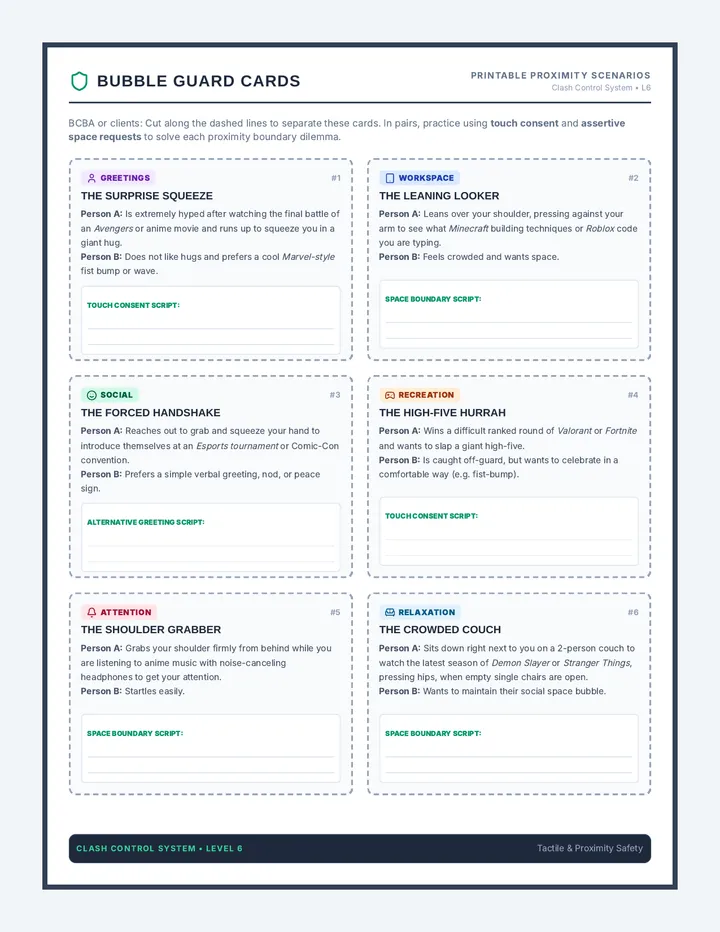
Bubble Guard Cards Bubble Guard Cards
Printable Proximity Scenarios
Clash Control System • L6
BCBA or clients: Cut along the dashed lines to separate these cards. In pairs, practice using touch consent and assertive space requests to solve each proximity boundary dilemma.
Greetings #1
The Surprise Squeeze
Person A: Is extremely hyped after watching the final battle of an Avengers or anime movie and runs up to squeeze you in a giant hug.
Person B: Does not like hugs and prefers a cool Marvel-style fist bump or wave.
TOUCH CONSENT SCRIPT:
Workspace #2
The Leaning Looker
Person A: Leans over your shoulder, pressing against your arm to see what Minecraft building techniques or Roblox code you are typing.
Person B: Feels crowded and wants space.
SPACE BOUNDARY SCRIPT:
Social #3
The Forced Handshake
Person A: Reaches out to grab and squeeze your hand to introduce themselves at an Esports tournament or Comic-Con convention.
Person B: Prefers a simple verbal greeting, nod, or peace sign.
ALTERNATIVE GREETING SCRIPT:
Recreation #4
The High-Five Hurrah
Person A: Wins a difficult ranked round of Valorant or Fortnite and wants to slap a giant high-five.
Person B: Is caught off-guard, but wants to celebrate in a comfortable way (e.g. fist-bump).
TOUCH CONSENT SCRIPT:
Attention #5
The Shoulder Grabber
Person A: Grabs your shoulder firmly from behind while you are listening to anime music with noise-canceling headphones to get your attention.
Person B: Startles easily.
SPACE BOUNDARY SCRIPT:
Relaxation #6
The Crowded Couch
Person A: Sits down right next to you on a 2-person couch to watch the latest season of Demon Slayer or Stranger Things , pressing hips, when empty single chairs are open.
Person B: Wants to maintain their social space bubble.
SPACE BOUNDARY SCRIPT:
Clash Control System • Level 6 Tactile & Proximity Safety