Target Reading Assessment Packet
Reading Intervention • Progress Monitoring Multiple Choice Edition
Reading Comprehension Monitoring Log
Goal: Read an accessible grade-level passage and answer higher-level comprehension questions (why, how, explain) using text details.
Student Name
Instructor
Mastery Benchmark
3 / 3 (100%) or 2 / 3 (67%)
10-Probe Score & Trial Record
Each probe includes 3 higher-level MC questions (Why, How, Explain)
| Probe |
Passage Topic |
Date Given |
Score /3 |
% Correct |
Observations |
| Probe 1 |
Creatures of the Deep (Bioluminescence) |
|
/ 3 |
% |
|
| Probe 2 |
Runners of the High Andes (Inca Chasqui) |
|
/ 3 |
% |
|
| Probe 3 |
Glass in the Desert Sand (Meteorite Impact) |
|
/ 3 |
% |
|
| Probe 4 |
Gardens in the Clouds (Rooftop Hydroponics) |
|
/ 3 |
% |
|
| Probe 5 |
The Power of Scent (Brain & Memory) |
|
/ 3 |
% |
|
| Probe 6 |
Swimsuits from Shark Skin (Biomimicry) |
|
/ 3 |
% |
|
| Probe 7 |
The Arctic Seed Fortress (Global Vault) |
|
/ 3 |
% |
|
| Probe 8 |
Listening to the Stars (Radio Astronomy) |
|
/ 3 |
% |
|
| Probe 9 |
Toolmakers of the Sky (Crow Intelligence) |
|
/ 3 |
% |
|
| Probe 10 |
Heroes on Snowy Peaks (Avalanche Dogs) |
|
/ 3 |
% |
|
Instructor Master Scoring Key Quick-Check Matrix
Probe 1
1. B • 2. A • 3. B
Probe 2
1. C • 2. B • 3. A
Probe 3
1. B • 2. C • 3. A
Probe 4
1. C • 2. A • 3. B
Probe 5
1. A • 2. C • 3. B
Probe 6
1. B • 2. A • 3. C
Probe 7
1. C • 2. B • 3. A
Probe 8
1. A • 2. B • 3. C
Probe 9
1. B • 2. A • 3. C
Probe 10
1. C • 2. B • 3. A
Accessible Grade-Level • High-legibility font sizing • Higher-level comprehension assessment Page 1 of 11
PROBE 1 Progress Monitoring Probe
Name: Date: Score: ___ / 3
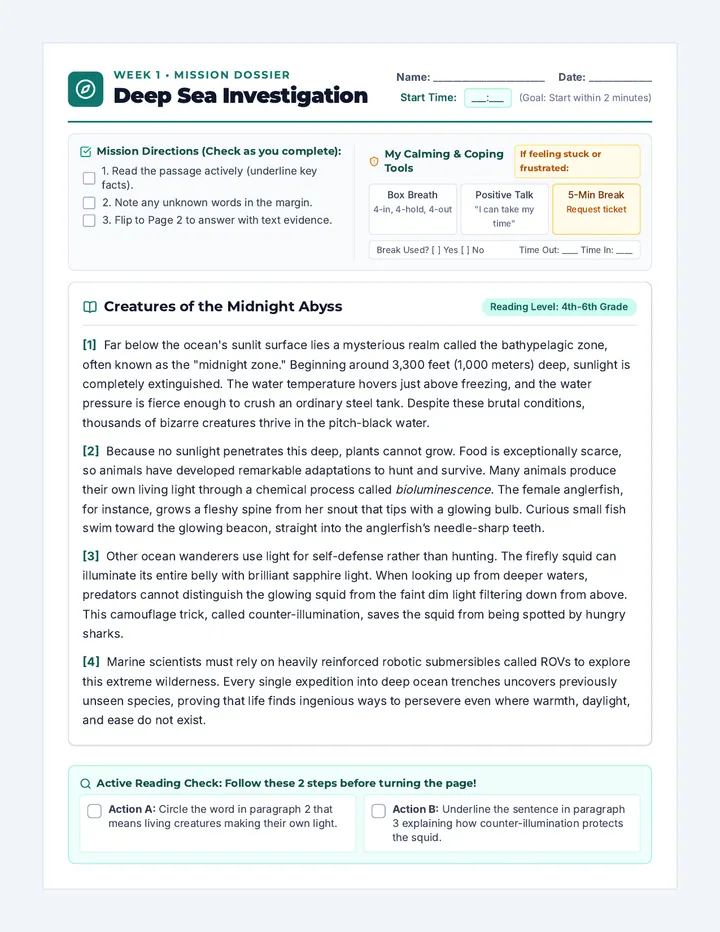
Creatures of the Deep Abyss
Science
Thousands of feet below the ocean surface, sunlight disappears completely. The water is freezing cold and pitch black. Yet, this dark world is alive with glowing lights. Many deep-sea animals produce their own glow through a chemical process called bioluminescence.
Animals use this light in clever ways to survive. The anglerfish dangles a bright glowing bulb from its head. Curious fish swim close to inspect the light, and the anglerfish snaps them up. Other creatures use light for protection. When a deep-sea shrimp is attacked, it vomits a cloud of glowing blue fluid into the predator's face. The blinding glow distracts the hunter, giving the shrimp time to dart away into the dark.
1. Why does the anglerfish dangle a glowing bulb from its head?
A To warm up freezing water so it can swim faster
B To lure curious prey close enough to catch and eat
C To warn dangerous predators to stay far away
D To communicate with other anglerfish across the reef
2. How does the deep-sea shrimp protect itself when attacked?
A By releasing a blinding cloud of glowing fluid to distract the attacker
B By burying its body under cold sand on the sea floor
C By turning off all its lights so it becomes completely invisible
D By stinging the predator with sharp, glowing spines
3. Explain which detail from the text best shows why glowing light is so useful in the abyss.
A The ocean current flows rapidly near deep canyons
B Sunlight disappears completely, leaving the surroundings pitch black
C Freezing water causes most sea creatures to move slowly
D Deep-sea animals have scales that reflect sunlight
Standard: Read grade-level text & answer higher-level questions using text details Page 2 of 11
PROBE 2 Progress Monitoring Probe
Name: Date: Score: ___ / 3
Runners of the High Andes
History
Centuries ago, the Inca Empire stretched thousands of miles along the rocky Andes Mountains. The Inca built stone roads across peaks and steep cliffs, but they had no horses or wheeled wagons. To send urgent messages across great distances, they created a relay system of elite runners called chasquis.
Chasquis were stationed in small watchtowers spaced every couple of miles along the trails. A runner carried spoken news or knotted cords called quipus. When a messenger neared the next watchtower, he blew a shell horn to alert the waiting runner. The next runner quickly sprinted out to meet him, memorized the message, and ran to the following station. Working together without stopping, they delivered messages up to 150 miles in a single day.
1. Why did the Inca rely on relay foot runners to send messages across their empire?
A They did not want other empires to hear their horns
B Only royal families were allowed to use mountain roads
C They had no horses or wheeled wagons to travel the steep trails
D Foot runners were trained to fly carrier pigeons from towers
2. How were the chasquis able to carry news up to 150 miles in only one day?
A One runner would sprint non-stop without taking any water breaks
B Fresh runners in spaced watchtowers passed the message in an unbroken relay
C They used smoke signals from high mountain peaks to flash words
D They rode trained llamas across the rocky stone paths
3. Explain how blowing a shell horn helped the runners save precious time.
A It warned the next runner ahead of time so he was ready to sprint immediately
B It scared away dangerous mountain animals from the trail
C It translated the knotted rope message into audible musical codes
D It informed nearby villagers to bring food to the runner
Standard: Read grade-level text & answer higher-level questions using text details Page 3 of 11
PROBE 3 Progress Monitoring Probe
Name: Date: Score: ___ / 3
Glass in the Desert Sand
Earth Science
In the vast, barren Sahara Desert, scattered chunks of yellow-green glass glisten across the sand dunes. For generations, travelers wondered how chunks of pure glass could exist across hundreds of miles of empty desert. Even ancient Egyptian craftspeople carved a piece into a prized beetle pendant for King Tutankhamun.
Scientists finally solved the riddle. Roughly 29 million years ago, a massive meteorite crashed through Earth's atmosphere. Before striking the ground, it exploded in a giant fireball. The explosion released extreme heat exceeding 3,000 degrees Fahrenheit. This intense blast instantly melted the desert sand into liquid silica. As the melted liquid cooled rapidly in the open air, it turned into solid, glassy rock that remains scattered there today.
1. Why was the presence of glass in the Sahara a mystery for travelers for so long?
A Glass can normally only be manufactured inside modern factories
B Pure glass was found spread across hundreds of miles of empty sand with no heat source in sight
C The glass disappeared every time the sun set behind the dunes
D The yellow-green glass was magnetic and stuck to travelers' metal boots
2. How did the meteorite fireball create the yellow-green glass?
A It burned down ancient pine forests that left hardened sap behind
B Its heavy weight crushed bedrock into crystalline diamond dust
C Its intense heat melted sand into liquid silica that cooled into rock
D It brought pieces of extraterrestrial glass from the asteroid belt
3. Explain what the detail about King Tutankhamun's pendant proves about this desert glass.
A Ancient humans recognized the glass was rare and valued it as a precious gem
B King Tutankhamun personally witnessed the meteorite explosion
C Ancient Egyptians had the technology to melt silica at 3,000 degrees
D Meteorites only strike deserts near royal tombs
Standard: Read grade-level text & answer higher-level questions using text details Page 4 of 11
PROBE 4 Progress Monitoring Probe
Name: Date: Score: ___ / 3
Gardens in the Clouds
Innovation
In crowded modern cities, open ground for farming is nearly impossible to find. Buildings stand wall-to-wall, and pavement covers the ground. To grow fresh food locally, inventive urban farmers are looking up. They are turning flat, unused building rooftops into productive farms.
Because roofs cannot support the heavy weight of tons of natural soil, farmers use hydroponics. Instead of soil, plants rest in lightweight trays with roots submerged in water mixed with nutrients. Rooftop farms also help city environments. The thick layer of plants absorbs summer heat, keeping buildings cooler and cutting air conditioning costs. In addition, rainwater that would normally flood city gutters is captured to irrigate crops.
1. Why do urban farmers choose hydroponics over traditional garden dirt on roofs?
A Sunlight is too strong on roofs for dirt to stay moist
B Hydroponic plants produce crops in the winter without water
C Regular soil is too heavy for building rooftops to support safely
D City birds eat all seeds planted directly in soil
2. How do rooftop farms lower air conditioning bills for the buildings below them?
A The thick layer of vegetation absorbs summer heat before it reaches the building
B Electric fans on the roof blow cold air down into the elevator shafts
C The water trays freeze every morning to chill the concrete
D Plants reflect all sunlight away from neighboring city streets
3. Explain how rooftop farms help prevent city streets from flooding during storms.
A They divert storm clouds away from metropolitan centers
B They capture rainwater to water crops instead of letting it rush into street gutters
C They pump standing water out of flooded underground basements
D They allow rain to evaporate before touching the building
Standard: Read grade-level text & answer higher-level questions using text details Page 5 of 11
PROBE 5 Progress Monitoring Probe
Name: Date: Score: ___ / 3
The Power of Scent
Biology
Have you ever caught a sudden whiff of cinnamon and instantly remembered baking holiday pies with a family member years ago? Scent has a unique power to spark vivid, emotional memories much faster and more intensely than sight or sound can.
This happens because of how the human brain is wired. When you see an object or hear a song, signals travel first through a relay hub before reaching memory areas. But smell bypasses that relay station entirely. Odor molecules enter the nose and go straight to the olfactory bulb. The olfactory bulb has direct links to the amygdala, which processes emotions, and the hippocampus, which stores memories. Because smell links straight to these centers, an aroma can instantly bring back a forgotten childhood moment.
1. Why does a familiar smell trigger memories faster than seeing an image or hearing music?
A Scent signals bypass the brain's relay hub and connect directly to memory centers
B Scent molecules travel through the bloodstream faster than sound waves
C Humans possess twice as many olfactory receptors as visual receptors
D Sound signals only activate emotions when someone is sleeping
2. How do the amygdala and hippocampus contribute to processing scents?
A They filter out poisonous fumes before they enter the lungs
B They turn aromas into spoken language in the vocal cords
C The amygdala handles emotions while the hippocampus stores the associated memories
D They allow the eyes to visualize what an odor looks like
3. Explain what path an odor takes from when it enters your nose to when you feel an emotion.
A It travels from the inner ear, through the spinal cord, to the brainstem
B It enters the nose, reaches the olfactory bulb, and connects straight to the amygdala
C It moves from the taste buds into the general information relay hub
D It activates visual nerves before registering in the memory cortex
Standard: Read grade-level text & answer higher-level questions using text details Page 6 of 11
PROBE 6 Progress Monitoring Probe
Name: Date: Score: ___ / 3
Swimsuits from Shark Skin
Engineering
Sharks are some of the fastest hunters in the sea. While most people assume their speed comes only from strong muscles, their skin plays an equally vital role. Under a microscope, shark skin is not smooth at all. It is covered in millions of tiny, tooth-like scales called dermal denticles that feature microscopic grooves.
Engineers studied this pattern to practice biomimicry—designing human inventions inspired by nature. They noticed that as a shark swims, these grooves channel water smoothly over its body, stopping swirling eddies that cause drag. Designers created high-tech competitive swimsuits with similar grooved fabric. Swimmers wearing the suits glided with less drag and set dozens of world records. Eventually, officials banned the suits because they gave athletes an unfair mechanical boost!
1. Why is shark skin textured with microscopic tooth-like scales?
A To scrape barnacles and algae off ocean coral reefs
B To channel water smoothly and stop swirling eddies that cause drag
C To keep the shark's muscles warm in arctic oceans
D To camouflage the shark against sandy ocean floors
2. How did clothing engineers apply biomimicry to create record-breaking swimsuits?
A By designing fabric with microscopic grooves that mimic shark scales to reduce water resistance
B By stitching actual dried shark fins into the shoulders of the suits
C By coating the suits in slippery fish oils that repel chlorine
D By making the fabric heavier so swimmers could dive deeper
3. Explain why sports officials chose to ban these shark-skin swimsuits from competition.
A The suits tore easily during aggressive race starts
B The fabric caused allergic reactions on swimmers' skin
C The suits gave athletes an artificial mechanical advantage rather than relying on pure skill
D Only two countries were permitted to purchase the fabric
Standard: Read grade-level text & answer higher-level questions using text details Page 7 of 11
PROBE 7 Progress Monitoring Probe
Name: Date: Score: ___ / 3
The Arctic Seed Fortress
Global Studies
Buried deep inside a frozen mountain on the remote Norwegian island of Spitsbergen sits the Svalbard Global Seed Vault. Often nicknamed the "Doomsday Vault," this underground facility acts as an insurance policy for human agriculture. It safeguards backup packets of crop seeds from around the world against war, climate disasters, and plant diseases.
Engineers picked this extreme northern location for security. The vault sits hundreds of feet above sea level, ensuring that melting polar ice cannot flood the chambers. Thick permafrost surrounds the concrete structure like a natural freezer. Even if electrical generators fail completely, the sub-zero ground keeps seeds frozen at safe temperatures for decades. Millions of seeds rest sealed in foil packages, waiting in case a country ever needs to replant its food supply.
1. Why was the Global Seed Vault constructed on a remote island in the Arctic?
A Farmers on the island needed a central storage depot for their harvests
B Cold temperatures make crops germinate and sprout faster underground
C Its high elevation and sub-zero permafrost naturally protect seeds from flooding and power failures
D Polar bears protect the perimeter from international seed thieves
2. How does the facility keep seeds frozen if its electrical power fails completely?
A Automated solar panels pump liquid nitrogen into the storage rooms
B The deep natural permafrost of the mountain acts as a permanent freezer
C Ocean water is flushed through the floors to create giant blocks of ice
D Workers pack snow into the foil envelopes by hand
3. Explain why nations send backup copies of their crop seeds to Svalbard.
A To ensure they can replant essential food crops if war or natural disasters destroy their fields
B To sell organic grain to European supermarkets for profit
C To test whether tropical seeds can mutate into cold-resistant strains
D To avoid paying agricultural property taxes in their home nations
Standard: Read grade-level text & answer higher-level questions using text details Page 8 of 11
PROBE 8 Progress Monitoring Probe
Name: Date: Score: ___ / 3
Listening to the Stars
Astronomy
When people picture astronomy, they often imagine looking through glass telescopes at sparkling stars. However, visual light reveals only a fraction of what happens in the cosmos. Enormous clouds of interstellar dust block visible light from distant galaxies. To look through this cosmic fog, astronomers use radio telescopes.
Instead of glass lenses, radio telescopes use giant curved metal dishes. Space objects like exploding stars, spinning pulsars, and black holes emit invisible radio waves. These waves easily pass straight through thick dust clouds. The dish catches the faint incoming waves and bounces them toward a central receiver. Supercomputers then translate these radio signals into colorful digital pictures, revealing secrets that human eyes could never see.
1. Why are optical glass telescopes unable to view many distant objects in space?
A Giant clouds of cosmic dust block visual light from passing through
B Glass lenses crack when pointed toward bright supernovas
C Most stars only shine during daytime hours when telescopes are closed
D Earth's gravity bends visual light beams backwards
2. How does a curved metal dish collect and process radio waves from deep space?
A It converts radio waves into laser beams aimed back into the night sky
B It catches incoming waves and bounces them to a receiver, which computers turn into images
C It broadcasts FM radio songs to see if alien civilizations reply
D It absorbs sound vibrations traveling through air currents above the dome
3. Explain what advantage radio waves have over ordinary visual light when studying the universe.
A Radio waves carry heat that can melt away distant asteroids
B Radio waves travel twice as fast as the speed of light
C Radio waves can easily pass right through thick interstellar dust clouds
D Radio waves produce music notes that human ears can directly hear
Standard: Read grade-level text & answer higher-level questions using text details Page 9 of 11
PROBE 9 Progress Monitoring Probe
Name: Date: Score: ___ / 3
Toolmakers of the Sky
Animal Behavior
For a long time, scientists believed that only humans and chimpanzees could create complex tools. But studies on the New Caledonian crow overturned that theory. These clever black birds not only use objects they find; they actively modify raw materials to solve difficult problems.
In the wild, tasty beetle grubs hide deep inside narrow holes in decaying tree trunks. A crow's beak is too thick to reach inside. To solve this problem, a crow snaps a twig from a bush. It strips away extra leaves and uses its beak to bend the tip into a sharp hook. The bird then slides the hook into the tree hole, snags the grub, and pulls it out to eat. Crows will even keep and hide favorite tools to reuse them later.
1. Why is a New Caledonian crow unable to catch beetle grubs with just its beak?
A Its beak is made of soft cartilage that breaks easily on tree bark
B Its beak is too wide and thick to reach into narrow tree trunk crevices
C Beetle grubs release acid that burns bird feathers on contact
D Crows only hunt insects while flying in mid-air
2. How does the crow transform an ordinary twig into a successful hunting hook?
A It strips off the leaves and carefully bends the tip into a curved hook
B It dips the stick in sticky tree sap to trap insects like glue
C It sets the twig on fire using forest friction to smoke grubs out
D It sharpens the wood against rocks until it resembles a razor blade
3. Explain what storing and saving a tool reveals about the intelligence of crows.
A It proves that crows copy every behavior directly from chimpanzees
B It indicates that crows forget where they leave things in the forest
C It shows they can anticipate future needs and plan ahead rather than acting solely on instinct
D It means crows cannot remember how to make new tools each day
Standard: Read grade-level text & answer higher-level questions using text details Page 10 of 11
PROBE 10 Progress Monitoring Probe
Name: Date: Score: ___ / 3
Heroes on Snowy Peaks
Working Animals
When tons of snow crash down a mountain in an avalanche, every single minute counts. Snow hardens like concrete within moments, trapping buried victims and cutting off their air supply. While human rescue teams carry metal probes and radar beacons, specially trained avalanche rescue dogs remain the fastest searchers on snowy slopes.
A single dog can search an entire football-field-sized area in about twenty minutes, a task that would take twenty human searchers four hours. Even through fifteen feet of packed snow, microscopic human scent particles drift upward to the surface. The dog runs zig-zag patterns across the slope into the wind. When its keen nose catches a scent plume, the dog halts, barks to summon handlers, and furiously digs into the snow to uncover the person in time.
1. Why is speed so critical when rescuing people buried in an avalanche?
A Dogs lose their sense of smell if they stay in the cold for more than an hour
B Avalanches trigger blizzards that ground rescue helicopters
C Snow quickly hardens like concrete, trapping people and cutting off their air
D Metal rescue probes melt under deep snow pressure
2. How can an avalanche dog find someone buried under fifteen feet of packed snow?
A By hearing victims whispering through long snow tunnels
B By catching human scent particles that drift up through the snow into the wind
C By sensing heat vibrations through padded paw pads
D By following electronic satellite signals on the dog's collar
3. Explain why a rescue team uses a dog rather than relying only on twenty human searchers.
A One dog can search a large debris field in twenty minutes compared to four hours for humans
B Human rescuers cannot climb snowy mountains without snowmobiles
C Dogs can dig through solid ice blocks with their claws faster than bulldozers
D Avalanche radar probes only operate when calibrated by animals
Standard: Read grade-level text & answer higher-level questions using text details Page 11 of 11