A simplified practice worksheet for Python logic, providing structured scaffolded work areas for writing if/else code blocks based on real-world scenarios.
A teacher answer key for the Equation Equilibrium worksheet, providing correct coefficients for all 15 chemical equations. Fixed spacing and alignment issues.
A drill-style worksheet for practicing balancing chemical equations, featuring basic and moderate complexity levels with clear coefficient lines. Fixed spacing issues and improved student writing areas.
Combined station worksheet for Zone 3: Biotech Lab. Integrates instructions, gel electrophoresis evidence, and student response areas into a single-page document. Focuses on fragment size analysis and molecular separation principles. Fixes layout cutoff issues and expands work areas.
Combined station worksheet for Zone 1: Pedigree Sleuth. Integrates instructions, pedigree evidence, and student response areas into a single-page document. Focuses on autosomal dominant inheritance and genotype deduction. Fixes pedigree line disconnections and page overflow.
Combined station worksheet for Zone 3: Biotech Lab. Integrates instructions, gel electrophoresis evidence, and student response areas into a single-page document. Focuses on fragment size analysis and molecular separation principles.
Combined station worksheet for Zone 2: Chromosomal Clinic. Integrates karyotype evidence (Patient 02-B) and structural mutation concepts with student response areas. Focuses on diagnosing aneuploidy and understanding structural changes.
Combined station worksheet for Zone 1: Pedigree Sleuth. Integrates instructions, pedigree evidence, and student response areas into a single-page document. Focuses on autosomal dominant inheritance and genotype deduction.
Advanced investigator worksheet for high-achieving students. Features DOK 3 level strategic thinking questions, including probability justification, evolutionary persistence of alleles, and a complex CER on meiosis errors. Updated to the 3-Zone structure. Fixes layout flow and adds evidence snippets for self-containment. Fixes work area contrast in the dark section.
Consolidated Human Genome investigation stations reduced from 4 to 3 focused 'Investigation Zones' (Pedigree, Chromosomes, and Biotech). This aligns perfectly with the 3 experiences in the Teacher Guide and reduces student/teacher confusion over station volume. Includes updated diagrams and clear alignment labels. Fixes pedigree line disconnections and page overflow issues. Added student response areas for functionality. Fixes affected legend icon to solid black.
High-impact presentation deck for Investigation 7, revamped to focus on Karyotypes, Chromosomal Mutations (Numerical and Structural), and Gel Electrophoresis. Matches the new station activities and anchoring phenomenon. Fixes text contrast and visual alignment issues. Added 3-Zone Investigation summary.
Comprehensive Master Answer Key for Investigation 7, updated to match the revamped 3-Zone station activities. Covers pedigree analysis, Trisomy 21 karyotype diagnosis, structural mutation logic, and gel electrophoresis fragment analysis. Fixes page breaks and contrast issues. Added Punnett labels.
Advanced investigator worksheet for high-achieving students. Features DOK 3 level strategic thinking questions, including probability justification, evolutionary persistence of alleles, and a complex CER on meiosis errors. Updated to the 3-Zone structure. Fixes layout flow and adds evidence snippets for self-containment.
Scaffolded investigator worksheet for students needing support. Updated to the 3-Zone structure (Pedigree, Chromosomes, and Biotech). Features simplified response areas and guided "hint" prompts for inheritance and mutation analysis. Fixes contrast issues in the biotech section and removes fixed height constraints.
Investigator Logbook for Investigation 7, updated to the 3-Zone structure (Pedigree, Chromosomes, and Biotech). Standard tier with clear response areas and Punnett square modeling. Aligned with the revamped station cards. Fixes page breaks and contrast issues in the biotech section. Added parent labels to Punnett square.
Consolidated Human Genome investigation stations reduced from 4 to 3 focused 'Investigation Zones' (Pedigree, Chromosomes, and Biotech). This aligns perfectly with the 3 experiences in the Teacher Guide and reduces student/teacher confusion over station volume. Includes updated diagrams and clear alignment labels. Fixes pedigree line disconnections and page overflow issues. Added student response areas for functionality.
A set of six role-play scenario cards for staff training. Each card presents a common special education classroom challenge. Revised to ensure cards stay on one page and remove all placeholder text.
A student-facing visual aid for restorative conversations. Uses simplified language, large icons, and clear steps to guide students through the 5 repair questions. Revised for single-page printing and larger interactive targets.
A facilitator's guide for staff on how to structure and implement restorative circles. Includes a 5-step structure, specific neurodiversity-affirming adaptations (communication and sensory), and a bank of circle prompts. Revised to ensure all content fits on one page and avoids awkward breaks.
A comprehensive staff training slide deck on implementing restorative practices in special education. Focuses on the shift from punitive to restorative mindsets, specific adaptations for neurodiverse learners, and simplified repair questions. Revised for better contrast and includes a workshop practice slide.
Expanded Teacher Guide for Investigation 7, covering all 3 Experiences over 5 blocks. Includes preparation checklists, common misconceptions, and detailed monitoring feedback loops. Fixes page breaks. Updated to reflect the 3-Zone Investigation structure.
Comprehensive Master Answer Key for Investigation 7, updated to match the revamped 3-Zone station activities. Covers pedigree analysis, Trisomy 21 karyotype diagnosis, structural mutation logic, and gel electrophoresis fragment analysis.
A teacher's answer key for the Heart Highway circulatory system worksheet, including standard alignment for each question and brief rationales. Consolidated for single-page printing.
A reading comprehension worksheet on the circulatory system for 3rd grade. Features a passage about the heart and blood vessels with 10 multiple-choice questions aligned to NC ELA standards for main idea, cause and effect, and vocabulary. Layout optimized for clean page breaks and condensed into 3 pages.
A combined resource featuring a social story to help students manage choice-based frustration and a behavior reflection worksheet for processing desk-flipping incidents.
A comprehensive teacher-facing guide providing insights into the functional behavior of desk-flipping, as well as specific instructional strategies for implementing forced-choice interventions.
A purely positive, goal-oriented 'Safety Mastery' tracking log for 4th graders. It replaces the smile/frown system with 'Star' (Mastery) and 'Reset' (Tool Use) icons to encourage self-regulation and skill building.
A positive, goal-oriented 'Safety Mastery' contract for 4th graders. It focuses on the mission of keeping hands, feet, and words safe through use of self-regulation tools and commitment to a personal goal.
A strengths-based Behavior Success Plan and teacher guide for 4th graders, focused on 'Safety Mastery' goals and positive reinforcement strategies. All negative framing has been removed in favor of skill-building and proactive support.
A professional data collection sheet for speech therapy sessions, designed to track /l/ blend production at the word and sentence levels. Aligned with the bioluminescence theme of the Luminous Language lesson.
A facilitation guide for teachers and administrators on how to implement the Success Strategy Blueprint, including launch steps, monitoring strategies, and scenario-based advice.
A restorative "Growth Reflection" log for a student to complete following a behavioral incident, prompting them to identify feelings, impacts, and alternative future actions with expanded emotion options and guided handwriting lines.
A daily behavior tracking point sheet for a 6th-grade student, focusing on "Hands to Self", "Focused Voice", and "In My Space" with a clear point system and goal-setting area.
A formal Behavior Intervention Plan (BIP) template for a 6th-grade student, featuring operational definitions, antecedent strategies, and replacement behaviors for physical aggression and classroom disruption, including safe regulation tools like wall pushes and Riss Coordinator breaks.
A comprehensive teacher guide for /l/ blend speech therapy, featuring learning objectives, articulation cues, a master word bank, and step-by-step facilitation instructions. Revised for single-page layout and improved flow.
A sentence-production activity where students "power up" a deep-sea submersible by creating sentences with targeted /l/ blend word pairs. Includes dedicated writing areas and a visual progress tracker.
A high-interest reading passage about bioluminescence, featuring 20+ embedded /l/ blend words for targeted speech practice. Revised for better printability and page layout.
A teacher-facing answer key and evaluation guide for the Morphology Blueprint lesson, including example correct sentences and a simple 3-point rubric for assessment.
A set of color-coded sentence-building cards designed for hands-on learning. Students can physically combine nouns, root verbs, and morphological endings to construct sentences, providing a tactile way to understand word structure.
A structured sentence-writing worksheet for high school students, using a "Blueprint" theme to guide them through applying morphological cues (-s, -es, -ed, -ing, -er, -est) with generous workspace and visual prompts.
A visual presentation designed for high school special needs students, introducing morphological cues (-s, -es, -ed, -ing, -er, -est) using a technical workshop theme with clear examples and large, accessible text.
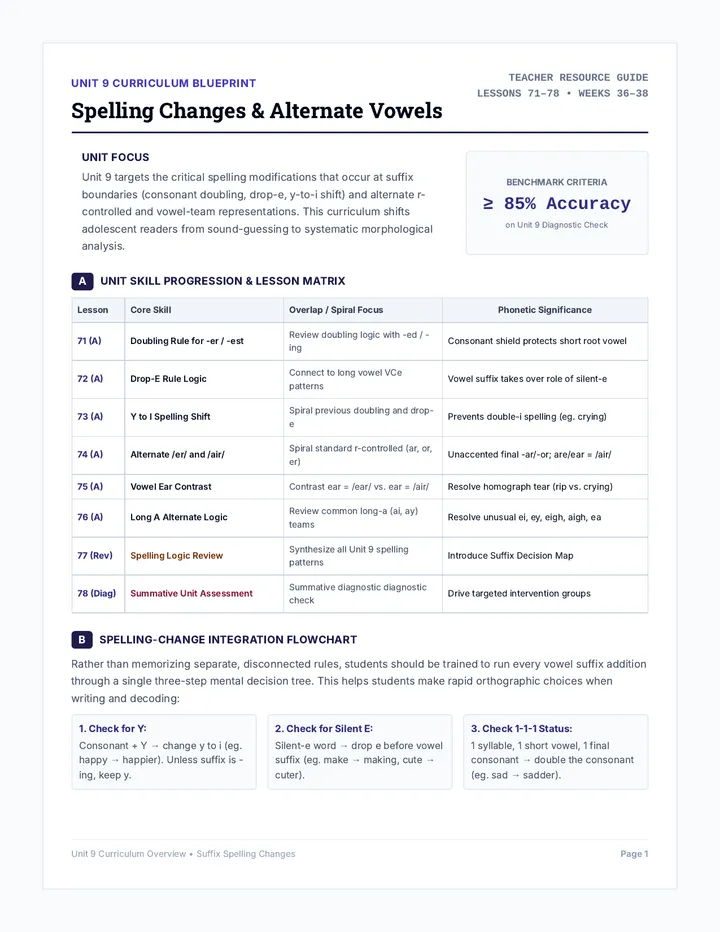
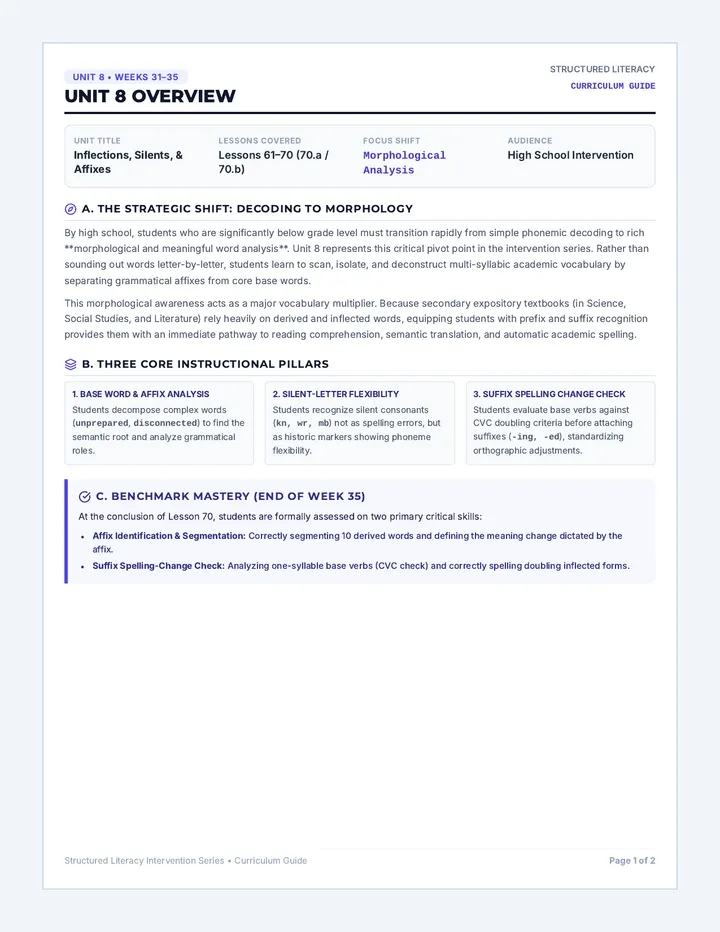
Teacher's facilitation guide for Lesson 3. Revisions include defined "Core 4" skills and improved page layout to prevent isolated sections.