A high-impact visual slide deck for teaching students with moderate support needs about personal responsibility for their electronics. Features large text, clear icons, and concrete scenarios to illustrate consequences and care routines.
A teacher-facing guide that provides context on how to implement the Patience Pilot materials. It includes pedagogical tips for working with ADHD/OCD/Anxiety, a recommended lesson flow, and scripts for modeling patience.
A collaborative, movement-based activity for a teacher and student. It gamifies patience through 'snail racing' and interrupted balancing tasks, specifically designed to simulate the physical tension of waiting.
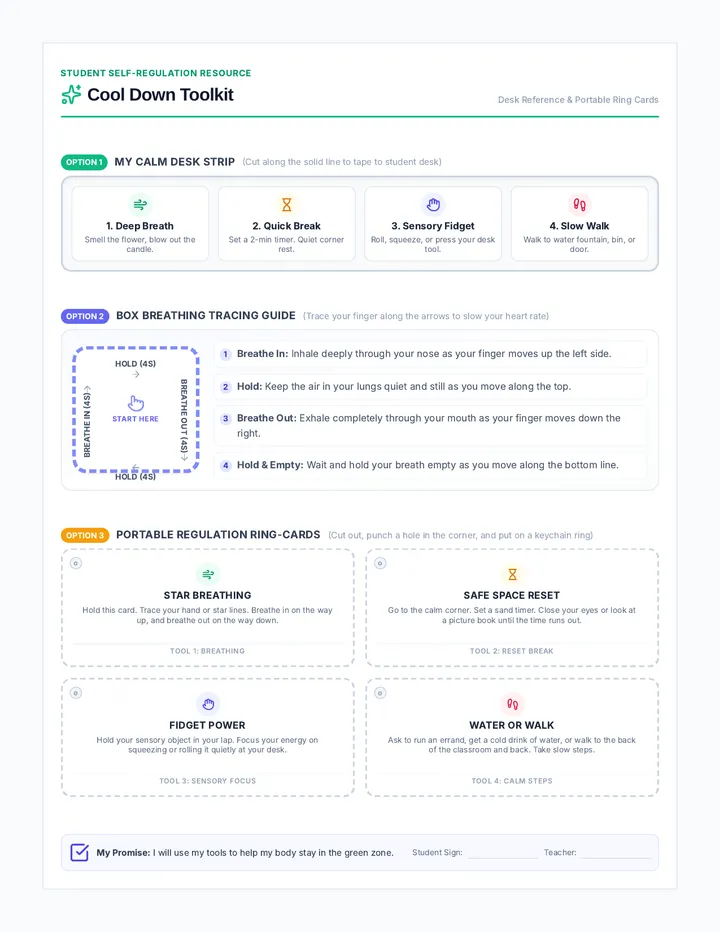
A reference sheet for the student to keep in their binder. It provides a menu of physical, mental, and verbal coping strategies to use during 'waiting gaps' to manage ADHD and anxiety-driven impulsivity.
A visual self-regulation worksheet that helps the student identify their 'internal gears' (Slow, Wait, Instant). It focuses on identifying physical triggers of impulsivity and practicing 'downshifting' to a more patient state.
A worksheet designed to address the specific scenario of needing immediate help after previously refusing it. It uses an air traffic controller metaphor to help the student understand the teacher's perspective and provides actionable waiting strategies.
A worksheet focused on the impulsivity of leaving the classroom when overstimulated. It teaches a '60-second buffer' strategy and helps the student identify physical symptoms of anxiety.
Answer key for the Final Inspection Quiz, providing syllable division and encoding solutions for the Consonant-le assessment.
A unit assessment for 6th grade special education students covering syllable division, identification, and encoding of Consonant-le multisyllabic words. Revised for accuracy and accessibility.
A teacher's answer key and instruction guide for the Independence Daily worksheet. Revised for single-page layout.
A 20-question functional life skills worksheet covering money counting, kitchen safety, recipe comprehension, and community safety. Revised to fix emoji clarity and layout overflow.
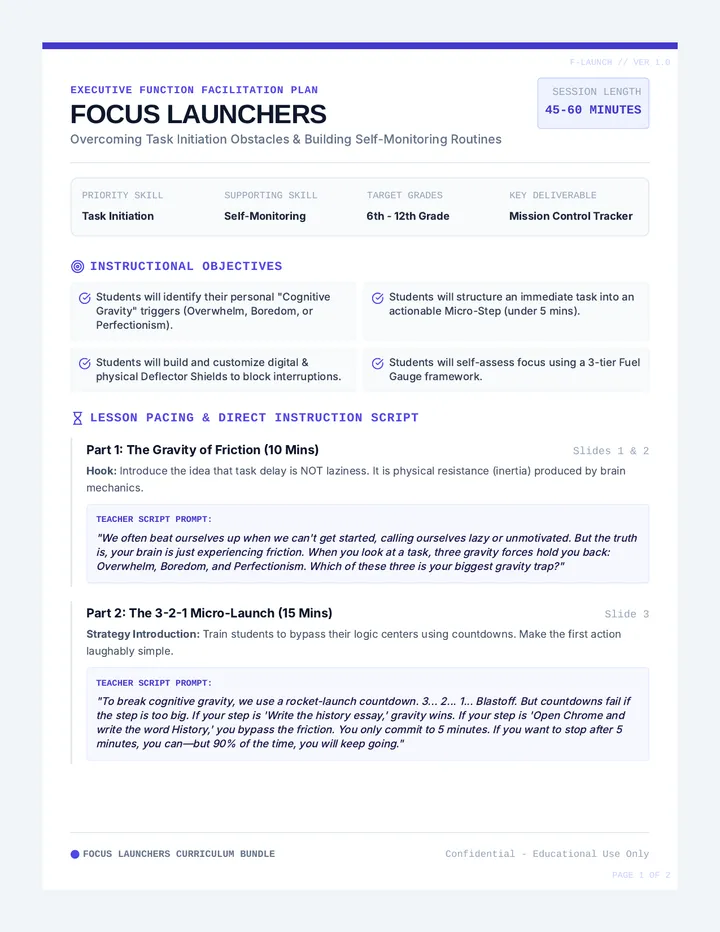
A professional guide for educators on how to implement the Mission Control focus system. Includes instructional scripts, troubleshooting tips for neurodivergent students, and strategies for non-verbal redirection.
A set of non-verbal redirection cards for teachers to use discretely with students. These provide visual prompts for 'Checking In', 'Back to Task', and 'Break Soon' to minimize verbal interruptions.
A set of printable time tracker strips designed to help students visualize the passage of time in set intervals. These strips function as physical 'progress bars' for tasks or breaks.
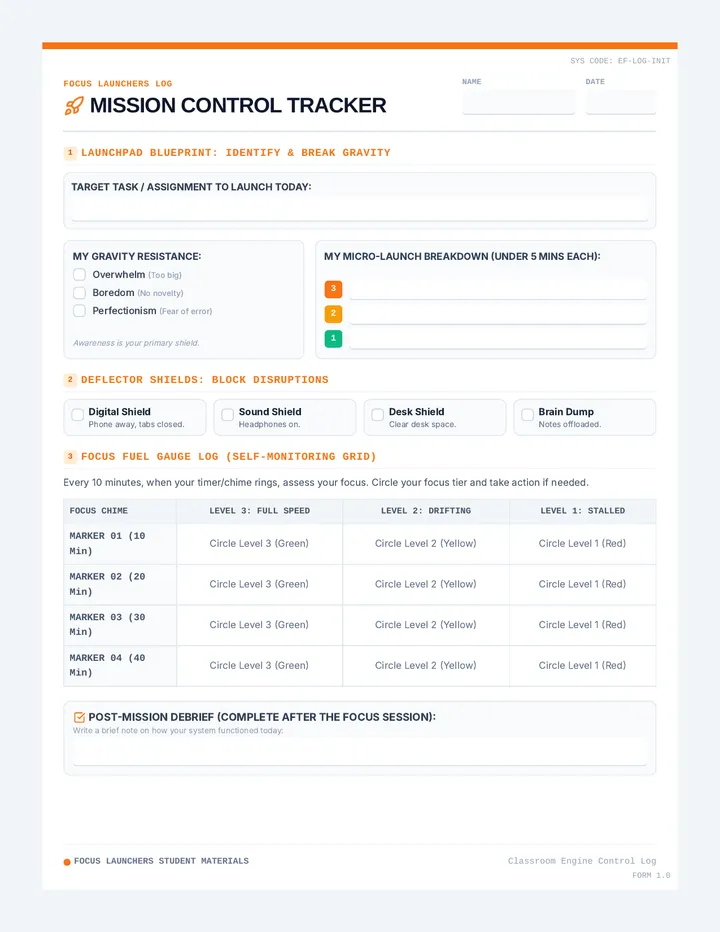
A high-school appropriate 'Mission Control' themed focus dashboard for students to track their current task, steps, and energy levels. It features a dedicated area for attaching visual timer strips and tracking next operations.
Expanded hands-on cards and assembly activity for 8 multisyllabic -cle words, featuring a mechanical workshop theme for 6th grade students. Includes Set A and Set B for 3-syllable practice. Fixed text overflow and standardized labels.
Updated student worksheet with a strong focus on 3-syllable -cle words, featuring midlines for handwriting and visual tips. Consistency and accessibility improved.
Instructional slides for a 6th grade special education lesson on -cle syllables, featuring a new "Triple Gear Challenge" slide, an interactive quiz, and detailed Master Challenge keys. Layout and contrast improved for readability.
Updated teacher guide and answer key to include the expanded set of 8 syllable mechanic cards and corrected 3-syllable word entries. Consistency in hyphenation fixed.
A comprehensive guide for teachers and staff to facilitate a non-confrontational, high-impact discussion with students about honesty. Includes specific strategies for ODD and ADHD, plus targeted discussion prompts.
A structured reflection worksheet for students to map the impact of lying across four key life spheres. Designed with ADHD-friendly layouts, including ranking exercises and space for a "Repair Plan."
A visually engaging slide deck designed for a 9th-grade student with ADHD/ODD. It explores the mechanics of lying through a scientific/structural lens ("The Ripple Effect") and examines impacts on teachers, peers, family, and future careers.
A 3-page comprehensive reading packet for 8th-grade students working at a 3rd-grade reading level. Includes a simplified article about the TogetherIV app, vocabulary exercises, comprehension questions, a sequencing activity, and a scaffolded writing response section.
A comprehensive facilitation guide for teachers to deliver the Gear Guardian lesson. Includes instructional steps, a consequence analysis table, and specific differentiation strategies for students with moderate support needs.
A scenario-based worksheet for students with moderate support needs. Students identify potential dangers to their electronics and propose "Guardian Solutions" to keep their tech safe.
A daily tracking sheet for students with moderate support needs to monitor their electronics. Includes checkpoints for arrival, lunch, and dismissal with clear icons for each device.
A clean and simplified visual schedule for the Artemis II vocabulary lesson, featuring three mission phases with checkboxes. Optimized for one-page printing.
A 1-page tracking sheet for students to monitor their vocabulary progress. Features an Earth-to-Moon trajectory with 10 'Thrust Zones' representing the 10 core vocabulary words, where students can place stickers as they master each term. Vocabulary words are prominently sized for clarity and optimized for single-page printing. 'Collaborate' replaced 'Trajectory' as word 03. 'Thrust Zone' labels removed as requested.
A visual exit ticket for high school special education students to assess their understanding of secret information, scam red flags, and identifying trusted adults.
A presentation guide and script planner for high school special education students to prepare a 2-minute project teaching others about identity theft and digital safety.
A group project guide for high school special education students to work in teams of three to create a 'Digital Safety Shield' poster, featuring defined roles and a structured checklist.
Practical task cards for a 'Safe or Sketchy' activity where students analyze different digital scenarios to practice identifying identity theft scams.
A student worksheet designed for special education high schoolers to identify personal information that should be kept secret, recognize scam red flags, and identify trusted adults for help.
A highly visual slide deck for high school special education students covering the basics of identity theft, red flags, and the 'STOP' rule for safety.
A comprehensive teacher lesson plan for high school special education, detailing instructional steps, learning objectives, and specific accommodations for teaching identity theft prevention.
A family communication handout explaining the refined PBIS approach, focusing on clarity, consistency, and campus alignment.
A student input survey covering all grade levels, with simplified visual scales for K-2 and reflective prompts for older students.
A highly visual behavior response flowchart designed for staff reference in classrooms and common areas.