Focus Bridge Teacher Guide
Middle School ELA Classroom Management Protocol
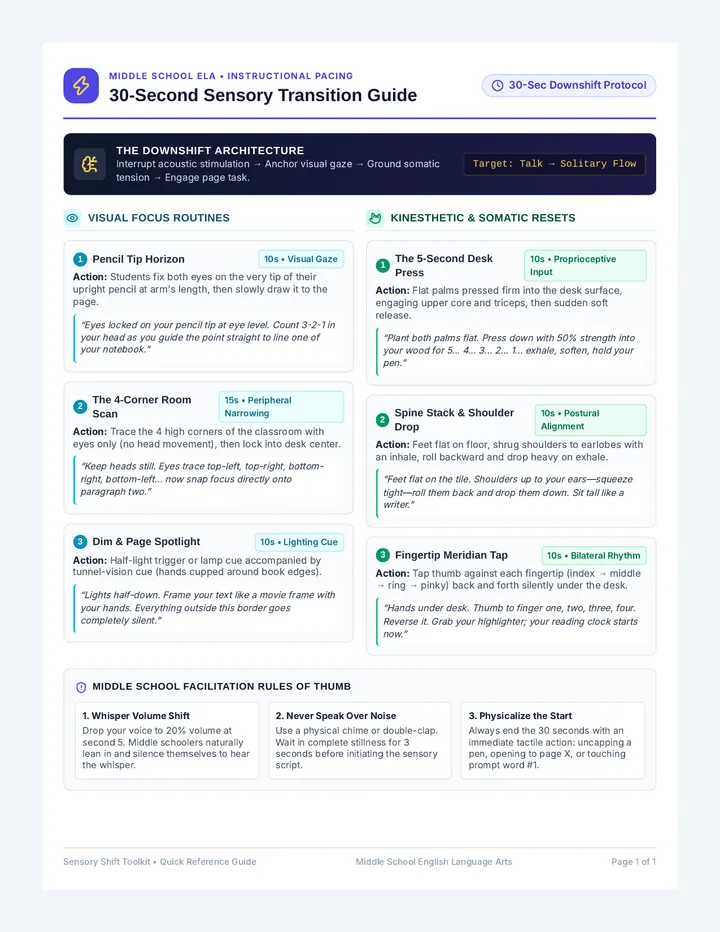
The Focus Bridge: Physical Reset Routine
Tactile grounding techniques to transition students from high-energy Socratic debate to deep independent work.
Duration 90 Seconds
The Middle School Nervous System: Adolescents struggle to shift from social verbalizing to internal synthesis using only auditory commands. Physical, tactile motor routines reset the sympathetic nervous system and create an unambiguous sensory boundary between discussion and solitary focus.
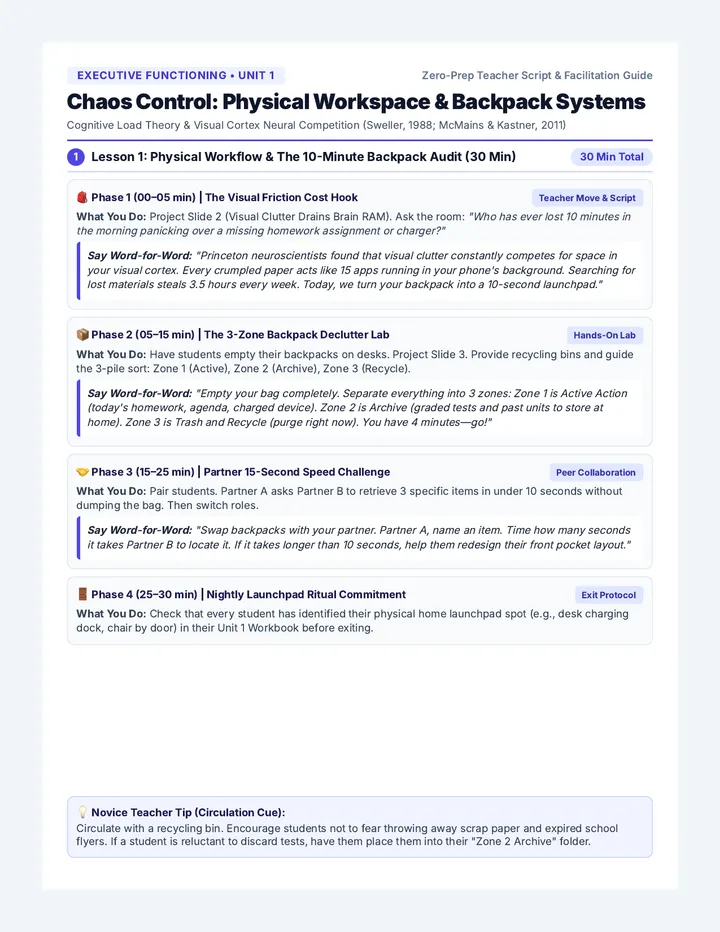
1 Routine A: The 4-Step Tactile Desk Reset (Solo Seat Shift)
45 Seconds
Step 1
The Purge
Students close all discussion notes and stack non-essential materials in the top-left desk corner.
"Stack all talk sheets top left in 3... 2... 1."
Step 2
Solo Runway
Place the independent text or writing draft dead center. Touch both top corners with index fingers.
"Target text centered. Two index fingers on top corners."
Step 3
Posture Lock
Both feet flat on the floor, chair pushed in until stomach is one fist-width from desk edge. Shoulders roll back.
"Feet planted, chair tucked, spine aligned."
Step 4
Pen Grip & Breath
Pick up writing instrument, place tip on line 1, take one synchronized deep breath in and silent exhale.
"Pen on line 1. Deep breath in... exhale into focus."
2 Routine B: The Silent Baton Relay (Group-to-Seat Re-engagement)
45 Seconds
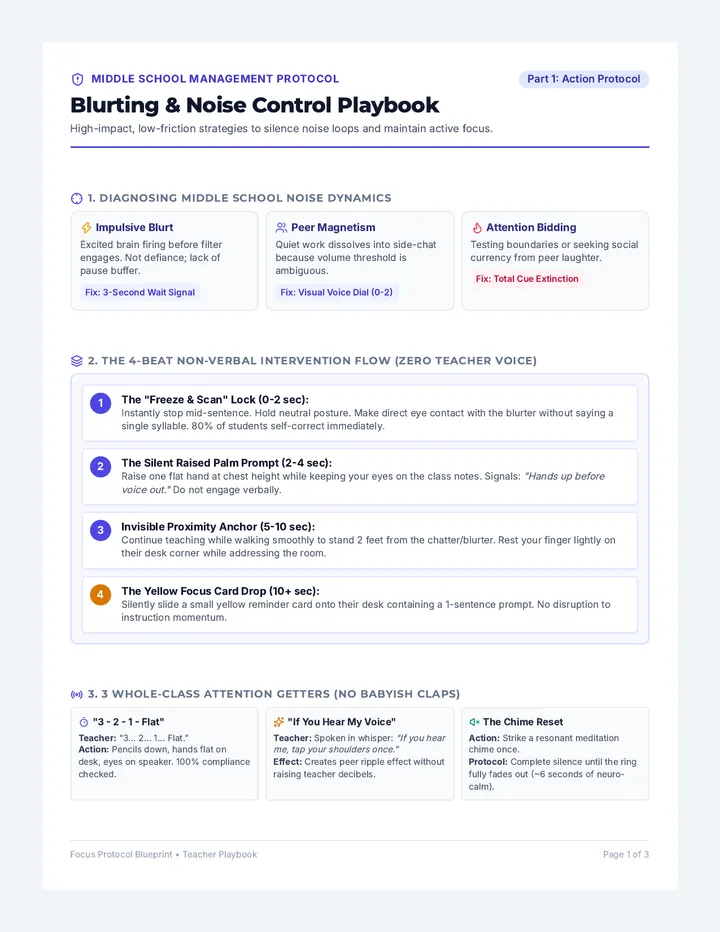
When students must disperse from pods, carpets, or debate circles back to rows/individual desks, eliminate verbal chaos with the Silent Baton Movement Drill.
Phase 1: Freeze & Point (10s)
Teacher sounds chime. All talk halts mid-sentence. Students point one finger directly at their destination chair.
Phase 2: Ghost Glide (20s)
Students walk to their desks without heels touching (toe-to-heel "ninja walk") carrying materials against chest with two hands.
Phase 3: Baton Pass (15s)
Pass task prompt silently sideways. Each receiver taps desk twice with two knuckles as silent receipt confirmation.
Teacher Delivery Script (Low-Tone, Measured Pace)
"That wraps our Socratic round. Keep that brilliant argument burning in your mind, but close your lips in 3... 2... 1. [Chime]. Initiate Desk Reset. Purge clutter to the top-left... solo prompt on runway... posture locked... pen point on paragraph one. Our 12-minute silent sprint begins now."
Implementation System & Student Anchors
Nonverbal signals, micro-corrections, and desk-ready student reference cues.
Page 2 of 2
Nonverbal Hand Signals for Zero-Voice Transition
1 Open Palm Flat Down
Meaning: "Lower voice volume immediately to zero." Teacher presses hand downward at chest level.
2 Two Index Fingers Down
Meaning: "Anchor pages on desk." Prompts students to touch paper corners and end fidgeting.
3 Pointer to Ear then Page
Meaning: "Shift from listening/talking mode into reading/writing mode." Point to ear, then point to desk.
Friction Troubleshooting (Middle School Quick-Fixes)
The "Last Word" Lingerer
Students continue whispering debate points. Fix: Introduce the "Thought Vault"—have them jot that single final spoken thought in the top margin in 5 seconds before writing.
The Slow-Motion Resetter
Student drags out backpack rummaging. Fix: Silent 10-second countdown on fingers while maintaining steady eye contact and holding up a spare pen.
The Kinetic Fidgeter
Student taps pencil or shakes legs. Fix: Give them a silent tactile anchor: press both palms firmly against desk for 5 seconds to ground kinetic energy.
The "I Don't Know What to Write" Wall
Student freezes after debate ends. Fix: Sentence Starter Card taped on corner: "During discussion, the strongest point raised was..."
Printable Desk Strips / Mini Visual Cue Cards (Cut & Tape to Student Desks) Student Reference
1
CLEAR
Stack all extra talk papers top left.
Zone Clean
2
CENTER
Main text in middle. 2 fingers on corners.
Runway Set
3
POSTURE
Feet flat, chair tucked, spine straight.
Body Locked
4
PEN & AIR
Pen on line 1. Deep breath in & write.
Flow State