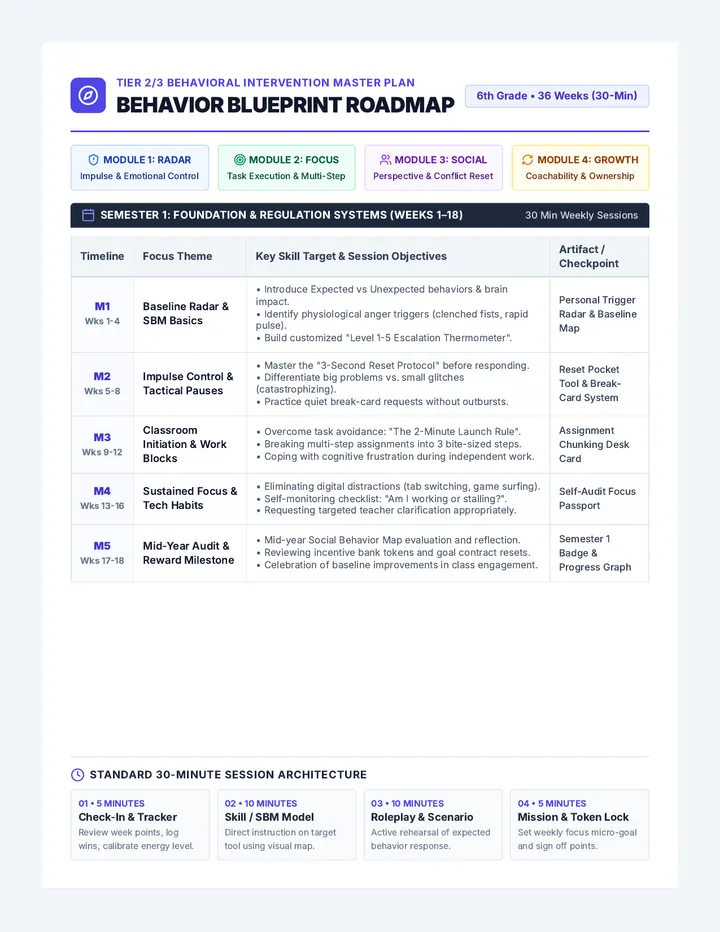
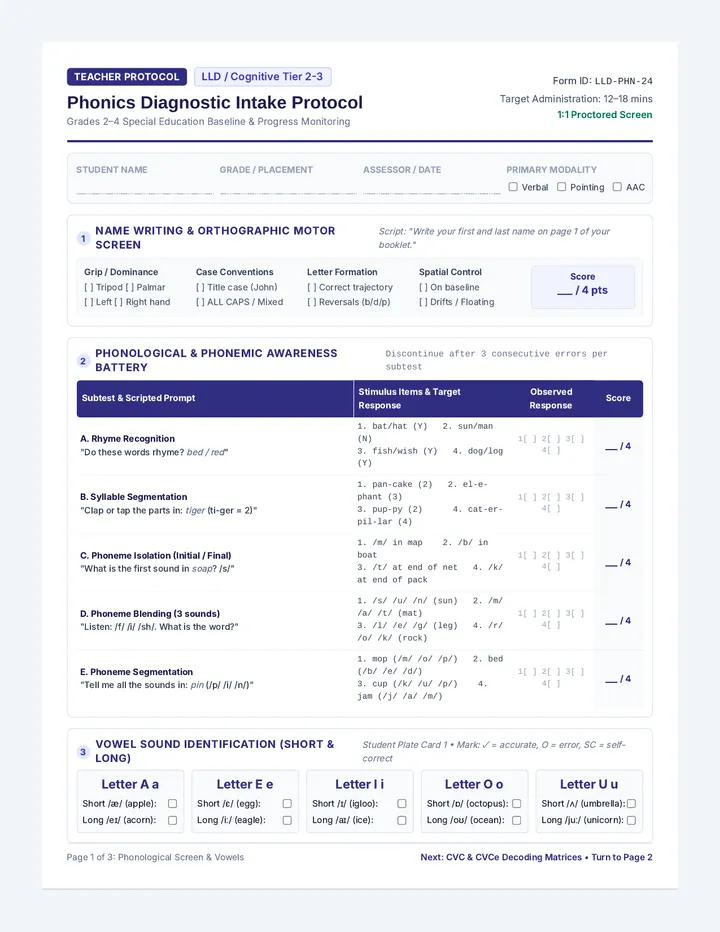
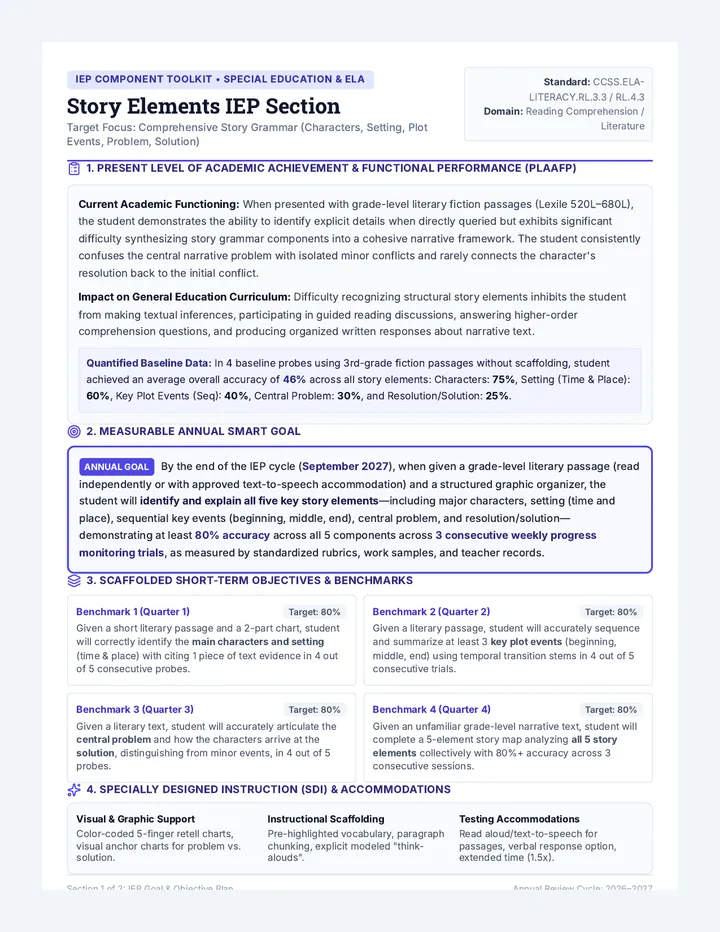
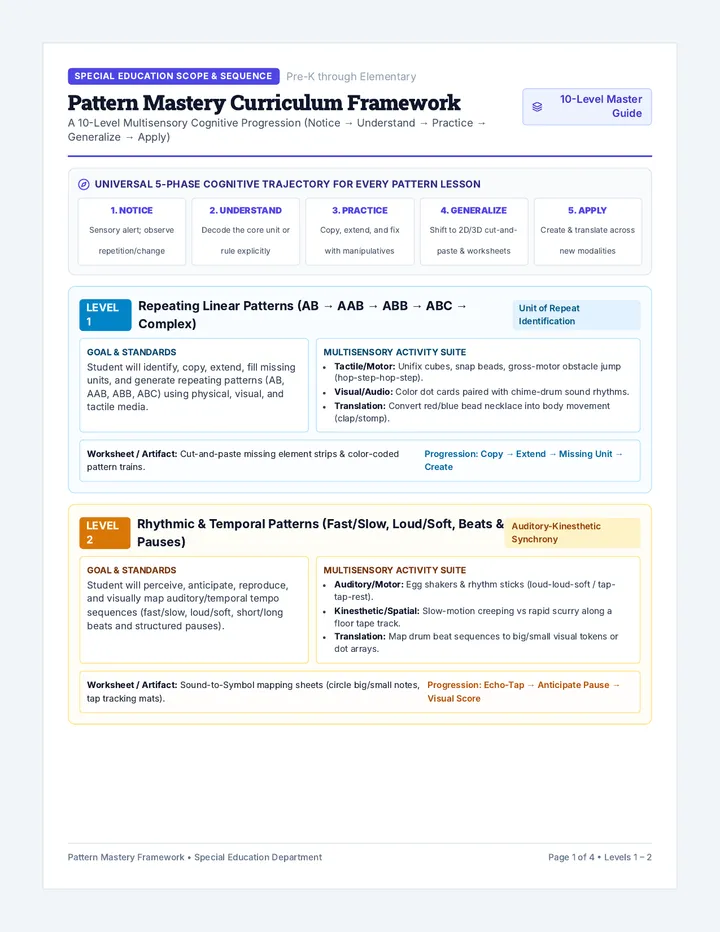
Character Clues Teacher Script
5th Grade SPED / Resource Reading Intervention • RL.5.3
Direct Instruction Script
Character Clues Teacher Script
Page 1 • Fable 1: Explicit Modeling
Focus Strategy: STEAL Method (Speech, Thoughts, Actions, Looks) to infer character traits and motivation.
Fable 1: Dog and His Reflection (Aesop)
Instructional Goal: Model annotating thoughts vs. actions to determine character flaws.
I Do / Model Target Trait: Greedy/Foolish
Annotated Reading Text Near-Original Text
A Dog, to whom the butcher had thrown a bone, was hurrying home with his prize as fast as he could go. As he crossed a narrow footbridge, he happened to look down and saw himself reflected in the quiet water as if in a mirror. [①]
But the jealous Dog thought he saw a real Dog carrying a bone much bigger than his own. [②]
If he had stopped to think he would have known better. But instead of thinking, he dropped his bone and sprang at the Dog in the river, only to find himself swimming for dear life to reach the shore. At last he managed to scramble out, and as he stood sadly thinking about the good bone he had lost, he realized what a stupid Dog he had been. [③]
[①] Action: "Hurrying home with his prize" shows he values the bone and is eager/excited.
[②] Trait/Thought: Aesop directly names him "jealous"; his thought reveals envy and greed for more.
[③] Action/Lesson: Dropping his bone to snatch another reveals impulsiveness; he ends empty-handed.
Annotation Codes: Green = Actions Blue = Thoughts Pink = Trait Word
Teacher Script & Prompts Verbatim
Step 1: Set Purpose & Pre-Teach
SAY: "Today we hunt for clues showing what a character is like inside. We look for thoughts and actions."
VOCAB: Prize = special reward; Reflection = water mirror; Jealous = wanting another's bone.
Step 2: Think-Aloud Modeling
MODEL: "In paragraph 1, 'hurrying home with his prize' is an ACTION."
SAY: "In paragraph 2, 'the jealous Dog thought he saw a real Dog' is a THOUGHT. He wants more than he has!"
Step 3: Guiding Question Prompt
ASK: "Did another dog actually have a bigger bone? What was he looking at?"
SPED CUE: Hold up a mirror or tap calm water image to show reflection.
⚠️ SPED Misconception: Students may think two dogs were in the water. Clarify: "His own greed made him see an imaginary competitor in the mirror!"
Teacher Answer Key & Student Work Exemplar (Fable 1) Scoring & Conferring Guide
1. Summary Exemplar:
"A dog with a bone saw his reflection in the river and thought it was another dog with a bigger bone. When he jumped in to steal it, he dropped his own bone and was left with nothing."
Formula: Somebody + Wanted + But + So.
2. Characterization & Evidence Key:
Trait: Greedy / Jealous / Foolish / Impulsive
How do you know? (Evidence): Aesop calls him "the jealous Dog." He was dissatisfied with his bone and thought he saw a dog with a bigger bone. His action of jumping in caused him to lose his prize.
Sentence Starter: "Aesop characterizes the Dog as greedy because he dropped his own bone to snatch the reflection's bone."
3. Methods Used:
✕ Speech (None)
Thoughts (Circled)
Actions (Circled)
✕ Looks (Not described)
*Thoughts & Actions circled.
5th Grade SPED / Resource Story Elements & Characterization
Guided Practice Script
Fable 2: The Rat and the Elephant
Page 2 • Guided Practice & Story Breakdown
Target Objectives: Identify story elements, analyze boastful speech/thoughts, and eliminate wrong multiple-choice distractors.
Annotated Reading Text Near-Original Text
A Rat was traveling along the King's highway. He was a very proud Rat, considering his small size and the bad reputation all Rats have. As Mr. Rat walked along— he kept mostly to the ditch—he noticed a great commotion up the road, and soon a grand procession came in view. It was the King and his retinue. [Setting / Trait]
The King rode on a huge Elephant adorned with the most gorgeous trappings. With the King in his luxurious howdah were the royal Dog and Cat. A great crowd of people followed the procession. They were so taken up with admiration of the Elephant, that the Rat was not noticed. His pride was hurt. [Conflict]
"What fools!" he cried. "Look at me, and you will soon forget that clumsy Elephant! Is it his great size that makes your eyes pop out? Or is it his wrinkled hide? Why, I have eyes and ears and as many legs as he! I am of just as much importance, and"— [Speech]
But just then the royal Cat spied him, and the next instant, the Rat knew he was not quite so important as an Elephant. [Resolution]
SPED Vocabulary Support:
• Retinue: Group of followers/guards
• Trappings: Fancy decorations
• Howdah: Seat on elephant's back
• Commotion: Loud, busy activity
Code: Purple = Speech Blue = Thoughts Green = Actions
Teacher Script (We Do) Prompts
Prompt 1: Contrasting Characters
ASK: "Where is the Rat walking? Where is the Elephant?"
SAY: "Notice the contrast! The Rat creeps in the ditch, but he claims he is just as important as the King's giant Elephant!"
Prompt 2: Analyzing Speech
READ ALOUD: Read the Rat's dialogue with a loud, bragging voice: 'What fools! Look at me!'
ASK: "When someone brags that they are better than everyone else, what character trait is that?"
GUIDE: Direct students to choose boastful.
Prompt 3: Distractor Elimination
SAY: "Let's test each option together:"
- • Greedy? No, he wants attention, not food/money.
- • Humble? No! Humble is the exact OPPOSITE.
- • Sympathetic? No, he calls people fools!
- • Boastful? YES, he brags about himself.
💡 SPED Story Elements Tip: Point out that the Protagonist is the character the story follows (the Rat), even though he is not a heroic "good guy."
Answer Keys & Evaluation Criteria (Fable 2) Full Exemplar
1. Story Elements Key:
Protagonist: The Rat (Mr. Rat)
Antagonist: The Royal Cat (and his own vanity)
Setting: King's highway (and ditch), daytime during royal parade
Plot: A proud rat watches a crowd praise a grand elephant in a parade. Angry that nobody notices him, he loudly brags that he is just as important. Suddenly, the royal cat attacks him, humbling his pride.
2. Summary & Trait Selection:
Summary: While traveling on the highway, a conceited rat brags that he is as important as a royal elephant, but a royal cat quickly proves him wrong.
Multiple Choice Question:
Correct: BOASTFUL
Distractors eliminated: greedy, humble, sympathetic.
3. Evidence & Methods Key:
How do you know? (Evidence): The Rat yells, "Look at me, and you will soon forget that clumsy Elephant!" and claims he is of just as much importance.
Characterization Methods (Circle):
✓ SPEECH ✓ THOUGHTS ✓ ACTIONS ✕ Looks
*Actions included: walking in ditch, shouting to crowd.
5th Grade SPED / Resource Intervention & IEP Alignment
Tier 2 / Tier 3 Scaffolds
SPED Replacement Script & Intervention Toolkit
Page 3 • Scaffolds, Reteach & Rubric
Explicit talk-tracks for non-responders, structured response frames, and IEP progress monitoring criteria.
Targeted Reteach Talk-Tracks (For Students Needing Intensive Support)
Misconception A Dog's Reflection
Student insists: "There were two real dogs!"
TEACHER TALK: "Look into this mirror. When I wave, who waves back? Me! Now look at the text: it says 'as if in a mirror.'"
PROMPT: "Did another dog jump in, or did the Dog jump at his own reflection?"
✓ Desired response: "He jumped at his own mirror image."
Misconception B Protagonist Meaning
Student names the Elephant as protagonist.
TEACHER TALK: "The protagonist is the main character whose thoughts and feelings we follow through the whole story."
PROMPT: "Does the story tell us what the Elephant thinks, or what the Rat thinks?"
✓ Desired response: "The Rat, because we hear his speech."
Misconception C Distractor Confusion
Student chooses "humble" or "greedy" for Rat.
TEACHER TALK: "Let's use our Word Clue anchor card. Humble means quiet and not bragging. Did the Rat act quiet?"
PROMPT: "He yelled 'Look at me!' Is that humble, or boastful?"
✓ Desired response: "Boastful, because he's bragging."
Accommodated Response Frames (For Student Writing Support)
Frame A: Character Trait & Evidence (RL.5.1 / RL.5.3)
"In the fable, Aesop characterizes the [character] as [trait]. I know this because in the text, his [speech/actions/thoughts] show that he [quote or paraphrase evidence]."
Provide word bank: greedy, envious, boastful, proud, conceited, foolish.
Frame B: 4-Part Summary Formula (SPED Graphic Organizer)
"Somebody: [Main Character] wanted [Goal], But [Problem/Conflict], So [Action taken], Then [Final Outcome/Lesson]."
Guarantees complete retelling without unstructured rambling.
5th Grade SPED Mastery Rubric & IEP Goal Tracker
Standard Alignment: CCSS.ELA-LITERACY.RL.5.1 & RL.5.3
| Skill Dimension | Level 4: Mastered (80-100%) | Level 2-3: Developing (50-79%) | Level 1: Emerging (<50%) |
|---|
| Trait Identification (RL.5.3) | Accurately names accurate trait (e.g., greedy, boastful) without prompting. | Selects correct trait from a 2-choice visual cue or word bank. | Confuses trait with temporary feelings (e.g., "sad" or "mad"). |
| Text Evidence Citation (RL.5.1) | Quotes or clearly paraphrases character's speech, thoughts, or actions directly. | Points to correct sentence in text when prompted by teacher. | Provides off-topic explanation or no text evidence. |
| Story Elements & Summary (RL.5.2 / RL.5.3) | Identifies protagonist, antagonist, setting, and writes complete B-M-E summary. | Completes summary with fill-in sentence stems; identifies 2/3 elements. | Requires direct 1-on-1 verbatim scribing to construct summary. |
Print Ready for Small-Group Intervention, Co-Teaching, or Resource Room AESOP FABLES UNIT • 5TH GRADE SPED