A functional math lesson focused on calculating elapsed time for real-world scenarios, designed for high school students developing life skills.
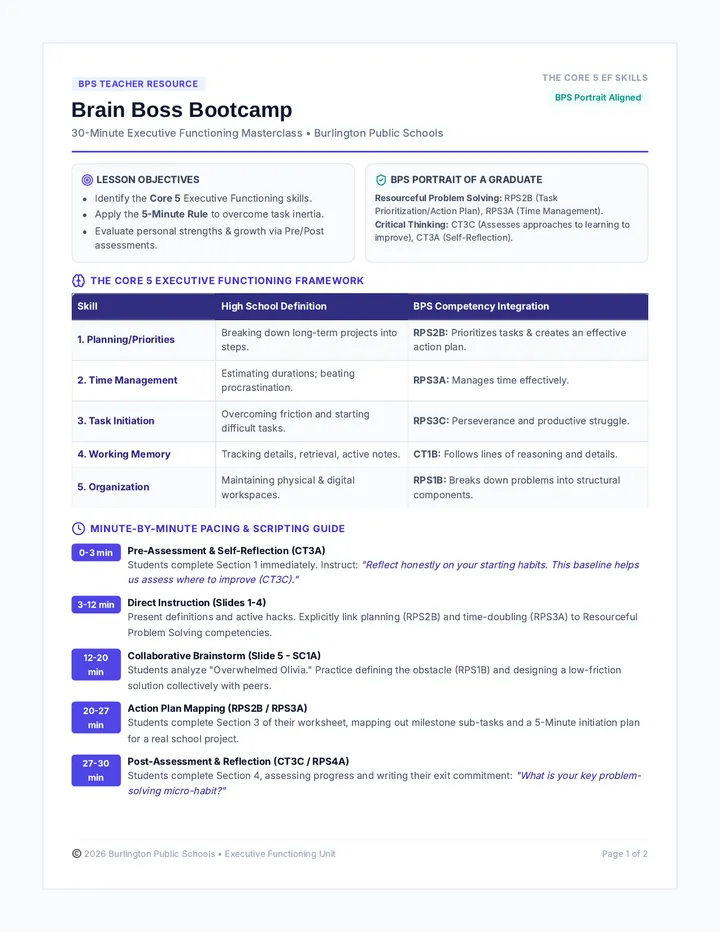
A comprehensive lesson on explicit teaching and effective modeling techniques. Students learn to break down complex tasks into learnable steps, provide verbal rationales, and check for understanding across academic, social-emotional, and vocational contexts.
A comprehensive guide for instructors working with neurodivergent students aged 16-21, providing practical strategies for environmental, instructional, and emotional support.
A lesson on the principles of explicit teaching and the strategy of teacher modeling, including key practices for effective implementation and analysis of modeling examples.
A comprehensive reflection lesson designed to help students process community outings, focusing on self-regulation, money management, and social safety through structured journaling and discussion.
Une séance coopérative pour découvrir les propriétés des angles inscrits et au centre dans un cercle, conçue pour les élèves de 3ème.
Students will learn to clarify learning outcomes using 'I can' statements to support student ownership and measurable success in the classroom.
Master complex fractions and high-precision decimal operations through the lens of algebraic manipulation and real-world mathematical modeling.
Explore the architecture of rational numbers, focusing on the rigorous conversion between fractions and decimals and the proof-based patterns of repeating digits.
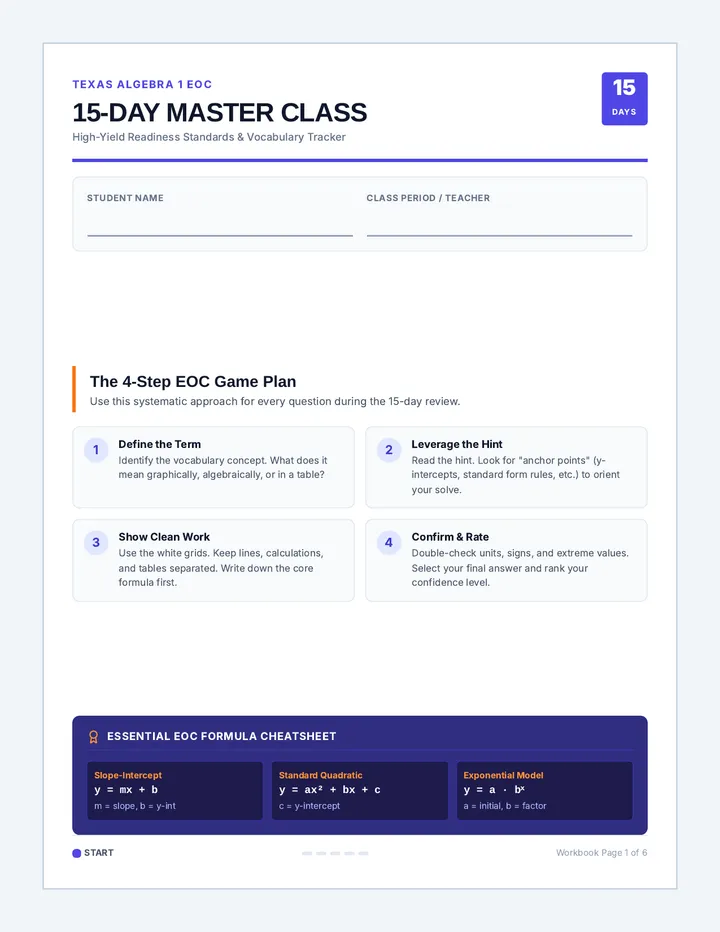
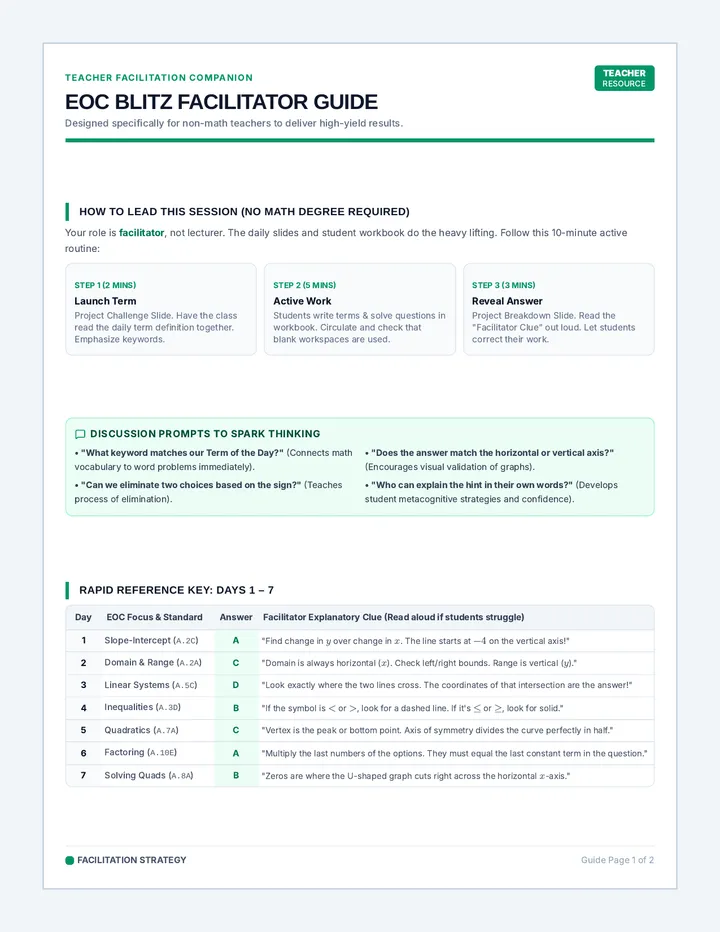
A comprehensive review lesson designed to prepare students for an upcoming Algebra quiz. It covers vertical lines, systems by elimination, factoring, vertex form, rate of change, and linear equations.
A comprehensive lesson for high school special education students to master emotional regulation through the Zones of Regulation, trigger identification, and calming strategies.
A statistics lesson themed around Canterlot High and the Equestria Girls, covering measures of center, data visualization, and simple probability. Students will help their favorite characters analyze school data through engaging, themed problems.
A series of focused assessments to verify student mastery of polar coordinate plotting, conversion, graphing special curves, and representing complex numbers in polar form.
A comprehensive review of basic trigonometry (sine, cosine, tangent) for finding missing sides and angles, featuring a step-by-step checklist and worked examples.
An introductory lesson covering the building blocks of geometry: points, lines, planes, rays, segments, and angles.
A lesson focusing on the Triangle Inequality Theorem, teaching students how to determine if three given side lengths can form a valid triangle.
A comprehensive practice module for high school Algebra 1 students focusing on slope, point-slope form, and slope-intercept form. Designed with scaffolding and visual aids specifically for special education support.
Two simple microwave mug recipes with step-by-step visual instructions for students with low reading levels.
A set of checklists for instructors to ensure fidelity to housing education goals and provide appropriate supports for neurodivergent participants.
A hands-on geometry lesson where students act as structural engineers to discover the Triangle Inequality Theorem through sorting and investigation.
Students act as architects to verify the structural integrity of triangular designs using the Triangle Inequality Theorem. They perform numeric checks, analyze visual models, and solve word problems to determine if three side lengths can form a valid triangle.
A statistics lesson for freshman students covering central tendency, probability, and stem-and-leaf plots, themed around the classic cartoon Ed, Edd n Eddy. Includes visual aids and simplified math for clear conceptual understanding.
A statistics lesson for freshmen using characters and scenarios from the Dog Man series to teach mean, median, mode, range, and probability.
A collection of resources for facilitators to ensure program fidelity and neurodivergent inclusivity during Impact Integrity sessions.
A comprehensive lesson for high school students with developmental disabilities on understanding family boundaries using the Circles Curriculum. It covers close vs. distant relatives, touch, talk, and trust rules.
The core instructional and project-based unit where students transition from architectural theory to a physical model, focusing on the mathematical precision required for construction.
A hands-on science experiment exploring heat conduction using hot and cold chocolate milk with metal and plastic spoons. Designed specifically for high school students with intellectual disabilities with visual supports and simplified response formats.
A professional development workshop for middle school staff focused on practical de-escalation techniques through movement and role-play. Participants will navigate the 'Rising Tide' of student escalation and practice verbal and non-verbal strategies.
A comprehensive guide to solving exponential and logarithmic equations using common bases and property-based manipulation. Students will master converting between forms and applying product, quotient, and power rules.
A guided exploration of discrete and continuous compound interest formulas through visual organizers and structured notes.
A summative assessment where students create a 'Future Profile' summarizing their findings from the unit.
A comprehensive review of the unit's key concepts to prepare for the summative assessment.
Focusing on social and communication strengths, practicing soft skills needed for the workplace.
Synthesizing skills and abilities into a 'Toolbelt' of career-ready assets.
Exploring work environments and preferences (indoor/outdoor, loud/quiet) through interactive sorting.
Connecting interests to specific job categories and beginning to explore which careers match their personal 'likes'.
Students practice identifying growth areas (weaknesses) in a positive way, using sentence frames to plan for improvement.
Students identify their functional abilities and physical/mental skills using checklists and 'I Can' statements.
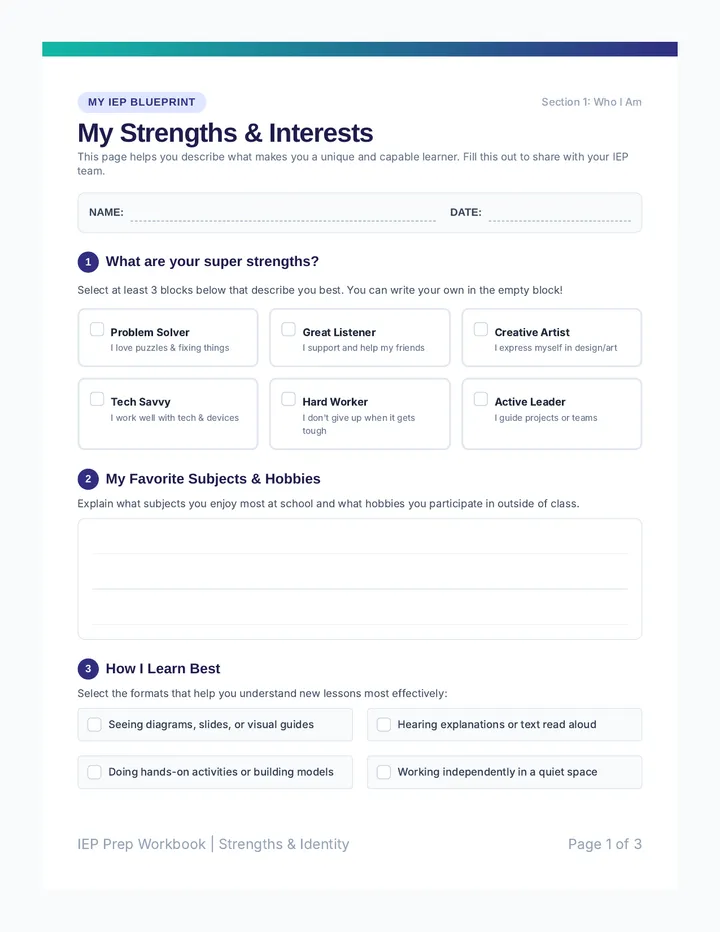
Students explore their innate strengths and 'superpowers' using sorting activities to identify what they are naturally good at.