Speak Up Step Up Lesson Plan Speak Up, Step Up
Self-Advocacy & Middle School Transition
Duration: 30 Minutes
Audience: 5th Grade (Tier 1)
Learning Objective
Students will identify key members of their support network and practice using self-advocacy phrases to ask for help, enabling a smoother transition to middle school.
The "Why"
As students with IEPs move to middle school, knowing who to turn to and how to ask for accommodations builds confidence, ensures they receive necessary support, and fosters independence.
Materials
Support Network Organizer
Role-Play Scenario Cards
Self-Advocacy Checklist
Transition Reflection Worksheet
Lesson Slides
Preparation (5 mins)
Review objective and procedures.
Print and organize copies of the Organizer for each student.
Pre-cut Role-Play Scenario Cards for small groups.
Prepare Checklist and Reflection Worksheets.
Lesson Sequence
5 mins
Introduction & Hook
Welcome students. Explain that middle school brings new supports and challenges. Ask: "Who do you turn to when you need help at school?" Record answers on the board. Introduce the idea of a support network and self-advocacy as tools for success.
10 mins
Identify Your Support
Distribute the Support Network Graphic Organizer . Instruct students to list at least four adults or peers they trust and note how each can help them.
Teacher Tip: Circulate to guide students with prompts like "Who helps you with math?" or "Who do you talk to when you're frustrated?"
10 mins
Advocacy Role-Play
Divide students into pairs. Give each group a set of Advocacy Role-Play Scenario Cards .
Students take turns practicing asking for help.
Encourage use of phrases from the Self-Advocacy Checklist .
Focus on speaking clearly and making eye contact (if comfortable).
5 mins
Reflection & Sharing
Hand out the Transition Reflection Worksheet . Ask students to reflect on how they felt speaking up and write one personal goal for middle school. Invite volunteers to share one insight or goal.
Speak Up Step Up Slides Speak Up, Step Up
Building your support network and self-advocacy skills for middle school success.
Teacher Notes
Welcome students. Introduce the lesson: learning who can help you in middle school and how to ask for that help. Emphasize that it’s okay and important to speak up.
Why Self-Advocacy Matters
Builds your confidence
Gets you the support you need
Solves problems faster
Ready for middle school
"Self-advocacy is being the expert on yourself!"
Teacher Notes
Discuss why self-advocacy matters. Explain that knowing how to ask for help leads to more success and independence.
What is a Support Network?
A group of people you trust to help you learn and grow.
They give advice, provide accommodations, or just listen when you need it.
Teacher Notes
Define support network. Ask students: who have they gone to for help before?
Map Your Support Network
1
Grab your Graphic Organizer .
2
List at least 4 people .
3
How can they help you?
Teachers
Parents
Friends
Counselors
Teacher Notes
Hand out the organizer. Guide students step-by-step as they fill in the four boxes.
Self-Advocacy Phrases
"Could I please have extra time on this assignment?"
"I’m not sure I understand—could you explain that again?"
"I need to use my accommodations so I can do my best."
"Can we meet after class to review?"
Teacher Notes
Introduce key phrases from the checklist. Model saying them with expression.
Role-Play Practice
Work in pairs or small groups .
Use the Scenario Cards to practice.
Use 2 advocacy phrases each time.
7 MINS
PRACTICE TIME
Teacher Notes
Circulate to listen and give feedback. Encourage students to speak clearly and confidently.
Reflect & Set a Goal
Reflection
How did it feel to ask for help today?
Personal Goal
Write one goal for middle school advocacy.
Support Network Organizer Support Network Map
My Middle School Success Team
Name: ___________________________
Date: ___________________________
Think about four people you trust who can help you in middle school. For each person, write their name or role (like "Math Teacher") and describe exactly how they can support you.
Support Person 1
Name or Role
How they can help me
Support Person 2
Name or Role
How they can help me
Support Person 3
Name or Role
How they can help me
Support Person 4
Name or Role
How they can help me
My Advocacy Plan
Pick one person from your list and think of a time you might ask them for help. What would you say?
I will ask...
When I need help with...
Keep this map in your binder to remind you that you are never alone!
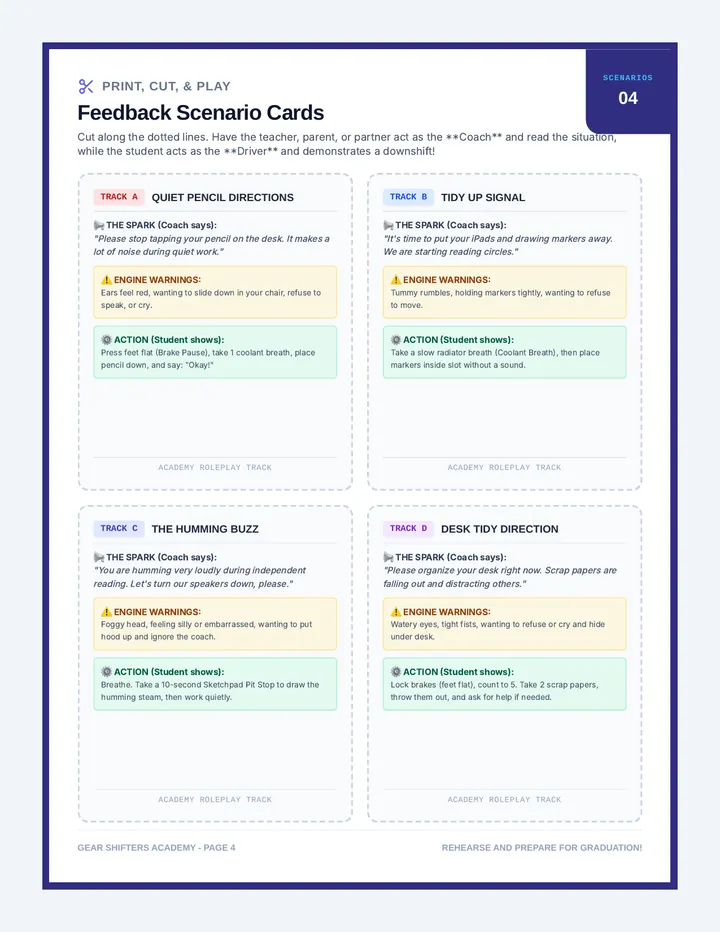
Advocacy Role Play Scenario Cards Advocacy Scenario Cards
Practice speaking up in different school situations.
Instructions: Cut along the dashed lines to create individual scenario cards. In your pairs, take turns drawing a card and role-playing the situation. Use self-advocacy phrases as you ask for help. Give your partner positive feedback after each turn!
Scenario 1
The Math Muddle
You’re working on your math homework but find the questions confusing. Ask your teacher for extra time and clarification on the problems.
Scenario 2
Too Much Noise
The classroom is very noisy today, and you’re having trouble focusing. Ask to go to a quiet space or resource room so you can complete your work.
Scenario 3
Wait, What?
You missed the teacher’s instructions at the start of class because of background noise. Ask the teacher to repeat the directions so you understand.
Scenario 4
Reading Help
You have dyslexia and need someone to read the passage aloud before you begin the reading quiz. Request this accommodation from your teacher.
Scenario 5
Overlay Time
You feel eye strain when reading without your colored overlay. Ask your teacher if you can use your overlay during independent reading time.
Scenario 6
IEP Insight
You want to make sure you understand your IEP accommodations for next year. Ask your special education teacher if you can meet after class to review them.
Scenario 7
Lost and Found
You lost the printed handout with the assignment details. Ask your teacher for a new copy or for help accessing it online.
Scenario 8
Peer Partner
You’re unsure how to start a project and want a peer buddy. Ask a classmate or the teacher if you can be paired with someone who can help.
Tip: Speaking clearly and politely makes people more likely to help!
Student Self Advocacy Checklist Self-Advocacy Checklist
My toolkit for asking for help.
Power Phrases
Practice saying these phrases. Check the box when you feel confident, then write how you'd say it in your own way.
“Could I please have extra time on this assignment?”
“I’m not sure I understand—could you explain that again?”
“I need to use my accommodations so I can do my best.”
“Can we meet after class to review this?”
“Could you please speak more slowly so I can follow?”
Steps to Speaking Up
Step 1
Identify the Problem
Step 2
Choose the Right Person
Step 3
Plan What You'll Say
Step 4
Speak Clearly & Politely
Step 5
Thank Them
Step 6
Reflect: How did it go?
You’ve got this! Keep this checklist in your binder for middle school.
Transition Reflection Worksheet Transition Reflection
Looking ahead to my middle school journey.
Name: ___________________________
Date: ___________________________
1
How did it feel to practice asking for help today during the role-play?
2
What is one personal goal you have for asking for help in middle school?
"You are your own best advocate!"
Great work today. Middle school is an exciting next step, and you have all the tools you need to succeed.
Keep this reflection in your binder to remind you of your strength and goals.